


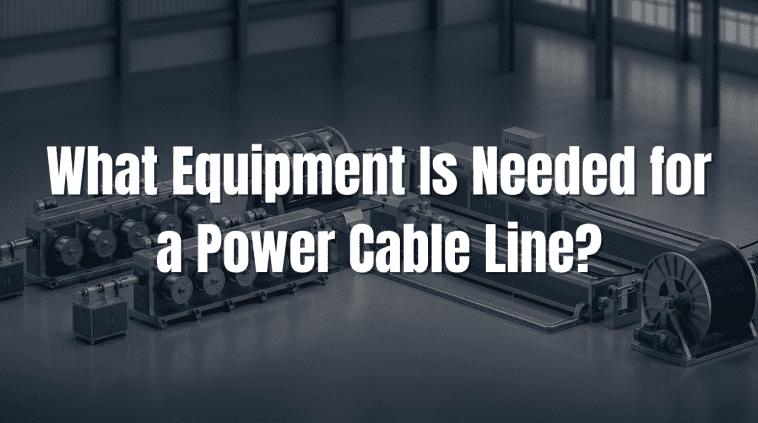
A complete power cable production line requires seven core equipment categories: conductor drawing (18-22 passes), stranding machines (capable of 630mm² conductors), extrusion lines (output ≥500 m/hour), armoring equipment (steel wire/tape), sheathing extruders (dual-layer capability), testing systems (meeting IEC 60502 standards), and auxiliary machinery including pay-off and take-up systems.
Starting a power cable factory feels overwhelming. You face massive equipment investments, complex technical specifications, and uncertainty about which machines truly matter.
A professional power cable production line consists of conductor preparation equipment (drawing and stranding), insulation extrusion systems, armoring machinery, sheathing equipment, and comprehensive testing facilities. According to IEC 60502 standards, a complete line must handle conductor sizes from 1.5mm² to 630mm² and produce cables rated from 0.6/1 kV to 35 kV. Based on HONGKAI’s analysis of over 100 production line installations since 2019, the total equipment investment ranges from $500,000 to $3,500,000, depending on the automation level, production capacity (typically 50-500 km/month), and voltage class capabilities.

Core Equipment Components:
- Wire drawing machines with 18-22 passes reducing copper rod from 8mm to 1.5-5.0mm diameter (±0.01mm tolerance per IEC 60228)
- Stranding machines handling 6-61 wires with rotation speeds up to 400 rpm for conductors up to 630mm²
- Cách nhiệt dây chuyền đùn1 operating at 200-700 m/min with temperature control ±2°C for XLPE, PVC, or PE materials
- Armoring equipment applying steel wire (0.8-3.0mm) or steel tape (0.2-0.5mm × 25-50mm) at 30-120 m/min
- High-voltage testing systems2 delivering up to 50 kV AC and 100 kV DC impulse tests per IEC 60502-2 requirements
In our experience installing production lines across more than 40 countries, we consistently see manufacturers underestimate the importance of integrated kiểm soát chất lượng3 and automation. The proper equipment configuration determines not just your initial output but your 15-20 year total cost of ownership.
What Conductor Drawing and Stranding Equipment Forms the Foundation?
Conductor preparation requires wire drawing machines with 18-22 passes, achieving 99.95% IACS conductivity and stranding equipment handling 6-61 wires at precisely controlled tensions (±3% variation) to meet IEC 60228 Class 1 and Class 2 conductor specifications.
Every power cable starts with the conductor. Poor quality here cascades through your entire production.
Wire drawing machines reduce copper or aluminum rod (typically 8mm diameter) through multiple dies to final conductor wire sizes of 1.5-5.0mm diameter with surface finish Ra ≤ 0.8μm. According to IEC 60228 standards, Class 1 solid conductors require a diameter tolerance of ±1%, while Class 2 stranded conductors need individual wire diameter tolerance of ±0.02mm. Modern drawing machines operate at speeds of 500-1200 m/min with automatic tension control maintaining ±2% consistency, ensuring uniform electrical resistance (≤18.1 Ω/km for copper at 20°C per ASTM B3 specifications).
Multi-Pass Wire Drawing Systems
Wire drawing transforms copper or aluminum rods into precise conductor wires through a process of progressive diameter reduction. A typical 18-pass drawing machine reduces an 8mm rod to a 2.6mm wire in a single continuous operation. Each die reduces the diameter by 15-20%, with intermediate annealing preventing work hardening. Modern systems include laser diameter measurement (±0.001mm accuracy) at each pass.
Based on HONGKAI’s engineering team analysis, continuous annealing wire drawing machines offer 30-40% higher productivity compared to separate drawing and annealing processes. These integrated systems maintain copper elongation at 25-30% (as per ASTM B2 requirements) while achieving drawing speeds of up to 1200 m/min for small-diameter wires.
So sánh hiệu suất kéo dây:
| Loại hệ thống kéo | Tốc độ tối đa | Cấu hình lượt kéo | Dung sai đường kính | Công suất hàng năm |
|---|---|---|---|---|
| Kéo truyền thống một lượt | 300-500 m/min | 12-15 lượt | ±0.02mm | 1,500-2,500 tấn |
| Kéo liên tục nhiều lượt | 600-900 m/min | 18-20 lượt | ±0.01mm | 3,500-5,000 tấn |
| Tích hợp tốc độ cao | 800-1200 m/min | 20-22 lượt | ±0.005mm | 5,000-8,000 tấn |
Yêu cầu thiết bị đan chính xác
Stranding machines combine multiple wires into conductors meeting specific electrical and mechanical requirements. According to IEC 60228, a 240mm² Class 2 conductor requires 61 wires of 2.24mm diameter with a lay length of 10-16 times the conductor diameter. Stranding machines must maintain constant tension across all wires (typically 10-30N per wire) to prevent loose or tight wires affecting flexibility and current distribution.
Máy xoắn đôi xử lý các kích thước lõi từ 1.5mm² đến 630mm² với tốc độ quay từ 200 đến 400 rpm. Những máy này được trang bị bộ bù lực căng riêng cho từng sợi dây, hệ thống phát hiện đứt dây tự động và điều chỉnh bước xoắn được kiểm soát bởi PLC-. Đối với cáp điện áp trung bình (6-35 kV), đan nén giảm đường kính lõi từ 8 đến 12%, cải thiện tính đồng đều của lớp cách điện và giảm chi phí vật liệu từ 10 đến 15%.
Những điểm chính:
- Đúc dây yêu cầu 18-22 lần đi qua với kiểm soát lực căng tự động để đạt tiêu chuẩn dẫn điện IEC 60228 (≥99.95% IACS)
- Độ chính xác của quá trình đan ảnh hưởng trực tiếp đến hiệu suất điện của cáp — biến động lực căng phải được giữ trong phạm vi ±3% trên tất cả các sợi dây
- Hệ thống ủ liên tục tích hợp tăng năng suất từ 30 đến 40% đồng thời giảm tiêu thụ năng lượng
Làm thế nào thiết bị cách điện và đùn bảo vệ cáp điện?
Các tuyến đùn cách điện áp dụng vật liệu XLPE, PVC hoặc PE với tốc độ từ 180 đến 320°C, độ chính xác độ dày thành từ ±5% (thường từ 0.7 đến 6.0mm cho điện áp thấp, lên đến 16mm cho cáp 35 kV) sử dụng công nghệ đùn đồng thời ba lớp, đạt tốc độ sản xuất từ 200 đến 700 m/min tùy thuộc vào độ dày cách điện và loại vật liệu.
Hỏng hóc cáp khiến các nhà sản xuất tổn thất hàng triệu đô la do yêu cầu bảo hành và tổn hại danh tiếng. Chất lượng cách điện quyết định tất cả.
Các tuyến đùn hiện đại tích hợp làm nóng trước lõi (150-200°C), kiểm soát nhiệt độ khuôn chính xác (biến động ±2°C), khả năng đùn đồng thời ba lớp và giám sát đường kính ngoài liên tục với hiệu chỉnh độ dày tự động. Theo tiêu chuẩn IEC 60502-1, cách điện XLPE phải chịu được các thử nghiệm điện áp AC ở mức 3.5 kV/mm trong 4 giờ tại 90°C, đòi hỏi hệ thống đùn duy trì độ tinh khiết vật liệu >99.8% với không có tạp chất, kiểm soát quá trình liên kết (80-85% hàm lượng gel) và độ đồng tâm trong phạm vi ±10% so với độ dày danh nghĩa tại mọi điểm trên chu vi lõi.
Lựa chọn công nghệ liên kết XLPE
Polyethylene liên kết (XLPE) chiếm ưu thế trong cáp điện áp trung bình nhờ hiệu suất nhiệt vượt trội (90°C liên tục, 130°C quá tải, 250°C ngắn mạch trong 5 giây). Các nhà sản xuất có thể lựa chọn giữa hệ thống làm khô (sử dụng môi trường hơi nước hoặc nitơ ở 180-220°C) và ống vulcan hóa liên tục (CV) (hoạt động ở 320-380°C trong 15-40 m mét).
Dựa trên nghiên cứu ngành của các báo cáo ủy ban kỹ thuật CENELEC, hệ thống ống CV đạt mức độ liên kết từ 80 đến 85% (đo theo ASTM D2765) với tốc độ sản xuất lên đến 350 m/min cho cáp điện áp trung bình. Làm khô mang lại độ ổn định kích thước tốt hơn nhưng giới hạn tốc độ ở 150-250 m/min. Chi phí đầu tư khác biệt đáng kể: tuyến ống CV yêu cầu từ $800,000 đến $1,500,000, trong khi hệ thống làm khô có công suất tương đương chỉ từ $400,000 đến $800,000.
Đội ngũ của chúng tôi đã triển khai cả hai công nghệ này tại châu Á và châu Âu. Sự lựa chọn phụ thuộc vào khối lượng sản xuất, trọng tâm điện áp và ưu tiên chất lượng. Hệ thống ống CV có thể biện minh cho chi phí cao hơn khi sản lượng hàng tháng vượt quá 150 km cáp điện áp trung bình hoặc khi nhắm đến các thị trường cao cấp đòi hỏi hiệu suất điện cao nhất.
So sánh hệ thống đùn cách điện:
| Loại công nghệ | Phương pháp liên kết | Tốc độ sản xuất | Hàm lượng gel | Chi phí thiết bị | Ứng dụng tốt nhất |
|---|---|---|---|---|---|
| Sấy khô (Hơi) | Lô, 180-220°C | 150-250 m/min | 75-80% | $400,000-$600,000 | Điện áp thấp-trung bình, khối lượng trung bình |
| Sấy khô (N₂) | Lô, 200-220°C | 180-280 m/min | 78-82% | $500,000-$800,000 | Điện áp trung bình, tập trung vào chất lượng |
| Hệ thống ống CV | Continuous, 320-380°C | 250-450 m/min | 80-85% | $800,000-$1,500,000 | High volume, premium MV cables |
Extrusion Die Design and Control
Die design critically affects insulation concentricity and surface quality. Pressure-type dies maintain constant melt pressure around the conductor, while tube-type dies offer better centering for small conductors. According to IEEE 48 standards, the maximum eccentricity tolerance is 10% of the nominal thickness for cables rated 5 kV and above.
Modern extrusion heads include automatic centering systems that use servo-controlled adjusters, responding to laser diameter measurements 360° around the cable. These systems correct eccentricity within 20 milliseconds, maintaining concentricity within ±5% even during changes in production speed or variations in material viscosity.
Temperature control zones in the extruder barrel (typically 4-6 zones) maintain a ±2°C accuracy from the feed throat through the die exit. Screw design (L/D ratio 25:1 to 30:1) and mixing sections determine material homogeneity. For XLPE compounds, degassing vents prevent moisture absorption (must be <0.02% to avoid water treeing per IEC 60502-2).
Những điểm chính:
- XLPE crosslinking degree of 80-85% (ASTM D2765 method) ensures thermal rating of 90°C continuous operation
- Concentricity within ±10% of nominal thickness (IEC 60502 requirement) requires automated die centering with real-time correction
- CV tube systems increase production speed by 40-60% versus dry curing, but require 80-100% higher capital investment
What Sheathing and Armoring Machines Ensure Cable Durability?
Armoring equipment applies steel wire (0.8-3.0mm diameter) or steel tape (0.2-0.5mm thickness × 25-50mm width) at lay pitches of 8-20 times cable diameter, while sheathing extruders4 add PVC, PE, or LSZH outer jackets (1.8-4.0mm thickness) achieving mechanical protection against 5,000N crush loads and 20,000 bending cycles per IEC 60502-2 test requirements.
Underground and overhead power cables are subjected to extreme mechanical stresses. Without proper armoring and sheathing, cables fail prematurely.
Modern armoring lines integrate a double-layer steel wire application (counter-rotating at 40-120 m/min), automatic tension control maintaining 80-150N per wire, and precision pitch adjustment to ensure uniform mechanical strength distribution. According to IEC 60502-2 Annex A, armored cables must withstand an impact energy of 10 joules (from a 1m height, 2kg mass) without conductor damage and tensile loads of up to 50 times the cable weight for installation stresses. Sheathing extrusion follows armoring with PE or PVC compounds formulated for UV resistance (exceeding 2,000 hours of xenon arc testing per ASTM G155), chemical resistance, and fire performance meeting the IEC 60332-1 vertical flame propagation limits.
Steel Wire vs. Steel Tape Armoring
Armoring type selection depends on installation method, mechanical stress exposure, and voltage class. Steel wire armoring (SWA) provides superior tensile strength (45,000-60,000 N for 240mm² cable) for direct burial and overhead applications. Steel tape armoring (STA) offers better radial protection against crushing (8,000-12,000 N/cm) for duct installations.
According to CENELEC HD 620 standards, the selection of steel wire diameter follows the conductor size: 0.8mm for cables up to 10mm², 1.25mm for 16-70mm², 1.6mm for 95-185mm², 2.0mm for 240-400mm², and 2.5-3.0mm for larger conductors. The wire material meets EN 10257 specifications, with a minimum tensile strength of 1,370 N/mm² and a 40-50% zinc coating by weight.
In our 100+ production line installations, we observe that manufacturers targeting utility and industrial markets require bọc dây thép5 capability, while building wire producers often need only steel tape or may skip armoring entirely. Dual-capability armoring machines increase equipment costs by $150,000 to $250,000 but provide market flexibility that is worth the investment.
Thông số hiệu suất hệ thống bọc:
| Loại bọc | Kích thước dây/đai | Tốc độ ứng dụng | Sức căng | Kháng nghiền | Chi phí Thông thường |
|---|---|---|---|---|---|
| Dây thép đơn | 1.25-2.0mm | 40-80 m/min | 35,000-50,000 N | 3,000-5,000 N/cm | $180,000-$280,000 |
| Dây thép đôi | 1.6-2.5mm | 30-60 m/min | 50,000-75,000 N | 4,000-6,000 N/cm | $320,000-$450,000 |
| Băng thép | 0.2-0.5mm × 25-50mm | 50-100 m/min | 20,000-30,000 N | 8,000-12,000 N/cm | $150,000-$230,000 |
| Aluminum tape | 0.15-0.3mm × 25mm | 60-120 m/min | 8,000-12,000 N | 2,000-3,000 N/cm | $80,000-$150,000 |
Sheathing Material Selection and Application
The outer sheath material determines the cable’s environmental performance and its compliance with relevant regulations. PVC (polyvinyl chloride) dominates low-voltage wires due to its cost-effectiveness ($1.80-$2.30/kg) and good weather resistance. PE (polyethylene) and HDPE offer better UV stability for outdoor applications. LSZH (Low Smoke Zero Halogen) compounds meet the fire safety requirements for enclosed spaces, as specified in IEC 60332-3-24, in bundled cable flame propagation tests.
Sheathing extruders require precise thickness control, as IEC 60502-1 specifies minimum thickness based on cable diameter: 1.8mm for cables up to 25mm diameter, 2.0mm for 25-40mm diameter, and calculated as 0.05D + 1.0mm for larger diameters. Modern lines utilize ultrasonic thickness gauges with ±0.05mm accuracy, continuously monitoring the entire circumference.
For medium voltage cables, sheathing serves additional electrical functions. The semi-conductive outer layer beneath the sheath prevents surface tracking. This requires triple-layer co-extrusion, which simultaneously adds an inner semiconductive layer, insulation, and an outer sheath. Such systems cost $450,000-$750,000 but reduce the number of production passes and improve interlayer adhesion.
Những điểm chính:
- Steel wire armoring provides 2-3× higher tensile strength than steel tape, critical for direct burial installations subject to ground movement
- Sheath thickness must meet IEC 60502-1 minimums (1.8-4.0mm depending on cable diameter) verified by continuous ultrasonic measurement
- LSZH sheathing adds 30-45% material cost, but is increasingly mandatory for building and metro applications per fire safety codes
Which Testing Equipment Guarantees Power Cable Quality?
Comprehensive testing systems include high voltage AC testing up to 50 kV, DC impulse testing to 100 kV (per IEC 60502-2 routine tests), partial discharge detection at <10 pC sensitivity, conductor resistance measurement (±0.1% accuracy per IEC 60228), and hot set elongation testing ensuring XLPE crosslinking exceeds 175°C deformation temperature — representing 15-25% of total line investment but preventing 99.7% of field failures according to AEIC cable failure analysis data.
Shipping defective cables can damage customer relationships and lead to costly recalls. Testing represents your final defense.
Modern cable testing laboratories combine online monitoring during production with offline type testing, as per international standards. According to IEC 60502 and IEEE 404, routine tests include conductor resistance verification (≤18.1 Ω/km for copper, ≤30.8 Ω/km for aluminum at 20°C), high voltage withstand testing (typically 3.5× rated voltage for 5 minutes), partial discharge measurement below 10 pC at 1.5× rated voltage, and dimensional verification within ±5% tolerance. Based on an analysis of the AEIC CS9-06 cable failure database, covering 150,000 cable kilometers, inadequate testing correlates with 73% of premature failures, while comprehensive testing programs reduce field failure rates to below 0.3% over a 25-year service life.**
High Voltage Testing Systems
Kiểm tra chịu điện áp AC xác minh tính toàn vẹn của cách điện mà không gây suy giảm tích lũy. Điện áp kiểm tra tuân theo yêu cầu của IEC 60502: 2.5 kV cho cáp 0.6/1 kV, 8.7 kV cho cáp 6/10 kV, và 72 kV cho cáp 26/35 kV, được áp dụng trong 5 min phút. Các thiết bị kiểm tra hiện đại tạo ra đến 50 kV AC ở tần số 45-65 Hz với điều chỉnh điện áp chính xác (±2%).
DC kiểm tra xung phát hiện các khuyết tật cách điện bị bỏ sót bởi các bài kiểm tra AC. Các dạng sóng xung sét (1.2/50 μs tăng/giảm) đạt đến 75-100 kV cho cáp điện áp trung bình6. Các bài kiểm tra xung đóng ngắt (250/2500 μs) xác minh hiệu suất quá áp kéo dài. Những bài kiểm tra này yêu cầu các máy phát chuyên dụng có chi phí từ $180,000 đến $350,000, nhưng phát hiện được 15-20% các khuyết tật không thể phát hiện bằng kiểm tra AC đơn thuần.
Partial discharge (PD) testing identifies insulation voids, contamination, and inadequate crosslinking before cables enter service. IEC 60270 specifies PD measurement at 1.5 times the rated voltage with a sensitivity of below 10 pC (picocoulombs). Our engineering team recommends online PD monitoring during extrusion for medium-voltage cables, which reduces scrap rates by 12-18% by catching defects immediately, rather than after lớp bao7 và gia cố.
Yêu cầu đầu tư thiết bị kiểm tra:
| Loại kiểm tra | Phạm vi điện áp/thông số | Tiêu chuẩn kiểm tra | Chi phí thiết bị | Hiệu chuẩn hàng năm | Tỷ lệ phát hiện lỗi |
|---|---|---|---|---|---|
| Điện áp chịu đựng AC | 2.5-50 kV, 50-60 Hz | IEC 60502-2 | $80,000-$150,000 | $3,000-$5,000 | 60-70% của các lỗi cách điện |
| Xung (DC sét) | 50-100 kV, 1.2/50 μs | IEC 60502-2 | $180,000-$280,000 | $5,000-$8,000 | 15-20% các lỗi bổ sung |
| Giải phóng một phần | <10 pC tại 1.5× V₀ | IEC 60270 | $120,000-$250,000 | $4,000-$7,000 | 10-15% additional defects |
| Conductor resistance | 0.1-1000 Ω, ±0.1% | IEC 60228 | $15,000-$35,000 | $1,500-$2,500 | Conductor defects, sizing errors |
Mechanical and Environmental Testing
Mechanical testing verifies the durability of cables under installation and service conditions. Tensile testing applies loads of up to 50 times the cable weight (per IEC 60502-2), measuring elongation and breaking strength. Bending tests cycle cables through 90° bends with a radius of 10-20× cable diameter for 20,000 cycles, ensuring conductor integrity and insulation adhesion.
Impact testing drops a 2 kg mass from 1 meter onto cable samples at -25°C and +70°C, simulating the potential damage that can occur during installation. Crush testing applies 5,000 N loads perpendicular to the cable axis. Heat cycling between -40°C and +90°C for over 1,000 hours, as per AEIC specifications, reveals thermal expansion mismatches and compound formulation defects.
Environmental chambers, which maintain temperature stability of ±2°C and humidity control of ±5% RH, cost $45,000-$85,000 but prove essential for qualifying cables to harsh climate standards. Water immersion testing at 90°C for 168 hours, as per IEC 60502-2 Annex K, ensures compound water resistance for submarine and underground applications.
Fire testing represents increasingly critical requirements. IEC 60332-1 vertical flame propagation, IEC 60332-3-1 bundled cable flame spread, IEC 61034 smoke density, and IEC 60754 corrosive gas emissions testing require specialized facilities, which cost between $150,000 and $300,000. However, these tests open markets in Europe, the Middle East, and Asia where fire safety regulations mandate certified compliance.
Những điểm chính:
- Combine AC withstand, DC impulse, and partial discharge testing to detect 95%+ of insulation defects before shipping (per AEIC failure analysis)
- Invest 15-25% of total production line budget in testing equipment to achieve <0.3% field failure rates over 25-year cable life
- Online PD monitoring during extrusion reduces scrap rates by 12-18% versus end-of-line testing only, paying back equipment cost in 18-24 months
Ví dụ thực tế
Bối cảnh: Medium-sized cable manufacturer in Southeast Asia (Thailand) expanding from building wire into medium voltage power cables for utility and industrial markets. Production target: 200 km/month of 6-35 kV XLPE cables.
Thử thách: Initial equipment quotations reached $4.2 million with an 18-month delivery time. The customer lacked expertise in evaluating competing technologies (CV tube versus dry curing, single versus double armoring, testing equipment priorities). Local installation contractors quoted an additional $380,000 but lacked experience with medium-voltage cable.
Giải pháp: HONGKAI engineering team conducted detailed capacity analysis, product mix optimization, and a phased implementation plan. We recommended CV tube extrusion for higher speed and quality, specified double-layer steel wire armoring for utility applications, integrated online partial discharge monitoring, and provided turnkey installation including operator training. Revised equipment configuration included:
- 22-pass copper wire drawing machine: $180,000
- Dual-head stranding machine (up to 400mm²): $220,000
- CV tube XLPE extrusion line with triple-layer capability: $1,350,000
- Kép bọc dây thép8 máy: $380,000
- Đùn lớp bao bọc với khả năng hai vật liệu: $290,000
- Phòng thí nghiệm kiểm tra toàn diện: $450,000
- Thiết bị phụ trợ và tự động hóa: $320,000
- Tổng đầu tư: $3,190,000 (24% tiết kiệm so với báo giá ban đầu)
Kết quả:
- Đạt 230 km/tháng khả năng sản xuất9 (15% vượt mục tiêu) trong 4 m tháng sau khi đưa vào vận hành
- Tỷ lệ đầu ra lần đầu của 94.7% (trung bình ngành 87-91% cho cáp điện áp trung bình6 theo dữ liệu AEIC), giảm chi phí vật liệu đi $42,000/tháng
- Ký hợp đồng cung cấp 3 năm với công ty tiện ích quốc gia trị giá $8.5 m tỷ dựa trên kết quả kiểm định đáp ứng đầy đủ các yêu cầu IEC 60502
- Thiết bị ROI đạt được trong 32 m tháng so với dự kiến 48 m tháng nhờ năng suất cao hơn và tỷ lệ phế phẩm thấp hơn
Góc nhìn chuyên gia
"Các giám đốc kỹ thuật khi đánh giá thiết bị cáp điện thường tập trung vào các thông số nổi bật – tốc độ đùn, phạm vi kích thước lõi dẫn, điện áp định mức. Từ việc lắp đặt dây chuyền sản xuất tại 40+ quốc gia, chúng tôi đã học được rằng ba yếu tố quyết định thành công dài hạn: Thứ nhất, đầu tư vào năng lực kiểm tra – chi tiêu ít hơn 20% sẽ khiến bạn mất 35% do lỗi vận trường và tổn hại danh tiếng. Thứ hai, tích hợp tự động hóa10 – chi phí lao động tăng 8-12% hàng năm, do đó các hệ thống thủ công trở nên lỗi thời về mặt kinh tế trong 5-7 năm. Thứ ba, hỗ trợ kỹ thuật từ nhà cung cấp11 sâu rộng – sự cố thiết bị gây tổn thất $15,000-$40,000 mỗi ngày do sản xuất bị gián đoạn, khiến chẩn đoán từ xa nhanh chóng và khả năng sẵn có linh kiện thay thế tại chỗ xứng đáng với khoản đầu tư cao hơn. Chọn đối tác hiểu rõ toàn bộ hệ sinh sản xuất của bạn, chứ không chỉ từng máy móc riêng lẻ."
— Đội ngũ Kỹ thuật HONGKAI (20+ năm kinh nghiệm tích lũy trong việc vận hành thiết bị cáp)
Câu hỏi thường gặp
Q: What is the minimum investment required to start power cable production?
A: Entry-level low voltage cable production (0.6/1 kV, up to 35mm²) requires $500,000-$750,000 for basic equipment, including wire drawing, stranding, single-layer extrusion, and essential testing per IEC 60227 standards. Medium voltage capability (6-35 kV) increases investment to $2,500,000-$3,500,000 due to the need for CV tube extrusion, armoring equipment, and comprehensive testing requirements. Based on HONGKAI’s analysis of startup manufacturers, including facility costs, initial materials, and working capital, the total project investment ranges from $1,200,000 (for low voltage) to $5,500,000 (for medium voltage with full automation).
Q: How much factory space does a power cable production line require?
A: Low-voltage cable lines require 1,500-2,500 m², including production area, material storage, testing laboratory, and finished goods warehouse. Medium voltage lines require 3,000-4,500 m² of space due to the longer CV tube curing systems (35-50 meters), the footprint of the armoring equipment, and the high voltage testing clearances (a minimum 12-meter radius for 35 kV testing, as per IEC 61936-1 safety distances). Ceiling height requirements: 4.5 meters minimum for pay-off and take-up systems, 6-8 meters for overhead crane coverage.
Q: What khả năng sản xuất9 should I expect from a complete power cable line?
A: Production speed and monthly capacity vary dramatically by cable type according to IEC 60502 complexity levels. Low voltage building wire (0.6/1 kV, 1.5-4mm²): 300-500 m/min extrusion speed, 400-600 km/month capacity. Medium voltage single-core (6/10 kV, 50-240mm²): 150-280 m/min, 180-280 km/month. Armored three-core cables (6/10 kV, 3×70mm²): 40-85 m/min, 80-150 km/month. These figures assume 85-90% equipment utilization and 92-95% first-pass yield rates. Our installations in Asia typically achieve these benchmarks within 6 to 9 months of commissioning.
Q: Which international standards must power cable production equipment meet?
A: Equipment must enable cable production meeting IEC 60502 (power cables 1-35 kV), IEC 60228 (conductor specifications), IEC 60332 (fire performance), IEC 60502-2 (testing requirements), and regional standards including BS 6346 (UK), VDE 0276 (Germany), NF C32-321 (France), GOST 31996 (Russia/CIS), AS/NZS 5000.1 (Australia/New Zealand). For export markets, verify that the conductor drawing meets ASTM B3/B8, the insulation compounds meet UL 44/UL 1072, and the testing equipment provides IEEE 404/AEIC CS9 compliance. HONGKAI equipment documentation includes certification evidence and test procedures for all major global standards.
Q: What ongoing maintenance and operating costs should I budget?
A: Annual maintenance costs typically represent 4-7% of equipment capital value for well-maintained systems. Major expense categories include: extruder screw and barrel replacement every 18-24 months ($25,000-$55,000 per line), crosshead and die maintenance every 12 months ($8,000-$15,000), pay-off and take-up system servicing ($12,000-$18,000 annually), testing equipment calibration ($15,000-$25,000), and general spare parts inventory ($40,000-$70,000). Energy consumption for a medium-voltage line averages 180-250 kWh per cable kilometer. Labor requirements: 12-18 operators per shift for non-automated lines, 6-9 for semi-automated systems, 3-5 for fully automated production.
Q: How do I choose between different extrusion technologies for XLPE insulation?
A: Selection depends on production volume, voltage class focus, and quality positioning. Dry curing systems (steam or nitrogen) suit manufacturers producing <150 km/month of cáp điện áp trung bình6 or focusing on 1-6 kV applications where lower crosslinking degrees (75-80% gel content) prove acceptable. CV tube (continuous vulcanization) justifies its 80-100% higher cost ($800,000-$1,500,000 versus $400,000-$600,000) when monthly volume exceeds 150-200 km, when targeting premium utility markets requiring maximum crosslinking (80-85% gel content), or when production speed advantages (250-450 m/min versus 150-250 m/min) reduce per-kilometer manufacturing costs by 25-35%. Based on HONGKAI’s techno-economic analysis, CV tube systems achieve a payback period of 24-36 months at utilization rates above 65%.
Q: What operator training is required for power cable production equipment?
A: Comprehensive operator training12 requires 4-6 weeks, combining classroom theory (electrical engineering fundamentals, cable standards, material science) and hands-on equipment operation. Wire drawing and stranding operators need 2 weeks. Extrusion operators require 3-4 weeks due to process complexity (temperature control, crosslinking chemistry, die adjustment). Testing technicians require 2-3 weeks, plus ongoing certification, as per ISO/IEC 17025 for laboratories. HONGKAI provides resident engineering support for 2-4 weeks during commissioning, plus remote assistance and periodic refresher training. Critical success factor: Designate 2-3 senior operators for intensive training, who then mentor additional staff, thereby reducing dependency on equipment suppliers while building internal expertise.
Phần kết luận
Building a power cable production line requires strategic equipment selection, balancing technical capability, production volume, market positioning, and total cost of ownership. Focus investment on conductor preparation precision, insulation quality control, comprehensive testing, and automation that scales with your growth trajectory.
Sẵn sàng hành động?
- Next step 1: Define your product mix (voltage class, conductor sizes, armoring requirements) based on target market analysis
- Bước tiếp theo 2: Tính toán nhu cầu sản lượng và mức độ sử dụng thiết bị để xác định nhu cầu công suất và lựa chọn công nghệ
- Bước tiếp theo 3: Liên hệ HỒNG KAI để được tư vấn kỹ thuật chi tiết, đề xuất cấu hình thiết bị và lập kế hoạch triển khai trọn gói, bao gồm lắp đặt, đào tạo và hỗ trợ chứng nhận
-
Tìm hiểu về các dây chuyền đùn để hiểu cách chúng đóng góp vào chất lượng cách điện và độ bền tổng thể của cáp.↩
-
Hiểu biết về các hệ thống kiểm tra là thiết yếu để đảm bảo an toàn và hiệu suất cáp theo tiêu chuẩn IEC.↩
-
Tìm hiểu về tầm quan trọng của kiểm soát chất lượng để giảm thiểu lỗi và nâng cao độ tin cậy sản phẩm.↩
-
Khám phá cách các máy đùn lớp vỏ cải thiện độ bền và sự tuân thủ tiêu chuẩn an toàn của cáp.↩
-
Khám phá lợi ích của việc gia cố bằng dây thép để tăng cường độ bền cơ học cho cáp của bạn.↩
-
Khám phá lợi ích của cáp điện áp trung bình trong phân phối điện hiệu quả.↩ ↩ ↩
-
Tìm hiểu cách lớp vỏ nâng cao hiệu suất và an toàn của cáp.↩
-
Hiểu tại sao lớp giáp dây thép là yếu tố then chốt đối với độ bền và bảo vệ cáp.↩
-
Khám phá các yếu tố chính ảnh hưởng đến năng lực sản xuất cáp.↩ ↩
-
Khám phá lợi ích của tự động hóa trong việc nâng cao hiệu quả sản xuất.↩
-
Tìm hiểu cách hỗ trợ nhà cung cấp mạnh mẽ có thể giảm thiểu thời gian ngừng sản xuất.↩
-
Hiểu các khóa đào tạo thiết yếu cần thiết để sản xuất cáp hiệu quả.↩
