


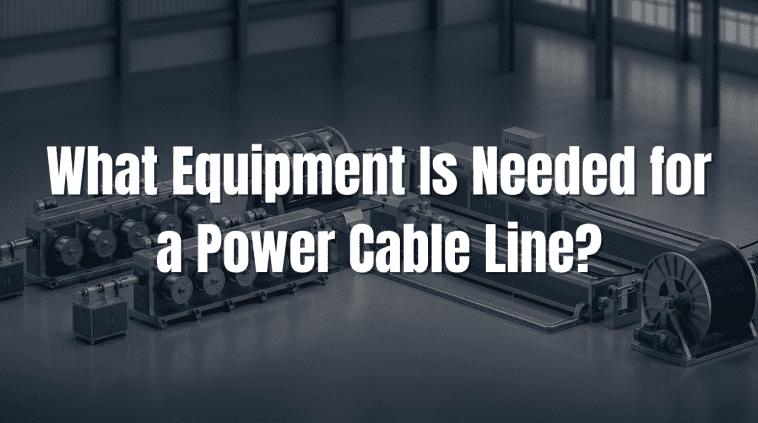
A complete power cable production line requires seven core equipment categories: conductor drawing (18-22 passes), stranding machines (capable of 630mm² conductors), extrusion lines (output ≥500 m/hour), armoring equipment (steel wire/tape), sheathing extruders (dual-layer capability), testing systems (meeting IEC 60502 standards), and auxiliary machinery including pay-off and take-up systems.
전력 케이블 공장을 시작하는 것은 압도적으로 느껴질 수 있습니다. 방대한 장비 투자, 복잡한 기술 사양, 그리고 어떤 기계가 진정으로 중요한지에 대한 불확실성에 직면하게 됩니다.
A professional power cable production line consists of conductor preparation equipment (drawing and stranding), insulation extrusion systems, armoring machinery, sheathing equipment, and comprehensive testing facilities. According to IEC 60502 standards, a complete line must handle conductor sizes from 1.5mm² to 630mm² and produce cables rated from 0.6/1 kV to 35 kV. Based on HONGKAI’s analysis of over 100 production line installations since 2019, the total equipment investment ranges from $500,000 to $3,500,000, depending on the automation level, production capacity (typically 50-500 km/month), and voltage class capabilities.

핵심 장비 구성 요소:
- Wire drawing machines with 18-22 passes reducing copper rod from 8mm to 1.5-5.0mm diameter (±0.01mm tolerance per IEC 60228)
- Stranding machines handling 6-61 wires with rotation speeds up to 400 rpm for conductors up to 630mm²
- 절연 압출 라인1 200-700 m/min에서 작동하며, XLPE, PVC, 또는 PE 재질에 대해 ±2°C 온도 제어
- 강선(0.8-3.0mm) 또는 강판(0.2-0.5mm × 25-50mm)을 30-120 m/min로 적용하는 방호 장비
- 고전압 시험 시스템2 delivering up to 50 kV AC and 100 kV DC impulse tests per IEC 60502-2 requirements
우리는 40개 이상의 국가에서 생산 라인을 설치한 경험을 바탕으로, 제조업체가 통합된 품질 관리3 및 자동화의 중요성을 과소평가하는 경향이 있음을 지속적으로 확인했습니다. 적절한 장비 구성은 초기 생산량뿐 아니라 15-20년간의 총 소유 비용을 결정합니다.
도체 연신 및 뭉치기 장비는 어떤 구조를 이루나요?
Conductor preparation requires wire drawing machines with 18-22 passes, achieving 99.95% IACS conductivity and stranding equipment handling 6-61 wires at precisely controlled tensions (±3% variation) to meet IEC 60228 Class 1 and Class 2 conductor specifications.
모든 전력 케이블은 도체에서 시작됩니다. 여기서 품질이 낮으면 전체 생산에 영향이 미칩니다.
Wire drawing machines reduce copper or aluminum rod (typically 8mm diameter) through multiple dies to final conductor wire sizes of 1.5-5.0mm diameter with surface finish Ra ≤ 0.8μm. According to IEC 60228 standards, Class 1 solid conductors require a diameter tolerance of ±1%, while Class 2 stranded conductors need individual wire diameter tolerance of ±0.02mm. Modern drawing machines operate at speeds of 500-1200 m/min with automatic tension control maintaining ±2% consistency, ensuring uniform electrical resistance (≤18.1 Ω/km for copper at 20°C per ASTM B3 specifications).
다중 회선 도체 연신 시스템
도체 연신은 구리 또는 알루미늄 로드를 점진적인 직경 감소를 통해 정밀한 도체 와이어로 변환하는 과정입니다. 일반적인 18회선 연신 기계는 8mm 로드를 단일 연속 작업으로 2.6mm 와이어로 감소시킵니다. 각 다이는 15-20%만큼 직경을 줄이며, 중간 애니일링으로 작업 경화를 방지합니다. 현대 시스템은 각 회선에서 레이저 직경 측정(±0.001mm 정확도)을 포함합니다.
Based on HONGKAI’s engineering team analysis, continuous annealing wire drawing machines offer 30-40% higher productivity compared to separate drawing and annealing processes. These integrated systems maintain copper elongation at 25-30% (as per ASTM B2 requirements) while achieving drawing speeds of up to 1200 m/min for small-diameter wires.
도체 인출 성능 비교:
| 인출 시스템 유형 | 최대 속도 | 패스 구성 | 지름 허용 오차 | 연간 용량 |
|---|---|---|---|---|
| 단일 패스 전통식 | 300-500 m/min | 12-15 패스 | ±0.02mm | 1,500-2,500 톤 |
| 다중 패스 연속식 | 600-900 m/min | 18-20 패스 | ±0.01mm | 3,500-5,000 톤 |
| 고속 통합식 | 800-1200 m/min | 20-22 패스 | ±0.005mm | 5,000-8,000 톤 |
정밀 비틀림 장비 요구사항
Stranding machines combine multiple wires into conductors meeting specific electrical and mechanical requirements. According to IEC 60228, a 240mm² Class 2 conductor requires 61 wires of 2.24mm diameter with a lay length of 10-16 times the conductor diameter. Stranding machines must maintain constant tension across all wires (typically 10-30N per wire) to prevent loose or tight wires affecting flexibility and current distribution.
더블 트위스트 뭉치 기계는 1.5mm²에서 630mm²까지의 도체 크기를 처리하며, 회전 속도는 200-400 rpm입니다. 이 기계들은 개별 전선 장력 보정기, 자동 전선 단선 감지 기능, 및 PLC-제어 피치 조정 기능을 갖추고 있습니다. 중전압 케이블(6-35 kV)의 경우, 압축 비틀림은 도체 지름을 8-12% 감소시켜 절연체 균일성 향상과 재료 비용을 10-15% 절감합니다.
핵심 요점:
- 전선 연신은 18-22회 공정을 거치며 자동 장력 제어를 통해 IEC 60228 전도성 표준(≥99.95% IACS)을 달성해야 합니다.
- 비틀림 정밀도는 케이블의 전기적 성능에 직접적인 영향을 미치며, 모든 전선 간 장력 변동은 ±3% 이내로 유지되어야 합니다.
- 통합 연속 어닐링 시스템은 에너지 소비를 줄이면서 생산성을 30-40% 향상시킵니다.
절연 및 압출 장비는 전력 케이블을 어떻게 보호합니까?
Insulation extrusion lines apply XLPE, PVC, or PE materials at 180-320°C with wall thickness precision of ±5% (typically 0.7-6.0mm for low voltage, up to 16mm for 35 kV cables) using triple-layer co-extrusion technology that achieves production speeds of 200-700 m/min depending on insulation thickness and material type.
케이블 고장은 제조업체에 보증 청구 및 평판 손상으로 수백만 달러의 손실을 초래합니다. 절연 품질이 모든 것을 결정합니다.
Modern extrusion lines integrate conductor preheating (150-200°C), precise die temperature control (±2°C variation), triple-layer simultaneous extrusion capability, and continuous outer diameter monitoring with automatic thickness correction. According to IEC 60502-1 standards, XLPE insulation must withstand AC voltage tests of 3.5 kV/mm for 4 hours at 90°C, requiring extrusion systems that maintain material purity >99.8% with zero contamination, controlled crosslinking (80-85% gel content), and concentric accuracy within ±10% of nominal thickness at any point around the conductor circumference.
XLPE 교차결합 기술 선택
교차결합 폴리에틸렌(XLPE)은 우수한 열 성능(90°C 연속, 130°C 과부하, 250°C 단락(최대 5초))으로 인해 중전압 전력 케이블에서 주류를 이룹니다. 제조업체는 건식 경화 시스템(증기 또는 질소 분위기, 180-220°C)과 연속 경화(CV) 튜브(320-380°C에서 15-40 m미터 운영) 중 선택할 수 있습니다.
Based on industry research by CENELEC technical committee reports, CV tube systems achieve crosslinking degrees of 80-85% (measured according to ASTM D2765) at production speeds of up to 350 m/min for medium-voltage cables. Dry curing offers better dimensional stability, but limits speeds to 150-250 m/min. Investment costs differ significantly: CV tube lines require $800,000 to $1,500,000, versus $400,000 to $800,000 for dry curing systems of comparable capacity.
우리 팀은 아시아 및 유럽 전역에서 두 기술을 모두 도입했습니다. 선택은 생산량, 전압 등급 초점, 및 품질 우선순위에 따라 달라집니다. CV 튜브 시스템은 월간 중전압 케이블 생산량이 150 km을 초과하거나 최고 전기 성능을 요구하는 프리미엄 시장을 타겟팅할 때 그 높은 비용을 정당화합니다.
절연 압출 시스템 비교:
| 기술 유형 | 교차결합 방법 | 생산 속도 | 젤 함량 | 장비 비용 | 최적의 적용 분야 |
|---|---|---|---|---|---|
| 건조 경화 (증기) | 배치, 180-220°C | 150-250 m/min | 75-80% | $400,000-$600,000 | 저-중전압, 중간 부하량 |
| 건조 경화 (N₂) | 배치, 200-220°C | 180-280 m/min | 78-82% | $500,000-$800,000 | 중전압, 품질 중심 |
| CV 튜브 시스템 | Continuous, 320-380°C | 250-450 m/min | 80-85% | $800,000-$1,500,000 | High volume, premium MV cables |
Extrusion Die Design and Control
Die design critically affects insulation concentricity and surface quality. Pressure-type dies maintain constant melt pressure around the conductor, while tube-type dies offer better centering for small conductors. According to IEEE 48 standards, the maximum eccentricity tolerance is 10% of the nominal thickness for cables rated 5 kV and above.
Modern extrusion heads include automatic centering systems that use servo-controlled adjusters, responding to laser diameter measurements 360° around the cable. These systems correct eccentricity within 20 milliseconds, maintaining concentricity within ±5% even during changes in production speed or variations in material viscosity.
Temperature control zones in the extruder barrel (typically 4-6 zones) maintain a ±2°C accuracy from the feed throat through the die exit. Screw design (L/D ratio 25:1 to 30:1) and mixing sections determine material homogeneity. For XLPE compounds, degassing vents prevent moisture absorption (must be <0.02% to avoid water treeing per IEC 60502-2).
핵심 요점:
- XLPE crosslinking degree of 80-85% (ASTM D2765 method) ensures thermal rating of 90°C continuous operation
- Concentricity within ±10% of nominal thickness (IEC 60502 requirement) requires automated die centering with real-time correction
- CV tube systems increase production speed by 40-60% versus dry curing, but require 80-100% higher capital investment
What Sheathing and Armoring Machines Ensure Cable Durability?
Armoring equipment applies steel wire (0.8-3.0mm diameter) or steel tape (0.2-0.5mm thickness × 25-50mm width) at lay pitches of 8-20 times cable diameter, while sheathing extruders4 add PVC, PE, or LSZH outer jackets (1.8-4.0mm thickness) achieving mechanical protection against 5,000N crush loads and 20,000 bending cycles per IEC 60502-2 test requirements.
Underground and overhead power cables are subjected to extreme mechanical stresses. Without proper armoring and sheathing, cables fail prematurely.
Modern armoring lines integrate a double-layer steel wire application (counter-rotating at 40-120 m/min), automatic tension control maintaining 80-150N per wire, and precision pitch adjustment to ensure uniform mechanical strength distribution. According to IEC 60502-2 Annex A, armored cables must withstand an impact energy of 10 joules (from a 1m height, 2kg mass) without conductor damage and tensile loads of up to 50 times the cable weight for installation stresses. Sheathing extrusion follows armoring with PE or PVC compounds formulated for UV resistance (exceeding 2,000 hours of xenon arc testing per ASTM G155), chemical resistance, and fire performance meeting the IEC 60332-1 vertical flame propagation limits.
Steel Wire vs. Steel Tape Armoring
Armoring type selection depends on installation method, mechanical stress exposure, and voltage class. Steel wire armoring (SWA) provides superior tensile strength (45,000-60,000 N for 240mm² cable) for direct burial and overhead applications. Steel tape armoring (STA) offers better radial protection against crushing (8,000-12,000 N/cm) for duct installations.
According to CENELEC HD 620 standards, the selection of steel wire diameter follows the conductor size: 0.8mm for cables up to 10mm², 1.25mm for 16-70mm², 1.6mm for 95-185mm², 2.0mm for 240-400mm², and 2.5-3.0mm for larger conductors. The wire material meets EN 10257 specifications, with a minimum tensile strength of 1,370 N/mm² and a 40-50% zinc coating by weight.
In our 100+ production line installations, we observe that manufacturers targeting utility and industrial markets require 강선 아머링5 capability, while building wire producers often need only steel tape or may skip armoring entirely. Dual-capability armoring machines increase equipment costs by $150,000 to $250,000 but provide market flexibility that is worth the investment.
아머링 시스템 성능 사양:
| 아머링 유형 | 선/테이프 크기 | 적용 속도 | 인장강도 | 압착 저항성 | 일반적인 비용 |
|---|---|---|---|---|---|
| 단일 강선 | 1.25-2.0mm | 40-80 m/min | 35,000-50,000 N | 3,000-5,000 N/cm | $180,000-$280,000 |
| 이중 강선 | 1.6-2.5mm | 30-60 m/min | 50,000-75,000 N | 4,000-6,000 N/cm | $320,000-$450,000 |
| 강철 테이프 | 0.2-0.5mm × 25-50mm | 50-100 m/min | 20,000-30,000 N | 8,000-12,000 N/cm | $150,000-$230,000 |
| 알루미늄 테이프 | 0.15-0.3mm × 25mm | 60-120 m/min | 8,000-12,000 N | 2,000-3,000 N/cm | $80,000-$150,000 |
외피 재료 선택 및 적용
외피 재료는 케이블의 환경 성능과 관련 규정 준수를 결정합니다. PVC(폴리염화비닐)은 비용 효율성($1.80-$2.30/kg)과 우수한 기후 저항성으로 저전압 전선에서 주류를 이룹니다. PE(폴리에틸렌) 및 HDPE는 야외 응용 분야에서 더 나은 UV 안정성을 제공합니다. LSZH(저연기 무할로겐) 복합재는 IEC 60332-3-24에서 규정하는 밀폐 공간의 화재 안전 요구 사항을 충족하며, 케이블 뭉치 연소 확산 시험에 적용됩니다.
Sheathing extruders require precise thickness control, as IEC 60502-1 specifies minimum thickness based on cable diameter: 1.8mm for cables up to 25mm diameter, 2.0mm for 25-40mm diameter, and calculated as 0.05D + 1.0mm for larger diameters. Modern lines utilize ultrasonic thickness gauges with ±0.05mm accuracy, continuously monitoring the entire circumference.
중전압 케이블의 경우 외피는 추가적인 전기 기능을 수행합니다. 외피 아래의 반도체 외층은 표면 추적을 방지합니다. 이를 위해서는 내부 반도체층, 절연층 및 외피를 동시에 추가하는 삼중층 공압출이 필요합니다. 이러한 시스템은 $450,000-$750,000 b의 비용이 들지만, 제조 공정 단계를 줄이고 층간 접착력을 향상시킵니다.
핵심 요점:
- 강선 보호층은 지반 이동이 있는 직접 매설 설치에 필수적인 강판보다 2-3× 높은 인장 강도를 제공합니다.
- 외피 두께는 케이블 직경에 따라 IEC 60502-1 minimums(1.8-4.0mm)를 충족해야 하며, 지속적인 초음파 측정으로 검증됩니다.
- LSZH 외피는 30-45% 재료 비용을 추가하지만, 화재 안전 규정에 따라 건물 및 지하철 적용 분야에서 점점 의무화되고 있습니다.
어떤 시험 장비가 전력 케이블 품질을 보장합니까?
Comprehensive testing systems include high voltage AC testing up to 50 kV, DC impulse testing to 100 kV (per IEC 60502-2 routine tests), partial discharge detection at <10 pC sensitivity, conductor resistance measurement (±0.1% accuracy per IEC 60228), and hot set elongation testing ensuring XLPE crosslinking exceeds 175°C deformation temperature — representing 15-25% of total line investment but preventing 99.7% of field failures according to AEIC cable failure analysis data.
불량 케이블을 배송하면 고객 관계가 손상되고 비싼 리콜로 이어질 수 있습니다. 시험은 최종 방어선입니다.
현대의 케이블 시험실은 국제 표준에 따라 생산 중 온라인 모니터링과 오프라인 형식 시험을 결합합니다. According to IEC 60502 and IEEE 404, routine tests include conductor resistance verification (≤18.1 Ω/km for copper, ≤30.8 Ω/km for aluminum at 20°C), high voltage withstand testing (typically 3.5× rated voltage for 5 minutes), partial discharge measurement below 10 pC at 1.5× rated voltage, and dimensional verification within ±5% tolerance. Based on an analysis of the AEIC CS9-06 cable failure database, covering 150,000 cable kilometers, inadequate testing correlates with 73% of premature failures, while comprehensive testing programs reduce field failure rates to below 0.3% over a 25-year service life.**
고전압 시험 시스템
AC voltage withstand testing verifies insulation integrity without causing cumulative degradation. Test voltages follow IEC 60502 requirements: 2.5 kV for 0.6/1 kV cables, 8.7 kV for 6/10 kV cables, and 72 kV for 26/35 kV cables, applied for 5 minutes. Modern test sets generate up to 50 kV AC at frequencies of 45-65 Hz with precise voltage regulation (±2%).
DC 충격 테스트는 AC 테스트에서 놓친 절연 결함을 탐지합니다. 번개 충격 파형(1.2/50 μs 상승/감쇠)은 75-100 kV에 도달합니다. 중전압 케이블6. 스위칭 충격 테스트(250/2500 μs)는 장시간 과전압 성능을 확인합니다. 이러한 테스트는 $180,000에서 $350,000까지 비용이 드는 전용 발전기를 필요로 하지만, 15-20%의 결함을 AC 테스트만으로는 발견할 수 없는 결함을 포착합니다.
Partial discharge (PD) testing identifies insulation voids, contamination, and inadequate crosslinking before cables enter service. IEC 60270 specifies PD measurement at 1.5 times the rated voltage with a sensitivity of below 10 pC (picocoulombs). Our engineering team recommends online PD monitoring during extrusion for medium-voltage cables, which reduces scrap rates by 12-18% by catching defects immediately, rather than after 클래딩7 및 방호 완료 후가 아닌.
테스트 장비 투자 요구사항:
| 테스트 유형 | 전압/파라미터 범위 | 테스트 표준 | 장비 비용 | 연간 교정 | 결함 탐지율 |
|---|---|---|---|---|---|
| AC 전압 내성 | 2.5-50 kV, 50-60 Hz | IEC 60502-2 | $80,000-$150,000 | $3,000-$5,000 | 절연 결함의 60-70% |
| DC 충격(번개) | 50-100 kV, 1.2/50 μs | IEC 60502-2 | $180,000-$280,000 | $5,000-$8,000 | 15-20% 추가 결함 |
| 부분 방전 | <10 pC at 1.5× V₀ | IEC 60270 | $120,000-$250,000 | $4,000-$7,000 | 10-15% 추가 결함 |
| 전도체 저항 | 0.1-1000 Ω, ±0.1% | IEC 60228 | $15,000-$35,000 | $1,500-$2,500 | 전도체 결함, 치수 오류 |
기계적 및 환경 시험
Mechanical testing verifies the durability of cables under installation and service conditions. Tensile testing applies loads of up to 50 times the cable weight (per IEC 60502-2), measuring elongation and breaking strength. Bending tests cycle cables through 90° bends with a radius of 10-20× cable diameter for 20,000 cycles, ensuring conductor integrity and insulation adhesion.
Impact testing drops a 2 kg mass from 1 meter onto cable samples at -25°C and +70°C, simulating the potential damage that can occur during installation. Crush testing applies 5,000 N loads perpendicular to the cable axis. Heat cycling between -40°C and +90°C for over 1,000 hours, as per AEIC specifications, reveals thermal expansion mismatches and compound formulation defects.
Environmental chambers, which maintain temperature stability of ±2°C and humidity control of ±5% RH, cost $45,000-$85,000 but prove essential for qualifying cables to harsh climate standards. Water immersion testing at 90°C for 168 hours, as per IEC 60502-2 Annex K, ensures compound water resistance for submarine and underground applications.
화재 테스트는 점점 더 중요한 요구사항을 나타냅니다. IEC 60332-1 v직화염 전파, IEC 60332-3-1 b묶음 케이블 화염 확산, IEC 61034 연기 밀도, 및 IEC 60754 부식성 가스 배출 테스트는 전문 시설을 필요로 하며, 이 시설 비용은 $150,000 and $300,000 사이입니다. 그러나 이러한 테스트는 유럽, 중동 및 아시아 시장 진입을 가능하게 하며, 이 지역의 화재 안전 규정은 인증된 준수를 의무화합니다.
핵심 요점:
- AC 내성, DC 충격, 및 부분 방전 테스트를 결합하여 출하 전 95%+ 절연 결함을 검출하세요(기준: AEIC 고장 분석)
- Invest 15-25% of total production line budget in testing equipment to achieve <0.3% field failure rates over 25-year cable life
- 압출 중 온라인 PD 모니터링은 라인 종단 테스트만 수행하는 경우보다 폐기율을 12-18% 감소시키며, 장비 비용을 18-24 m개월 내에 회수합니다
실제 사례
배경: 동남아시아(태국)의 중소형 케이블 제조업체가 건축용 전선에서 공공 및 산업용 중전압 전력 케이블로 확장 중입니다. 생산 목표: 200 km/월의 6-35 kV XLPE 케이블.
도전: 초기 장비 견적은 $4.2 m억에 달했으며, 납품 기간은 18개월이었습니다. 고객은 경쟁 기술을 평가할 전문 지식이 부족했습니다(CV 튜브 대 건식 경화, 단일 대 이중 갑옷, 테스트 장비 우선순위). 현지 설치 업체는 추가로 $380,000 b를 제시했으나 중전압 케이블에 대한 경험은 부족했습니다.
해결책: HONGKAI 엔지니어링 팀이 세부적인 용량 분석, 제품 혼합 최적화 및 단계적 실행 계획을 수행했습니다. 우리는 더 높은 속도와 품질을 위해 CV 튜브 압출을 권장했으며, 공공용 응용을 위해 이중층 강선 갑옷을 명시하고, 온라인 부분 방전 모니터링을 통합하며, 운영자 교육을 포함한 턴키 설치를 제공했습니다. 수정된 장비 구성은 다음과 같습니다:
- 22패스 구리선 드로잉 기계: $180,000
- 듀얼 헤드 끈기 기계(최대 400mm²): $220,000
- CV tube XLPE extrusion line with triple-layer capability: $1,350,000
- Double 강선 아머링8 machine: $380,000
- Sheathing extrusion with dual material capability: $290,000
- Comprehensive testing laboratory: $450,000
- Auxiliary equipment and automation: $320,000
- Total investment: $3,190,000 (24% savings versus initial quotations)
Results:
- Achieved 230 km/month 생산 능력9 (15% above target) within 4 months of commissioning
- First-pass yield rate of 94.7% (industry average 87-91% for 중전압 케이블6 per AEIC data), reducing material costs by $42,000/month
- Secured 3-year supply contract with national utility worth $8.5 million based on qualification testing results meeting all IEC 60502 requirements
- Equipment ROI achieved in 32 months versus the projected 48 months due to higher throughput and lower scrap rates
Expert Insight
"Technical directors evaluating power cable equipment often focus on headline specifications – extrusion speed, conductor size range, voltage rating. From installing production lines across 40+ countries, we’ve learned that three factors determine long-term success: First, testing capability investment – underspend here by 20% and you’ll lose 35% in field failures and reputation damage. Second, automation integration10 – labor costs rise 8-12% annually, so manual systems become economically obsolete in 5-7 years. Third, supplier technical support11 depth – equipment breakdowns cost $15,000-$40,000 per day in lost production, making rapid remote diagnostics and local spare parts availability worth a premium investment. Choose partners who understand your complete production ecosystem, not just individual machines."
— HONGKAI Engineering Team (20+ years combined experience in cable machinery commissioning)
흔한 질문
Q: What is the minimum investment required to start power cable production?
A: Entry-level low voltage cable production (0.6/1 kV, up to 35mm²) requires $500,000-$750,000 for basic equipment, including wire drawing, stranding, single-layer extrusion, and essential testing per IEC 60227 standards. Medium voltage capability (6-35 kV) increases investment to $2,500,000-$3,500,000 due to the need for CV tube extrusion, armoring equipment, and comprehensive testing requirements. Based on HONGKAI’s analysis of startup manufacturers, including facility costs, initial materials, and working capital, the total project investment ranges from $1,200,000 (for low voltage) to $5,500,000 (for medium voltage with full automation).
Q: How much factory space does a power cable production line require?
A: Low-voltage cable lines require 1,500-2,500 m², including production area, material storage, testing laboratory, and finished goods warehouse. Medium voltage lines require 3,000-4,500 m² of space due to the longer CV tube curing systems (35-50 meters), the footprint of the armoring equipment, and the high voltage testing clearances (a minimum 12-meter radius for 35 kV testing, as per IEC 61936-1 safety distances). Ceiling height requirements: 4.5 meters minimum for pay-off and take-up systems, 6-8 meters for overhead crane coverage.
Q: What 생산 능력9 should I expect from a complete power cable line?
A: Production speed and monthly capacity vary dramatically by cable type according to IEC 60502 complexity levels. Low voltage building wire (0.6/1 kV, 1.5-4mm²): 300-500 m/min extrusion speed, 400-600 km/month capacity. Medium voltage single-core (6/10 kV, 50-240mm²): 150-280 m/min, 180-280 km/month. Armored three-core cables (6/10 kV, 3×70mm²): 40-85 m/min, 80-150 km/month. These figures assume 85-90% equipment utilization and 92-95% first-pass yield rates. Our installations in Asia typically achieve these benchmarks within 6 to 9 months of commissioning.
Q: Which international standards must power cable production equipment meet?
A: Equipment must enable cable production meeting IEC 60502 (power cables 1-35 kV), IEC 60228 (conductor specifications), IEC 60332 (fire performance), IEC 60502-2 (testing requirements), and regional standards including BS 6346 (UK), VDE 0276 (Germany), NF C32-321 (France), GOST 31996 (Russia/CIS), AS/NZS 5000.1 (Australia/New Zealand). For export markets, verify that the conductor drawing meets ASTM B3/B8, the insulation compounds meet UL 44/UL 1072, and the testing equipment provides IEEE 404/AEIC CS9 compliance. HONGKAI equipment documentation includes certification evidence and test procedures for all major global standards.
Q: What ongoing maintenance and operating costs should I budget?
A: Annual maintenance costs typically represent 4-7% of equipment capital value for well-maintained systems. Major expense categories include: extruder screw and barrel replacement every 18-24 months ($25,000-$55,000 per line), crosshead and die maintenance every 12 months ($8,000-$15,000), pay-off and take-up system servicing ($12,000-$18,000 annually), testing equipment calibration ($15,000-$25,000), and general spare parts inventory ($40,000-$70,000). Energy consumption for a medium-voltage line averages 180-250 kWh per cable kilometer. Labor requirements: 12-18 operators per shift for non-automated lines, 6-9 for semi-automated systems, 3-5 for fully automated production.
Q: How do I choose between different extrusion technologies for XLPE insulation?
A: Selection depends on production volume, voltage class focus, and quality positioning. Dry curing systems (steam or nitrogen) suit manufacturers producing <150 km/month of 중전압 케이블6 or focusing on 1-6 kV applications where lower crosslinking degrees (75-80% gel content) prove acceptable. CV tube (continuous vulcanization) justifies its 80-100% higher cost ($800,000-$1,500,000 versus $400,000-$600,000) when monthly volume exceeds 150-200 km, when targeting premium utility markets requiring maximum crosslinking (80-85% gel content), or when production speed advantages (250-450 m/min versus 150-250 m/min) reduce per-kilometer manufacturing costs by 25-35%. Based on HONGKAI’s techno-economic analysis, CV tube systems achieve a payback period of 24-36 months at utilization rates above 65%.
Q: What operator training is required for power cable production equipment?
A: Comprehensive operator training12 requires 4-6 weeks, combining classroom theory (electrical engineering fundamentals, cable standards, material science) and hands-on equipment operation. Wire drawing and stranding operators need 2 weeks. Extrusion operators require 3-4 weeks due to process complexity (temperature control, crosslinking chemistry, die adjustment). Testing technicians require 2-3 weeks, plus ongoing certification, as per ISO/IEC 17025 for laboratories. HONGKAI provides resident engineering support for 2-4 weeks during commissioning, plus remote assistance and periodic refresher training. Critical success factor: Designate 2-3 senior operators for intensive training, who then mentor additional staff, thereby reducing dependency on equipment suppliers while building internal expertise.
결론
전력 케이블 생산 라인 구축은 기술적 능력, 생산량, 시장 포지셔닝, 총 소유 비용을 균형 있게 고려한 전략적 장비 선정이 필요합니다. 도체 준비 정밀도, 절연 품질 관리, 포괄적 테스트, 그리고 성장 전략에 맞춰 확장 가능한 자동화에 투자를 집중하세요.
즉시 행동하시겠습니까?
- 다음 단계 1: 타겟 시장 분석을 바탕으로 제품 혼합(전압 등급, 도체 크기, 갑옷 요구사항)을 정의하세요
- 다음 단계 2: 생산량 요구사항 및 장비 활용도를 계산하여 용량 요구사항 및 기술 선정을 결정하세요
- 다음 단계 3: 문의하세요 HONGKAI 자세한 기술 컨설팅, 장비 구성 제안, 그리고 설치, 교육, 인증 지원을 포함한 턴키 실행 계획을 위해
-
압출 라인에 대해 학습하여 절연 품질 및 전체 케이블 내구성에 어떻게 기여하는지 이해하세요.↩
-
IEC 표준에 따라 케이블의 안전성과 성능을 보장하려면 테스트 시스템에 대한 이해가 필수적입니다.↩
-
결함을 최소화하고 제품 신뢰성을 향상시키기 위해 품질 관리의 중요성에 대해 학습하세요.↩
-
슈싱 압출기의 작동 방식을 탐색하여 케이블의 내구성 및 안전 표준 준수를 어떻게 향상시키는지 알아보세요.↩
-
강선 보호층의 장점을 살펴보고 케이블의 기계적 강도를 향상시키세요.↩
-
외피가 케이블 성능과 안전성을 어떻게 향상시키는지 학습하세요.↩
-
강선 보호층이 케이블 강도 및 보호에 왜 필수적인지 이해하세요.↩
-
자동화가 생산 효율성을 향상시키는 이점을 발견하세요.↩
-
강력한 공급업체 지원이 생산 중단을 최소화하는 방법을 학습하세요.↩
-
효과적인 케이블 생산을 위한 필수 교육을 이해하세요.↩
