












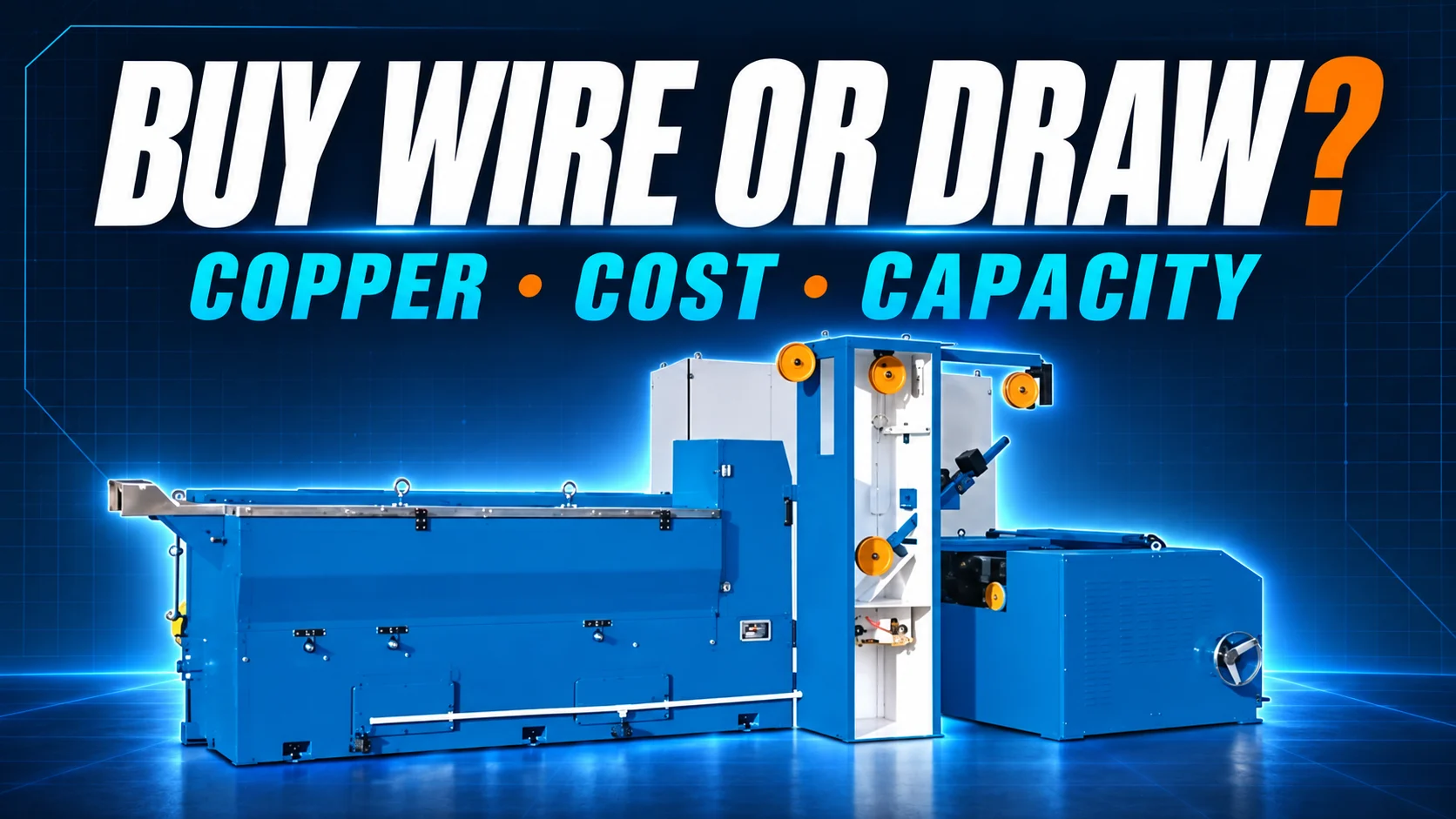
A cable factory considering a copper wire drawing machine should start with its wire demand, not a machine catalogue. The first decision is whether to keep buying wire at the required size or bring some of that work in-house.
Before comparing machines, confirm how much copper the factory uses each month, which wire sizes it needs and whether the finished wire must be annealed. Then compare the full cost of buying wire with the cost of producing acceptable wire in-house.
This guide helps factory owners and technical buyers make that comparison. It does not assume that every cable factory needs a drawing line, or that one monthly volume guarantees savings.
Lượng đồng sử dụng hàng tháng có đủ cao để đánh giá việc kéo sợi tại chỗ không?
In HONGKAI’s buying discussions, copper use of around four metric tonnes per month is an initial reference for evaluating in-house drawing. That figure comes from practical sales-planning experience, not a universal minimum or a calculated break-even point. It does not prove that a particular machine will save money.
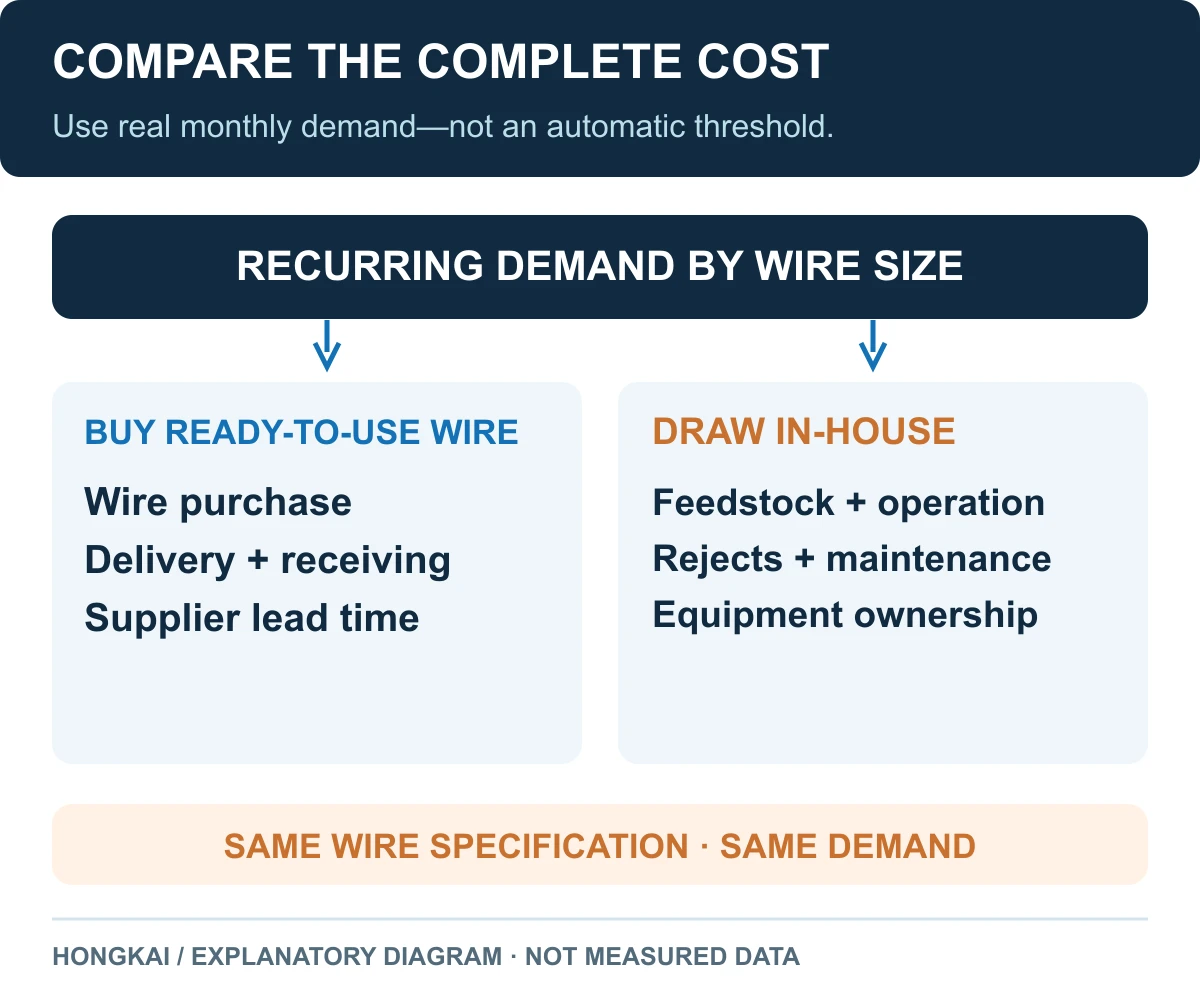
Sơ đồ lập kế hoạch: so sánh tổng chi phí đầy đủ dựa trên cùng các giả định về nhu cầu. Đây không phải là phép tính hòa vốn hay tuyên bố tiết kiệm.
Separate actual recurring demand from a hoped-for production target. Record how much wire the factory needs at each diameter, and whether that volume is steady or changes with individual orders. A large catalogue capacity is not useful if the factory cannot use the output.
Compare the delivered cost of ready-to-use copper wire with the cost of suitable feedstock plus drawing. Include labour, electricity, dies, drawing fluid, maintenance, rejected material and the cost of owning the equipment. Annealing, when required, also belongs in the comparison. Transport, waiting time and the cost of purchasing different sizes may matter, but their value must come from the factory’s actual purchasing records.
Buying wire remains a serious option when demand is uncertain or the full operating cost has not been established. Reaching the planning reference is a reason to obtain quotations and compare costs, not a reason to place an equipment order automatically. For a first network cable factory, the hướng dẫn lập kế hoạch kinh doanh cáp mạng giải thích cách các đơn hàng và nhu cầu thị trường nên được xem xét trước khi lựa chọn thiết bị.
Ghi lại các kích cỡ dây dẫn yêu cầu và vật liệu ban đầu
Máy kéo sợi phải phù hợp đồng thời với cả vật liệu đưa vào và loại dây yêu cầu đầu ra. Chỉ biết đường kính thành phẩm thôi là chưa đủ để lựa chọn máy.
Write down the purchased material, its diameter and condition, the required final wire diameter, and the monthly quantity for each size. If those details are not yet known, first settle the wire specification rather than choosing between machine names.
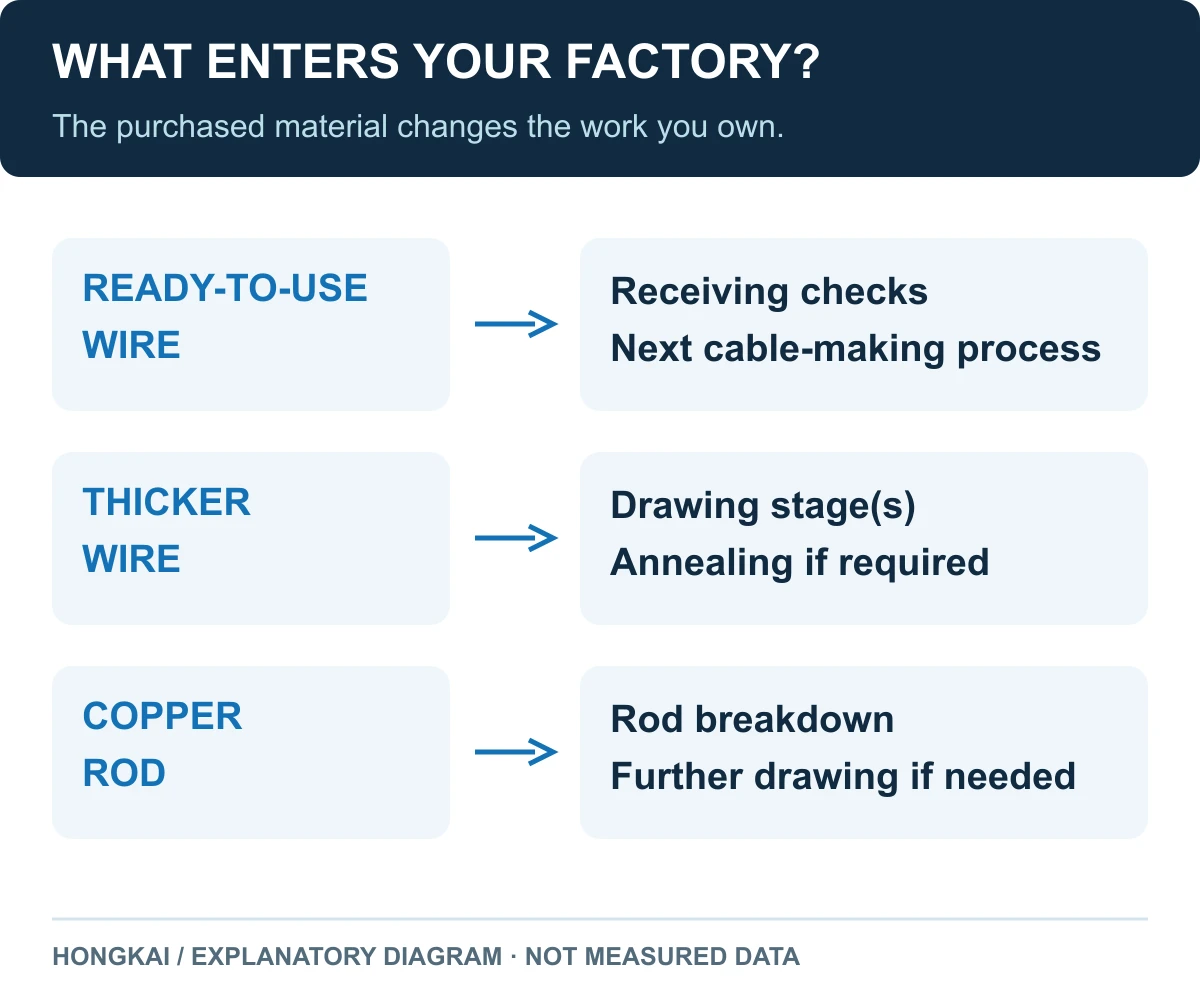
Sơ đồ phạm vi đơn giản hóa, không phải bố trí tuyến cố định. Các yêu cầu về ủ và thu dây phải được thống nhất cho tuyến đã chọn.
Bảng sau phân chia ba tuyến mua hàng. Đây không phải là danh sách thiết bị cố định cho mọi nhà máy.
| Những gì nhà máy mua | Công việc được giữ bên trong nhà máy | Câu hỏi chính trước khi lựa chọn |
|---|---|---|
| Dây đồng đã đạt đường kính và tình trạng yêu cầu | Kiểm tra đầu vào và quy trình sản xuất cáp tiếp theo; kéo sợi nằm ngoài phạm vi này | Nhà cung cấp có thể giao dây, số lượng và bao bì yêu cầu một cách đáng tin cậy không? |
| Dây đồng vẫn cần giảm đường kính | Các công đoạn kéo sợi cần thiết để đạt được mục tiêu, cộng với phạm vi ủ và thu cuộn đã được thỏa thuận | Does the selected machine accept the purchased wire and produce the required output? |
| Copper rod | Rod breakdown, with further drawing where needed for the final wire specification | Is the broader process justified by real demand, available skills and the full operating cost? |
Rod breakdown reduces rod into smaller wire. Further drawing may be required to reach the final size. Intermediate and fine drawing are useful machine categories, but their names alone do not specify a complete route. Manufacturer product ranges distinguish drawing machines, annealers and take-up equipment as separate parts of the production system.1
For a new factory, buying ready-to-use wire can be a practical starting point if there is a dependable source. Request the same written wire specification from the material supplier that you would use to accept wire from an in-house line. Buying wire transfers a process to a supplier; it does not remove the need to verify the output.
If a supplier proposes more than one drawing stage, ask what each stage receives and produces. For a stranded conductor, specify the diameter of the individual wires, not just the total conductor cross-section.
Do not assume that the words “intermediate” or “fine” have identical limits in every catalogue. Ask for a written operating range for the offered model and the exact route needed for your main products. HONGKAI’s intermediate drawing equipment reference is a starting point for that discussion, not confirmation of a project’s final configuration. A range that covers a small trial sample still needs to be checked against the planned production mix.
The input copper also matters. BECHEM’s technical guide identifies incoming rod quality and the drawing emulsion as important to the drawing process.2 Keep the feedstock supplier, material batch and actual input size in the trial record, so a change in the raw material is not confused with a change in machine performance.
Does the Finished Wire Need Annealing?
Drawing makes the wire smaller, but it also hardens the copper through deformation. Annealing is used to soften the drawn wire when the required finished condition calls for it. BECHEM’s technical guide describes this soft-annealing purpose and an inline drawing, annealing and spooling route.2 That example does not mean every purchase needs the same arrangement.

Decision illustration: specify the required wire condition before choosing the annealing scope. This is not an annealer setup instruction.
For a buyer, the useful question is what condition the next process or final product requires. Specify the required wire condition and applicable mechanical properties, such as elongation and tensile strength where the product specification calls for them. Do not describe acceptance only as “not brittle” or “soft enough”. Ask the supplier which tests will demonstrate the agreed condition.
The proposal should state whether annealing is included and where it occurs. Online or separate annealing must be selected for the actual route; this guide does not prescribe one arrangement. A drawing-only price and a drawing-and-annealing price do not cover the same work.
The finished package is another interface. Record the spool dimensions, usable loading requirement and the next machine’s pay-off arrangement. A spool that leaves the drawing line successfully still has to work at the insulation, bunching or other downstream process. For a bunched conductor, the hướng dẫn lựa chọn máy bó dây explains the input-wire and package information needed at that next stage.
Use one scope sheet for the drawing machine, annealing equipment, take-up, dies, cooling or fluid system, and required utilities. Mark each item as included, supplied separately or provided by the buyer. This is a scope comparison, not a claim that every project needs every accessory.
Compare Accepted Output, Not Only Metres per Minute
A line-speed figure tells you how quickly wire moves. It does not, by itself, tell you how much usable copper the factory produces during a shift. Wire diameter, number of wires, running time and rejected material all affect that comparison.
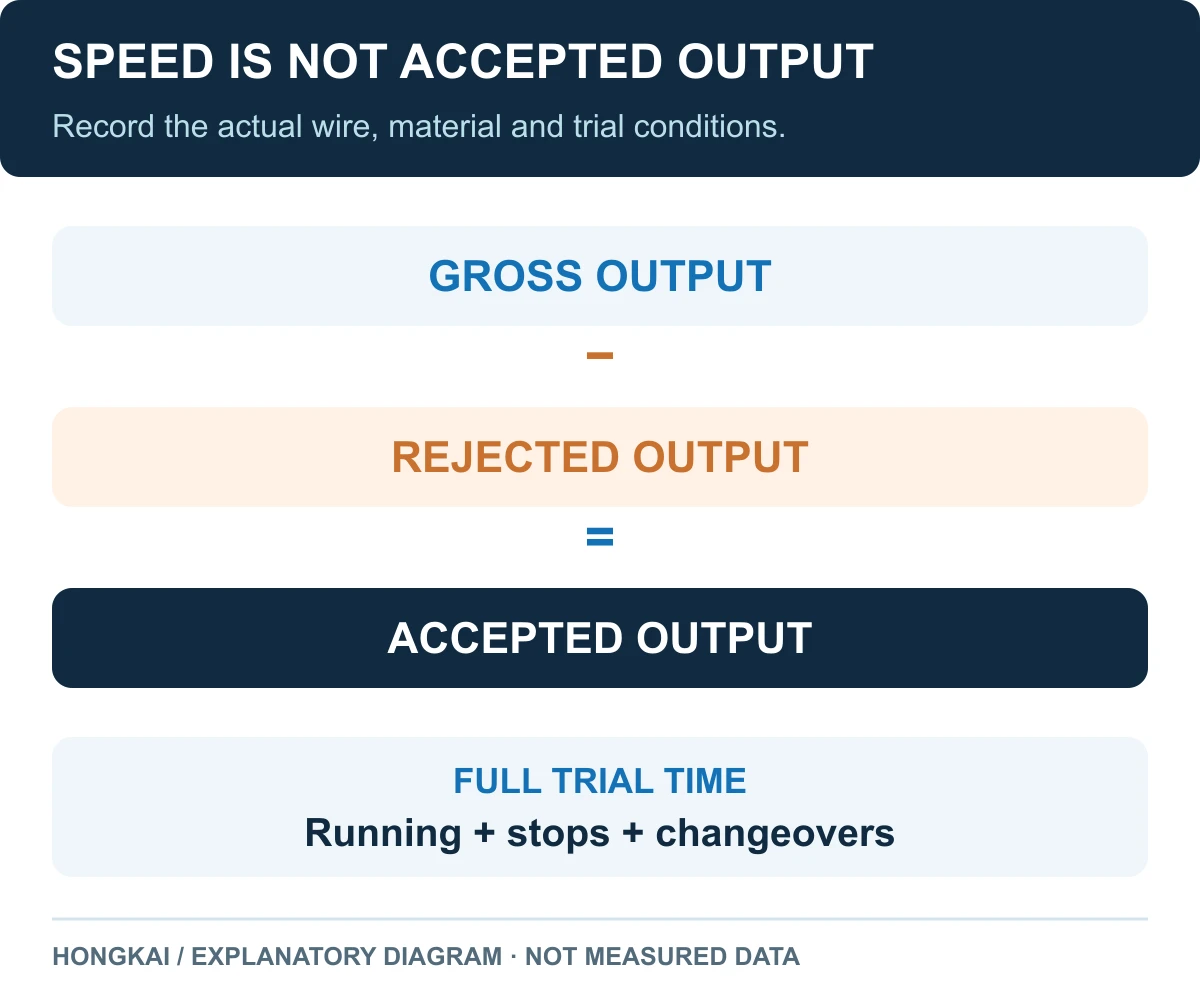
Minh họa bảng ghi đầu ra không có kết quả mẫu. Giữ nguyên số lượng trong cùng đơn vị và thống nhất cách tính vật liệu bị loại và vật liệu được làm lại.
Ask for an output record for the diameter and material you intend to run. Keep two figures separate: accepted output during stable running, and accepted output over the full agreed trial period. The second includes the effect of recorded stops and changeovers.
Một bản ghi so sánh hữu ích bao gồm:
- Vật liệu đầu vào và đường kính, đường kính dây mục tiêu và số lượng dây được kéo.
- Tốc độ chạy thực tế, thời gian thử nghiệm đã trôi qua, các lần dừng và lý do cho từng lần dừng.
- Sản lượng tổng, sản lượng bị loại và sản lượng được chấp nhận, kèm theo phương pháp cân hoặc đếm.
- Cụm ủ và cuộn đầu ra được sử dụng trong quá trình chạy.
These are proposed buyer records, not universal acceptance limits. Set the sample requirements and trial duration in the purchase agreement. If a supplier offers only a maximum speed without the associated product and test conditions, the factory still lacks the information needed for capacity planning.
Tránh việc cho rằng một lần thử nghiệm có thể chứng minh cho mọi đường kính trong catalogue. Hãy chọn các sản phẩm thử nghiệm phản ánh đúng mục đích mua hàng và thống nhất cách thức chứng minh cho các kích cỡ khác.
Decide Which Responsibilities Your Factory Is Ready to Own
The final choice is a boundary decision. Buying finished wire keeps drawing with the material supplier. Buying intermediate wire brings part of that work inside. Starting with rod brings a wider processing route into the project.
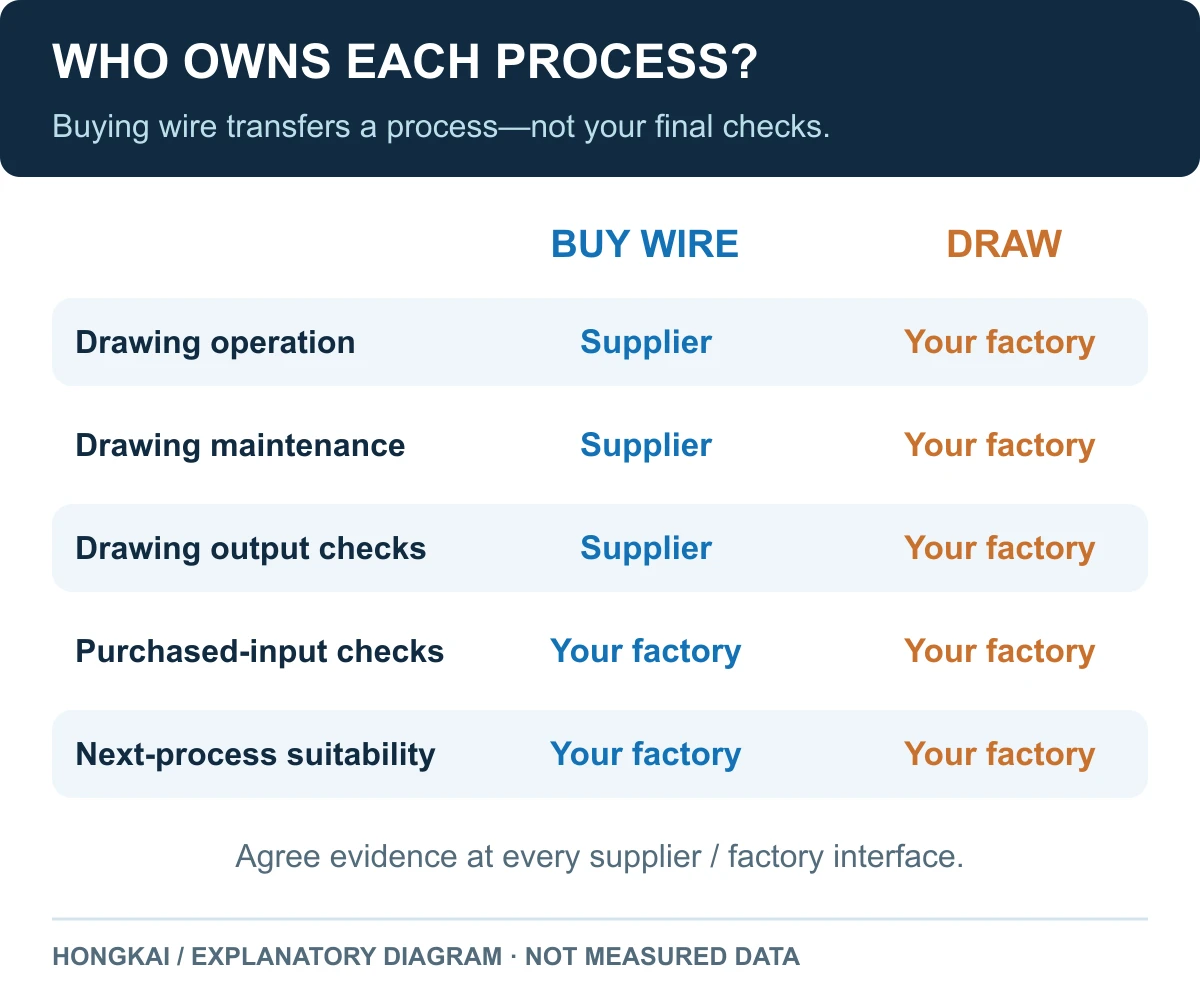
Sơ đồ trách nhiệm đơn giản hóa cho dây thành phẩm mua ngoài so với công đoạn kéo sợi nội bộ. Cả hai tuyến đường vẫn cần kiểm tra vật liệu và tính phù hợp cho các công đoạn tiếp theo.
Keep purchased wire as a serious option when demand is still uncertain or the factory has not yet budgeted for drawing operation and quality control. Evaluate an in-house stage when the product mix and material demand are clear enough to compare complete costs and responsibilities.
Một giai đoạn nội bộ cũng cần có một chủ sở hữu được chỉ định để bảo trì và phụ tùng. Giai đoạn hướng dẫn lập kế hoạch bảo trì dây chuyền cáp helps define that responsibility; it is not a universal spare-parts list for every drawing machine.
Use the same wire specification and demand assumptions for both purchasing routes. Keep the supplier’s confirmed scope separate from options that still need a quotation. Neither an attractive machine price nor a generic savings percentage settles the make-or-buy decision.
Before accepting a drawing proposal, tie the trial results to the agreed finished-wire specification. Relevant items to define can include diameter, surface condition, electrical resistance and mechanical properties, together with the spool requirements. Select the actual tests and limits from the intended product specification, rather than borrowing numbers from an unrelated cable.
The result should be a clear decision: what copper enters the factory, what operations the factory owns, and what verified wire leaves those operations. Only then does comparing individual drawing machines become useful.
-
Dải sản phẩm NIEHOFF phân biệt thiết bị kéo rút thanh, kéo dây đơn, kéo đa sợi, ủ và thu cuộn. Đây là tài liệu tham khảo về phạm vi quy trình, không phải bằng chứng về hiệu suất của model HONGKAI. ↩
-
BECHEM, Giải pháp bôi trơn cho kéo dây, printed pages 08–09, discusses incoming rod, drawing fluids and the drawing/annealing/spooling sequence. Its product-specific figures are not HONGKAI specifications. ↩ ↩

 English
  हिन्दी
  فارسی
فارسی