










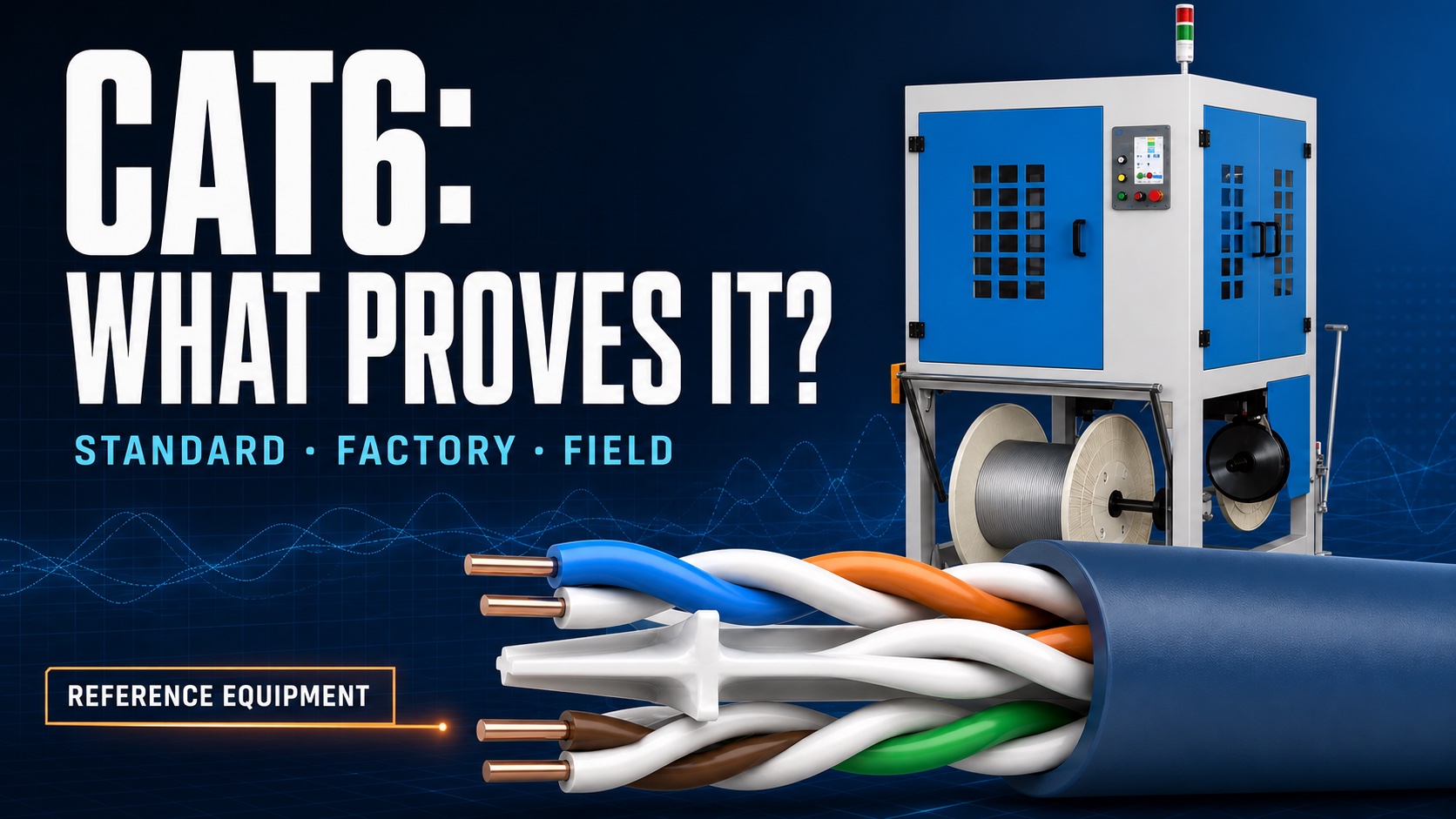
A network-cable factory can make a reel that passes one handheld test and still lack the evidence needed to release Cat6 product consistently. Factory owners, production managers and technical buyers therefore need to decide what is being accepted: a cable design, a production lot, a third-party product listing, or an installed link.
Cat6 compliance is proved by a connected evidence chain, not by a generic “TIA certificate.” Start with the current contract standard and exact cable construction, control the geometry that creates transmission performance, test the finished cable with suitable laboratory methods, and keep lot-level records. Treat installed-link testing and independent product verification as separate evidence layers.
Sự khác biệt này quan trọng trước khi đặt mua máy móc. Một bộ đầy đủ Tuyến sản xuất cáp LAN must connect conductor preparation, insulation, pair twisting, cabling, optional shielding, sheathing, testing and packing. The test plan must be designed with that route because end-of-line testing can identify a result; it cannot repair uncontrolled conductor, insulation or pair geometry.
Thay thế “Chứng nhận TIA” bằng một Đối tượng Chấp nhận Có tên
ANSI/TIA-568.2-E is a balanced twisted-pair cabling and components standard, not a universal certificate issued to every Cat6 cable factory. A buyer should name the standard edition, product construction, verification body if any, sample scope and evidence required instead of asking only for “TIA certification.”
TIA announced ANSI/TIA-568.2-E in November 2024 as the revision of ANSI/TIA-568.2-D.1 TIA also explains that its engineering committees develop standards through an ANSI-accredited process.2 Những sự thật đó xác lập vai trò về tiêu chuẩn. Chúng không chứng minh rằng TIA đã thanh tra nhà máy, kiểm tra một cuộn cáp hoặc chứng nhận sản phẩm Cat6 nào.
Cụm từ “chứng nhận Cat6” có thể che giấu bốn yêu cầu khác nhau:

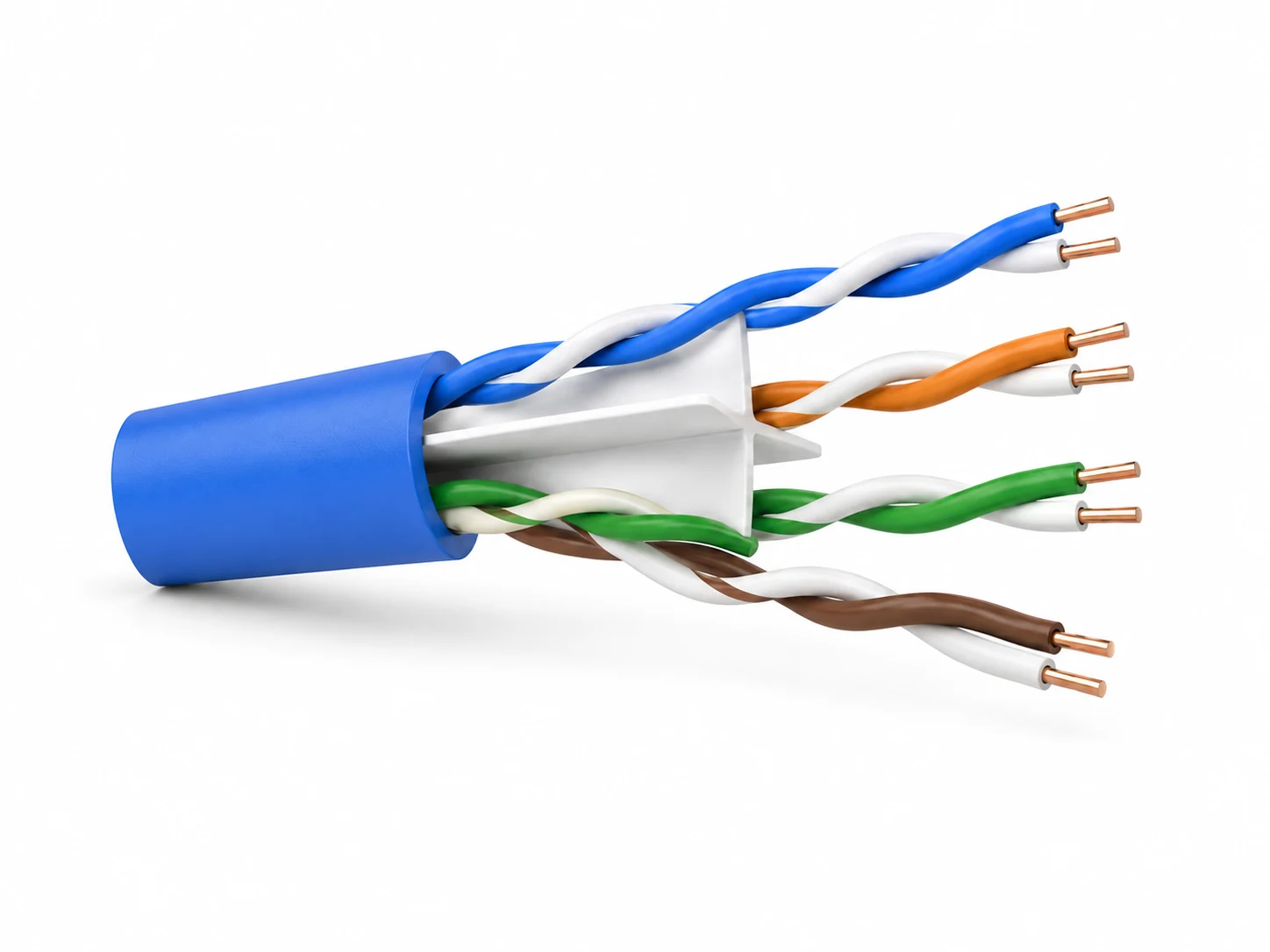
Minh họa giải thích do AI tạo ra. Ghép từng đối tượng nghiệm thu với bằng chứng tương ứng của chính nó; đây không phải là chứng chỉ, kết quả thử nghiệm hay bản vẽ lắp đặt. View full-size illustration.
| Acceptance object | Main question | Appropriate evidence | What it does not prove alone |
|---|---|---|---|
| Cable design | Does the defined cable construction meet the signed electrical and physical requirements? | Controlled specification, qualified samples, laboratory results and change control | That every later production lot remains within control |
| Production lot or reel | Was this identified output released against the factory plan? | Traceable raw-material, process, dimensional and finished-cable records | Independent product verification or installed-link performance |
| Independent product verification | Did a named third party assess the identified product against a named specification? | Current directory entry or certificate with product, standard edition, scope and surveillance status | A different model, construction, jacket rating or unlisted factory |
| Liên kết cố định hoặc kênh đã lắp đặt | Does the completed cabling system pass the project’s field limits? | Calibrated field-test report with link type, adapters, instrument and results | Factory cable qualification without the rest of the installed system |
Intertek’s ETL Verified cabling directory illustrates the third-party layer: entries are organized by company and specific product, while a certificate identifies the tested construction and referenced standard.3 One published certificate also states that verification of transmission requirements is distinct from a certification program.4 This is why a buyer should verify the exact wording, product identity, current status and surveillance arrangement rather than treating any logo as a broad Cat6 claim.
Decision criterion: Write the acceptance object as a noun before choosing the test: “bulk horizontal cable,” “patch cord,” “production reel,” “permanent link” or “channel.” If the noun changes, the fixture, limits, sample preparation and responsible party may also change.
Freeze the Cable Construction Before Selecting Tests
A Cat6 test plan begins with the saleable cable definition. Category alone is incomplete because conductor, pair, separator, shielding, jacket, installation use and delivery form change what must be manufactured and what evidence the customer may request.
The buyer should approve at least these inputs before the supplier fixes the equipment route or FAT scope:
- solid or stranded conductor and the approved conductor material;
- conductor size and finished conductor tolerance;
- insulation material, nominal dimensions and color identification;
- U/UTP, F/UTP or another defined screening construction;
- pair lay plan and any separator construction;
- cabling lay, binder or shield elements where applicable;
- jacket material, marking, color and market-specific fire or environmental requirement;
- bulk cable, patch cord, permanent-link or channel acceptance boundary;
- target standard edition, customer specification and third-party program if required;
- chiều dài cuộn hoặc hộp, chiều dài mẫu, kế hoạch lấy mẫu xử lý và xuất hàng.
IEC 61156-5:2020 is a separate official reference for symmetrical pair/quad cables used primarily in horizontal floor wiring. Its public scope covers individually screened, common-screened and unscreened pairs or quads; the purchased standard is needed to establish the applicable detailed requirements.5 ISO/IEC 11801-1:2017, with its later amendment, addresses generic customer-premises cabling across multi-vendor systems.6 These standards are related to the product and system decision, but they are not interchangeable labels. The signed order must say which document and edition governs each acceptance object.
Common mistakes: A quotation says only “Cat6 UTP, Fluke test pass.” It does not identify bulk cable versus installed link, conductor construction, sample preparation, test method, standard edition, parameter set, limit set, instrument class or raw-data format.
Hiệu suất xây dựng phía thượng nguồn của bộ phân tích cuối cùng
Cat6 electrical performance is created through repeatable conductor, insulation, twisting and cabling geometry. Final transmission testing verifies the result, while upstream process records explain why the result is stable or why it failed.
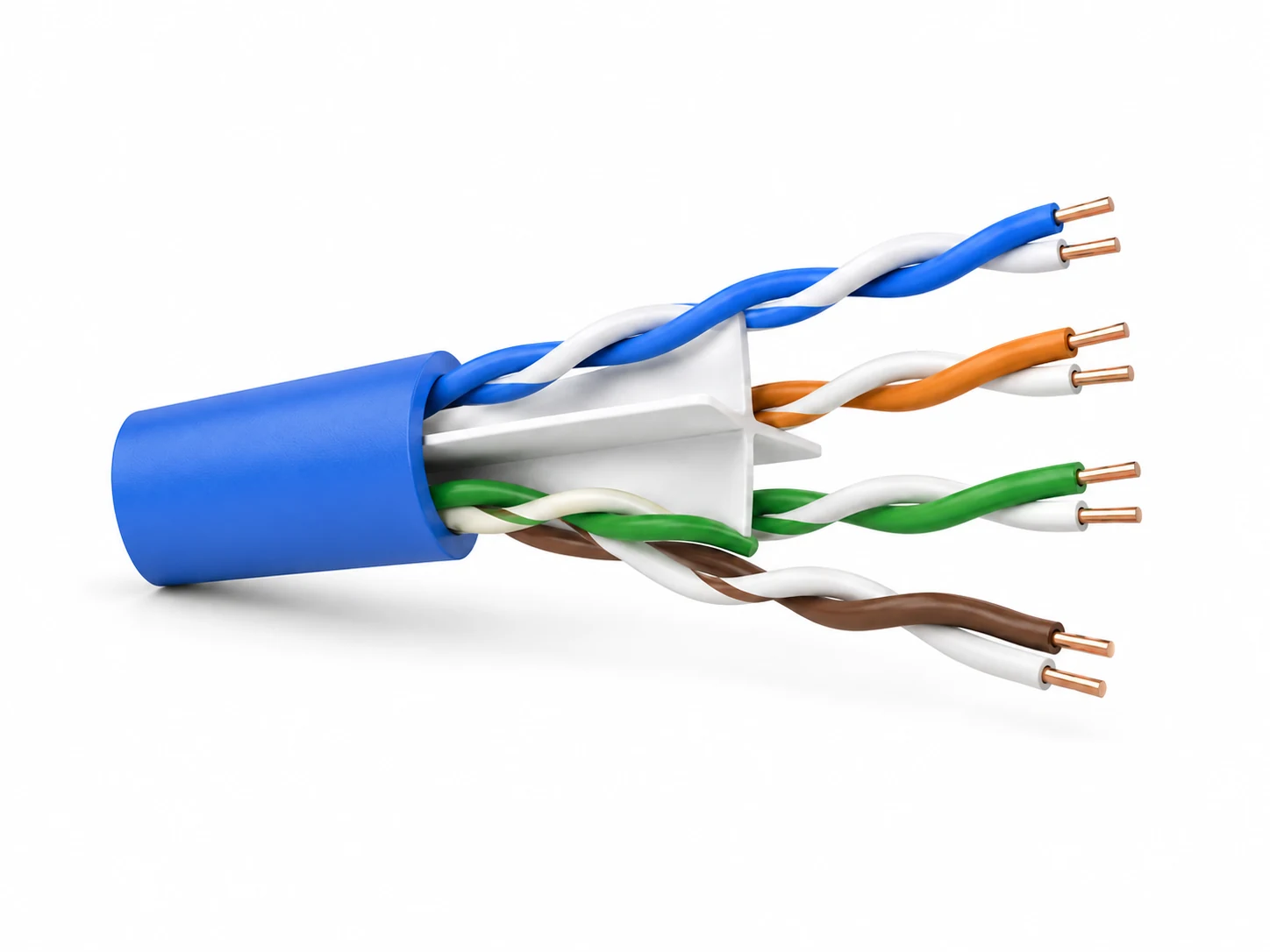
Đối với tuyến cáp Cat6 UTP, kế hoạch kiểm soát hữu ích nhất tuân theo quy trình vật lý:
| Production stage | Xử lý bằng chứng để lưu giữ | Lý do bản ghi thuộc về chuỗi bằng chứng |
|---|---|---|
| Chuẩn bị lõi dẫn | Lô nhà cung cấp, mã vật liệu, kích thước ruột dẫn và dữ liệu điện trở áp dụng | Thiết lập đầu vào về điện và kích thước cho lớp cách điện |
| Cách điện lõi dây | Lô cách điện, xu hướng đường kính, bằng chứng độ lệch tâm hoặc đồng tâm, tình trạng bề mặt, hồ sơ thử nghiệm phóng điện và mã cuộn | Theo dõi hình học và độ toàn vẹn của từng dây dẫn được cách điện |
| Xoắn cặp | Định danh đôi dây, cài đặt bước xoắn, cài đặt lực căng/xoắn ngược (nếu áp dụng), ánh xạ cuộn dây và tình trạng bề ngoài | Liên kết độ cân bằng cặp và độ lặp lại với kết quả cáp thành phẩm |
| Cáp và bộ phân cách | Trình tự cặp, độ xoắn cáp, nhận dạng bộ phân cách, cài đặt lực căng và quan sát biến dạng | Ghi lại hình học được tạo ra khi bốn cặp trở thành một lõi cáp |
| vỏ bọc | Lô vỏ bọc, kích thước lõi trước khi bọc, xu hướng đường kính thành phẩm, bản ghi in/chiều dài và cuộn thu | Hiển thị liệu quy trình cuối cùng có làm thay đổi lõi hoặc danh tính sản phẩm hay không |
| Thử nghiệm trong phòng thí nghiệm đối với cáp thành phẩm | Sample ID, length, conditioning, fixture, calibration status, standard/limit set, raw plots and result | Cung cấp bằng chứng giải phóng cho mẫu và lô đã được xác định |
The HONGKAI LAN cable production guide maps Cat6 UTP production through insulation, precision pair twisting, separator handling where the approved construction requires it, cabling, sheathing, electrical testing and packing. That route is a project reference, not a declaration that every Cat6 design uses the same separator, machine model or acceptance limit.
How to verify: Ask the line supplier to map each critical finished-cable result back to a controllable production variable and a retained record. “The analyzer will tell us” is incomplete unless the factory can identify which process data will be checked after a failure.
Tách biệt các thử nghiệm trong phòng thí nghiệm nhà máy với các thử nghiệm tại hiện trường
Factory cable release and installed-cabling field testing answer different questions. A field tester is valuable for permanent-link or channel acceptance, but it should not automatically replace the laboratory method and fixtures needed to qualify bulk cable or components.
TIA’s ANSI/TIA-1152-A announcement defines requirements for field test instruments used with balanced twisted-pair cabling, including reporting and accuracy performance.7 That scope is useful when the acceptance object is an installed cabling configuration. A factory product program may require different laboratory instrumentation, fixtures and sample preparation to assess the cable or component itself under the governing product standard.
Sử dụng thang bằng chứng thay vì một dòng mục kiểm tra chung chung:
| Evidence layer | Typical decision | Danh mục thiết bị hoặc hồ sơ | Buyer check |
|---|---|---|---|
| Kiểm soát trong quá trình sản xuất | Quy trình sản xuất có đang duy trì hình học đã được phê duyệt không? | Đo đường kính/độ đồng tâm, thử nghiệm xung điện, hồ sơ bước xoắn/lực căng và kiểm tra kích thước | Mỗi lần đọc có thể được liên kết với một lõi, một cặp, một cuộn và một khoảng thời gian không? |
| Thông báo giải phóng điện nhà máy | Mẫu cáp đã xác định có đáp ứng các yêu cầu cáp đã ký không? | Hệ thống đo điện trở và truyền dẫn phù hợp với các thiết bị kẹp và phần mềm đã được phê duyệt | Các phương pháp, hiệu chuẩn, chiều dài mẫu, điều kiện xử lý và biểu đồ thô đã được ghi lại chưa? |
| Independent verification | Sản phẩm đã xác định đã được đánh giá bởi cơ quan được nêu tên chưa? | Báo cáo của bên thứ ba, mục nhập trong danh bạ và bằng chứng giám sát | Các thông tin về công ty, nhà máy, model, cấu tạo và phiên bản tiêu chuẩn có khớp nhau không? |
| Installation acceptance | Liên kết hoặc kênh đã hoàn thành có đáp ứng giới hạn của dự án không? | Bộ kiểm tra hiện trường và bộ chuyển đổi liên kết/kênh chính xác | Giới hạn đã chọn có phù hợp với cấu hình đã lắp đặt không? |
For machinery procurement, the HONGKAI LAN production guide identifies electrical testing as a supporting system whose scope requires written project confirmation. The buyer should separately name responsibility for the analyzer, fixtures, software, calibration service and third-party verification; those items should not be implied by the extruder, twister or cabling machine.
Note: A field PASS file is evidence for the tested configuration at the recorded time. It is not by itself evidence that every reel from the factory, every product variation or every future production lot meets the same requirements.
Fluke Testing: Is the Requirement for a 305 m Reel or a 100 m Connection?
Before accepting a requirement to “pass Fluke,” define the product being tested, its actual test length, the connection arrangement and the selected limit. A 305 m box or reel and a connection of approximately 100 m represent different customer requirements; a PASS result is useful only when the test setup matches the agreed acceptance object.
HONGKAI insight: In the customer requirements described for this guide, Fluke testing is a preferred practical acceptance reference. Some customers ask about a complete 305 m box or reel; others describe a finished connection of around 100 m. Confirm which form the customer means before discussing performance or a pass rate. These are examples of project requirements, not a universal length rule or a promised test outcome.
Use precise terms when converting the customer’s wording into the test plan. Fluke describes a conventional channel as the complete connection including patch and equipment cords, with an overall length limit of 100 m. A permanent link is the fixed portion, with a 90 m limit in that model. Testing a patch cord itself uses the relevant patch-cord limits and adapters, which assess its end connections differently from channel testing.8 Do đó, chỉ riêng chiều dài không xác định được chế độ kiểm tra đúng.
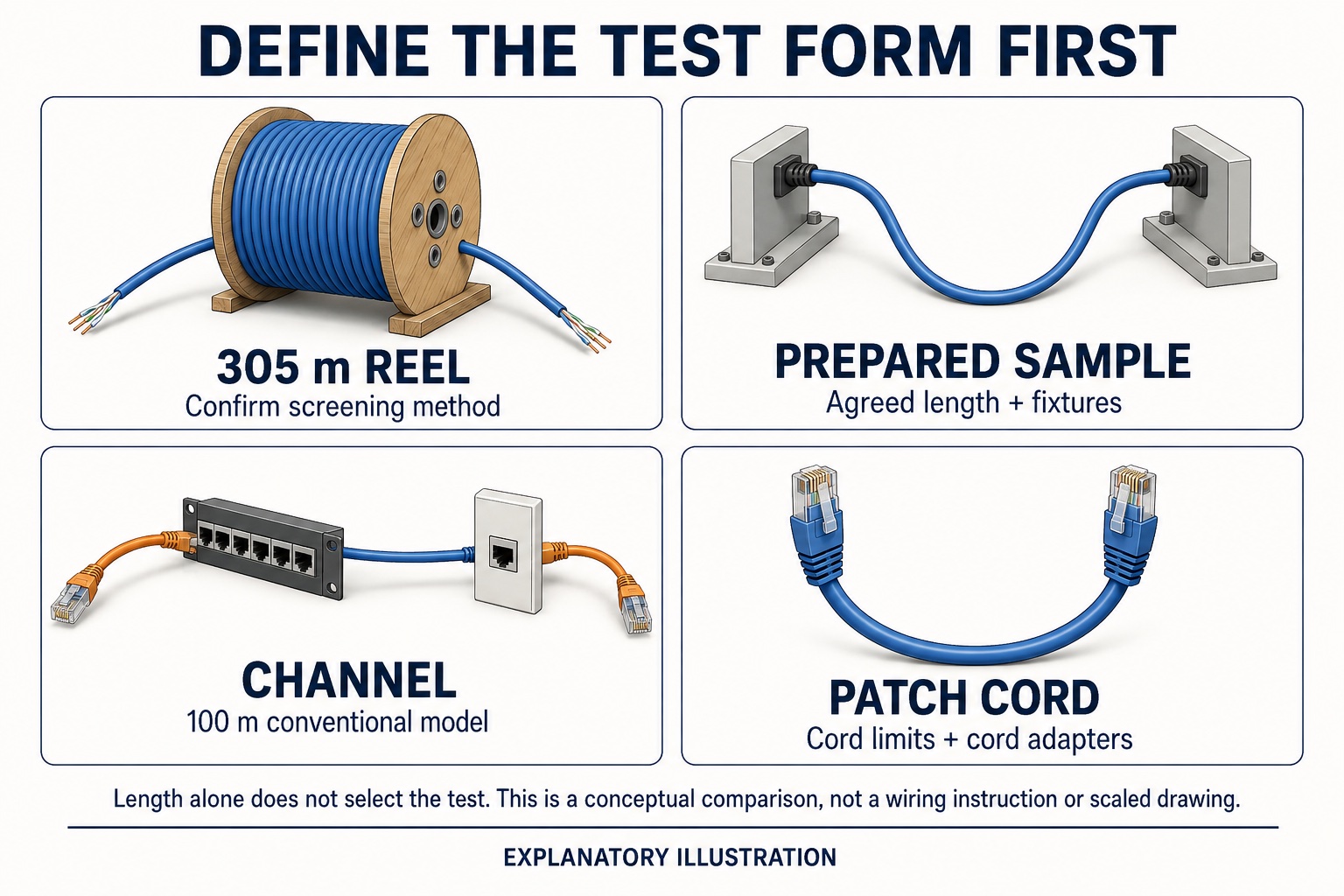
AI-generated conceptual comparison, not a wiring diagram. The 100 m figure refers to the conventional channel model, including its cords. Reel screening, prepared-sample testing and patch-cord testing require their own agreed methods and limits. View full-size illustration.
| Customer wording | Điều mà người mua phải làm rõ | Ghi lại trước khi chấp nhận kết quả |
|---|---|---|
| “Test the 305 m box or reel” | Yêu cầu là kiểm tra cáp khi đang cuộn hay đánh giá một mẫu đã chuẩn bị theo các yêu cầu về thành phần? Cả hai đầu có thể tiếp cận được không? | Độ dài đóng gói và đã kiểm tra, tình trạng cuộn/tháo cuộn, cấu hình một đầu/hai đầu, các thông số đo được và giới hạn đã thỏa thuận |
| “Test the approximately 100 m finished connection” | Đây là một kênh, một mẫu cáp đã được chuẩn bị sẵn, hay một bố trí đầu cuối được chỉ định khác? | Bản vẽ kết nối, chiều dài thực tế, phích cắm/ổ cắm, bộ chuyển đổi và tên giới hạn chính xác |
| “Kiểm tra dây nối” | Khách hàng có ý đề cập đến dây cáp như một thành phần, bao gồm cả các đầu cắm của nó, hay là một kênh hoàn chỉnh chứa dây cáp đó? | Cấu tạo dây dẫn và chiều dài, cấu hình thử nghiệm dây dẫn áp dụng và tiêu chí chấp nhận |
Fluke’s single-ended DSX application note explains that reel screening measures a limited parameter set and cannot replace all double-ended measurements. It also notes that coiling can affect results and distinguishes typical 305 m reels from formal component testing based on a prepared 100 m sample with specified terminations.9 Confirm the supported method with the instrument supplier; do not select a channel limit merely to obtain a PASS for a reel.
Evidence to request: Save the Fluke model, software version, adapter identification, calibration status, test-limit name, cable/sample ID, actual length and complete result file. If the customer requests a pass rate, agree whether the denominator is boxes, reels, prepared samples or finished connections, and how first tests and retests are reported. Keep differently configured tests in separate result groups; no acceptance percentage is assumed here.
Chẩn đoán kết quả thất bại thông qua chuỗi quy trình
A failed Cat6 result should trigger a controlled check sequence: first verify the sample and measurement setup, then inspect the production records connected to the failure pattern, and only then adjust the process. Changing several settings at once destroys the evidence needed to confirm the cause.
Use the table as a proposed investigation record, not a confirmed diagnosis or a list of the most common causes. Each process connection must be checked against the actual cable design, raw measurements and the factory’s validated process plan; the table does not replace the governing test method.
| Họ kết quả quan sát được | Xác minh trước khi thay đổi sản xuất | Process areas to inspect next | Recovery evidence |
|---|---|---|---|
| Kết quả suy hao hoặc tổn hao chèn không mong đợi | Chiều dài mẫu, nhiệt độ dây dẫn, đầu nối/đồ gá, hiệu chuẩn và chuẩn hóa chiều dài | Conductor dimension/material record, joints, insulation condition and finished length | Lặp lại kết quả từ cùng một mẫu cộng với một mẫu xác nhận được xác định riêng biệt |
| Độ mất mát phản hồi hoặc sự bất thường liên quan đến trở kháng | Đồ gá, kết thúc, xử lý mẫu và tính nhất quán của dấu vết thô | Đường kính lõi/độ đồng tâm, độ ổn định bước xoắn cặp, lực kéo khi bện cáp, vị trí dải phân cách và biến dạng do lớp vỏ gây ra | Hồ sơ truy xuất nguyên liệu ổn định và hồ sơ kích thước/quy trình nằm trong giới hạn được phê duyệt |
| Lỗi liên quan đến nhiễu xuyên âm | Xác định cặp, ánh xạ bộ chuyển đổi, cách ly fixture và thiết lập giới hạn | Độ đồng bộ bước xoắn cặp, cân bằng cặp, điểm chéo/trình tự, hình học vách ngăn và biến dạng cặp trong quá trình bện hoặc bọc vỏ | Kết quả lặp lại được trên toàn bộ kế hoạch mẫu đã được phê duyệt với dữ liệu cặp/quy trình có thể truy xuất |
| Lo ngại về điện trở hoặc sự mất cân bằng điện trở | Điện trở tiếp xúc, chuẩn bị mẫu, hiệu chỉnh về điểm không của thiết bị và phương pháp hiệu chỉnh nhiệt độ | Đầu vào dây dẫn, xu hướng đường kính, mối nối và định danh cặp/lõi | Đo lường đã hiệu chỉnh cộng với khả năng truy xuất dây dẫn và mẫu |
| Lo ngại về độ trễ hoặc độ trễ giữa các cặp dây | Chiều dài mẫu, ánh xạ cặp và cài đặt phần mềm | Pair lay plan, actual lay records and pair length relationship | Đã xác nhận danh tính cặp dây và phép đo lặp lại được theo phương pháp đã ký |
Red flags: The only retained record is a screenshot that says PASS. It omits the raw plot, test limit, standard edition, sample ID, instrument serial number, calibration state, adapter/fixture, operator and time.
Chuyển đổi Tuân thủ thành Gói Báo giá (RFQ) và Hồ sơ minh chứng FAT
The machinery RFQ should define who supplies each production and testing function, while FAT should prove the agreed sample can be produced under recorded conditions. Product verification and continuing factory surveillance remain separate commercial and conformity-assessment scopes.
Xây dựng gói RFQ dựa trên các đầu vào sau.
- the approved cable drawing and construction schedule;
- the governing standard editions and customer-specific limits;
- mọi biến thể sản phẩm có thể bán được bao gồm trong phạm vi nghiệm thu đầu tiên;
- tình trạng cung cấp nguyên vật liệu và dây dẫn theo kế hoạch;
- the process route and machine responsibility map;
- các đồng hồ đo lắp sẵn bắt buộc, thử nghiệm đánh lửa và lưu giữ dữ liệu;
- bộ thông số phòng thí nghiệm nhà máy, trách nhiệm về đồ gá và phần mềm;
- sample length, conditioning, termination and retest rules;
- đối với việc nghiệm thu dựa trên Fluke, bao gồm giới hạn hộp/cuộn, mẫu cáp, dây nhảy hoặc ranh giới kênh, giới hạn chính xác và tính toán tỷ lệ đạt;
- FAT material, sample plan, stable-run definition and witness responsibilities;
- mục tiêu xác minh độc lập, chủ sở hữu ứng dụng và phạm vi giám sát;
- giới hạn thử nghiệm hiện trường nếu việc nghiệm thu lắp đặt cũng là một phần của dự án;
- report format, raw-data export and traceability fields.
Evidence to request: For the first accepted Cat6 run, retain the material lots, machine setup, stable production window, reel map, dimensional data, sample extraction point, laboratory setup, raw results, disposition and any approved deviation in one release package.
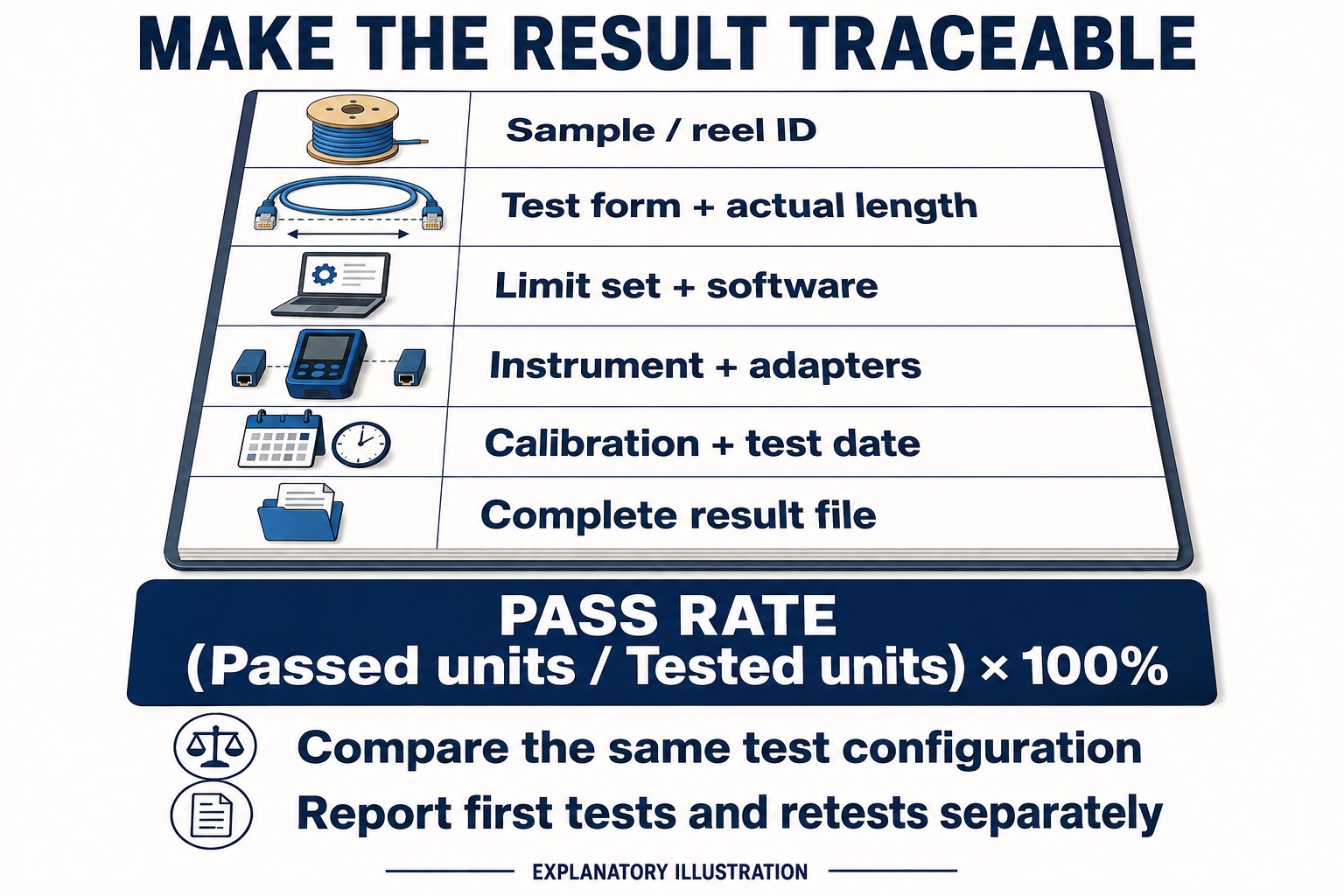
AI-generated explanatory illustration, not a real test report. Pass rate equals passed units divided by tested units, multiplied by 100%. Agree the unit, use the same test configuration within each result group, and report first tests and retests separately; no acceptance percentage is implied. View full-size illustration.
The factory should also protect change control. A different conductor, insulation grade, pair lay plan, separator, jacket compound, supplier, tooling or process window may affect the evidence basis. The responsible technical owner should decide whether the change needs a comparison trial, partial requalification, full third-party review or only a documented routine check.
The resulting release package should let the buyer trace an accepted sample back to the cable drawing, material lots, production window and test setup. Keep that evidence tied to the approved construction so a later product or process change receives an explicit technical review.
-
Thông báo của TIA về ANSI/TIA-568.2-E, released in November 2024. ↩
-
Tổng quan về phát triển tiêu chuẩn TIA, describing TIA engineering committees and the ANSI-accredited process. ↩
-
Danh mục sản phẩm cáp được Intertek ETL xác nhận, được tổ chức theo công ty niêm yết và sản phẩm.↩
-
Ví dụ về Chứng nhận Tuân thủ đã được Intertek ETL xác nhận, used only to illustrate the scope wording of one independent verification document. ↩
-
IEC 61156-5:2020 official catalogue page, dành cho cáp đi dây trên sàn ngang dạng đôi/bộ bốn đối xứng.↩
-
ISO/IEC 11801-1:2017 official catalogue page, bao gồm vòng đời của bản sửa đổi và bản đính chính đã được công bố.↩
-
TIA announcement for ANSI/TIA-1152-A, mô tả các yêu cầu đối với thiết bị kiểm tra hiện trường và phép đo dùng cặp xoắn cân bằng.↩
-
Giải thích của Fluke Networks về kiểm tra kênh, liên kết cố định và cáp nối, được sử dụng cho thuật ngữ cấu hình thử nghiệm; xác nhận phiên bản hợp đồng hiện tại và thư viện giới hạn thiết bị để nghiệm thu.↩
-
Fluke Networks: Kiểm tra một đầu với máy phân tích cáp DSX, giải thích các giới hạn của việc kiểm tra cuộn dây và sự khác biệt của nó so với thử nghiệm linh kiện chính thức.↩

 English
  हिन्दी
  فارسی
فارسی