











A network-cable factory can make a reel that passes one handheld test and still lack the evidence needed to release Cat6 product consistently. Factory owners, production managers and technical buyers therefore need to decide what is being accepted: a cable design, a production lot, a third-party product listing, or an installed link.
Cat6 compliance is proved by a connected evidence chain, not by a generic “TIA certificate.” Start with the current contract standard and exact cable construction, control the geometry that creates transmission performance, test the finished cable with suitable laboratory methods, and keep lot-level records. Treat installed-link testing and independent product verification as separate evidence layers.
Perbedaan ini penting sebelum mesin dipesan. Sebuah lengkap Rute produksi kabel LAN must connect conductor preparation, insulation, pair twisting, cabling, optional shielding, sheathing, testing and packing. The test plan must be designed with that route because end-of-line testing can identify a result; it cannot repair uncontrolled conductor, insulation or pair geometry.
Ganti “Sertifikasi TIA” dengan Objek Penerimaan yang Dinamai
ANSI/TIA-568.2-E is a balanced twisted-pair cabling and components standard, not a universal certificate issued to every Cat6 cable factory. A buyer should name the standard edition, product construction, verification body if any, sample scope and evidence required instead of asking only for “TIA certification.”
TIA announced ANSI/TIA-568.2-E in November 2024 as the revision of ANSI/TIA-568.2-D.1 TIA also explains that its engineering committees develop standards through an ANSI-accredited process.2 Fakta-fakta tersebut menetapkan peran standar. Fakta-fakta tersebut tidak menetapkan bahwa TIA telah melakukan inspeksi pabrik, menguji gulungan, atau mensertifikasi produk Cat6.
Frasa “persetujuan Cat6” dapat menyembunyikan empat permintaan berbeda:

AI-generated explanatory illustration. Match each acceptance object to its own evidence; this is not a certificate, test result or installation drawing. View full-size illustration.
| Acceptance object | Main question | Appropriate evidence | What it does not prove alone |
|---|---|---|---|
| Cable design | Does the defined cable construction meet the signed electrical and physical requirements? | Controlled specification, qualified samples, laboratory results and change control | That every later production lot remains within control |
| Production lot or reel | Was this identified output released against the factory plan? | Traceable raw-material, process, dimensional and finished-cable records | Independent product verification or installed-link performance |
| Independent product verification | Did a named third party assess the identified product against a named specification? | Current directory entry or certificate with product, standard edition, scope and surveillance status | A different model, construction, jacket rating or unlisted factory |
| Tautan permanen atau saluran yang terpasang | Does the completed cabling system pass the project’s field limits? | Calibrated field-test report with link type, adapters, instrument and results | Factory cable qualification without the rest of the installed system |
Intertek’s ETL Verified cabling directory illustrates the third-party layer: entries are organized by company and specific product, while a certificate identifies the tested construction and referenced standard.3 One published certificate also states that verification of transmission requirements is distinct from a certification program.4 This is why a buyer should verify the exact wording, product identity, current status and surveillance arrangement rather than treating any logo as a broad Cat6 claim.
Decision criterion: Write the acceptance object as a noun before choosing the test: “bulk horizontal cable,” “patch cord,” “production reel,” “permanent link” or “channel.” If the noun changes, the fixture, limits, sample preparation and responsible party may also change.
Freeze the Cable Construction Before Selecting Tests
A Cat6 test plan begins with the saleable cable definition. Category alone is incomplete because conductor, pair, separator, shielding, jacket, installation use and delivery form change what must be manufactured and what evidence the customer may request.
The buyer should approve at least these inputs before the supplier fixes the equipment route or FAT scope:
- solid or stranded conductor and the approved conductor material;
- conductor size and finished conductor tolerance;
- insulation material, nominal dimensions and color identification;
- U/UTP, F/UTP or another defined screening construction;
- pair lay plan and any separator construction;
- cabling lay, binder or shield elements where applicable;
- jacket material, marking, color and market-specific fire or environmental requirement;
- bulk cable, patch cord, permanent-link or channel acceptance boundary;
- edisi standar target, spesifikasi pelanggan, dan program pihak ketiga jika diperlukan;
- reel or box length, sample length, conditioning and release sampling plan.
IEC 61156-5:2020 is a separate official reference for symmetrical pair/quad cables used primarily in horizontal floor wiring. Its public scope covers individually screened, common-screened and unscreened pairs or quads; the purchased standard is needed to establish the applicable detailed requirements.5 ISO/IEC 11801-1:2017, with its later amendment, addresses generic customer-premises cabling across multi-vendor systems.6 These standards are related to the product and system decision, but they are not interchangeable labels. The signed order must say which document and edition governs each acceptance object.
Common mistakes: A quotation says only “Cat6 UTP, Fluke test pass.” It does not identify bulk cable versus installed link, conductor construction, sample preparation, test method, standard edition, parameter set, limit set, instrument class or raw-data format.
Membangun Kinerja Hulu dari Analyzer Akhir
Cat6 electrical performance is created through repeatable conductor, insulation, twisting and cabling geometry. Final transmission testing verifies the result, while upstream process records explain why the result is stable or why it failed.
Untuk rute Cat6 UTP, rencana pengendalian yang paling berguna mengikuti proses fisik:
| Production stage | Bukti proses untuk disimpan | Mengapa catatan tersebut termasuk dalam rantai bukti |
|---|---|---|
| Persiapan konduktor | Nomor lot pemasok, identitas material, dimensi konduktor, dan data resistansi yang berlaku | Menetapkan masukan listrik dan dimensi untuk isolasi |
| Isolasi kawat inti | Lot isolasi, tren diameter, bukti eksentrisitas atau konsentrisitas, kondisi permukaan, catatan uji percikan, dan identitas gulungan | Melacak geometri dan integritas setiap konduktor berinsulasi |
| Pemutaran pasangan | Identitas pasangan, pengaturan lay, pengaturan tegangan/puntiran balik jika berlaku, pemetaan gulungan, dan kondisi visual | Menghubungkan keseimbangan pasangan dan pengulangan dengan hasil kabel jadi |
| Kabel dan pemisah | Urutan pasangan, arah pilinan kabel, identitas separator, pengaturan tegangan, dan pengamatan deformasi | Mencatat geometri yang terbentuk ketika empat pasang menjadi satu inti kabel |
| Bahan pelapis | Lot jaket, dimensi inti sebelum jaket, tren diameter jadi, catatan cetak/panjang, dan paket penggulung | Menunjukkan apakah proses akhir mengubah inti atau identitas produk |
| Uji laboratorium kabel jadi | ID Sampel, panjang, kondisi, fixture, status kalibrasi, set standar/batas, plot mentah, dan hasil | Memberikan bukti pelepasan untuk sampel dan lot yang diidentifikasi |
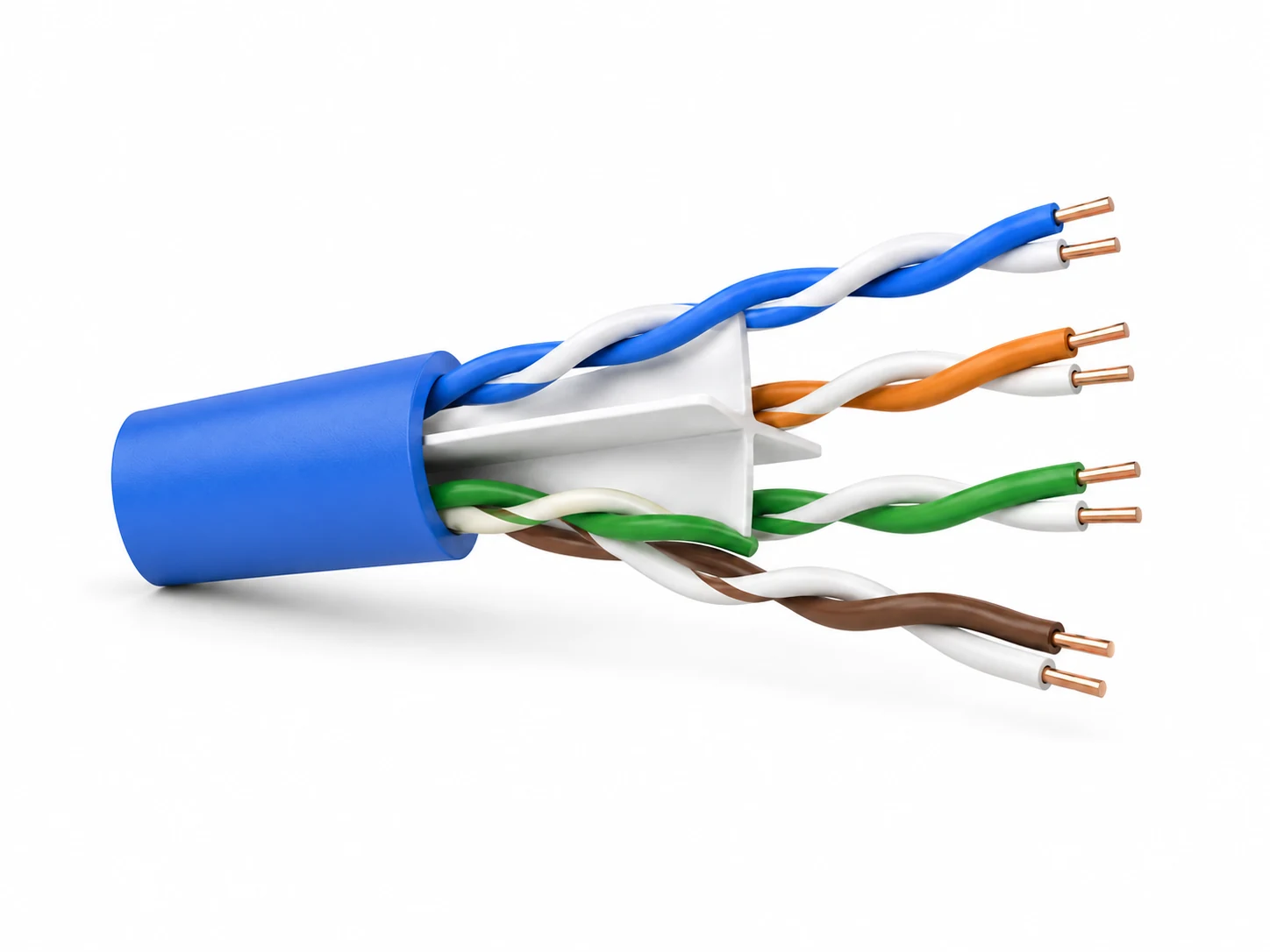
The HONGKAI LAN cable production guide maps Cat6 UTP production through insulation, precision pair twisting, separator handling where the approved construction requires it, cabling, sheathing, electrical testing and packing. That route is a project reference, not a declaration that every Cat6 design uses the same separator, machine model or acceptance limit.
How to verify: Ask the line supplier to map each critical finished-cable result back to a controllable production variable and a retained record. “The analyzer will tell us” is incomplete unless the factory can identify which process data will be checked after a failure.
Pisahkan Pengujian Laboratorium Pabrik dari Pengujian Lapangan
Factory cable release and installed-cabling field testing answer different questions. A field tester is valuable for permanent-link or channel acceptance, but it should not automatically replace the laboratory method and fixtures needed to qualify bulk cable or components.
TIA’s ANSI/TIA-1152-A announcement defines requirements for field test instruments used with balanced twisted-pair cabling, including reporting and accuracy performance.7 That scope is useful when the acceptance object is an installed cabling configuration. A factory product program may require different laboratory instrumentation, fixtures and sample preparation to assess the cable or component itself under the governing product standard.
Gunakan tangga bukti alih-alih satu pos pengujian generik:
| Evidence layer | Typical decision | Kategori instrumen atau catatan | Buyer check |
|---|---|---|---|
| Kontrol proses | Apakah proses manufaktur mempertahankan geometri yang telah disetujui? | Pengukuran diameter/konsentrisitas, pengujian percikan listrik, catatan pitch/tegangan, dan inspeksi dimensi | Dapatkah setiap pembacaan dikaitkan dengan inti, pasangan, gulungan, dan jendela waktu? |
| Rilis listrik pabrik | Apakah sampel kabel yang diidentifikasi memenuhi persyaratan kabel yang telah ditandatangani? | Sistem pengukuran resistansi dan transmisi yang sesuai dengan perlengkapan dan perangkat lunak yang telah disetujui | Apakah metode, kalibrasi, panjang sampel, kondisi, dan plot mentah telah dicatat? |
| Independent verification | Apakah produk yang diidentifikasi telah dinilai oleh lembaga yang disebutkan? | Laporan pihak ketiga, entri direktori, dan bukti pengawasan | Apakah perusahaan, pabrik, model, konstruksi, dan edisi standar sesuai? |
| Installation acceptance | Apakah tautan atau saluran yang telah selesai memenuhi batas proyek? | Penguji lapangan dan adaptor tautan/saluran yang benar | Apakah set batas yang dipilih sudah sesuai untuk konfigurasi yang terpasang? |
For machinery procurement, the HONGKAI LAN production guide identifies electrical testing as a supporting system whose scope requires written project confirmation. The buyer should separately name responsibility for the analyzer, fixtures, software, calibration service and third-party verification; those items should not be implied by the extruder, twister or cabling machine.
Note: A field PASS file is evidence for the tested configuration at the recorded time. It is not by itself evidence that every reel from the factory, every product variation or every future production lot meets the same requirements.
Fluke Testing: Is the Requirement for a 305 m Reel or a 100 m Connection?
Before accepting a requirement to “pass Fluke,” define the product being tested, its actual test length, the connection arrangement and the selected limit. A 305 m box or reel and a connection of approximately 100 m represent different customer requirements; a PASS result is useful only when the test setup matches the agreed acceptance object.
HONGKAI insight: In the customer requirements described for this guide, Fluke testing is a preferred practical acceptance reference. Some customers ask about a complete 305 m box or reel; others describe a finished connection of around 100 m. Confirm which form the customer means before discussing performance or a pass rate. These are examples of project requirements, not a universal length rule or a promised test outcome.
Use precise terms when converting the customer’s wording into the test plan. Fluke describes a conventional channel as the complete connection including patch and equipment cords, with an overall length limit of 100 m. A permanent link is the fixed portion, with a 90 m limit in that model. Testing a patch cord itself uses the relevant patch-cord limits and adapters, which assess its end connections differently from channel testing.8 Oleh karena itu, panjang saja tidak menentukan mode uji yang benar.
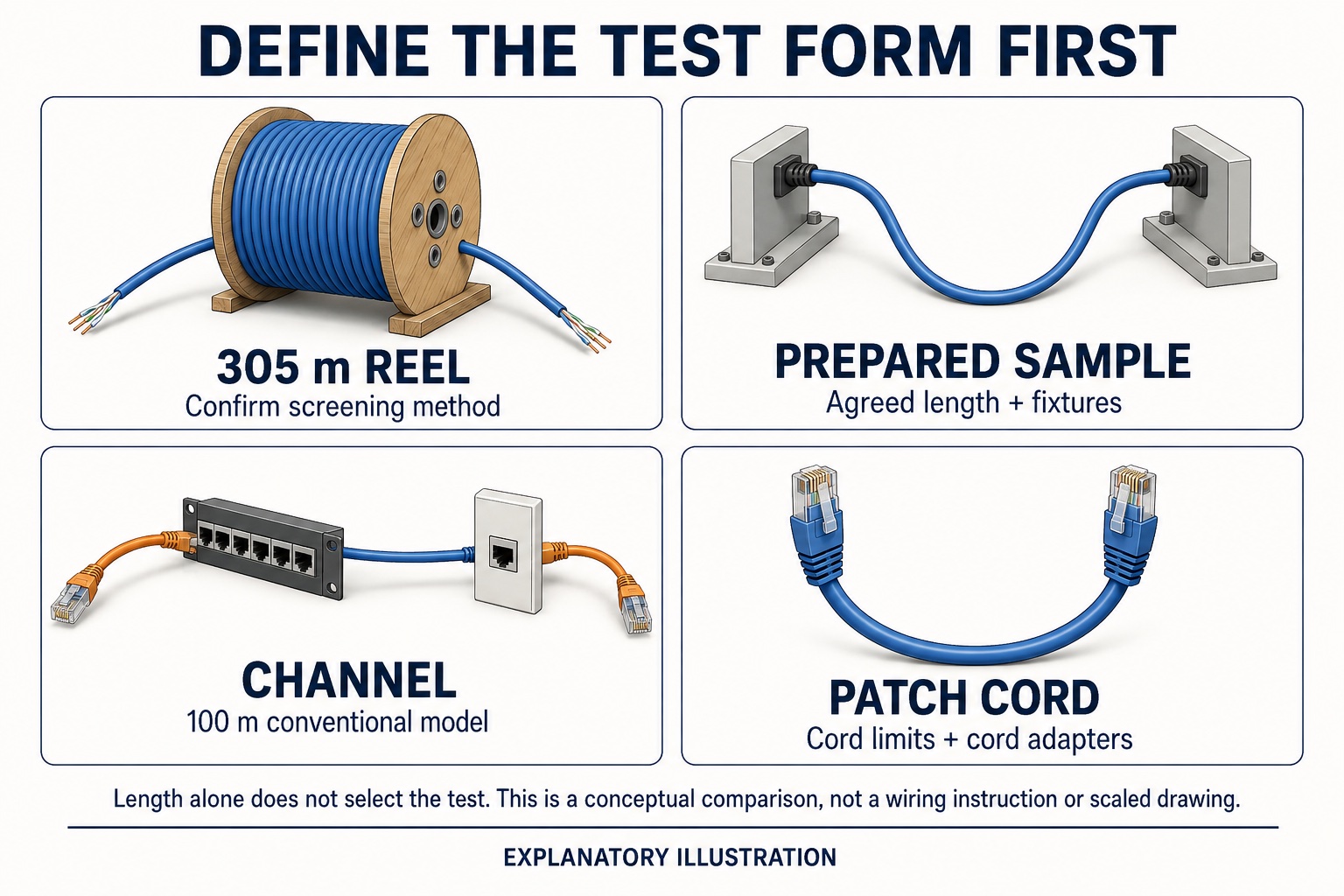
AI-generated conceptual comparison, not a wiring diagram. The 100 m figure refers to the conventional channel model, including its cords. Reel screening, prepared-sample testing and patch-cord testing require their own agreed methods and limits. View full-size illustration.
| Customer wording | Apa yang harus diklarifikasi oleh pembeli | Catat sebelum menerima hasilnya |
|---|---|---|
| “Test the 305 m box or reel” | Apakah persyaratannya adalah memeriksa kabel dalam keadaan tergulung, atau menguji sampel yang telah disiapkan terhadap persyaratan komponen? Apakah kedua ujungnya dapat diakses? | Panjang paket dan teruji, kondisi digulung/tidak digulung, pengaturan ujung tunggal/ujung ganda, parameter yang diukur, dan batas yang disepakati |
| “Test the approximately 100 m finished connection” | Apakah ini sebuah saluran, sampel kabel yang telah disiapkan, atau susunan ujung-ke-ujung lain yang telah ditentukan? | Gambar sambungan, panjang aktual, steker/jack, adaptor, dan nama batas yang tepat |
| “Uji kabel patch” | Apakah pelanggan mengacu pada kabel sebagai komponen, termasuk stekernya, atau saluran lengkap yang berisi kabel tersebut? | Konstruksi dan panjang kabel, konfigurasi pengujian kabel yang berlaku, serta kriteria penerimaan |
Fluke’s single-ended DSX application note explains that reel screening measures a limited parameter set and cannot replace all double-ended measurements. It also notes that coiling can affect results and distinguishes typical 305 m reels from formal component testing based on a prepared 100 m sample with specified terminations.9 Confirm the supported method with the instrument supplier; do not select a channel limit merely to obtain a PASS for a reel.
Evidence to request: Save the Fluke model, software version, adapter identification, calibration status, test-limit name, cable/sample ID, actual length and complete result file. If the customer requests a pass rate, agree whether the denominator is boxes, reels, prepared samples or finished connections, and how first tests and retests are reported. Keep differently configured tests in separate result groups; no acceptance percentage is assumed here.
Mendiagnosis Hasil yang Gagal melalui Rantai Proses
A failed Cat6 result should trigger a controlled check sequence: first verify the sample and measurement setup, then inspect the production records connected to the failure pattern, and only then adjust the process. Changing several settings at once destroys the evidence needed to confirm the cause.
Use the table as a proposed investigation record, not a confirmed diagnosis or a list of the most common causes. Each process connection must be checked against the actual cable design, raw measurements and the factory’s validated process plan; the table does not replace the governing test method.
| Famili hasil yang diamati | Verifikasi sebelum mengubah produksi | Area proses yang akan diperiksa selanjutnya | Recovery evidence |
|---|---|---|---|
| Hasil redaman atau rugi sisipan yang tidak terduga | Sample length, conductor temperature, connectors/fixture, calibration and length normalization | Catatan dimensi/material konduktor, sambungan, kondisi isolasi, dan panjang akhir | Repeat result from the same sample plus a separately identified confirmation sample |
| Ketidakteraturan yang terkait dengan return-loss atau impedansi | Fixture, termination, sample handling and raw trace consistency | Diameter inti/konsentrisitas, stabilitas lay pasangan, tegangan pengabelan, posisi separator, dan deformasi yang disebabkan oleh jaket | Stable raw trace and dimensional/process records within the approved window |
| Kegagalan terkait crosstalk | Pair identification, adapter mapping, fixture isolation and limit set | Koordinasi lay pasangan, keseimbangan pasangan, cross-over/urutan, geometri separator, dan deformasi pasangan selama proses pengabelan atau pelapisan jaket | Repeatable result across the approved sample plan with traceable pair/process data |
| Masalah resistansi atau ketidakseimbangan resistansi | Contact resistance, sample preparation, instrument zeroing and temperature correction method | Masukan konduktor, tren diameter, sambungan, dan identitas pasangan/inti | Corrected measurement plus conductor and sample traceability |
| Kekhawatiran keterlambatan atau waktu antar pasangan | Panjang sampel, pemetaan pasangan, dan pengaturan perangkat lunak | Rencana lay pasangan, catatan lay aktual, dan hubungan panjang pasangan | Confirmed pair identity and repeatable measurement under the signed method |
Red flags: The only retained record is a screenshot that says PASS. It omits the raw plot, test limit, standard edition, sample ID, instrument serial number, calibration state, adapter/fixture, operator and time.
Ubah Kepatuhan menjadi Paket RFQ dan Bukti FAT
The machinery RFQ should define who supplies each production and testing function, while FAT should prove the agreed sample can be produced under recorded conditions. Product verification and continuing factory surveillance remain separate commercial and conformity-assessment scopes.
Buat paket RFQ berdasarkan masukan-masukan berikut.
- gambar kabel yang disetujui dan jadwal konstruksi;
- edisi standar yang berlaku dan batas spesifik pelanggan;
- setiap varian produk yang dapat dijual yang termasuk dalam ruang lingkup penerimaan pertama;
- the planned raw material and conductor supply condition;
- the process route and machine responsibility map;
- pengukur dalam-lini yang diperlukan, pengujian percikan listrik, dan retensi data;
- the factory laboratory parameter set, fixture and software responsibility;
- panjang sampel, kondisioning, terminasi, dan aturan uji ulang;
- for Fluke-based acceptance, the box/reel, cable-sample, patch-cord or channel boundary, exact limit and pass-rate calculation;
- Material FAT, rencana pengambilan sampel, definisi stable-run, dan tanggung jawab saksi;
- independent verification target, application owner and surveillance boundary;
- batas uji lapangan jika penerimaan instalasi juga merupakan bagian dari proyek;
- format laporan, ekspor data mentah, dan bidang ketertelusuran.
Evidence to request: For the first accepted Cat6 run, retain the material lots, machine setup, stable production window, reel map, dimensional data, sample extraction point, laboratory setup, raw results, disposition and any approved deviation in one release package.
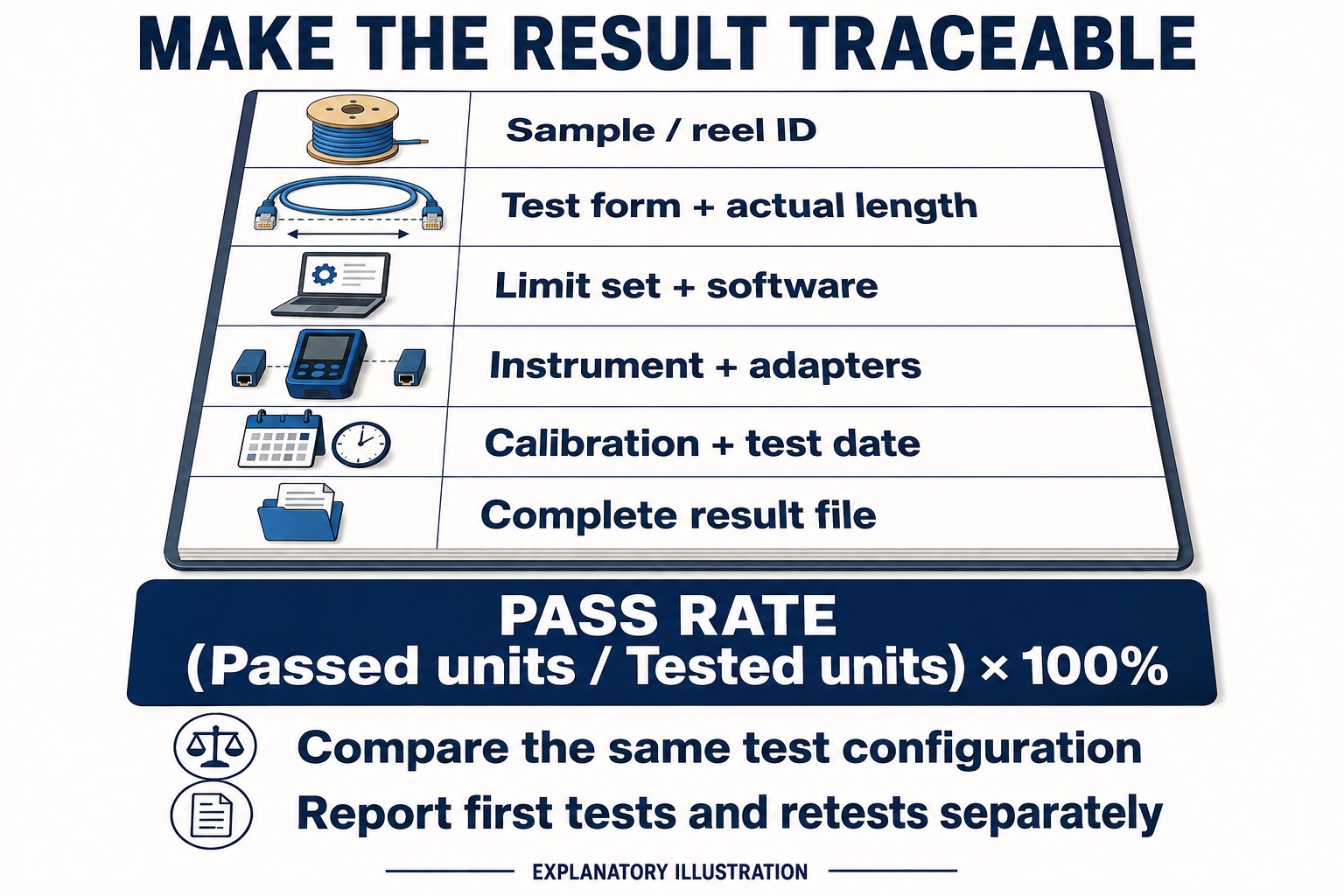
AI-generated explanatory illustration, not a real test report. Pass rate equals passed units divided by tested units, multiplied by 100%. Agree the unit, use the same test configuration within each result group, and report first tests and retests separately; no acceptance percentage is implied. View full-size illustration.
The factory should also protect change control. A different conductor, insulation grade, pair lay plan, separator, jacket compound, supplier, tooling or process window may affect the evidence basis. The responsible technical owner should decide whether the change needs a comparison trial, partial requalification, full third-party review or only a documented routine check.
The resulting release package should let the buyer trace an accepted sample back to the cable drawing, material lots, production window and test setup. Keep that evidence tied to the approved construction so a later product or process change receives an explicit technical review.
-
TIA announcement for ANSI/TIA-568.2-E, released in November 2024. ↩
-
Ikhtisar pengembangan standar TIA, describing TIA engineering committees and the ANSI-accredited process. ↩
-
Direktori produk kabel bersertifikasi Intertek ETL Verified, diorganisir berdasarkan perusahaan terdaftar dan produk.↩
-
Contoh Sertifikat Kesesuaian yang Diverifikasi Intertek ETL, used only to illustrate the scope wording of one independent verification document. ↩
-
IEC 61156-5:2020 official catalogue page, untuk kabel pemasangan lantai horizontal pasangan/kuad simetris.↩
-
Halaman katalog resmi ISO/IEC 11801-1:2017, termasuk siklus hidup amandemen dan korigendum yang diterbitkan.↩
-
Pengumuman TIA untuk ANSI/TIA-1152-A, yang menjelaskan persyaratan untuk instrumen dan pengukuran uji lapangan pasangan-terpilin seimbang.↩
-
Penjelasan Fluke Networks mengenai pengujian saluran, tautan permanen, dan kabel patch, digunakan untuk terminologi konfigurasi pengujian; konfirmasi edisi kontrak saat ini dan pustaka batas instrumen untuk penerimaan.↩
-
Fluke Networks: Pengujian Single-Ended dengan Penganalisis Kabel DSX, menjelaskan batasan pemeriksaan reel dan perbedaannya dari pengujian komponen formal.↩

 English
  हिन्दी
  فارسی
فارسی