Separate lines with reel transfers. Double-jacket ADSS also needs an inner-sheath pass between stages 02 and 03. Add upstream fiber coloring if required.
Mulailah dengan kabel yang dibutuhkan pelanggan Anda. Jelajahi suatu arah untuk melihat bagaimana hal tersebut mengubah rute produksi dan rencana pabrik Anda.
Rute proses khasProcess steps, not a list of standalone machines
01Pemberian serat
02Anggota kekuatan
03Jacket extrusion
04Pendinginan & penandaan
05Pengambilan & pengujian
Rute kabel drop dapat dimulai dari serat optik yang telah dibeli dan elemen penguat yang telah disiapkan. Pewarnaan dan persiapan kawat penyangga hanya ditambahkan jika diperlukan oleh proyek.
04
Project requirement snapshot
Tentukan pabrik tersebut. Then select the equipment.
Beberapa input proyek menghubungkan kabel target Anda ke pabrik yang dibutuhkannya. Mulailah dari apa yang Anda ketahui. Setiap kolom bersifat opsional.
05
Arsitektur proses pabrik lengkap
Lihat bisnis Anda take shape.
Dari bahan baku hingga kabel jadi: hubungkan lini produksi lengkap, gulungan antara, pemeriksaan laboratorium, dan pengiriman dengan sistem yang mendukungnya.
Eksplorasi seluruh pabrikKabel FTTH / drop
ILLUSTRATIVE MASTERPLANPilih sistem atau mainkan tur
Alur material & produkSupporting infrastructure
SYSTEM 01 / 08
Apa saja yang masuk ke dalam kabel saya?
Material yang tepat, siap untuk produksi pertama.
Coordinate the material bill with the cable drawing and the equipment, from optical fiber to the finished reel.
Fiber, polymers, yarns and strength members
Supplier matching, TDS and sample review
Storage, trial-run quantities and packaging
WHAT WE PLAN TOGETHERInitial material BOM & sourcing plan
Diskusi pabrik AndaExplore the complete scope, then add the topics you want to discuss.
Jalur produksi yang tepat. One workable factory flow.
Pabrik kabel menghubungkan lini proses lengkap, bukan hanya mesin-mesin individual. Pilih kabel untuk melihat kombinasi lini dan produk antara yang ditransfer di antara mereka.
LINE 01
Jalur kabel drop FTTH
INPUTSerat optik + elemen penguat yang telah disiapkanOUTPUTKabel drop jadi pada gulungan
Feed the fiber and strength members into one coordinated extrusion, cooling, marking and take-up line. Pemberian messenger ditambahkan untuk desain yang dapat menopang sendiri.
What belongs in each production stage?
Status perencanaan untuk kabel yang dipilih, bukan daftar pasokan akhir.
Production stageEquipment & interfacesPlanning status
Persiapan serat
Pewarnaan, penggulungan ulang, dan pay-off yang kompatibel
Use purchased optical fiber and prepared strength members. Add fiber coloring / rewinding or wire coating only if those inputs will be made in-house.
Conditional
Pembentukan tabung/penyangga
Tidak ada lapisan sekunder dalam contoh ini
Sesuaikan produk antara dengan desain kabel yang telah disetujui.
Tidak dalam rute
Cable core & reinforcement
Pemberian elemen kekuatan paralel
Peralatan penguat diselaraskan dengan jalur induknya.
Design dependent
Sheathing & marking
Jalur kabel drop FTTH
Ekstrusi, pendinginan, penandaan, dan penggulungan beroperasi sebagai satu kesatuan lini.
Di rute ini
Testing & finishing
Instrumen pengujian, transfer gulungan, penggulungan ulang/penggulungan, dan pengepakan
Pilih peralatan uji dan penanganan gulungan jadi sesuai spesifikasi pelanggan.
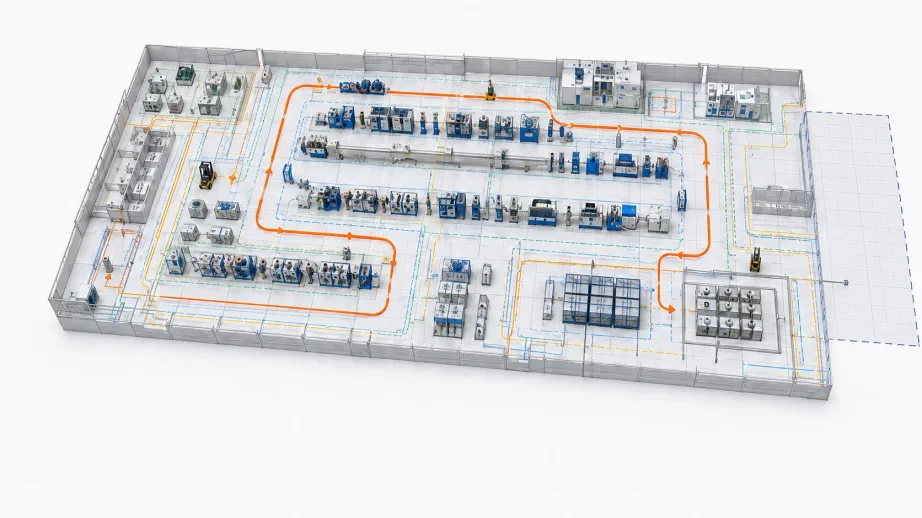
Penerimaan, produksi, pengujian, dan pengiriman perlu bekerja sebagai satu alur material. Dimensi peralatan hanyalah bagian dari rencana bangunan.
Factory layout conceptIlustratif. Tidak sesuai skala.
Building inputDimensions and site drawing to confirmPlanning exampleKabel Jatuhkan FTTH
FLOW STEP 2 / 5
Rancang ruang di antara garis-garis lengkap.
Produksi tidak berjalan melalui satu mesin kontinu. Sertakan penyimpanan reel proses, inspeksi, dan transfer aman ke lini berikutnya.
Line length and operator access
Buffer reel/drum antara
Maintenance access around every line
Planning outputEquipment positions and WIP handling plan
Final planning uses your building drawing, reel sizes, line configuration and local requirements. Forklift routes, operator aisles, cabinets, water routes and cable trays must be reviewed together.
08
Utilities & infrastructure
Persiapkan layanan-layanan tersebut yang memungkinkan produksi.
Hitung kebutuhan utilitas setelah lingkup peralatan dikonfirmasi. Satu angka tetap untuk daya atau air tidak dapat menggambarkan setiap pabrik.
Electrical power
Beban terpasang, tegangan/frekuensi lokal, distribusi, dan koneksi mesin.
Cooling water
Sirkuit pendingin ekstrusi, kontrol suhu, dan titik koneksi.
Compressed air
Tekanan yang dibutuhkan, kualitas udara, dan titik koneksi untuk peralatan yang berlaku.
Ventilation
Ventilasi ekstrusi dan bengkel disesuaikan dengan peralatan dan kondisi setempat.
Material storage
Penyimpanan dan persiapan material untuk serat, polimer, benang, dan elemen penguat.
Process environment
Kontrol suhu, kelembapan, debu, dan akses aman di tempat yang memerlukannya dalam proses.
09
Laboratory & quality control
Bangun kontrol kualitas into the factory plan.
Dari bahan baku hingga gulungan jadi, rencanakan instrumen, metode pengujian, dan catatan yang dibutuhkan pelanggan Anda.
01
Incoming materials
Identitas, catatan pemasok, dan pemeriksaan masuk yang disepakati.
02
Kontrol proses
Process settings, dimensions and reel traceability.
03
Finished cable
Pengujian spesifik produk dan kriteria pelepasan yang terekam.
LABORATORY EQUIPMENT PLANNING
Existing HONGKAI 3D equipment reference · configuration to confirm
Mechanical
Pengujian tarik kabel
Evaluate the cable under the agreed pulling load and monitoring conditions.
Lingkup peralatan
Peralatan tarik, remas, bentur, tekuk, atau puntir dipilih sesuai dengan spesifikasi kabel.
Konfirmasi sebelum memilih
Rentang beban, perlengkapan, panjang sampel, pemantauan optik, dan batas penerimaan.
Required evidence
Recorded loading conditions and the specified cable / optical results.
10
Dukungan bahan baku & BOM awal
The cable you want to make. The materials to start it.
Plan your first production run alongside the equipment. Explore the material layers, then connect the cable drawing to an initial bill of materials (BOM) and sourcing plan.
Kabel Jatuhkan FTTHEXISTING 3D REFERENCE
01
Approximate layer locator. Final materials follow the approved cable drawing.
BAHAN 01 / 03
Serat optik
Elemen transmisi optik di pusat kabel Anda.
Where it enters production
Fiber preparation and the first production line
Konfirmasi untuk BOM awal
Fiber specification, colour, reel format and supplier records
Jelajahi lapisan materialSelect a category to see its role.
Also plan reels, packaging, process consumables and incoming inspection with the first material order.
From a cable drawing to the first material order.
HONGKAI dapat mengoordinasikan perencanaan dan pengadaan material bersama peralatan pabrik Anda. Proposal ini menjelaskan apa yang disediakan, oleh siapa, serta apa yang perlu dipersiapkan oleh tim Anda.
Connect each material category to the cable drawing and production stage. Confirm grades, dimensions and reel or package formats before ordering.
BOM awal dan rencana material percobaan
Separate trial-production needs from planned production stock. Quantities follow the agreed cable dimensions, output plan and startup allowance.
Sourcing and incoming-check coordination
Review supplier data sheets, samples and batch records. Identify the material manufacturer, supply responsibility and agreed incoming checks in the project scope.
1
Cable drawingConfirm the construction
2
Initial BOMIdentifikasi grade dan kuantitas
3
Supplier reviewCheck TDS & samples
4
Trial productionValidasi masukan yang telah disepakati
11
Phased factory configuration
Start with the essentials. Rencanakan langkah berikutnya.
Choose the planning horizon for your brief.
12
Manufacturing & responsibility
Satu tim proyek. Tanggung jawab yang didefinisikan dengan jelas.
A few useful answers for your first factory discussion.
Can I start if I do not know the machine names?
Yes. Start with your intended customers, installation environment and the cable you want to sell. A sample, drawing or application description gives HONGKAI a basis for discussing the product, process and factory scope.
Lini produksi apa saja yang dibutuhkan pabrik baru?
The cable portfolio determines the line combination. FTTH drop cable, GJFJV, central-tube GYXTPY and stranded ADSS use different routes. Review purchased intermediate products, preparation, reel transfers and testing before fixing the equipment list.
Can materials and specialist equipment be included?
Material sourcing, auxiliary systems and specialist laboratory equipment can be coordinated within the agreed scope. Their manufacturers, technical requirements and responsibilities are identified in the proposal.
How much investment and factory space do I need?
A useful estimate requires the target cable portfolio, output, automation level, available building and local utility conditions. The project can then be evaluated by production phase. This page does not apply a fixed price or area to every factory.
Dapatkah kita membangun proyek ini secara bertahap?
Yes, phased planning can begin with the core product range and consider additional parallel lines or new cable families later. Space, material flow and utility interfaces should be reviewed before the first phase is finalized.
What should we prepare for the first discussion?
Share your target market and cable products, country, capacity goal, available factory information and expected timing. Mark unknown items as “to confirm”; the first conversation can help identify the missing technical inputs.
Utilitas apa saja yang harus disiapkan?
Power, cooling water, compressed air where required, ventilation and process conditions are evaluated after equipment selection. Share the existing voltage, frequency and building conditions so equipment-side and site-side responsibilities can be defined.
Do we need to build a new laboratory?
Review your current instruments, target cable requirements and testing plan first. The scope may involve a new laboratory, additions to an existing one or identified external testing. Test methods, equipment and documentation are confirmed for the project.
Apa saja yang termasuk dalam FAT?
Factory Acceptance Test checks the contracted equipment against an agreed plan, including the test material, running conditions, acceptance criteria and documentation. Results and open items should be recorded before the contracted shipment-release decision.
Can we keep our existing production equipment?
Share the machine list, current process, controls, utility needs and condition. Reuse depends on technical compatibility and the planned output; integration is reviewed before it is included in the factory configuration.
How are installation and training arranged?
Site readiness, travel or remote support, installation responsibilities, commissioning, training and acceptance conditions are defined in the project agreement. Your local team prepares the building, utilities and operators assigned to the project.
18
Mulai proyek pabrik Anda
Bring your cable idea. Let’s plan the factory.
You do not need every technical answer today. Start with what you know and we can work through the missing details together.