


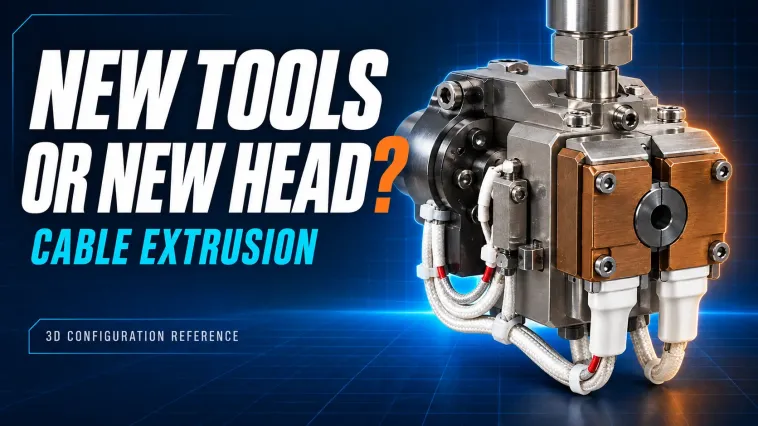
A cable production manager may need new tooling after changing a cable size, adding a layer or finding uneven insulation. Before ordering a new crosshead, separate the cable requirement from the condition of the installed tooling and the way the line is running.
A new cable size does not always require a new crosshead. Check the incoming core structure, the required outside shape and size, and the head’s confirmed range. Then check line alignment, wall thickness and heating: changing tools or adjusting the head cannot correct every cause of an uneven wall.
This guide concerns the information and evidence needed for insulation and jacket extrusion. It is not a universal die-sizing recipe, a centering procedure for a particular machine or a substitute for its operating manual.
적용 중인 층부터 시작하세요
Begin with a drawing of the product entering the crosshead and the product leaving it. A solid conductor, a stranded conductor and an assembled cable core should not be treated as interchangeable inputs simply because their nominal diameters are similar.
Record the incoming construction, its size range and the layer being applied. For a finished cable, identify whether the purchase concerns conductor insulation, an inner sheath or the outer jacket. Where several materials or layers are involved, identify them separately rather than requesting a generic “multilayer head.”
다음 내용을 포함하는 간략한 제품 기록을 작성하세요:
- 들어오는 도체 또는 코어 도면 및 대표 샘플.
- 화합물 제조업체, 정확한 등급 및 가공 지침.
- 완성된 외부 치수, 요구되는 벽 두께 및 적용 가능한 허용 한계.
- 스트라이프 또는 기타 별도의 재료 공급을 포함한 레이어의 수 및 순서.
- 케이블 사양에 포함된 경우, 피복 제거, 접착 또는 층 분리와 관련된 요구사항.
- 현재 압출기, 크로스헤드 사양, 라인 배치 및 제안된 운전 범위.
압출 방식과 층 배열을 각각 별도로 선택하세요.
Pressure tooling and tubing tooling describe different extrusion approaches. Single-layer and coextrusion describe the layer arrangement. These are separate decisions, not four competing names for the same choice. Tooling manufacturers offer different pressure/tubing, layer and centering configurations.1
Start with the product and required wall thickness when choosing the extrusion approach. In the HONGKAI applications discussed for this guide, the optical-fiber tube operation uses tubing tooling, while the sheath operation uses pressure tooling. These are application examples, not a rule that every optical cable tube or jacket uses the same method.
Next, specify whether the product needs one layer, two layers in separate operations, or two layers extruded together. If both layers must be applied in one pass, the proposed head and material feeds must support that coextrusion arrangement. Identify a color stripe separately; a stripe is not automatically another complete sheath layer.

HONGKAI 3D exterior reference for a dual-layer coextrusion crosshead with a color-stripe arrangement. This is not a dimensioned drawing or a universal design for other crossheads.
For an expansion project, separate the first approved product from future products. Ask the supplier to identify which changes remain within the proposed head and tooling range, and which require a different setup or an application trial. A possible future configuration should not be listed as proven production scope.
공구를 교체할 것인가, 아니면 크로스헤드 전체를 교체할 것인가?
Check the tip when the incoming core construction changes, and the die when the required outside shape or dimension changes. If the product is outside the installed head’s confirmed size range, a tooling change alone is not enough: the head must also change. Staying within that range is only the first compatibility check.

Explanatory decision map based on the application distinctions discussed for this guide. It is not a tooling drawing; fit, material and layer arrangement still require confirmation.
HONGKAI’s sizing discussions include U7, U10, U14 and U20 crossheads. In this family, the number indicates the supported maximum line-size range. Confirm the actual limit and which product dimension it refers to against the particular head’s drawing or specification. These names are not a universal sizing system across manufacturers.
For tooling, separate the incoming construction from the finished shape. A single-core and a two-core product can require different tips. The die must suit the target outer shape and size as well as the agreed material and extrusion method. Do not assume that each product change requires both tools to be replaced, or that a larger die can extend the head beyond its approved range.
| What changes? | 먼저 검토할 사항 | 무엇을 확인해야 합니까? |
|---|---|---|
| 싱글 코어에서 듀얼 코어와 같은 인입 코어 구조 | 팁 또는 가이드 형상 | 통로, 가이드 장치 및 다이와의 호환성 |
| 필요한 외형 또는 최종 치수 | 다이 형상 및 사용 가능 범위 | 선택한 재료와 압출 방식을 사용한 대상 형상 및 크기 |
| 필요한 제품 크기가 헤드의 확인된 한도를 초과함 | 적절한 범위를 갖춘 헤드 | 완전한 패키지로 제공되는 새로운 헤드, 공구 및 라인 인터페이스 |
| 층 배열, 스트라이프 또는 재료 변경 | 공구 개구부뿐만 아니라 압출 장치 구성 | 필요한 피드, 호환 가능한 헤드/공구 및 모든 적용 시험 |
For an existing machine, provide its head identification, photographs and tooling drawing. Confirm the mounting dimensions, locating surfaces, holders and adjustment arrangement. Different manufacturers’ tools are not interchangeable merely because the finished cable diameter is the same.
HONGKAI’s published 압출 예비 부품 페이지 lists die, tip and adjusting-ring components and asks for photos or drawings before confirming a replacement. That is a starting point for part identification, not evidence that an unknown tool will fit every crosshead.
A worn part can help identify the assembly, but its measured dimensions should not automatically become the dimensions of a new part. Ask the supplier to distinguish the original design from wear, damage or earlier modifications. Record drawing revisions and part numbers so a later order refers to the same approved package.
Have the supplier record the agreed scope: replacement tools, a modified tooling package or a different head. That written boundary is more useful than an unsupported claim that one head can make every future product.
헤드를 탓하기 전에 와이어 경로를 확인하세요
An uneven wall is a reason to investigate, not an automatic instruction to replace the crosshead. Preserve the sample and operating record before changing the setup. Record whether the issue appeared after a tool change, a material change, a restart or a change in line operation.
생산 전에 중심 맞춤 장치를 설정하세요.
Identify whether the particular head uses manual adjustment, assisted adjustment or a fixed/self-centering arrangement. Follow the setup method for that design before formal production. A head described as requiring no routine centering adjustment still needs correct installation, matched tooling and a check of the finished wall.
설치 상태와 인장력, 그리고 헤드를 점검하세요.
HONGKAI’s commissioning checks for the applications discussed here include equipment leveling, alignment between the crosshead’s cable path and the haul-off centerline, and abnormal haul-off vibration or jerking. Establish these conditions during installation rather than trying to compensate for them with the head’s centering adjustment later.
An uneven floor matters if the equipment has not been correctly supported and leveled. The floor does not have to serve as the alignment reference by itself. Ask the installer to verify the machine positions and cable path against the approved layout. A misaligned haul-off or unstable pull is a separate issue to correct; adjusting the head alone does not resolve it.
단순화된 정렬 개념이며, 설치 도면이나 완전한 생산 라인이 아닙니다. 장비 위치, 지지대 및 허용오차는 실제 배치를 따라야 합니다.
이 조사 질문들을 분리해 두세요:
- Part identity: 설치된 팁, 다이 및 홀더가 승인된 조합입니까?
- Assembly condition: 점검 결과 손상, 오염 또는 수정이 필요한 다른 상태가 발견됩니까?
- Line behavior: 코어가 의도된 경로를 따라 일관되게 이동하는가, 아니면 위치나 장력이 변하는가?
- Heating behavior: 헤드의 측정된 온도 및 제어 동작이 승인된 레시피와 일치하는가, 아니면 단지 설정값만 표시되는가?
- Extrusion behavior: 승인된 레시피 하에서 재료 준비 및 출력이 안정적인가요?
- Measurement: 보고된 결함은 외경 변화, 균일하지 않은 벽 두께, 타원도 또는 이들의 복합적인 문제입니까?
이 질문들은 증거를 정리하는 데 도움을 주며, 그 중 어느 하나도 단독으로 원인을 입증하지는 않는다. 이 재료 및 공정 결함 조사 가이드 기포, 거칠기 또는 불안정한 압출이 발생할 때뿐만 아니라 치수 문제에 대해서도 보다 광범위한 점검을 포함한다.
If several settings are changed together, record all of them. A better sample after multiple changes cannot show which change solved the problem. Where a controlled comparison is practical, agree on the change and its evaluation before running the trial.
Note: Intrusive inspection, cleaning and tool changes require qualified personnel following the machine’s isolation, pressure-release and temperature-control instructions. This article does not authorize adjusting, opening or reaching into running or pressurized equipment.
벽 두께를 측정하세요. 외경만 측정하지 마세요.
A stable outside diameter does not prove that the conductor or core is centered. Accept the layer using the wall-thickness and dimensional evidence required by the cable specification, not only the diameter display.
SIKORA explains that comparing diameters before and after extrusion can provide a thickness value, but that laser-diameter comparison alone does not measure eccentricity. A system intended to measure eccentricity needs the relevant additional measurement capability.2
동일한 외경을 가진 개념적 단면도입니다. 중심이 이탈된 코어는 벽두께 분포를 변경하며, 이는 측정된 시료나 허용 한계를 나타내지 않습니다.
구매 및 시험 기록에 검사 조건을 명확히 유지하십시오:
| 증거 | 무엇을 확립하는 데 도움이 되는지 | 자체적으로 확립하지 않는 것 |
|---|---|---|
| 외경 기록 | 측정된 외경 치수의 변동 | 층 내부의 도체 또는 코어 위치 |
| 준비된 단면 | 해당 특정 샘플의 국부 벽면 분포 | 전체 생산 길이의 품질 |
| 적합한 온라인 벽두께 또는 편심 측정 | 기록된 실행 중 측정된 파라미터의 동작 | Suitability for an unverified material, size or construction |
| Surface inspection | 검사 위치에서의 외관 | All hidden dimensional or electrical requirements |
Before the trial, agree on how samples will be prepared and measured. Identify the instrument, the recorded quantities and the acceptance limits. Where a percentage such as “concentricity” appears in a proposal, require its definition and calculation method; do not assume that different reports use identical terminology.
Link each result to the same material batch, tooling setup and sample position or production time. If an online gauge and an offline sample disagree, first confirm that they refer to the same product and measurement conditions. Do not choose whichever result happens to be more favorable.
The measuring system also needs an application check. Ask which materials, layer arrangements, product dimensions and operating conditions it can evaluate in the proposed setup. This guide does not require a particular instrument brand or claim that one sensing method covers every cable.
재현 가능한 설정을 받아들일 것, 단 하나의 우수한 샘플이 아닌
Agree on the trial before accepting the proposed crosshead or tooling change. Define the sample product, material grade, setup identity, operating conditions, measurement method and decision limits. The buyer and supplier should know what evidence will settle acceptance before the machine is demonstrated.
For the head itself, HONGKAI’s priorities in the applications discussed here are the actual product’s centering and normal heating behavior. Demonstrate both on the agreed product: inspect the wall distribution and retain the corresponding temperature records. These head-focused checks do not replace the other tests required for the finished cable.
설명용 기록 도표이며, 시험 보고서가 아님. 중앙 정렬 샘플과 온도 기록을 동일한 설정에 연결하고, 실제 허용 한계 및 기타 제품 시험은 별도로 합의함.
유용한 시험 기록은 다음 항목들을 관련 없는 사진으로 저장하는 대신 서로 연결합니다:
- 승인된 케이블 도면 및 사용된 컴파운드 배치.
- 헤드 식별, 공구 부품 번호 및 도면 개정판.
- The centering arrangement, verified line alignment and agreed operating conditions.
- 지정된 온도 설정값 및 해당 측정 온도 기록.
- 시간 또는 길이 기준이 있는 보관 샘플.
- The corresponding dimensional results and other applicable product checks.
- 중단이나 조정이 있는 경우, 그 이유와 이후 결과.
Where frequent product changes are important, include an agreed changeover in the demonstration. The question is not merely whether an experienced operator can produce one acceptable short sample. It is whether the factory can identify the approved tools, follow the documented setup and verify the result again under the agreed conditions.
Do not invent a universal test speed, duration or sample count. Those values must match the product, contract and factory’s acceptance method. Startup material and output made during an unapproved adjustment should remain identifiable under the factory’s quality procedure.
At handover, retain the accepted tool drawings or identifiers, setup instructions, maintenance guidance and sample records. List future materials and product sizes separately if they have not been demonstrated. A clear scope prevents the accepted setup for one cable from becoming an unsupported promise about every cable the factory may make later.
The strongest result is a matched tooling package with traceable samples and a repeatable setup. That gives production staff a basis for the next changeover and gives the buyer evidence for accepting the equipment.
-
길 툴 & 엔지니어링, 시리즈 및 구성 옵션. Used only to substantiate the existence of distinct pressure/tubing and fixed/adjustable configurations, not as a HONGKAI product specification, supplier endorsement or universal selection rule. ↩
-
SIKORA, Thickness measurement, particularly the laser-measurement discussion. Supports the distinction between diameter-derived thickness and eccentricity measurement; no vendor-specific accuracy or performance claim is adopted. ↩
