











A cable production manager may need new tooling after changing a cable size, adding a layer or finding uneven insulation. Before ordering a new crosshead, separate the cable requirement from the condition of the installed tooling and the way the line is running.
A new cable size does not always require a new crosshead. Check the incoming core structure, the required outside shape and size, and the head’s confirmed range. Then check line alignment, wall thickness and heating: changing tools or adjusting the head cannot correct every cause of an uneven wall.
This guide concerns the information and evidence needed for insulation and jacket extrusion. It is not a universal die-sizing recipe, a centering procedure for a particular machine or a substitute for its operating manual.
Comece com a camada sendo aplicada
Begin with a drawing of the product entering the crosshead and the product leaving it. A solid conductor, a stranded conductor and an assembled cable core should not be treated as interchangeable inputs simply because their nominal diameters are similar.
Record the incoming construction, its size range and the layer being applied. For a finished cable, identify whether the purchase concerns conductor insulation, an inner sheath or the outer jacket. Where several materials or layers are involved, identify them separately rather than requesting a generic “multilayer head.”
Prepare um breve registro do produto contendo:
- O desenho do condutor ou núcleo recebido e amostras representativas.
- O fabricante do composto, a classificação exata e as orientações de processamento.
- A dimensão externa final, a espessura de parede exigida e os limites de aceitação aplicáveis.
- O número e a ordem das camadas, incluindo qualquer listra ou outra alimentação separada de material.
- Requisitos relevantes para descascamento, aderência ou separação de camadas, se a especificação do cabo os incluir.
- A extrusora atual, a identidade do cabeçote cruzado, o layout da linha e a faixa operacional proposta.
Escolha o método de extrusão e a disposição das camadas separadamente
Pressure tooling and tubing tooling describe different extrusion approaches. Single-layer and coextrusion describe the layer arrangement. These are separate decisions, not four competing names for the same choice. Tooling manufacturers offer different pressure/tubing, layer and centering configurations.1
Start with the product and required wall thickness when choosing the extrusion approach. In the HONGKAI applications discussed for this guide, the optical-fiber tube operation uses tubing tooling, while the sheath operation uses pressure tooling. These are application examples, not a rule that every optical cable tube or jacket uses the same method.
Next, specify whether the product needs one layer, two layers in separate operations, or two layers extruded together. If both layers must be applied in one pass, the proposed head and material feeds must support that coextrusion arrangement. Identify a color stripe separately; a stripe is not automatically another complete sheath layer.
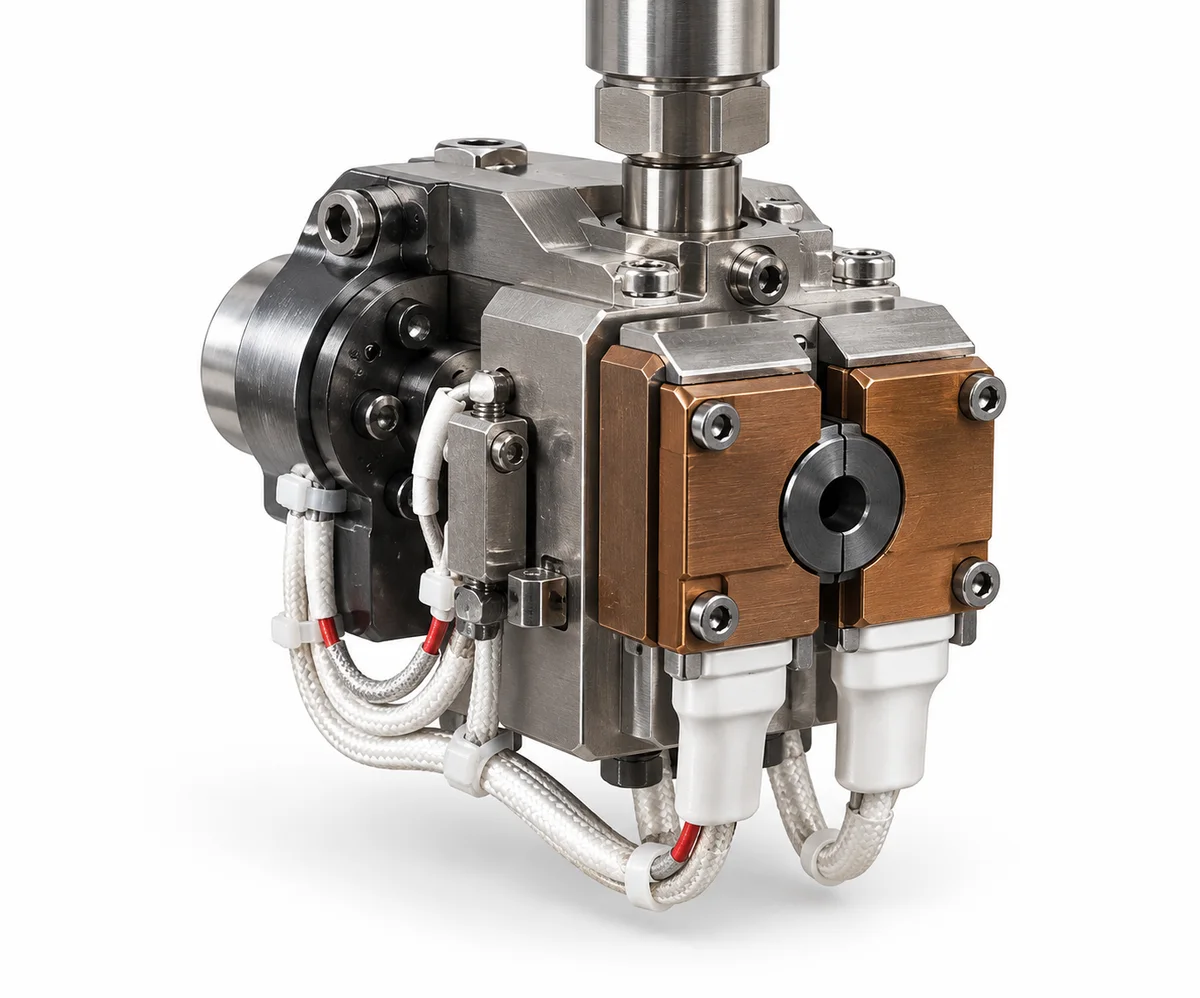
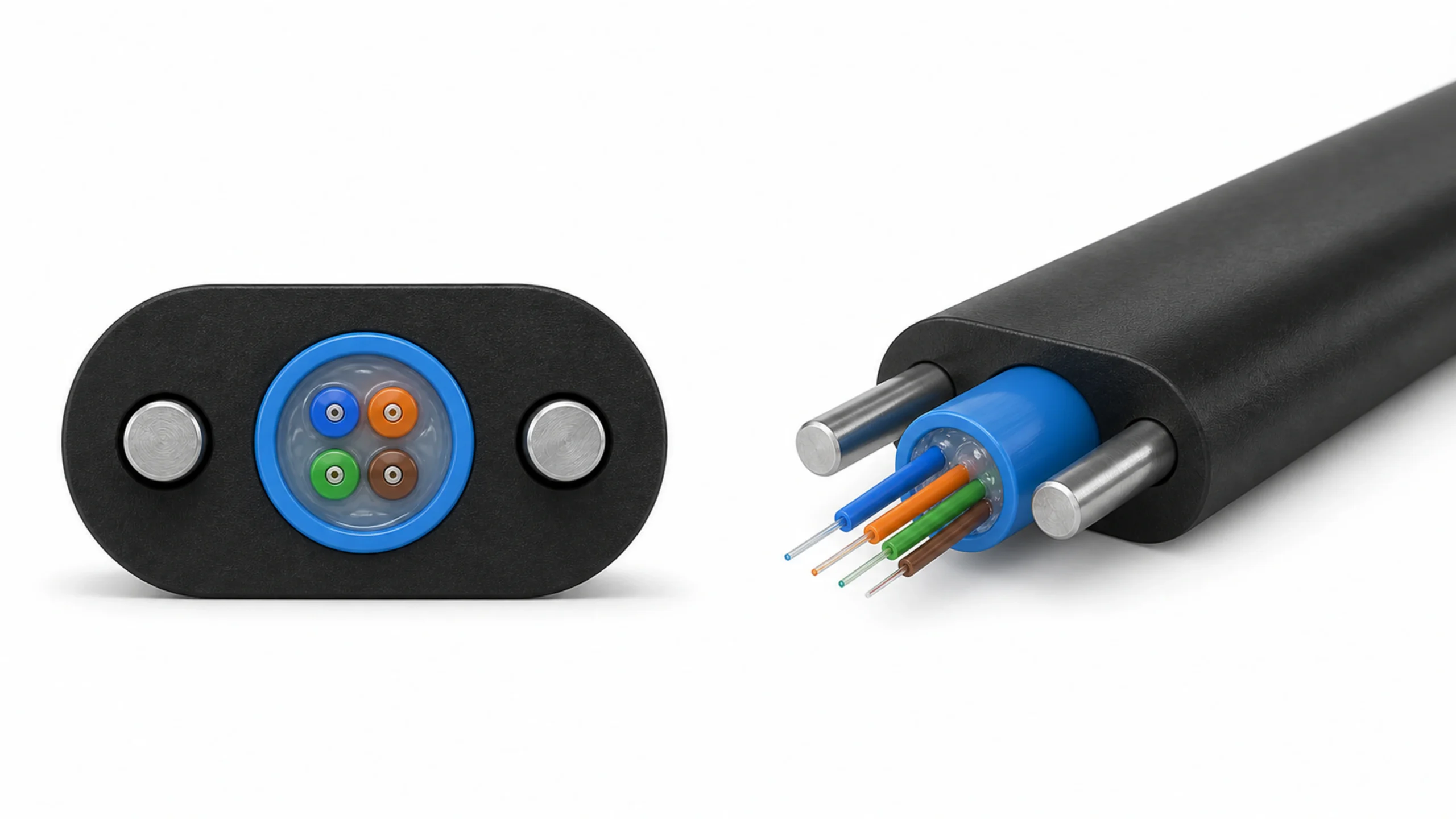
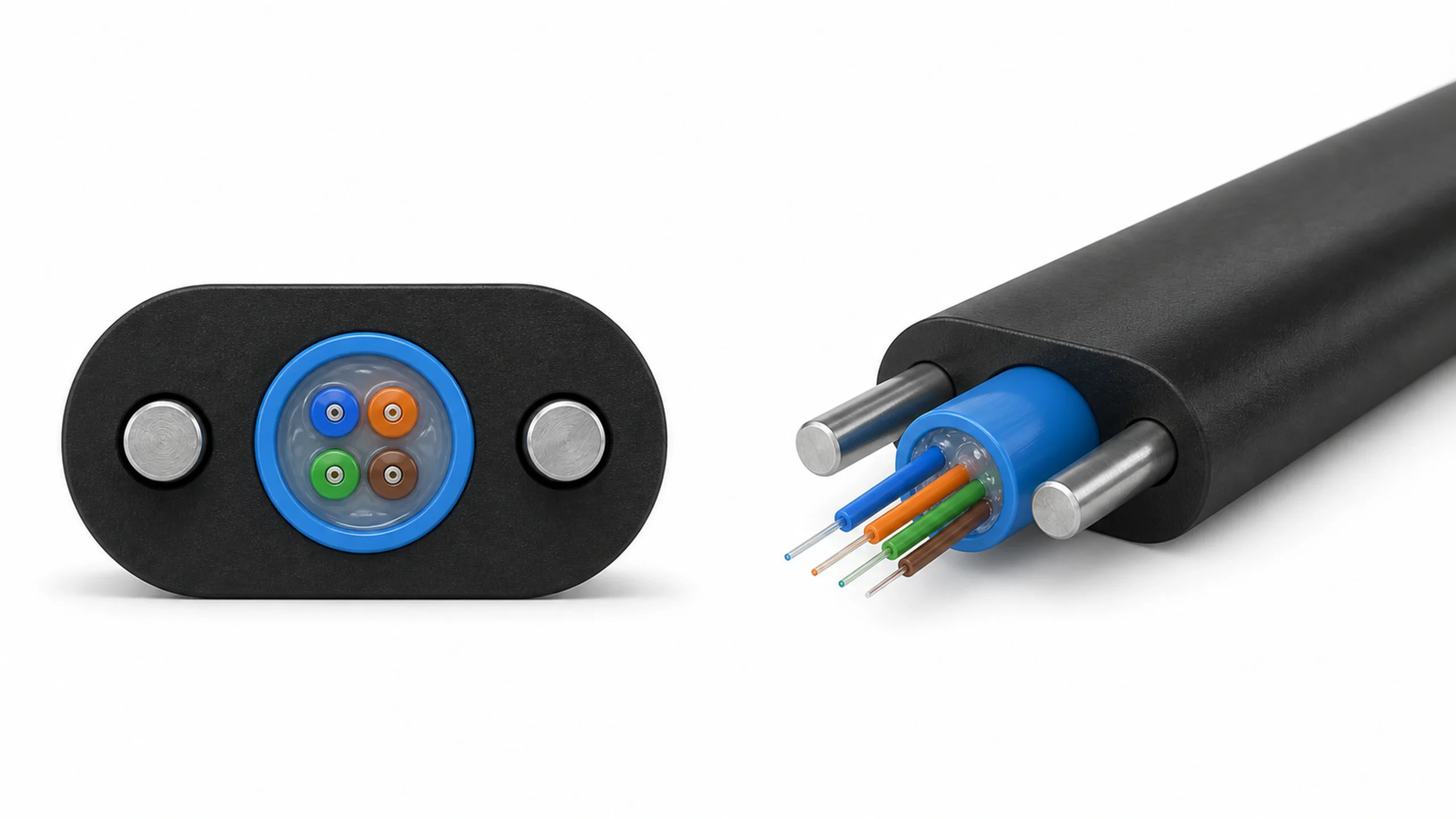
HONGKAI 3D exterior reference for a dual-layer coextrusion crosshead with a color-stripe arrangement. This is not a dimensioned drawing or a universal design for other crossheads.
For an expansion project, separate the first approved product from future products. Ask the supplier to identify which changes remain within the proposed head and tooling range, and which require a different setup or an application trial. A possible future configuration should not be listed as proven production scope.
Trocar as Ferramentas—ou toda a Cabeça de Extrusão?
Check the tip when the incoming core construction changes, and the die when the required outside shape or dimension changes. If the product is outside the installed head’s confirmed size range, a tooling change alone is not enough: the head must also change. Staying within that range is only the first compatibility check.
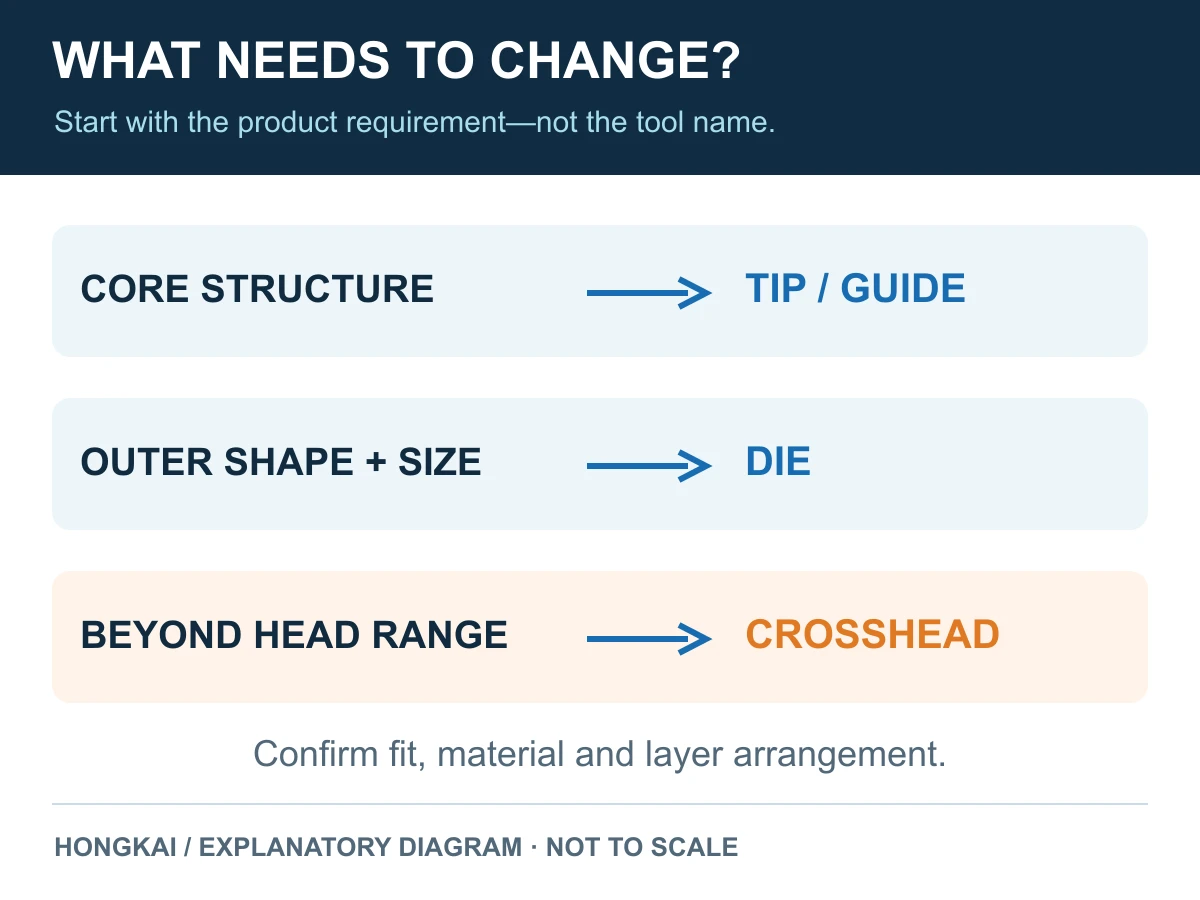
Explanatory decision map based on the application distinctions discussed for this guide. It is not a tooling drawing; fit, material and layer arrangement still require confirmation.
HONGKAI’s sizing discussions include U7, U10, U14 and U20 crossheads. In this family, the number indicates the supported maximum line-size range. Confirm the actual limit and which product dimension it refers to against the particular head’s drawing or specification. These names are not a universal sizing system across manufacturers.
For tooling, separate the incoming construction from the finished shape. A single-core and a two-core product can require different tips. The die must suit the target outer shape and size as well as the agreed material and extrusion method. Do not assume that each product change requires both tools to be replaced, or that a larger die can extend the head beyond its approved range.
| What changes? | O que revisar primeiro | O que deve ser confirmado? |
|---|---|---|
| Construção do núcleo de entrada, como de núcleo único para dois núcleos | Geometria da ponta ou do guia | Passagem, arranjo de guia e compatibilidade com a fieira |
| Formato externo ou dimensão final exigida | Geometria da matriz e faixa utilizável | Formato e tamanho desejados com o material selecionado e o método de extrusão |
| O tamanho exigido do produto excede o limite confirmado da cabeça | Uma cabeça com uma faixa adequada | A nova cabeça, ferramental e interfaces de linha como um pacote completo |
| Disposição das camadas, alterações de listras ou materiais | O arranjo de extrusão, não apenas a abertura da ferramenta | Alimentações necessárias, cabeçote/ferramental compatível e qualquer teste de aplicação |
For an existing machine, provide its head identification, photographs and tooling drawing. Confirm the mounting dimensions, locating surfaces, holders and adjustment arrangement. Different manufacturers’ tools are not interchangeable merely because the finished cable diameter is the same.
HONGKAI’s published página de peças sobressalentes para extrusão lists die, tip and adjusting-ring components and asks for photos or drawings before confirming a replacement. That is a starting point for part identification, not evidence that an unknown tool will fit every crosshead.
A worn part can help identify the assembly, but its measured dimensions should not automatically become the dimensions of a new part. Ask the supplier to distinguish the original design from wear, damage or earlier modifications. Record drawing revisions and part numbers so a later order refers to the same approved package.
Have the supplier record the agreed scope: replacement tools, a modified tooling package or a different head. That written boundary is more useful than an unsupported claim that one head can make every future product.
Verifique o caminho do fio antes de culpar a cabeça
An uneven wall is a reason to investigate, not an automatic instruction to replace the crosshead. Preserve the sample and operating record before changing the setup. Record whether the issue appeared after a tool change, a material change, a restart or a change in line operation.
Estabeleça o arranjo de centralização antes da produção
Identify whether the particular head uses manual adjustment, assisted adjustment or a fixed/self-centering arrangement. Follow the setup method for that design before formal production. A head described as requiring no routine centering adjustment still needs correct installation, matched tooling and a check of the finished wall.
Verifique a instalação e a tração, bem como a cabeça
HONGKAI’s commissioning checks for the applications discussed here include equipment leveling, alignment between the crosshead’s cable path and the haul-off centerline, and abnormal haul-off vibration or jerking. Establish these conditions during installation rather than trying to compensate for them with the head’s centering adjustment later.
An uneven floor matters if the equipment has not been correctly supported and leveled. The floor does not have to serve as the alignment reference by itself. Ask the installer to verify the machine positions and cable path against the approved layout. A misaligned haul-off or unstable pull is a separate issue to correct; adjusting the head alone does not resolve it.

Conceito de alinhamento simplificado, não é um desenho de instalação nem uma linha de produção completa. As posições dos equipamentos, suportes e tolerâncias devem seguir o layout real.
Mantenha estas perguntas de investigação separadas:
- Part identity: A ponta, a fieira e os suportes instalados são a combinação aprovada?
- Assembly condition: A inspeção mostra danos, contaminação ou outra condição que necessite correção?
- Line behavior: O núcleo percorre consistentemente o trajeto pretendido ou sua posição ou tensão muda?
- Heating behavior: As temperaturas medidas pela cabeça e o comportamento de controle correspondem à receita aprovada, em vez de apenas exibir os pontos de ajuste pretendidos?
- Extrusion behavior: A preparação do material e a saída são estáveis sob a receita aprovada?
- Measurement: A falha relatada é uma alteração no diâmetro externo, espessura de parede irregular, ovalização ou uma combinação?
Essas perguntas organizam as evidências; nenhuma estabelece a causa por si só. O guia de investigação de defeitos de material e processo abrange as verificações mais amplas quando bolhas, rugosidade ou extrusão instável aparecem, bem como problemas dimensionais.
If several settings are changed together, record all of them. A better sample after multiple changes cannot show which change solved the problem. Where a controlled comparison is practical, agree on the change and its evaluation before running the trial.
Note: Intrusive inspection, cleaning and tool changes require qualified personnel following the machine’s isolation, pressure-release and temperature-control instructions. This article does not authorize adjusting, opening or reaching into running or pressurized equipment.
Meça a Espessura da Parede, Não Apenas o Diâmetro Externo
A stable outside diameter does not prove that the conductor or core is centered. Accept the layer using the wall-thickness and dimensional evidence required by the cable specification, not only the diameter display.
SIKORA explains that comparing diameters before and after extrusion can provide a thickness value, but that laser-diameter comparison alone does not measure eccentricity. A system intended to measure eccentricity needs the relevant additional measurement capability.2
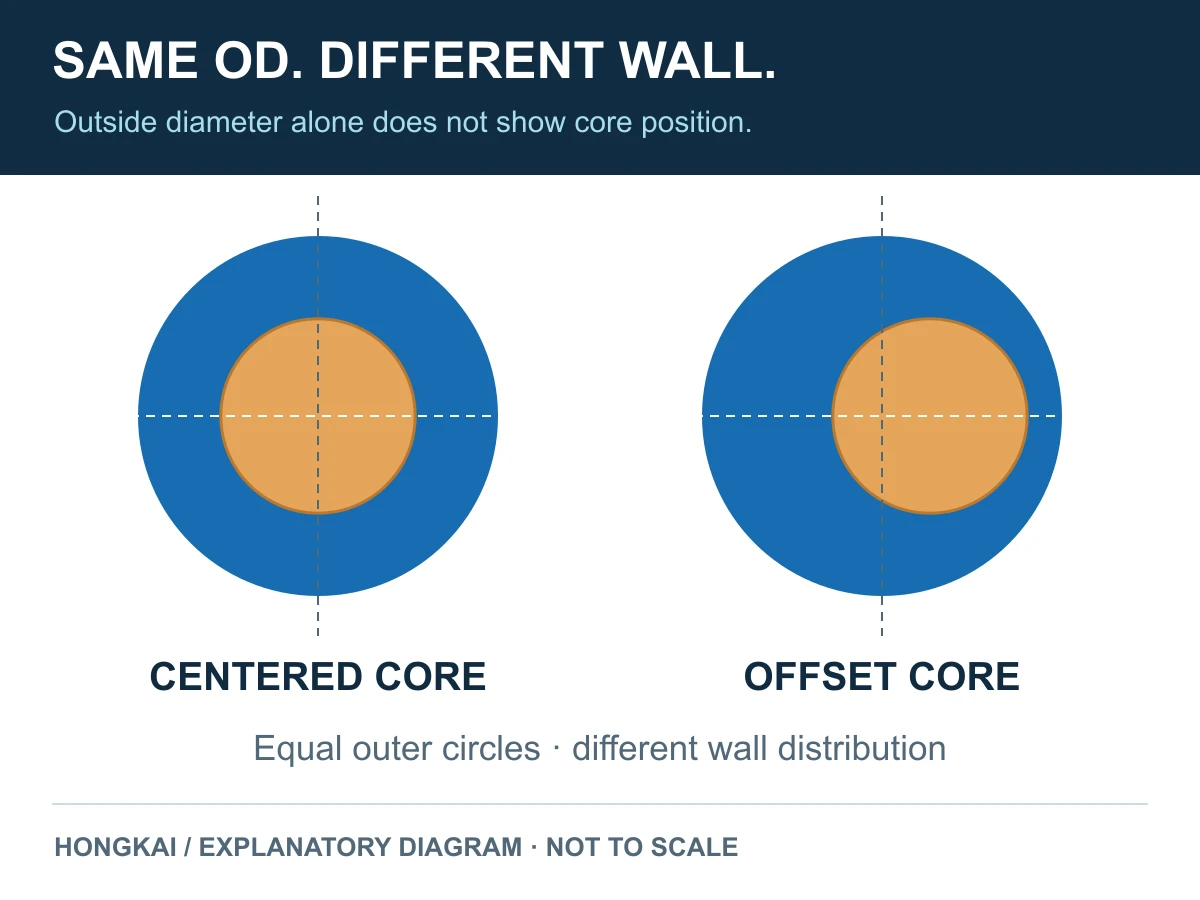
Seções transversais conceituais com o mesmo diâmetro externo. O núcleo excêntrico altera a distribuição da espessura da parede; estas não são amostras medidas nem limites de aceitação.
Mantenha os termos de inspeção claros nos registros de compra e teste:
| Evidência | O que ajuda a estabelecer | O que não estabelece por si só |
|---|---|---|
| Registro de diâmetro externo | Variação na dimensão externa medida | Posição do condutor ou núcleo dentro da camada |
| Seção transversal preparada | Distribuição local na parede naquela amostra específica | Qualidade de todo o comprimento da produção |
| Suitable online wall or eccentricity measurement | Comportamento do parâmetro medido durante a execução registrada | Suitability for an unverified material, size or construction |
| Surface inspection | Aparência visível na localização inspecionada | Todos os requisitos dimensionais ou elétricos ocultos |
Before the trial, agree on how samples will be prepared and measured. Identify the instrument, the recorded quantities and the acceptance limits. Where a percentage such as “concentricity” appears in a proposal, require its definition and calculation method; do not assume that different reports use identical terminology.
Link each result to the same material batch, tooling setup and sample position or production time. If an online gauge and an offline sample disagree, first confirm that they refer to the same product and measurement conditions. Do not choose whichever result happens to be more favorable.
The measuring system also needs an application check. Ask which materials, layer arrangements, product dimensions and operating conditions it can evaluate in the proposed setup. This guide does not require a particular instrument brand or claim that one sensing method covers every cable.
Aceite uma configuração reproduzível, não apenas uma boa amostra
Agree on the trial before accepting the proposed crosshead or tooling change. Define the sample product, material grade, setup identity, operating conditions, measurement method and decision limits. The buyer and supplier should know what evidence will settle acceptance before the machine is demonstrated.
For the head itself, HONGKAI’s priorities in the applications discussed here are the actual product’s centering and normal heating behavior. Demonstrate both on the agreed product: inspect the wall distribution and retain the corresponding temperature records. These head-focused checks do not replace the other tests required for the finished cable.
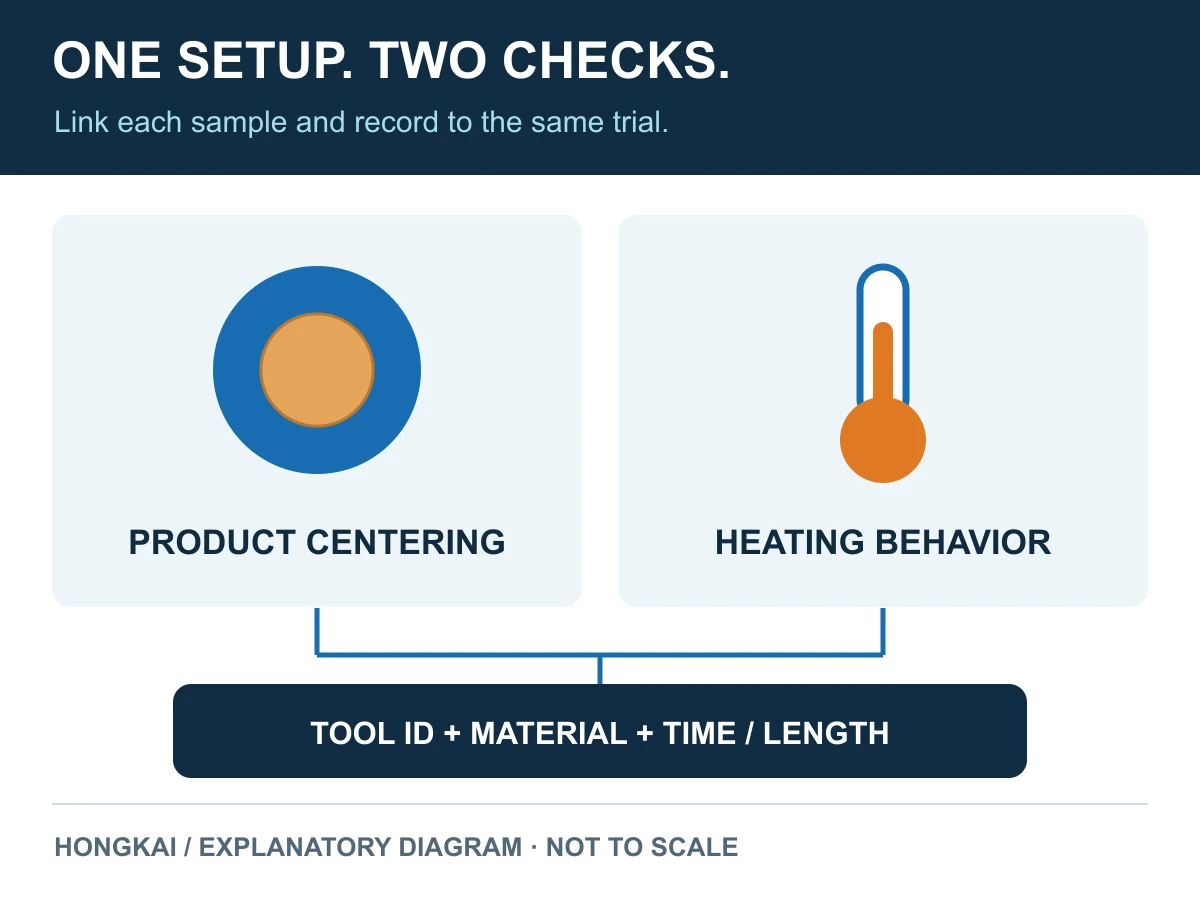
Mapa de registro explicativo, não um relatório de teste. Relacione as amostras de centralização e os registros de temperatura à mesma configuração; defina separadamente os limites reais e outros testes do produto.
Um registro de teste útil vincula os seguintes itens em vez de armazená-los como fotografias não relacionadas:
- O desenho do cabo aprovado e o lote do composto utilizado.
- A identificação da cabeça, os números das peças de ferramental e as revisões dos desenhos.
- O arranjo de centralização, o alinhamento da linha verificado e as condições operacionais acordadas.
- As configurações de temperatura especificadas e os registros correspondentes de temperatura medida.
- The retained samples with their time or length references.
- Os resultados dimensionais correspondentes e outras verificações aplicáveis do produto.
- Qualquer interrupção ou ajuste, o motivo dele e o resultado posterior.
Where frequent product changes are important, include an agreed changeover in the demonstration. The question is not merely whether an experienced operator can produce one acceptable short sample. It is whether the factory can identify the approved tools, follow the documented setup and verify the result again under the agreed conditions.
Do not invent a universal test speed, duration or sample count. Those values must match the product, contract and factory’s acceptance method. Startup material and output made during an unapproved adjustment should remain identifiable under the factory’s quality procedure.
At handover, retain the accepted tool drawings or identifiers, setup instructions, maintenance guidance and sample records. List future materials and product sizes separately if they have not been demonstrated. A clear scope prevents the accepted setup for one cable from becoming an unsupported promise about every cable the factory may make later.
The strongest result is a matched tooling package with traceable samples and a repeatable setup. That gives production staff a basis for the next changeover and gives the buyer evidence for accepting the equipment.
-
Guill Tool & Engineering, Séries e opções de configuração. Used only to substantiate the existence of distinct pressure/tubing and fixed/adjustable configurations, not as a HONGKAI product specification, supplier endorsement or universal selection rule. ↩
-
SIKORA, Thickness measurement, particularly the laser-measurement discussion. Supports the distinction between diameter-derived thickness and eccentricity measurement; no vendor-specific accuracy or performance claim is adopted. ↩