


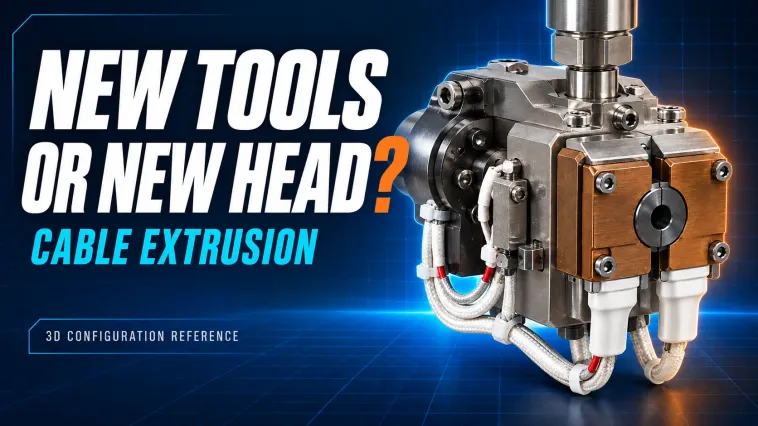
A cable production manager may need new tooling after changing a cable size, adding a layer or finding uneven insulation. Before ordering a new crosshead, separate the cable requirement from the condition of the installed tooling and the way the line is running.
A new cable size does not always require a new crosshead. Check the incoming core structure, the required outside shape and size, and the head’s confirmed range. Then check line alignment, wall thickness and heating: changing tools or adjusting the head cannot correct every cause of an uneven wall.
This guide concerns the information and evidence needed for insulation and jacket extrusion. It is not a universal die-sizing recipe, a centering procedure for a particular machine or a substitute for its operating manual.
Bắt đầu với lớp đang được áp dụng
Begin with a drawing of the product entering the crosshead and the product leaving it. A solid conductor, a stranded conductor and an assembled cable core should not be treated as interchangeable inputs simply because their nominal diameters are similar.
Record the incoming construction, its size range and the layer being applied. For a finished cable, identify whether the purchase concerns conductor insulation, an inner sheath or the outer jacket. Where several materials or layers are involved, identify them separately rather than requesting a generic “multilayer head.”
Chuẩn bị một phiếu sản phẩm ngắn bao gồm:
- Bản vẽ dây dẫn hoặc lõi đầu vào và các mẫu đại diện.
- Nhà sản xuất hợp chất, mác chính xác và hướng dẫn gia công.
- Kích thước ngoài thành phẩm, độ dày thành yêu cầu và các giới hạn chấp nhận áp dụng.
- Số lượng và thứ tự các lớp, bao gồm bất kỳ lớp sọc hoặc nguồn cấp liệu vật liệu riêng biệt nào khác.
- Các yêu cầu liên quan đến bóc tách, độ bám dính hoặc tách lớp, nếu đặc tả cáp có bao gồm chúng.
- Đầu đùn hiện tại, mã đầu chéo, bố trí dây chuyền và dải vận hành đề xuất.
Chọn phương pháp đùn và cách sắp xếp lớp riêng biệt
Pressure tooling and tubing tooling describe different extrusion approaches. Single-layer and coextrusion describe the layer arrangement. These are separate decisions, not four competing names for the same choice. Tooling manufacturers offer different pressure/tubing, layer and centering configurations.1
Start with the product and required wall thickness when choosing the extrusion approach. In the HONGKAI applications discussed for this guide, the optical-fiber tube operation uses tubing tooling, while the sheath operation uses pressure tooling. These are application examples, not a rule that every optical cable tube or jacket uses the same method.
Next, specify whether the product needs one layer, two layers in separate operations, or two layers extruded together. If both layers must be applied in one pass, the proposed head and material feeds must support that coextrusion arrangement. Identify a color stripe separately; a stripe is not automatically another complete sheath layer.

HONGKAI 3D exterior reference for a dual-layer coextrusion crosshead with a color-stripe arrangement. This is not a dimensioned drawing or a universal design for other crossheads.
For an expansion project, separate the first approved product from future products. Ask the supplier to identify which changes remain within the proposed head and tooling range, and which require a different setup or an application trial. A possible future configuration should not be listed as proven production scope.
Thay đổi Công cụ—hay Toàn bộ Đầu chéo?
Check the tip when the incoming core construction changes, and the die when the required outside shape or dimension changes. If the product is outside the installed head’s confirmed size range, a tooling change alone is not enough: the head must also change. Staying within that range is only the first compatibility check.

Explanatory decision map based on the application distinctions discussed for this guide. It is not a tooling drawing; fit, material and layer arrangement still require confirmation.
HONGKAI’s sizing discussions include U7, U10, U14 and U20 crossheads. In this family, the number indicates the supported maximum line-size range. Confirm the actual limit and which product dimension it refers to against the particular head’s drawing or specification. These names are not a universal sizing system across manufacturers.
For tooling, separate the incoming construction from the finished shape. A single-core and a two-core product can require different tips. The die must suit the target outer shape and size as well as the agreed material and extrusion method. Do not assume that each product change requires both tools to be replaced, or that a larger die can extend the head beyond its approved range.
| What changes? | Nên xem lại điều gì trước tiên | Điều gì phải được xác nhận? |
|---|---|---|
| Cấu trúc lõi đầu vào, ví dụ như từ lõi đơn sang lõi đôi | Hình học đầu mút hoặc hướng dẫn | Đoạn dẫn, cụm định hướng và khả năng tương thích với khuôn |
| Hình dạng bên ngoài hoặc kích thước hoàn thiện yêu cầu | Hình học khuôn và phạm vi sử dụng được | Hình dạng và kích thước mục tiêu với vật liệu đã chọn và phương pháp đùn |
| Kích thước sản phẩm yêu cầu vượt quá giới hạn đã được xác nhận của đầu máy | Một đầu có phạm vi phù hợp | Gói hoàn chỉnh bao gồm đầu mới, dụng cụ và giao diện dây chuyền |
| Sắp xếp lớp, thay đổi sọc hoặc vật liệu | Cụm đùn ép, không chỉ là phần mở của dụng cụ | Các đầu cấp liệu yêu cầu, đầu dao/dụng cụ tương thích và bất kỳ thử nghiệm ứng dụng nào |
For an existing machine, provide its head identification, photographs and tooling drawing. Confirm the mounting dimensions, locating surfaces, holders and adjustment arrangement. Different manufacturers’ tools are not interchangeable merely because the finished cable diameter is the same.
HONGKAI’s published trang phụ tùng đùn ép lists die, tip and adjusting-ring components and asks for photos or drawings before confirming a replacement. That is a starting point for part identification, not evidence that an unknown tool will fit every crosshead.
A worn part can help identify the assembly, but its measured dimensions should not automatically become the dimensions of a new part. Ask the supplier to distinguish the original design from wear, damage or earlier modifications. Record drawing revisions and part numbers so a later order refers to the same approved package.
Have the supplier record the agreed scope: replacement tools, a modified tooling package or a different head. That written boundary is more useful than an unsupported claim that one head can make every future product.
Kiểm tra đường đi của dây trước khi đổ lỗi cho đầu
An uneven wall is a reason to investigate, not an automatic instruction to replace the crosshead. Preserve the sample and operating record before changing the setup. Record whether the issue appeared after a tool change, a material change, a restart or a change in line operation.
Thiết lập cơ cấu định tâm trước khi sản xuất
Identify whether the particular head uses manual adjustment, assisted adjustment or a fixed/self-centering arrangement. Follow the setup method for that design before formal production. A head described as requiring no routine centering adjustment still needs correct installation, matched tooling and a check of the finished wall.
Kiểm tra việc lắp đặt, lực kéo cũng như đầu máy
HONGKAI’s commissioning checks for the applications discussed here include equipment leveling, alignment between the crosshead’s cable path and the haul-off centerline, and abnormal haul-off vibration or jerking. Establish these conditions during installation rather than trying to compensate for them with the head’s centering adjustment later.
An uneven floor matters if the equipment has not been correctly supported and leveled. The floor does not have to serve as the alignment reference by itself. Ask the installer to verify the machine positions and cable path against the approved layout. A misaligned haul-off or unstable pull is a separate issue to correct; adjusting the head alone does not resolve it.
Khái niệm căn chỉnh đơn giản, không phải bản vẽ lắp đặt hay dây chuyền sản xuất hoàn chỉnh. Vị trí thiết bị, các điểm đỡ và dung sai phải tuân theo bố trí thực tế.
Giữ riêng biệt các câu hỏi điều tra này:
- Part identity: Các đầu nối, khuôn và bộ giữ đã lắp đặt có phải là tổ hợp được phê duyệt không?
- Assembly condition: Kiểm tra có cho thấy hư hỏng, nhiễm bẩn hoặc tình trạng nào khác cần được khắc phục không?
- Line behavior: Lõi có chạy đều đặn dọc theo đường dẫn dự kiến hay không, hay vị trí hoặc lực căng của nó thay đổi?
- Heating behavior: Nhiệt độ đo được của đầu và hành vi điều khiển có khớp với công thức đã được phê duyệt, thay vì chỉ hiển thị các điểm đặt mong muốn không?
- Extrusion behavior: Việc chuẩn bị vật liệu và đầu ra có ổn định theo công thức đã được phê duyệt không?
- Measurement: Lỗi được báo cáo có phải là sự thay đổi đường kính ngoài, độ dày thành không đều, độ ô van hoặc kết hợp các yếu tố này không?
Những câu hỏi này sắp xếp bằng chứng; không câu nào tự nó xác lập được nguyên nhân. The hướng dẫn điều tra khuyết tật vật liệu và quy trình bao gồm các kiểm tra tổng quát hơn khi xuất hiện bọt khí, độ nhám hoặc hiện tượng đùn không ổn định cũng như các vấn đề về kích thước.
If several settings are changed together, record all of them. A better sample after multiple changes cannot show which change solved the problem. Where a controlled comparison is practical, agree on the change and its evaluation before running the trial.
Note: Intrusive inspection, cleaning and tool changes require qualified personnel following the machine’s isolation, pressure-release and temperature-control instructions. This article does not authorize adjusting, opening or reaching into running or pressurized equipment.
Đo độ dày thành ống, không chỉ đường kính ngoài
A stable outside diameter does not prove that the conductor or core is centered. Accept the layer using the wall-thickness and dimensional evidence required by the cable specification, not only the diameter display.
SIKORA explains that comparing diameters before and after extrusion can provide a thickness value, but that laser-diameter comparison alone does not measure eccentricity. A system intended to measure eccentricity needs the relevant additional measurement capability.2
Các mặt cắt ngang minh họa có cùng đường kính ngoài. Lõi lệch tâm làm thay đổi sự phân bố độ dày thành ống; đây không phải là các mẫu đo lường hay giới hạn nghiệm thu.
Giữ các điều khoản kiểm tra rõ ràng trong hồ sơ mua hàng và thử nghiệm:
| Bằng chứng | Điều mà nó giúp thiết lập | Điều mà nó không tự thiết lập được |
|---|---|---|
| Bản ghi đường kính ngoài | Sự biến đổi trong kích thước ngoài đo được | Vị trí của ruột dẫn hoặc lõi bên trong lớp |
| Mặt cắt ngang đã được chuẩn bị | Phân bố thành tường cục bộ trong mẫu cụ thể đó | Chất lượng của toàn bộ chiều dài sản xuất |
| Phù hợp để đo độ dày thành ống hoặc độ lệch tâm trực tuyến | Hành vi của thông số đo được trong quá trình chạy đã ghi lại | Độ phù hợp cho vật liệu, kích cỡ hoặc kết cấu chưa được xác minh |
| Surface inspection | Ngoại quan nhìn thấy được tại vị trí kiểm tra | Tất cả các yêu cầu về kích thước hoặc điện ẩn |
Before the trial, agree on how samples will be prepared and measured. Identify the instrument, the recorded quantities and the acceptance limits. Where a percentage such as “concentricity” appears in a proposal, require its definition and calculation method; do not assume that different reports use identical terminology.
Link each result to the same material batch, tooling setup and sample position or production time. If an online gauge and an offline sample disagree, first confirm that they refer to the same product and measurement conditions. Do not choose whichever result happens to be more favorable.
The measuring system also needs an application check. Ask which materials, layer arrangements, product dimensions and operating conditions it can evaluate in the proposed setup. This guide does not require a particular instrument brand or claim that one sensing method covers every cable.
Chấp nhận một thiết lập có thể tái tạo, chứ không phải một mẫu tốt duy nhất
Agree on the trial before accepting the proposed crosshead or tooling change. Define the sample product, material grade, setup identity, operating conditions, measurement method and decision limits. The buyer and supplier should know what evidence will settle acceptance before the machine is demonstrated.
For the head itself, HONGKAI’s priorities in the applications discussed here are the actual product’s centering and normal heating behavior. Demonstrate both on the agreed product: inspect the wall distribution and retain the corresponding temperature records. These head-focused checks do not replace the other tests required for the finished cable.
Bản đồ ghi chú giải thích, không phải báo cáo thử nghiệm. Liên kết các mẫu căn tâm và hồ sơ nhiệt độ với cùng một thiết lập; thống nhất riêng về giới hạn thực tế và các phép thử sản phẩm khác.
Một bản ghi thử nghiệm hữu ích liên kết các mục sau đây thay vì lưu trữ chúng dưới dạng các bức ảnh không liên quan:
- Bản vẽ cáp đã được phê duyệt và lô hợp chất được sử dụng.
- Mã nhận dạng đầu, số hiệu chi tiết dụng cụ và phiên bản bản vẽ.
- Cơ cấu định tâm, độ thẳng hàng của đường dây đã được xác minh và các điều kiện vận hành đã được thống nhất.
- Các cài đặt nhiệt độ đã chỉ định và các bản ghi nhiệt độ đo được tương ứng.
- Các mẫu lưu giữ kèm theo mốc thời gian hoặc tham chiếu chiều dài của chúng.
- Các kết quả kích thước tương ứng và các kiểm tra sản phẩm áp dụng khác.
- Bất kỳ sự gián đoạn hoặc điều chỉnh nào, lý do của nó và kết quả sau đó.
Where frequent product changes are important, include an agreed changeover in the demonstration. The question is not merely whether an experienced operator can produce one acceptable short sample. It is whether the factory can identify the approved tools, follow the documented setup and verify the result again under the agreed conditions.
Do not invent a universal test speed, duration or sample count. Those values must match the product, contract and factory’s acceptance method. Startup material and output made during an unapproved adjustment should remain identifiable under the factory’s quality procedure.
At handover, retain the accepted tool drawings or identifiers, setup instructions, maintenance guidance and sample records. List future materials and product sizes separately if they have not been demonstrated. A clear scope prevents the accepted setup for one cable from becoming an unsupported promise about every cable the factory may make later.
The strongest result is a matched tooling package with traceable samples and a repeatable setup. That gives production staff a basis for the next changeover and gives the buyer evidence for accepting the equipment.
-
Guill Tool & Engineering, Các tùy chọn dòng sản phẩm và cấu hình. Used only to substantiate the existence of distinct pressure/tubing and fixed/adjustable configurations, not as a HONGKAI product specification, supplier endorsement or universal selection rule. ↩
-
SIKORA, Thickness measurement, đặc biệt là phần thảo luận về đo lường bằng laser. Hỗ trợ sự phân biệt giữa độ dày suy ra từ đường kính và phép đo độ lệch tâm; không áp dụng bất kỳ tuyên bố nào về độ chính xác hoặc hiệu suất mang tính đặc thù của nhà cung cấp.↩
