


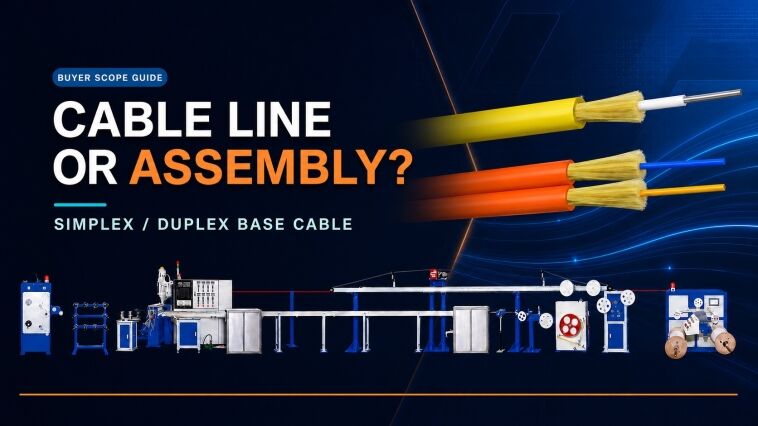
A fiber optic cable factory owner, production manager or technical buyer planning conventional patch cords must define two connected scopes. One scope makes the simplex or duplex base cable; the other cuts that cable and turns each end into an inspected, optically tested connector assembly.
A complete fiber optic patch-cord factory is not one extrusion line. It is either a qualified purchased-cable supply plus a complete connector-assembly workcell, or an integrated route that adds tight-buffer and outer-jacket production before the same back-end workcell.

Peta cakupan pembeli: lini produksi kabel membuat kabel dasar simplex atau duplex; sel kerja perakitan konektor terpisah mengubah kabel tersebut menjadi kabel patch LC atau SC jadi.
This guide maps the complete manufacturing boundary for conventional LC and SC patch cords. FC and ST may be added as project-specific fixture variants, but they are not the main production scope in this article. MPO and MTP multi-fiber assemblies are excluded because their cable construction, ferrule preparation, polishing, geometry control, polarity and multi-channel testing require a separate project scope.
Apa Saja yang Termasuk dalam Pabrik Patch Cord Lengkap?
A complete patch-cord route must end with a saleable, traceable connectorized product—not merely a reel of cable or a visually polished connector. The proposal needs an owner and acceptance record for every stage from incoming fiber or cable through final optical test and packing.
| Manufacturing boundary | Input | Output utama | Bukti sebelum rilis |
|---|---|---|---|
| Produksi tight-buffer ketika kabel dasar diproduksi sendiri di pabrik | Senyawa serat optik dan buffer yang disetujui | Serat berpelapis ketat yang memenuhi syarat | Identitas material, dimensi, kondisi permukaan, dan pemeriksaan optik yang disepakati |
| Produksi aramid dan jaket luar ketika kabel dasar diproduksi secara internal | Senyawa jaket, aramid, dan serat berpelapis ketat yang telah disetujui | Kabel simplex atau duplex pada gulungan | Penggambaran kabel, dimensi, identitas gulungan, penampilan, dan pemeriksaan optik yang disepakati |
| Cable preparation | Gulungan yang dilepas atau kabel berkualifikasi yang dibeli | Ujung kabel yang dipotong dan disiapkan | Panjang, orientasi, dimensi strip, dan identitas traveler |
| Connector assembly | Kabel yang telah disiapkan, komponen konektor, dan bahan habis pakai yang telah disetujui | Ujung konektor yang telah dirakit dan dikeringkan | Lot komponen, pengaturan proses, dan catatan batch atau operator |
| Pemolesan dan inspeksi ujung serat | Rangkaian konektor yang distabilkan | Bersihkan ujung ferrule | Proses pemolesan yang disetujui dan hasil inspeksi yang disimpan atau dapat dilacak |
| Pengujian dan finishing optik | Kabel patch yang telah selesai | Produk yang dilepas untuk dijual | Pengaturan pengujian, panjang gelombang, hasil, identitas, label, dan catatan pengemasan |
Itu Garis produksi kabel patch-cord HONGKAI supports the base-cable side for applicable constructions. The confirmed project route then adds partner-integrated back-end stations, together with connector-specific fixtures, hand tools and consumables. HONGKAI’s published model manufaktur dan integrasi spesialis explains this source boundary; the final commercial proposal must still distinguish HONGKAI-manufactured equipment, partner-integrated equipment and buyer-supplied items.
Common mistakes: A quotation calls the cable line a complete patch-cord factory but omits connectorization and optical testing. Another quotation lists a polishing machine but omits its connector fixtures, films, inspection adapter, reference cords or process responsibility.
Jalur HONGKAI Mana yang Membentuk Kabel Dasar?
For the reviewed simplex or duplex construction, the HONGKAI route uses the HK-30 to produce tight-buffered fiber and the HK-50 to apply aramid reinforcement and the outer jacket. If the factory purchases qualified tight-buffered fiber, the cable-making scope can start with the HK-50.
tahap buffer ketat HK-30
The reviewed HK-30 configuration receives optical fiber and applies the specified tight-buffer layer. Its functional modules include controlled payoff, preheating, material drying and feeding, extrusion, warm and cold cooling, online diameter measurement, capstan control and take-up. These functions define the production stage; the customer’s approved construction must define the actual polymer, color, dimensions, reel format and acceptance limits.
Referensi HONGKAI HK-30 3D terverifikasi yang menunjukkan keseluruhan lini produksi tight-buffer. Nilai akhir peralatan, material, dan operasional tetap spesifik untuk proyek.
HK-50 aramid-dan-jaket tahap
The reviewed HK-50 configuration receives the approved tight-buffered input, pays off the aramid reinforcement and extrudes the outer jacket. Its functional modules include input payoff, adjustable aramid payoff, positioning, material preparation, extrusion, cooling, online diameter measurement, capstan, accumulation and take-up.

Verified HONGKAI HK-50 3D reference showing the complete line used for an applicable aramid-reinforced simplex or duplex jacket stage. The accepted cable construction controls the final configuration.
The complete in-house route is therefore HK-30 tight buffering followed by HK-50 aramid reinforcement and jacketing. An HK-50-only route is appropriate when the factory has an approved external source for tight-buffered fiber and the incoming package, material, dimensions and optical condition match the signed HK-50 input specification.
The HK-30 and HK-50 documents are older project configurations. They verify the process stages and equipment functions, but their speeds, tensions, power, output, material options and package sizes must not be copied into a new proposal without reconfirmation.
The earlier HONGKAI panduan proses kabel patch-cord juga menunjukkan tahapan produksi terpisah untuk HK-30 a dan HK-50 a. Gunakan hanya sebagai acuan; gambar kabel yang telah disetujui dan perjanjian teknis terkini mengendalikan proyek baru.
How to verify: During FAT, connect the raw-fiber or tight-buffer input to the approved recipe and identify the resulting reel. Retain the actual cable drawing, material lots, tooling, dimensions, surface result, optical check and take-up package used for the trial.
Apa Proses Back-End Lengkap untuk Kabel Patch LC atau SC?
The supplied conventional LC/SC package covers cable cutting, jacket and buffer stripping, adhesive preparation and dispensing, connector assembly, crimping, curing, fiber scribing, polishing, end-face inspection, optical testing, labeling and packing. The ten powered back-end stations are integrated through HONGKAI’s specialist partner; connector-specific hand tools, fixtures and consumables complete the route.
The sequence below is a controlled planning route for the supplied epoxy-and-polish package. It is not a universal connector recipe. The approved connector-component instructions must set the exact strip dimensions, cleaning method, adhesive, assembly order, crimp tooling, cure cycle, polish sequence and optical limits. A factory should turn those instructions into a traveler or batch record before FAT.
1. Lepaskan kabel masuk dan pesanan produksi
Before cutting, verify the cable drawing, connector family, ferrule finish, finished length, quantity, label data and test requirements. Record the incoming reel or cable lot against the work order. If base cable is made in house, the released HK-50 reel is the handoff point; if it is purchased, the supplier’s reel identity and incoming inspection are the handoff evidence.
Cara memverifikasi: Operator harus dapat melacak setiap sampel FAT kembali ke satu gulungan kabel yang disetujui, satu lot komponen konektor, dan satu revisi instruksi kerja.
2. Potong kabel sesuai panjang yang ditentukan
The automatic fiber cable cutting machine measures and cuts the released cable for the planned patch-cord length. The RFQ should define the cable-size range, required length range, tolerance, quantity count and whether allowance for stripping and connector assembly is included in the cutting instruction.
3D technical model based on the verified automatic cable cutting machine in Peter’s supplied conventional patch-cord package. Supplier branding has been removed; this back-end station is integrated through HONGKAI’s specialist partner.
Jebakan: Jangan hanya menerima panjang potong yang ditampilkan. Selama FAT, ukur sampel yang telah ditentukan dan simpan baik nilai yang diatur maupun hasil aktualnya.
3. Kupas jaket luar
The optical cable stripping machine removes the required jacket length so the aramid yarn and buffered fiber can be prepared for the connector. The work instruction must match the actual simplex or duplex cable diameter, jacket material and connector boot or crimp sleeve. Acceptance should cover strip length, a clean cut and no damage to the reinforcement or buffered fiber.
3D technical model based on the verified outer-jacket stripping station. Supplier branding has been removed; final tooling is selected against the approved cable and connector construction.
4. Kupas penyangga ketat
The buffer stripping machine exposes the glass fiber to the dimension required by the connector assembly process. The operator must control the strip length and inspect the exposed fiber for coating residue, scratches or breakage. The machine does not replace cleaning and handling discipline.
3Model teknis D berdasarkan stasiun pengupasan tight-buffer yang telah diverifikasi dalam paket LC/SC yang disediakan. Branding pemasok telah dihapus.
Yang harus ditanyakan: Minta rentang kabel dan buffer yang dapat diterima, daftar pisau atau perkakas pengganti, metode verifikasi panjang pengupasan, serta kriteria penolakan untuk serat yang rusak.
5. Prepare adhesive with the Model 800 centrifuge
For the reviewed epoxy-and-polish route, the approved adhesive is prepared according to its supplier instruction. The Model 800 epoxy centrifuge supports controlled preparation and removal of entrained air before dispensing. Adhesive identity, mix ratio when applicable, preparation time, usable life, storage condition and disposal rule belong in the batch record.
3D technical model based on the verified epoxy centrifuge in the supplied package. Supplier markings have been removed; the approved connector and adhesive suppliers—not the image—define the preparation recipe.
Jebakan: Daftar mesin yang hanya menyebutkan “epoxy” membuat pembeli tidak memiliki sistem perekat yang kompatibel, kontrol batch, atau aturan masa pakai yang dapat digunakan.
6. Keluarkan perekat
The epoxy dispenser delivers the prepared adhesive to the connector assembly process. The dispensing needle or adapter, dose, cleaning interval and confirmation method must suit the selected LC or SC connector components. Record the adhesive batch and preparation time with the work order.
3D technical model based on the verified adhesive dispensing station in the supplied conventional connector route. Supplier branding has been removed.
7. Insert the fiber, assemble components and crimp
The operator threads the prepared fiber into the ferrule, seats the cable and assembles the boot, crimp sleeve and other specified parts in the connector supplier’s approved order. The pneumatic crimping machine applies the connector-specific crimp through the correct die or fixture. The factory must provide stable compressed air at the agreed pressure and quality.
3D technical model based on the verified pneumatic crimping machine. Supplier branding has been removed; the connector construction controls the die, crimp position and acceptance check.
How to verify: Inspect component seating, aramid capture, boot position and crimp condition on representative LC and SC assemblies. Record the die or fixture identity and compressed-air condition used for FAT.
8. Lakukan pengawetan pada rakitan konektor
The curing oven stabilizes the adhesive under the approved time-and-temperature instruction. The work instruction must define loading orientation, fixture or holder, setpoint, actual cycle evidence, batch size and handling after cure. Do not transfer a cure recipe from another adhesive or connector system without approval.
3D model teknis berdasarkan unit pengawet konektor terverifikasi dalam paket LC/SC yang disediakan. Branding pemasok telah dihapus.
Bukti yang diminta: Dokumen FAT harus menghubungkan setiap sampel dengan batch perekat, identitas oven, catatan siklus, dan operator yang bertanggung jawab.
9. Scribe excess fiber and prepare the ferrule for polishing
After the approved cure and cooling sequence, use the specified fiber cutting pen or scribing tool to remove the protruding fiber without chipping the ferrule or damaging the fiber. Clean the connector and polishing fixture before loading. This is a hand-tool step in the supplied package, not a reason to invent another machine.
Kesalahan umum: Gaya berlebihan saat menggores, kotoran yang terbawa ke dalam fixture pemolesan, dan tidak adanya aturan penggantian untuk perkakas tangan yang aus.
10. Poles ferrule LC dan SC
The fiber connector polishing machine performs the mechanical polishing stage. A complete station also needs the correct LC or SC holder, the approved UPC or APC process where applicable, polishing pads and films, cleaning materials and a controlled film-change rule. Peter’s supplied package lists connector-specific fixtures; they must be scheduled by actual launch product rather than assumed from the machine name.
3D technical model based on the verified polishing machine in the supplied package. Supplier branding has been removed; LC and SC require the correct connector-specific holder and approved consumable sequence.
What to ask: Require a connector-to-fixture matrix, film sequence, cleaning step, process ownership and replacement plan. A polishing machine without the right holder and consumables is not a working LC/SC station.
11. Bersihkan dan periksa permukaan ujungnya
After polishing, clean the connector with the approved materials and inspect it using the fiber connector inspection microscope with the correct adapter. The acceptance record should distinguish contamination that can be cleaned from scratches, chips or other defects that require rework or rejection.
Model teknis 3D berdasarkan mikroskop inspeksi ferrule yang telah diverifikasi dalam workcell LC/SC yang disediakan. Branding pemasok telah dihapus.
IEC 61300-3-35:2022 covers visual inspection and classification of contamination, scratches and defects on fibre-optic connector interfaces. The product specification still needs to identify the applicable connector interface, inspection method and acceptance criteria. Visual inspection does not replace finished-product optical testing.
12. Ukur insertion loss dan return loss dengan 7420B
The 7420B insertion-loss and return-loss tester is the final powered test station in the supplied package. Before FAT, define fiber type, wavelength, reference method, connector adapters, reference cords, test direction, acceptance limits, calibration responsibility and how each result is tied to the finished patch cord.
3D technical model based on the verified optical tester in the supplied package. Supplier branding has been removed; the station supports traceable insertion-loss and return-loss testing of the finished conventional patch cord.
IEC 61300-3-4:2023 mengulas metode pengukuran redaman, sedangkan IEC 61300-3-6:2008 addresses return-loss measurement procedures. These references do not supply the product’s pass/fail values; those values must come from the approved product specification and customer agreement.
13. Lakukan pemeriksaan visual akhir, beri label, dan kemas
Use the visual fault locator when it belongs to the agreed work instruction, complete the final visual and dimensional checks, fit clean dust caps, apply the traceable label and pack the patch cord so the connector end faces and cable bend condition are protected. The released sample should carry the product code, length, connector configuration, fiber or cable identity, batch or serial reference and test status required by the buyer’s system.
The connector-processing area should be clean and have little airborne dust; a cleanroom is preferable when the product and quality requirements justify it. The layout must separate dirty preparation work from cleaned ferrules and finished connectors. The RFQ should assign compressed air, benches, lighting, cleaning materials, waste handling, labels and packaging instead of assuming they are included with the machines.
Pitfalls: The workcell depends on operator memory for strip length or polishing steps, end-face images are not tied to product identity, optical results have no documented reference method, or tested connectors are exposed to dust again before capping and packing.
Ringkasan peralatan back-end
| Process stage | Reference equipment | Kontrol yang berdekatan diperlukan |
|---|---|---|
| Length cutting | Mesin pemotong kabel otomatis | Toleransi panjang, ketentuan toleransi, dan pengukuran sampel |
| Jacket stripping | Mesin pengupas kabel optik | Peralatan khusus kabel dan kriteria kerusakan |
| Buffer stripping | Mesin pengupas serat optik berlapis ketat | Inspeksi dan pembersihan kondisi serat |
| Adhesive preparation | Model 800 | Catatan identitas perekat, pencampuran, dan masa pakai |
| Adhesive dispensing | Epoxy dispenser | Dosis, adaptor, dan kontrol pembersihan |
| Connector crimping | Mesin crimping pneumatik | Die khusus konektor dan udara tekan |
| Curing | Oven pemanas konektor | Kemampuan pelacakan siklus dan batch yang telah disetujui |
| Ferrule polishing | Mesin pemoles konektor serat optik | Fiksasi LC/SC, film, dan urutan pembersihan |
| Inspeksi ujung muka | Mikroskop inspeksi konektor serat | Adaptor, kriteria, dan hasil yang dapat dilacak |
| Optical testing | 7420B | Panjang gelombang, pengaturan referensi, batas, dan kalibrasi |
Perlengkapan, Peralatan, dan Barang Habis Pakai Mana yang Termasuk dalam RFQ?
Fixtures and consumables are part of the manufacturing system because they determine which connectors can be processed and whether the result is repeatable. A machine without the correct holder, film, adapter or cleaning control is not a complete station.
Peter’s supplied package names LC and SC polishing fixtures, including UPC and APC variants where applicable. FC and ST fixtures are also available in the reference package, but they should be added only when those connector families belong to the approved product list. The package also includes fiber and cable strippers, crimping pliers, aramid scissors, a fiber cutting pen, an electronic balance, adhesive, polishing pads and films, a visual fault locator and cleaning paper.
| Scope group | Item yang akan dijadwalkan | Keputusan pembeli |
|---|---|---|
| Connector fixtures | Dudukan pemoles, adaptor inspeksi, adaptor uji, dan semua perlengkapan crimp atau perakitan | Cantumkan setiap keluarga konektor, finishing ferrule, dan pemasok komponen |
| Alat persiapan manual | Pengupas serat, pengupas jaket, gunting aramid, alat pemotong, dan tang crimping | Tentukan jumlah penggantian, alokasi operator, dan metode inspeksi |
| Adhesive controls | Perekat, alat timbang atau pencampur, sentrifus, dispenser, dan perlengkapan pembersih | Bekukan sistem perekat yang kompatibel serta kontrol penyimpanan, persiapan, dan masa pakai |
| Polishing consumables | Bantalan, film, dan bahan pembersih | Menyetujui urutan, mutu, pemasok, aturan perubahan, dan kendali lot |
| Test accessories | Kabel referensi, adaptor, mandrel, atau item kondisioning mode bila diperlukan, dan locator kesalahan visual | Tentukan metode pengujian, antarmuka konektor, dan kepemilikan kalibrasi |
| Finishing materials | Tutup debu, label, dan bahan kemasan | Tentukan kebersihan, identitas, presentasi, dan perlindungan pengiriman |
What to ask: Require a connector-to-fixture matrix and a consumable list for the launch products. The supplier should state which items are included, which wear out, which require regular replacement and which must be sourced from the connector or consumable manufacturer.
Haruskah Pabrik Baru Membeli Kabel Dasar atau Memproduksinya Sendiri?
Start with the narrowest complete route that can release the intended saleable patch cord. Buying qualified cable concentrates investment and training on connector assembly; adding HK-30 and HK-50 brings cable construction and supply control in house but also adds extrusion, material, reel and intermediate-quality responsibilities. Yang lebih luas peta rute produksi kabel serat optik membantu pembeli menempatkan rute kabel dalam ruangan yang sempit ini di samping keluarga jalur kabel optik lainnya tanpa menganggap satu daftar mesin sebagai universal.
| Decision factor | Beli kabel dasar yang memenuhi syarat | Tambahkan produksi kabel dasar internal |
|---|---|---|
| Cakupan proses awal | Kualifikasi kabel masuk ditambah perakitan konektor | Pemrosesan buffer ketat, aramid, dan jaket plus perakitan konektor |
| Kontrol pemasok utama | Penggambaran kabel, catatan gulungan, dan pemberitahuan perubahan | Serat, senyawa, peralatan, resep, pelacakan kabel dalam proses dan gulungan |
| Keterampilan yang perlu dikembangkan | Persiapan, pemasangan konektor, pemolesan, inspeksi, dan pengujian optik | Semua keterampilan perakitan ditambah ekstrusi, pendinginan, kontrol tegangan, dan penggulungan |
| Expansion constraint | Portofolio pemasok yang disetujui dan ketentuan waktu tunggu | Jendela peralatan, perkakas, material, dan rencana pergantian yang telah diverifikasi |
| Handoff risk | Persetujuan gulungan masuk ke traveler perakitan | Output HK-30 ke HK-50, kemudian gulungan jadi ke perakitan konektor |
Decision criterion: Compare the approved product mix, cable-source reliability, process knowledge, staffing, quality system and traceability burden. Do not justify the integrated route only with an unsupported production-volume or payback threshold.
Red flags: A proposal adds cable extrusion without an intermediate-reel release plan, or assumes that owning the cable line automatically reduces finished-patch-cord defects. Control improves only when materials, work instructions, operators and evidence are qualified together.
Mengapa MPO Dikecualikan dari Rute Peralatan Ini?
MPO is excluded because both its incoming multi-fiber cable and its connector-assembly workcell can differ from conventional single-fiber patch cords. A polishing fixture alone does not convert the ordinary patch-cord route into an MPO route.
The supplied specialist catalog separates the ordinary patch-cord machines from a dedicated MPO/MTP group. That group includes multi-fiber-specific preparation, polishing fixtures, curing, end-face or geometry inspection, polarity or channel control and multi-channel optical testing. Peter’s supplied experience also identifies more stable automatic polishing pressure as an important MPO consideration because one connector presents multiple fibers to the polishing process.
This article therefore stops at conventional single-fiber connector families. A separate MPO article must begin with the exact cable construction, fiber count, ferrule and connector system, polarity, end-face geometry requirement and channel-test method before selecting equipment.
Note: The supplied conversation mentions a project range of multiple fibers per MPO connector. That range remains a bounded project observation and will not be published as a universal MPO specification without Peter’s confirmation.
Apa yang Harus Dibuktikan oleh RFQ dan FAT?
The RFQ must describe the complete route and responsibility boundary. FAT should use representative finished LC and SC patch cords from the approved launch range and prove them through the selected cable, connector, fixture, consumable, inspection and optical-test system.
| Acceptance layer | RFQ document | Bukti FAT |
|---|---|---|
| Produk jadi | Penggambaran kabel, komponen konektor, jenis serat, panjang, finishing, dan label | Sampel yang diidentifikasi sesuai dengan konfigurasi yang telah disetujui |
| Batas tanggung jawab | matriks item HONGKAI-diproduksi, terintegrasi spesialis, disediakan pembeli, dan dikecualikan | Setiap stasiun, utilitas, dan pengujian memiliki pemilik dan status item terbuka |
| Kabel dasar jika disertakan | Material, perkakas, resep, paket, dan rencana rilis | Gulungan tight-buffer dan kabel jadi yang dapat dilacak dengan catatan dimensi dan optik yang disepakati |
| Cable preparation | Instruksi kerja pemotongan dan pengupasan | Panjang terukur, kondisi ujung yang telah disiapkan, dan identitas traveler |
| Connector assembly | Komponen, perekat, instruksi crimp dan pengawetan | Lot komponen dan bahan habis pakai, pengaturan, serta catatan siklus |
| Pemolesan dan inspeksi | Matriks konektor-ke-fixture, urutan film, dan kriteria inspeksi | Hasil ujung-akhir yang dapat dilacak untuk setiap sampel FAT |
| Optical test | Panjang gelombang, pengaturan referensi, batas, arah, dan pengambilan sampel | Hasil rugi sisipan dan rugi pengembalian yang direkam saat diperlukan |
| Work environment | Tingkat kebersihan, pengendalian debu, udara tekan, dan kondisi meja kerja | Area back-end bersih, rendah debu di udara, dan sesuai untuk proses konektor yang disepakati |
| Pengemasan dan label | Tutup debu, bidang label, metode pengemasan, dan pemasok yang bertanggung jawab | Sampel yang dirilis memiliki identitas, perlindungan, dan presentasi yang telah disepakati |
| Serah terima dan pelatihan | Tata letak, utilitas, manual, kalibrasi, suku cadang, bahan habis pakai, dan pembagian pelatihan | HONGKAI melatih operator pada peralatan HONGKAI; mitra integrasi melatih operator pada peralatan mitra |
Daftar Periksa:
- ☐ Produk Launch dan keluarga konektor tercantum secara terpisah
- ☐ Ruang lingkup pembuatan kabel dan perakitan konektor dipisahkan
- ☐ Setiap mesin, perlengkapan, adaptor, dan barang habis pakai memiliki tujuan produk yang diberi nama
- ☐ HONGKAI-manufactured, specialist-integrated and buyer-supplied items are explicit
- ☐ Komponen serat masuk, kabel, konektor, dan barang habis pakai memiliki aturan persetujuan
- ☐ Inspeksi ujung sambungan dan pengujian optik keduanya disertakan jika diperlukan
- ☐ Sampel FAT menggunakan kabel, konektor, perlengkapan, dan instruksi kerja yang telah disepakati
- ☐ Area back-end, udara tekan, pengemasan, dan label memiliki pemilik yang ditunjuk
- ☐ Kepemilikan pelatihan, kalibrasi, pemeliharaan, dan ketertelusuran telah ditetapkan
Evidence to request: Keep the approved drawings, equipment configuration, material and component lots, work instructions, operator identity, settings, cure and polish records, inspection images, optical-test setup, raw results, sample labels and a dated open-item list. The separate panduan instalasi dan commissioning jalur serat optik menyediakan kerangka penerimaan yang lebih luas untuk utilitas, dokumentasi, startup, dan serah terima.
Note: The complete patch-cord production route is the smallest connected system that can turn approved inputs into a repeatable, traceable finished product. Equipment count alone does not prove that the route is complete.
