


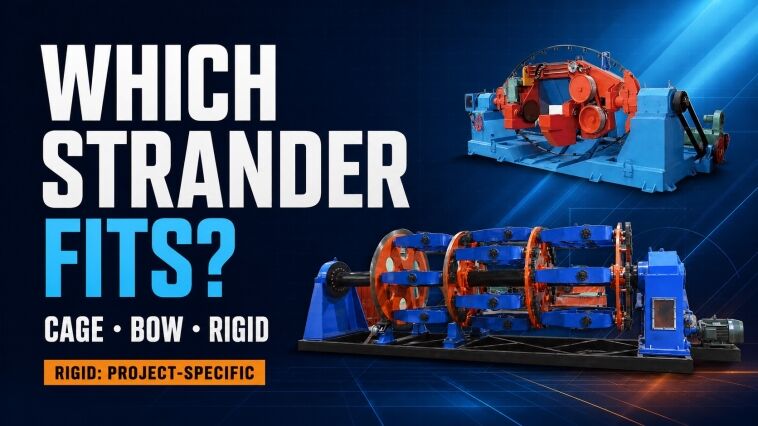
A factory owner, production manager or technical buyer comparing stranding machines must decide which rotating system can produce the approved conductor or cable core—not which catalog name sounds fastest. The choice affects input packages, torsion behavior, lay control, loading, floor interfaces, tooling and the evidence required at factory acceptance.
Cage, bow and rigid stranding machines are not interchangeable model tiers. Start with the finished product construction, then match the element being stranded, individual-wire or core packages, required lay, compaction or backtwist behavior, take-up package and acceptance tests to a verified machine configuration.

Real HONGKAI cage/planetary stranding machine reference. The final cage arrangement, bobbin count, package size and application must be confirmed for the project.
This guide uses “planetary cage,” “bow” and “rigid” as three comparison routes. Supplier terminology is not consistent: a rigid strander is also a cage-type machine, and a page labelled only “cage strander” may describe a planetary, rigid or project-specific arrangement. The purchase specification must therefore describe the mechanism and product duty, not rely on the category name alone.
Why Are the Machine Names Alone Not Enough?
The three names describe rotating arrangements, not a complete production capability. A valid selection still needs the element being stranded, its construction, input packages, output package, lay, direction, tension behavior, tooling and downstream process.
The same factory may use stranding equipment for bare conductor, insulated cores, cable laying-up, screening, armouring or other project-specific work. Those duties impose different requirements even when the nominal finished diameter overlaps. A bare round-wire conductor and a laid-up group of insulated cores should not be assigned to one machine merely because both are called “stranded.”
The first drawing should be the approved conductor or cable construction. For a conductor, define material, individual-wire count and diameter, nominal cross-sectional area, finished geometry, compaction or sector requirement, lay and direction. For insulated cores or cable elements, add element diameter, stiffness, allowable torsion, color sequence, filler or binder requirements and the downstream sheath or armour route.
IEC 60228:2023 covers nominal cross-sectional areas, wire numbers and sizes, and resistance values for several conductor types used in power cables and cords. The IEC record also explains that applicability depends on the relevant cable standard and generally concerns the conductor in the finished cable.1 A machine quotation must therefore connect the stranding process to the finished-product specification instead of treating a standard number as proof that the equipment is suitable.
Common mistakes: A supplier receives only the finished cable name, finished outside diameter or conductor area and selects a machine before the strand construction is known. Another common error is to compare maximum rotational speed without confirming the actual lay, package state, wire condition and stable product result.
How Do Cage, Bow and Rigid Stranding Machines Compare?
Use a same-dimension matrix to narrow the route, then request a project-specific operating window. The table below is a screening tool; it does not replace the signed machine specification or FAT plan.
| Comparison dimension | Planetary cage route | Bow route | Rigid strander route |
|---|---|---|---|
| Rotating concept | Bobbins sit in cradles carried by a rotating cage; a planetary arrangement can control element orientation or backtwist | Elemen busur berputar memberikan twist pada strand; konfigurasi busur-skip juga dapat mencakup backtwist terkendali | Bobin payoff dipasang pada dudukan kaku yang berputar bersama rotor, biasanya tanpa backtwist planetari |
| Pertanyaan aplikasi pertama | Apakah produk mengandung inti terisolasi, elemen berbentuk, atau input lain yang memerlukan pengendalian orientasi atau torsinya? | Apakah model busur yang diverifikasi mencakup konduktor tepat, pelapisan kabel terisolasi, atau tugas strand, termasuk perilaku backtwist, lay, dan paket? | Apakah tugasnya adalah konduktor daya, konduktor udara, lapisan penyekat, atau konstruksi lain yang cocok untuk susunan rotor kaku? |
| Pertanyaan paket input | Berapa banyak bobin, dimensi dan massa apa, serta susunan dudukan/backtwist apa yang diperlukan? | Di mana lokasi paket input, bagaimana cara memuatnya, dan ukuran paket mana yang telah terbukti sesuai kondisi yang dibutuhkan? | Diameter bobin, sistem pemuatan, bagian kandang, dan jumlah kawat apa yang diperlukan untuk setiap lapisan produk? |
| Bukti produk | Orientasi elemen, lay, geometri inti, perilaku binder, dan pembangunan reel | Lay, geometri konduktor, perilaku tegangan, kondisi permukaan, dan pembangunan reel | Lay, geometri konduktor, hasil kompaksi atau pembentukan, dasar uji listrik, dan pembangunan reel |
| Risiko utama pemilihan | “Kandang” diterima tanpa menyatakan perilaku planetari atau kaku | Kecepatan katalog dianggap sebagai bukti produksi stabil untuk setiap lay dan konduktor | Kapasitas rotor besar dibeli tanpa membuktikan produk terkecil, metode pemuatan, atau peralatan yang diperlukan |
| Status konfigurasi | Jumlah bobin, rasio backtwist, binder, capstan, dan take-up tetap spesifik proyek | Tabel model aktif HONGKAI hanya merupakan referensi penyaringan awal; rentang tepat harus diterbitkan ulang | HONGKAI has no universal rigid-strander table approved for this article; the complete scope must be confirmed per project |
Itu HONGKAI cage stranding machine page shows that cage arrangements vary by bobbin quantity, stranding diameter and support form. That variation is more useful to a buyer than the category name: it proves that the cage block, package and product window must be configured together.
Itu HONGKAI bow-type stranding machine page likewise separates models by input-wire range, finished conductor range, lay window and machine speed. Those published values can begin a technical discussion, but this article deliberately does not repeat them as universal capability. The final proposal must identify which exact model, product, package, lay and test condition supports every quoted value.
Bow does not mean only fine wire. An official MFL GROUP bow-skip machinery catalogue describes backtwist configurations for bare copper, aluminium and aluminium-alloy conductors, insulated-cable laying-up and steel strands.2 This establishes category-level applications, not a HONGKAI model guarantee; the exact duty still needs a verified proposal and product test.

Real HONGKAI bow-type stranding machine reference. Exact model, wire range, lay, package and supplied controls require project confirmation.
Note: “Cage” and “rigid” are not always mutually exclusive sales categories. Require a layout and mechanism description that states whether the bobbin cradles backtwist, rotate rigidly with the cage, or use another arrangement.
Which Product Inputs Decide the Route?
Five connected inputs decide the route: finished construction, individual elements, lay and direction, package interfaces, and required proof. A missing value in any one group can change the selected stranding machine or make its claimed operating window unusable.
Finished construction and strand duty
List every launch product separately. For each one, state whether the machine produces a bare conductor, a compacted or shaped conductor, a laid-up cable core, a screen, an armour layer or another defined intermediate product. Add the applicable cable drawing and finished-product standard. Do not combine future products into one unsupported “maximum range.”
Individual wires, cores or cable elements
Define material, coating, diameter, count, surface condition, stiffness and allowable torsion. For insulated cores, include the insulation outside diameter and tolerance. For bare wires, include the incoming wire condition and the forming or compaction requirement. If a product uses fillers, binders, tapes or water-blocking elements, show their position and supply package.
Lay, direction and layer sequence
Write the required lay or lay range by product and layer, including S or Z direction and the measurement method. State whether alternating layers, concentric construction, sector formation, preforming or post-forming is required. A nominal pitch range does not prove that the machine can hold the product result at the requested operating condition.
Payoff and take-up packages
Give drawings or verified dimensions for every input and output reel: flange diameter, barrel diameter, traverse width, center hole or pintle interface, approved mass and lifting method. Specify shafted or shaftless loading, trolley, crane or hydraulic assistance, aisle and service access. Reel diameter by itself does not prove that the package can be loaded, clamped, braked or traversed correctly.
Dasar penerimaan
Connect each product to a representative sample, machine recipe or gear setting, test method, instrument, pass limit and retained record. Define which checks occur at the stranding stage and which are only valid on the finished conductor or cable. A no-load rotation test is an assembly check, not product acceptance.
Jaga rute penganyaman tetap sementara ketika permintaan hanya menyebutkan “mesin penganyam.” Pertama-tama tentukan diameter luar masing-masing kawat, inti, atau elemen kabel sebelum proses penganyaman, diameter luar akhir yang diinginkan, jumlah elemen, serta spesifikasi lengkap produk. Arah anyaman (lay) yang diperlukan dan detail gulungan payoff/take-up kemudian dapat mempersempit pilihan mesin yang sesuai, namun tidak menggantikan gambar konstruksi yang telah disetujui.
Jangan mewajibkan backtwist planetary semata-mata karena inputnya berupa subunit kawat tembaga; pertama-tama pastikan apakah konstruksinya memberlakukan kondisi orientasi atau torsi. Apabila konstruksi loose-tube optik plastik memerlukan pelepasan dari puntiran, lenturan, atau tumpang tindih yang terakumulasi, rute SZ arah bolak-balik dapat dipertimbangkan. Mesin kabel LAN juga bersifat spesifik produk: halaman resmi peralatan SETIC mencantumkan solusi non-backtwist, single-backtwist, dan triple-twist untuk aplikasi LAN.3 Nama bahan saja oleh karena itu tidak dapat menentukan mekanisme; konstruksi kabel, torsi yang diizinkan, dan hasil transmisi yang dibutuhkan harus dikonfirmasi.
Kriteria keputusan: Jika pemasok tidak dapat memetakan semua lima kelompok ke satu konfigurasi yang ditandatangani dan matriks FAT, biarkan rute tetap sementara. Jangan gunakan diameter terbesar atau kecepatan tertinggi yang terdaftar untuk mengisi keputusan yang hilang.
Bagaimana Pembeli Harus Memilih Rute Langkah Demi Langkah?
Eliminasi rute yang tidak kompatibel sebelum membandingkan penawaran komersial. Setujui produk, tentukan setiap masukan, sesuaikan mekanisme rotasi dengan beban, dan sepakati bukti yang diperlukan untuk jendela operasi.
-
Produk — Sebutkan output yang tepat. Setujui gambar, beban konstruksi, standar yang berlaku, serta produk yang diluncurkan dan produk masa depan yang benar-benar termasuk dalam lingkup.
-
Elemen — Tentukan setiap masukan. Daftarkan kawat atau inti individu, bahan, diameter, jumlah, sensitivitas torsi, pengikat, perkakas, dan paket masuk.
-
Mechanism — Match rotation to duty. Decide whether orientation/backtwist control, a bow arrangement or a rigid rotor is technically appropriate for the confirmed construction.
-
Evidence — Prove the operating window. Agree the reels, lay, operating condition, sample, tests, safeguards and records before approving the model.
Use the following route logic as a first technical filter:
- If insulated cores or shaped cable elements must keep a controlled orientation, review a planetary cage arrangement and state the required backtwist behavior.
- If the confirmed product is a bare conductor, insulated-cable laying-up duty or strand covered by a verified bow model, compare bow loading, backtwist behavior, lay, tension, surface condition and stable product evidence.
- If the product is a power conductor, aerial conductor, screen or other duty suited to a rigid rotor, review the rigid cage sections, bobbin loading, compaction/forming tools, capstan and take-up as one line. Official rigid-cage equipment information shows separate configurations for conductor and screening duties across aerial, submarine and wind-power cable applications.4
- If the duty is only to bunch fine wires into a flexible conductor, compare a wire bunching machine before assuming that a cage, bow or rigid line is necessary. HONGKAI’s wire bunching machine selection guide explains the conductor, lay, reel, tension and FAT inputs for that separate route.
The route can still change after this filter. A buyer may discover that one product family needs two machines because the smallest and largest constructions do not share a practical operating window. The alternative is not automatically one oversized machine: the factory must compare changeover, input packages, stable operating evidence, floor handling and future product volume.
Tambahkan posisi sangkar hanya ketika jumlah elemen aktual pembeli, rentang produk, dan ukuran gulungan sesuai dengan posisi tersebut. Sebagai contoh, cantumkan keluarga kabel konsentris mendatang berdasarkan konstruksi riil dan jumlah elemen yang dibutuhkan sebelum menambahkan posisi bobbin tambahan. “Lebih banyak posisi untuk ekspansi” tidak cukup tanpa matriks produk yang menunjukkan di mana posisi-posisi tersebut akan digunakan.
Red flags: A proposal calls a machine “multi-purpose” but does not list excluded products; the layout omits loading or service zones; a bow machine is selected only from maximum speed; or a rigid machine is selected only because it has more bobbins than the launch product needs.
Which Factory Interfaces Can Change the Decision?
The selected mechanism must also fit the factory. Power, foundation, guarding, reel movement, lifting, material flow, operator access and downstream packages can disqualify a technically plausible machine.
Large rotating assemblies require an approved foundation, alignment method and controlled access. The exact civil load, installation tolerance and anchoring method must come from the selected supplier drawing. Do not copy foundation data from another model or assume that overall machine dimensions define the required operating area.
Reel logistics deserve a separate layout check. Mark the path from incoming reel storage to every payoff, the loading device and clearance, the finished-reel removal path and transfer to the next process. Include the largest approved package and the lifting radius. A reel that fits inside the machine may still fail at the doorway, aisle, crane, trolley or downstream payoff.
Electrical and safety scope must be machine-specific. IEC 60204-1:2016 with Amendment 1:2021 applies to electrical, electronic and programmable electronic equipment of machines from the supply connection.5 ISO 12100:2010 memberikan prinsip dan metodologi untuk penilaian risiko mesin dan pengurangan risiko.6 Tidak ada referensi yang menggantikan uji coba perlindungan, interlock, stop darurat, pengereman, isolasi, pemuatan, dan restart yang diperlukan oleh jalur yang disediakan.
Daftar Periksa:
- ☐ Pasokan daya dan ruang lingkup listrik mesin yang disetujui
- ☐ Gambar fondasi, pengancing, dan penyelarasan
- ☐ Perlindungan, kontrol akses, dan perilaku pemberhentian aman
- ☐ Perangkat pemuatan gulungan, massa dan jalur perjalanan yang disetujui
- ☐ Aliran material dari payoff ke take-up dan jarak pelayanan
- ☐ Antarmuka pengikat, pita, pemadatan, pembentukan, dan pengukuran
- ☐ Kompatibilitas gulungan hilir dan metode penanganan
- ☐ Utilitas, dokumentasi, dan tanggung jawab yang ditetapkan oleh pihak
Catatan: Sebuah kepala pilitan yang secara teknis benar tidak membuat jalur yang dapat digunakan secara lengkap. Ruang lingkup yang ditandatangani harus mencakup setiap antarmuka yang diperlukan untuk memuat, menjalankan, mengukur, menghentikan, melepaskan, dan mentransfer produk yang disetujui dengan aman.
Apa yang Harus Dibuktikan oleh FAT untuk Mesin Pilitan?
FAT harus membuktikan rute produk yang disepakati, bukan hanya rotasi. Bukti yang diterima harus menghubungkan paket input dan material yang diidentifikasi dengan pengaturan mesin, gulungan output yang dapat dilacak, pengukuran produk, uji keselamatan, dan konfigurasi yang ditandatangani.
Buat matriks FAT saat penawaran masih sedang dibandingkan. Ini mencegah bahan, gulungan, perkakas, atau instrumen menjadi substitusi mendadak. Pilih sampel yang mewakili risiko nyata pembeli: kawat input terkecil, produk terbesar atau paling menuntut, jarak pilitan terpendek atau kritis, geometri berbentuk atau terkompaksi, transisi paket, dan kondisi apa pun yang mengubah ketegangan atau beban.
| Bukti FAT | Apa yang harus dicantumkan dalam catatan | Mengapa pembeli membutuhkannya |
|---|---|---|
| Kesesuaian konfigurasi | Bagian mesin, jumlah dan ukuran bobbin, drive, capstan, penarik, perkakas, pengikat, pelindung, dan versi perangkat lunak/resep | Membuktikan bahwa mesin yang diuji adalah mesin yang dibeli |
| Jejak input | Material, dimensi dan jumlah kawat/inti, gambar gulungan, keadaan dan sumber paket | Mencegah input substitusi mudah menyamarkan tugas produksi |
| Jarak dan arah | Nilai pengaturan, pengukuran aktual, metode, panjang sampel, arah S/Z, dan lapisan | Menghubungkan pengaturan dengan output pilitan nyata |
| Geometri dan uji produk | Diameter, kerataan atau geometri berbentuk, bukti kompaksi/forming, permukaan, dan uji listrik atau kabel yang berlaku | Menunjukkan apakah output dapat digunakan dan memenuhi dasar yang disepakati |
| Perilaku ketegangan dan paket | Startup, operasi stabil, perlambatan, berhenti, pembangunan gulungan, dan kondisi representatif dari kosong-ke-penuh atau simulasi yang disepakati | Mengungkap ketidakstabilan yang tersembunyi oleh demonstrasi singkat yang stabil |
| Perlindungan dan kesalahan | Perlindungan/interlock, berhenti darurat, putus kawat, pengereman, dan perilaku reset serta restart terkendali sebagaimana disediakan | Mengonfirmasi fungsi perlindungan dan respons kesalahan |
| Dokumen dan item terbuka | Gambar, manual, daftar suku cadang, pengaturan, hasil mentah, sampel, penyimpangan, pemilik, dan tanggal penutupan | Membuat penerimaan dapat diaudit setelah pengiriman |
Bukti yang diminta: Simpan gambar input dan output yang disetujui, tata letak mesin, daftar konfigurasi, pengaturan, pengukuran mentah, identitas sampel, foto, atau rekaman operasi tanpa diedit, hasil perlindungan, dan daftar item terbuka yang bertanggal. Jika suatu hasil hanya berlaku untuk satu produk atau kondisi operasi, label batas tersebut dalam laporan FAT.
Kesalahan umum: FAT menggunakan kawat yang tidak diidentifikasi, gulungan yang berbeda, lay yang lebih panjang dan lebih mudah, pengambilan yang sebagian terisi, atau produk di luar rencana peluncuran pembeli. Kegagalan lain adalah menerima lay yang dihitung, nilai tampilan, atau video singkat tanpa mengukur strand sebenarnya dan menyimpan hasilnya.
Pilih produk FAT representatif dari spesifikasi yang telah dikonfirmasi, rentang lay yang dipersyaratkan, persyaratan tegangan, serta ukuran reel payoff/take-up. Sertakan kondisi produk yang menguji batas-batas yang disepakati dan simpan bukti aktual mengenai lay dan tegangan tersebut. Lulusnya satu sampel yang lebih mudah hanya membuktikan sampel tersebut saja; hal ini tidak memvalidasi setiap produk dalam rentang yang diusulkan.
Bagaimana HONGKAI Merumuskan Perbandingan Spesifik Proyek?
HONGKAI merumuskan permintaan sebagai perbandingan produk-ke-proses, lalu membedakan keluarga referensi HONGKAI saat ini dari peralatan spesialis yang memerlukan konfigurasi spesifik proyek. Proposal harus menjaga sumber, tanggung jawab, eksklusi, dan dasar penerimaan tetap terlihat.
Ruang lingkup peralatan saat ini HONGKAI membedakan mesin inti yang diproduksi oleh HONGKAI dari proses spesialis yang dapat diintegrasikan dari produsen yang memenuhi syarat. Gambar, penggabungan, pelintiran, dan pelapisan termasuk dalam kelompok proses spesialis pada Ikhtisar ruang lingkup proyek HONGKAI. Artinya, pembeli harus mengharapkan satu ruang lingkup proyek yang terkoordinasi, sementara tanggung jawab dan sumber tepat setiap mesin harus tetap terlihat dalam penawaran.
Untuk permintaan cage atau bow, HONGKAI dapat memulai dengan keluarga produk aktif saat ini, lalu mengeluarkan kembali aplikasi, model, rentang, dan antarmuka yang persis sama untuk proyek tersebut. Untuk permintaan rigid-strander, draf ini tidak mengklaim bahwa model HONGKAI tertentu, susunan bobbin, kecepatan, rentang konduktor, atau sistem pemuatan sudah disetujui. Detail-detail tersebut harus dikonfirmasi terhadap portofolio produk dan konfigurasi spesialis yang dipilih.
Pembeli harus mengirim satu matriks produk sebelum meminta perbandingan komersial:
| Bidang yang diperlukan | Masukan pembeli |
|---|---|
| Produk jadi | Penggambaran konduktor/kabel, tugas, dan standar yang berlaku |
| Elemen-elemen individual | Material, pelapisan, diameter, jumlah, isolasi, dan sensitivitas torsi |
| Geometri untaian | Diameter/bentuk akhir, persyaratan pemadatan atau sektor, urutan lapisan |
| Lay | Nilai atau rentang, arah S/Z, toleransi, dan metode pengukuran |
| Paket | Setiap gulungan penarik dan penerima, metode massa dan pemuatan |
| Penambahan proses | Unit pengikat, pita, pemblokir air, pre-forming, post-forming, pemadatan atau pengukuran |
| Antarmuka pabrik | Daya, fondasi, pelindung, pengangkat, lorong, dan transfer downstream |
| Penerimaan | FAT sampel, kondisi operasi, uji produk, pengaman, dan catatan yang disimpan |
Apa yang harus ditanyakan: Mintalah proposal HONGKAI untuk menyatakan mekanisme yang dipilih, mengapa mekanisme tersebut sesuai dengan setiap produk peluncuran, produk mana yang dikecualikan, nilai mana yang masih perlu dikonfirmasi, dan peralatan spesialis mana yang diintegrasikan daripada diproduksi langsung oleh HONGKAI. Ini menciptakan perbandingan teknis yang lebih jelas daripada tiga tabel katalog dengan definisi berbeda.
Catatan: Pembelian yang tepat adalah konfigurasi paling sempit yang telah diverifikasi yang mencakup portofolio produk yang disetujui, antarmuka pabrik, dan bukti penerimaan. Kategori mesin, diameter maksimum, dan kecepatan maksimum adalah label penyaringan—bukan keputusan akhir.
-
IEC, “IEC 60228:2023 — Penghantar kabel berisolasi,” catatan publikasi resmi.↩
-
MFL GROUP, “Katalog Mesin Kabel & Kawat,” aplikasi mesin stranding bow skip dan informasi backtwist.↩
-
SETIC & POURTIER, “Group Twinners,” halaman resmi peralatan kabel LAN.↩
-
MFL GROUP, “Solusi Mesin Kabel & Kawat,” halaman resmi keluarga produk yang mencantumkan rute konduktor dan skrining CES dan RCS dengan sangkar kaku.↩
-
IEC, “IEC 60204-1:2016+AMD1:2021 — Keselamatan mesin — Peralatan listrik mesin — Bagian 1: Persyaratan umum,” catatan publikasi resmi.↩
-
ISO, “ISO 12100:2010 — Keselamatan mesin — Prinsip umum perancangan — Penilaian risiko dan pengurangan risiko,” catatan publikasi resmi.↩
