










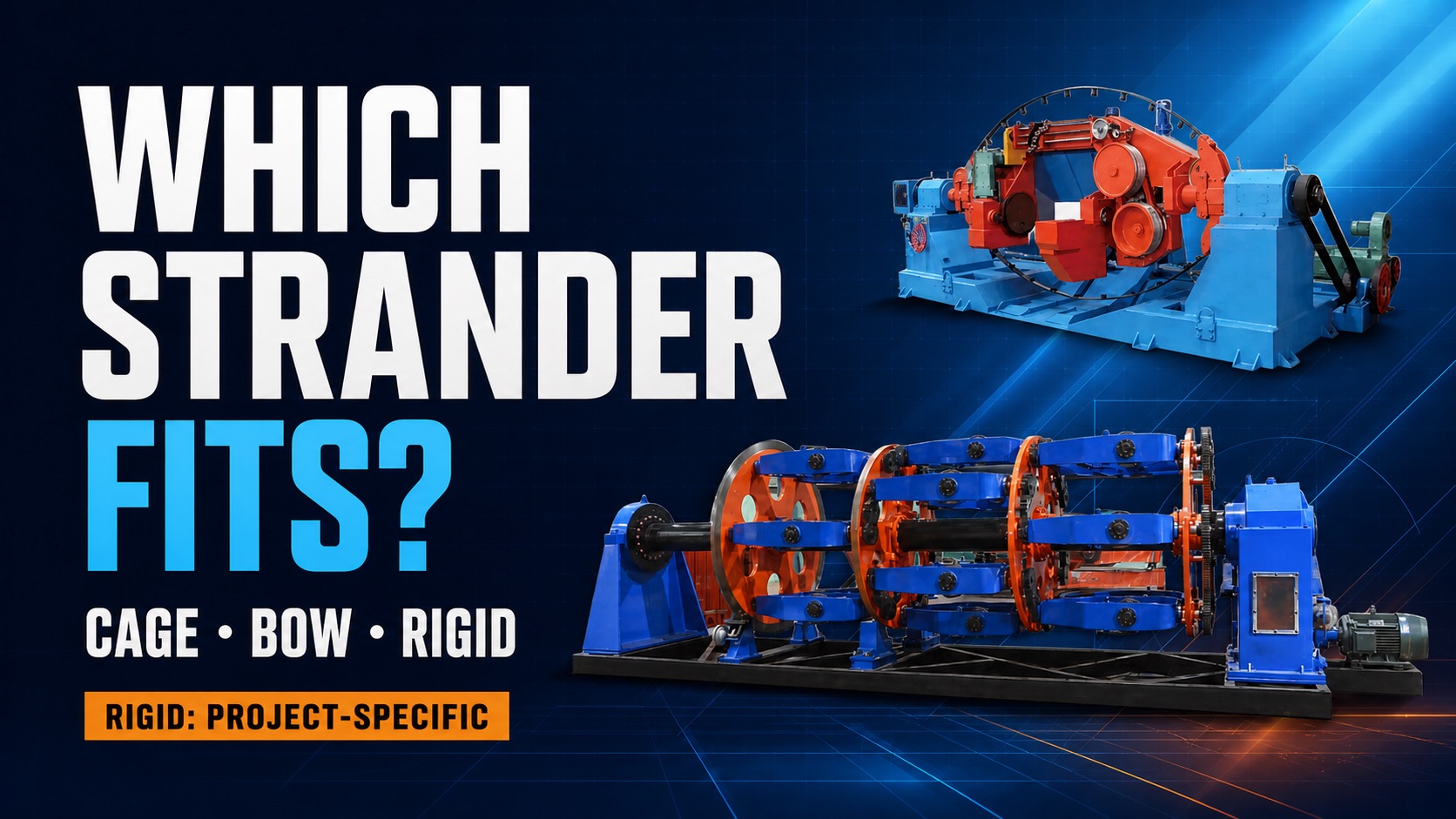
A factory owner, production manager or technical buyer comparing stranding machines must decide which rotating system can produce the approved conductor or cable core—not which catalog name sounds fastest. The choice affects input packages, torsion behavior, lay control, loading, floor interfaces, tooling and the evidence required at factory acceptance.
Cage, bow and rigid stranding machines are not interchangeable model tiers. Start with the finished product construction, then match the element being stranded, individual-wire or core packages, required lay, compaction or backtwist behavior, take-up package and acceptance tests to a verified machine configuration.
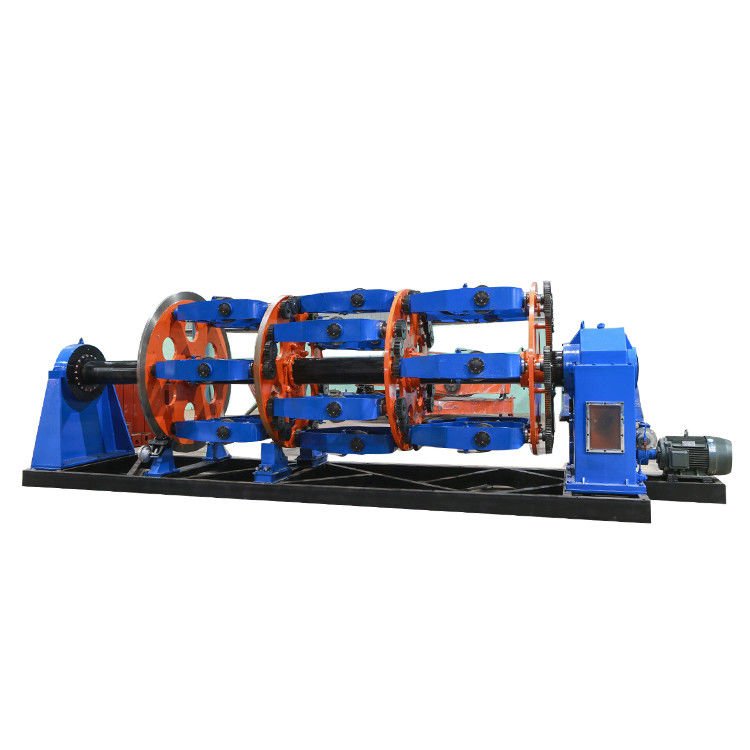
Real HONGKAI cage/planetary stranding machine reference. The final cage arrangement, bobbin count, package size and application must be confirmed for the project.
This guide uses “planetary cage,” “bow” and “rigid” as three comparison routes. Supplier terminology is not consistent: a rigid strander is also a cage-type machine, and a page labelled only “cage strander” may describe a planetary, rigid or project-specific arrangement. The purchase specification must therefore describe the mechanism and product duty, not rely on the category name alone.
Why Are the Machine Names Alone Not Enough?
The three names describe rotating arrangements, not a complete production capability. A valid selection still needs the element being stranded, its construction, input packages, output package, lay, direction, tension behavior, tooling and downstream process.
The same factory may use stranding equipment for bare conductor, insulated cores, cable laying-up, screening, armouring or other project-specific work. Those duties impose different requirements even when the nominal finished diameter overlaps. A bare round-wire conductor and a laid-up group of insulated cores should not be assigned to one machine merely because both are called “stranded.”
The first drawing should be the approved conductor or cable construction. For a conductor, define material, individual-wire count and diameter, nominal cross-sectional area, finished geometry, compaction or sector requirement, lay and direction. For insulated cores or cable elements, add element diameter, stiffness, allowable torsion, color sequence, filler or binder requirements and the downstream sheath or armour route.
IEC 60228:2023 covers nominal cross-sectional areas, wire numbers and sizes, and resistance values for several conductor types used in power cables and cords. The IEC record also explains that applicability depends on the relevant cable standard and generally concerns the conductor in the finished cable.1 A machine quotation must therefore connect the stranding process to the finished-product specification instead of treating a standard number as proof that the equipment is suitable.
Common mistakes: A supplier receives only the finished cable name, finished outside diameter or conductor area and selects a machine before the strand construction is known. Another common error is to compare maximum rotational speed without confirming the actual lay, package state, wire condition and stable product result.
How Do Cage, Bow and Rigid Stranding Machines Compare?
Use a same-dimension matrix to narrow the route, then request a project-specific operating window. The table below is a screening tool; it does not replace the signed machine specification or FAT plan.
| Comparison dimension | Planetary cage route | Bow route | Rigid strander route |
|---|---|---|---|
| Rotating concept | Bobbins sit in cradles carried by a rotating cage; a planetary arrangement can control element orientation or backtwist | Rotating bow elements impart the strand; a bow-skip configuration may also include controlled backtwist | Payoff bobbins are mounted in rigidly carried cradles that rotate with the rotor, normally without planetary backtwist |
| First application question | Does the product contain insulated cores, shaped elements or other inputs whose orientation or torsion needs control? | Does the verified bow model cover the exact conductor, insulated-cable laying-up or strand duty, including backtwist behavior, lay and packages? | Is the duty a power conductor, aerial conductor, screening layer or another construction suited to a rigid rotor arrangement? |
| Input-package question | How many bobbins, what dimensions and mass, and what cradle/backtwist arrangement are required? | Where are the input packages, how are they loaded, and which package sizes are proven at the required condition? | Which bobbin diameter, loading system, cage section and wire count are needed for every product layer? |
| Product evidence | Element orientation, lay, core geometry, binder behavior and reel build | Lay, conductor geometry, tension behavior, surface condition and reel build | Lay, conductor geometry, compaction or forming result, electrical test basis and reel build |
| Main selection risk | “Cage” is accepted without stating planetary or rigid behavior | Catalog speed is treated as stable production evidence for every lay and conductor | Large rotor capacity is purchased without proving the smallest product, loading method or required tooling |
| কনফিগারেশন অবস্থা | Bobbin count, backtwist ratio, binder, capstan and take-up remain project-specific | HONGKAI’s live model table is only an initial screening reference; exact range must be reissued | HONGKAI has no universal rigid-strander table approved for this article; the complete scope must be confirmed per project |
দ্য HONGKAI cage stranding machine page shows that cage arrangements vary by bobbin quantity, stranding diameter and support form. That variation is more useful to a buyer than the category name: it proves that the cage block, package and product window must be configured together.
দ্য HONGKAI bow-type stranding machine page likewise separates models by input-wire range, finished conductor range, lay window and machine speed. Those published values can begin a technical discussion, but this article deliberately does not repeat them as universal capability. The final proposal must identify which exact model, product, package, lay and test condition supports every quoted value.
Bow does not mean only fine wire. An official MFL GROUP bow-skip machinery catalogue describes backtwist configurations for bare copper, aluminium and aluminium-alloy conductors, insulated-cable laying-up and steel strands.2 This establishes category-level applications, not a HONGKAI model guarantee; the exact duty still needs a verified proposal and product test.
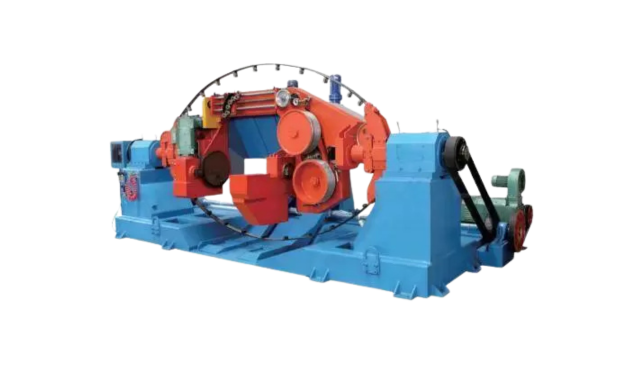
Real HONGKAI bow-type stranding machine reference. Exact model, wire range, lay, package and supplied controls require project confirmation.
Note: “Cage” and “rigid” are not always mutually exclusive sales categories. Require a layout and mechanism description that states whether the bobbin cradles backtwist, rotate rigidly with the cage, or use another arrangement.
Which Product Inputs Decide the Route?
Five connected inputs decide the route: finished construction, individual elements, lay and direction, package interfaces, and required proof. A missing value in any one group can change the selected stranding machine or make its claimed operating window unusable.
Finished construction and strand duty
List every launch product separately. For each one, state whether the machine produces a bare conductor, a compacted or shaped conductor, a laid-up cable core, a screen, an armour layer or another defined intermediate product. Add the applicable cable drawing and finished-product standard. Do not combine future products into one unsupported “maximum range.”
Individual wires, cores or cable elements
Define material, coating, diameter, count, surface condition, stiffness and allowable torsion. For insulated cores, include the insulation outside diameter and tolerance. For bare wires, include the incoming wire condition and the forming or compaction requirement. If a product uses fillers, binders, tapes or water-blocking elements, show their position and supply package.
Lay, direction and layer sequence
Write the required lay or lay range by product and layer, including S or Z direction and the measurement method. State whether alternating layers, concentric construction, sector formation, preforming or post-forming is required. A nominal pitch range does not prove that the machine can hold the product result at the requested operating condition.
Payoff and take-up packages
Give drawings or verified dimensions for every input and output reel: flange diameter, barrel diameter, traverse width, center hole or pintle interface, approved mass and lifting method. Specify shafted or shaftless loading, trolley, crane or hydraulic assistance, aisle and service access. Reel diameter by itself does not prove that the package can be loaded, clamped, braked or traversed correctly.
গ্রহণযোগ্যতার ভিত্তি
Connect each product to a representative sample, machine recipe or gear setting, test method, instrument, pass limit and retained record. Define which checks occur at the stranding stage and which are only valid on the finished conductor or cable. A no-load rotation test is an assembly check, not product acceptance.
Keep the stranding route provisional when an enquiry says only “stranding machine.” First define the outside diameter of each wire, core or cable element before stranding, the required finished outside diameter, the number of elements and the complete product specification. Required lay and payoff/take-up reel details can then narrow the candidate machine, but they do not replace the approved construction drawing.
Do not require planetary backtwist solely because the inputs are copper-wire subunits; first confirm whether the construction imposes an orientation or torsion condition. Where a plastic optical loose-tube construction needs relief from accumulated twist, bending or overlap, an alternating-direction SZ route may be considered. LAN cable machinery is also product-specific: an official SETIC equipment page lists non-backtwist, single-backtwist and triple-twist solutions for LAN applications.3 Material name alone therefore cannot decide the mechanism; the cable construction, allowable torsion and required transmission result must be confirmed.
Decision criterion: If the supplier cannot map all five groups to one signed configuration and FAT matrix, keep the route provisional. Do not use the largest diameter or highest listed speed to fill the missing decisions.
How Should a Buyer Choose the Route Step by Step?
Eliminate incompatible routes before comparing commercial offers. Approve the product, define every input, match the rotation mechanism to the duty and agree the proof required for the operating window.
-
Product — Name the exact output. Approve the drawing, construction duty, applicable standard, launch products and future products that genuinely belong in scope.
-
Elements — Define every input. List individual wires or cores, material, diameter, count, torsion sensitivity, binders, tooling and incoming packages.
-
Mechanism — Match rotation to duty. Decide whether orientation/backtwist control, a bow arrangement or a rigid rotor is technically appropriate for the confirmed construction.
-
Evidence — Prove the operating window. Agree the reels, lay, operating condition, sample, tests, safeguards and records before approving the model.
Use the following route logic as a first technical filter:
- If insulated cores or shaped cable elements must keep a controlled orientation, review a planetary cage arrangement and state the required backtwist behavior.
- If the confirmed product is a bare conductor, insulated-cable laying-up duty or strand covered by a verified bow model, compare bow loading, backtwist behavior, lay, tension, surface condition and stable product evidence.
- If the product is a power conductor, aerial conductor, screen or other duty suited to a rigid rotor, review the rigid cage sections, bobbin loading, compaction/forming tools, capstan and take-up as one line. Official rigid-cage equipment information shows separate configurations for conductor and screening duties across aerial, submarine and wind-power cable applications.4
- If the duty is only to bunch fine wires into a flexible conductor, compare a wire bunching machine before assuming that a cage, bow or rigid line is necessary. HONGKAI’s তার বান্ডিলিং মেশিন নির্বাচন গাইড সেই পৃথক রুটের জন্য কন্ডাক্টর, লে, রিল, টেনশন এবং FAT ইনপুটগুলি ব্যাখ্যা করে।.
The route can still change after this filter. A buyer may discover that one product family needs two machines because the smallest and largest constructions do not share a practical operating window. The alternative is not automatically one oversized machine: the factory must compare changeover, input packages, stable operating evidence, floor handling and future product volume.
Add cage positions only when the buyer’s actual element counts, product range and reel sizes map to them. For example, list a future concentric-cable family by real construction and required number of elements before adding extra bobbin positions. “More positions for expansion” is not enough without a product matrix that shows where those positions will be used.
Red flags: A proposal calls a machine “multi-purpose” but does not list excluded products; the layout omits loading or service zones; a bow machine is selected only from maximum speed; or a rigid machine is selected only because it has more bobbins than the launch product needs.
কোন কারখানা ইন্টারফেসগুলি সিদ্ধান্ত পরিবর্তন করতে পারে?
The selected mechanism must also fit the factory. Power, foundation, guarding, reel movement, lifting, material flow, operator access and downstream packages can disqualify a technically plausible machine.
Large rotating assemblies require an approved foundation, alignment method and controlled access. The exact civil load, installation tolerance and anchoring method must come from the selected supplier drawing. Do not copy foundation data from another model or assume that overall machine dimensions define the required operating area.
Reel logistics deserve a separate layout check. Mark the path from incoming reel storage to every payoff, the loading device and clearance, the finished-reel removal path and transfer to the next process. Include the largest approved package and the lifting radius. A reel that fits inside the machine may still fail at the doorway, aisle, crane, trolley or downstream payoff.
বৈদ্যুতিক এবং নিরাপত্তা স্কোপ অবশ্যই মেশিন-নির্দিষ্ট হতে হবে।. IEC 60204-1:2016 with Amendment 1:2021 applies to electrical, electronic and programmable electronic equipment of machines from the supply connection.5 ISO 12100:2010 provides principles and a methodology for machinery risk assessment and risk reduction.6 Neither reference is a substitute for the exact guarding, interlock, emergency-stop, braking, isolation, loading and restart tests required by the supplied line.
Checklist:
- ☐ Approved power supply and machine electrical scope
- ☐ Foundation, anchoring and alignment drawing
- ☐ Guarding, access control and safe stopping behavior
- ☐ Reel loading device, approved mass and travel path
- ☐ Payoff-to-take-up material flow and service clearance
- ☐ Binder, tape, compaction, forming and measuring interfaces
- ☐ Downstream reel compatibility and handling method
- ☐ Utilities, documentation and responsibilities assigned by party
Note: A technically correct stranding head does not make a complete usable line. The signed scope must include every interface required to load, run, measure, stop, unload and transfer the approved product safely.
What Must the FAT Prove for Stranding Machines?
FAT must prove the agreed product route, not only rotation. The accepted evidence should connect identified input packages and material to machine settings, a traceable output reel, product measurements, safeguard tests and the signed configuration.
Build the FAT matrix while the quotation is still being compared. This prevents material, reels, tooling or instruments from becoming last-minute substitutions. Select samples that represent the buyer’s actual risk: the smallest input wire, largest or most demanding product, shortest or critical lay, shaped or compacted geometry, package transition, and any condition that changes tension or loading.
| FAT evidence | What the record should contain | Why the buyer needs it |
|---|---|---|
| Configuration match | Machine sections, bobbin count and size, drives, capstan, take-up, tooling, binders, guards and software/recipe version | Proves that the tested machine is the purchased machine |
| Input traceability | Material, wire/core dimensions and count, reel drawings, package state and source | Prevents an easy substitute input from masking the production duty |
| Lay and direction | Set value, actual measurement, method, sample length, S/Z direction and layer | Connects the setting to the real stranded output |
| Geometry and product tests | Diameter, roundness or shaped geometry, compaction/forming evidence, surface and applicable electrical or cable tests | Shows whether the output is usable and meets the agreed basis |
| Tension and package behavior | Startup, stable running, slowdown, stop, reel build and representative empty-to-full condition or agreed simulation | Reveals instability hidden by a short steady demonstration |
| Safeguards and faults | Guard/interlock, emergency stop, wire break, braking, controlled reset and restart behavior as supplied | Confirms protective functions and fault response |
| Documents and open items | ড্রয়িং, ম্যানুয়াল, পার্টস লিস্ট, সেটিংস, কাঁচা ফলাফল, নমুনা, ব্যতিক্রম, মালিক এবং বন্ধ করার তারিখ | Makes acceptance auditable after delivery |
Evidence to request: Retain the approved input and output drawings, machine layout, configuration list, settings, raw measurements, sample identity, photographs or unedited running records, safeguard results and a dated open-item list. If a result applies only to one product or operating condition, label that boundary in the FAT report.
Common mistakes: FAT uses unidentified wire, a different reel, a longer and easier lay, a partly filled take-up or a product outside the buyer’s launch plan. Another failure is to accept calculated lay, display values or a short video without measuring the actual strand and retaining the result.
Choose the representative FAT product from the confirmed specification, required lay range, tension requirement and payoff/take-up reel sizes. Include the product condition that exercises the agreed limits and retain the actual lay and tension evidence. Passing one easier sample proves that sample only; it does not validate every product in the proposed range.
How Does HONGKAI Frame a Project-Specific Comparison?
HONGKAI frames the enquiry as a product-to-process comparison, then distinguishes current HONGKAI reference families from specialist equipment that requires a project-specific configuration. The proposal should keep the source, responsibility, exclusions and acceptance basis visible.
HONGKAI’s current equipment scope distinguishes core machines manufactured by HONGKAI from specialist processes that can be integrated from qualified manufacturers. Drawing, bunching, stranding and armouring fall into the specialist-process group on the HONGKAI project-scope overview. That means the buyer should expect one coordinated project scope, while the exact responsibility and source of each machine must remain visible in the quotation.
For a cage or bow enquiry, HONGKAI can begin with the current live product families and then reissue the exact application, model, range and interfaces for the project. For a rigid-strander enquiry, this draft makes no claim that a specific HONGKAI model, bobbin arrangement, speed, conductor range or loading system is already approved. Those details must be confirmed against the product portfolio and the selected specialist configuration.
The buyer should send one product matrix before requesting a commercial comparison:
| Required field | Buyer input |
|---|---|
| Finished product | Conductor/cable drawing, duty and applicable standard |
| Individual elements | Material, coating, diameter, count, insulation and torsion sensitivity |
| Strand geometry | Finished diameter/shape, compaction or sector requirement, layer sequence |
| Lay | Value or range, S/Z direction, tolerance and measurement method |
| Packages | Every payoff and take-up reel drawing, mass and loading method |
| Process additions | Binder, tape, water blocking, preforming, post-forming, compaction or measuring units |
| Factory interfaces | Power, foundation, guarding, lifting, aisle and downstream transfer |
| গ্রহণযোগ্যতা | FAT samples, operating conditions, product tests, safeguards and retained records |
What to ask: Require HONGKAI’s proposal to state the selected mechanism, why it matches each launch product, which products are excluded, which values remain to be confirmed and which specialist equipment is integrated rather than manufactured directly by HONGKAI. This creates a clearer technical comparison than three catalog tables with different definitions.
Note: The correct purchase is the narrowest verified configuration that covers the approved product portfolio, factory interfaces and acceptance evidence. Machine category, maximum diameter and maximum speed are screening labels—not the final decision.
-
IEC, “IEC 60228:2023 — Conductors of insulated cables,” official publication record. ↩
-
MFL GROUP, “Wire & Cable Machinery Catalogue,” bow skip stranding-machine application and backtwist information. ↩
-
SETIC & POURTIER, “Group Twinners,” official LAN cable equipment page. ↩
-
MFL GROUP, “Wire & Cable Machinery Solutions,” official product-family page listing CES and RCS rigid-cage conductor and screening routes. ↩
-
IEC, “IEC 60204-1:2016+AMD1:2021 — Safety of machinery — Electrical equipment of machines — Part 1: General requirements,” official publication record. ↩
-
ISO, “ISO 12100:2010 — Safety of machinery — General principles for design — Risk assessment and risk reduction,” official publication record. ↩