













A cable factory owner or production manager needs more than a video of a new production line running. Before accepting the equipment, agree on the trial cable, the required product quality, the supplied configuration and the evidence that will be kept. These decisions should be made before a factory acceptance test (FAT), then carried through to the site acceptance test (SAT) at the customer’s factory.
For a cable production line, FAT should demonstrate the agreed equipment configuration and selected trial products before shipment. SAT should verify installation, running behavior and product quality at the customer’s factory. Select the products and test conditions in advance, and close any failed acceptance item through a recorded correction and retest.
FAT and SAT are project-specific acceptance stages. IEC’s guidance for process-industry automation systems likewise emphasizes agreement on specifications, test scope and responsibilities; that is useful planning context, not a claim that every cable line is certified to that standard.1 The practical cable-line examples below use HONGKAI’s confirmed commissioning experience, with the actual test limits left to the customer’s product and purchase agreement.
Choose Trial Products That Prove the Order
A supplier-factory FAT does not automatically cover every cable in the customer’s future catalogue. Agree on a manageable group of representative products: the cables expected to account for substantial production, together with a technically demanding construction that exercises the ordered equipment. Record what the trial leaves untested.
Testing every specification at the supplier’s workshop may require different material grades, incoming sizes, reels and tooling. The preparation and material consumption can be substantial. In the HONGKAI practice described for this guide, selection therefore starts with commercially important products and a few constructions that can meaningfully verify the equipment. A higher-element-count optical cable may be one such sample when it exercises the processes and quality requirements included in the order; a high core count alone does not prove every process capability.
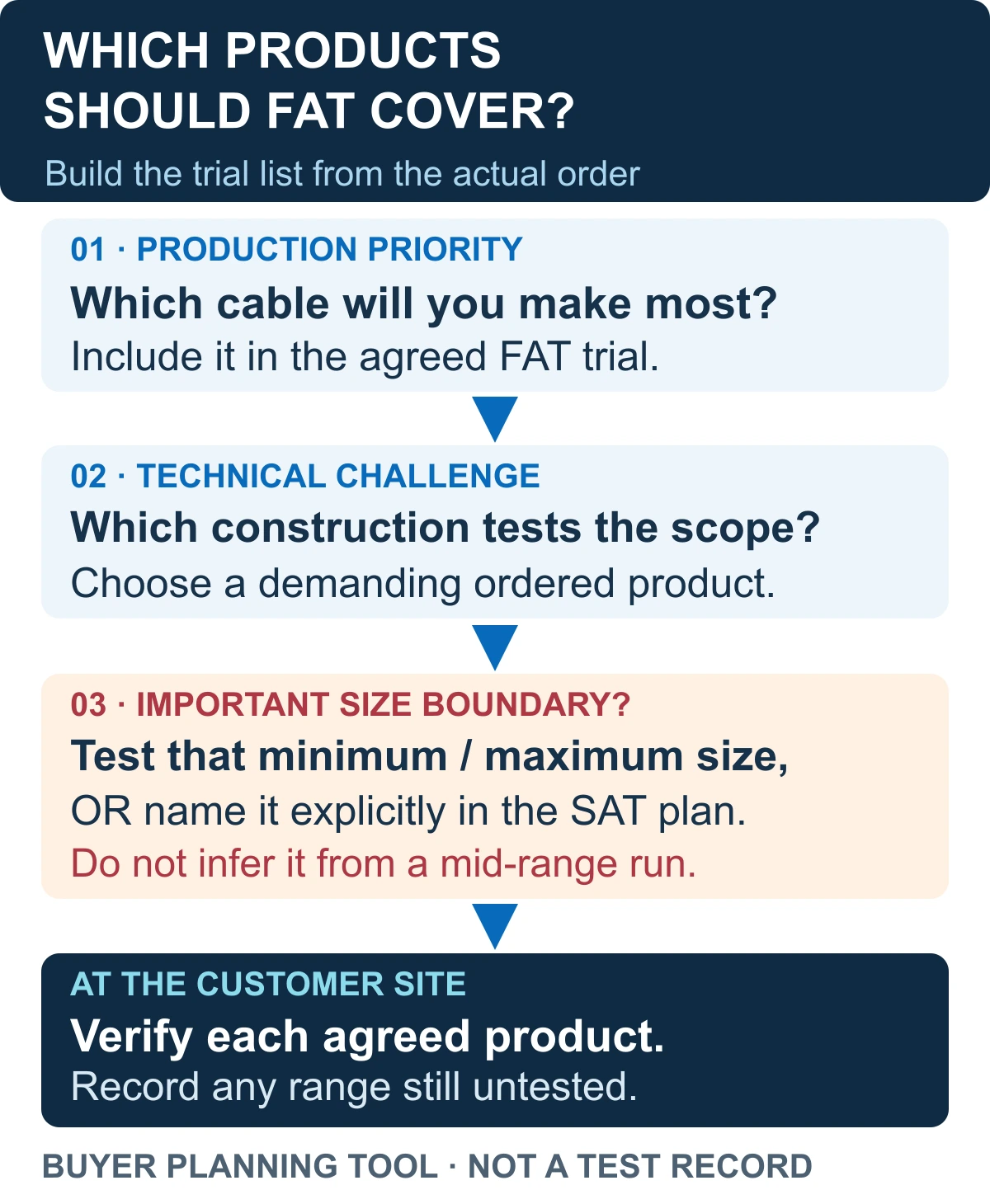
Buyer planning worksheet: agree on FAT trial products and explicitly identify any boundaries left for SAT. Not a completed test record.
Minimum and maximum sizes belong in the FAT plan when those boundaries are important to the purchase. Do not silently assume that one successful mid-range product proves both extremes. If a boundary is left for the customer’s site, name that product and its later verification step in the test matrix.
At the customer’s factory, plan to test each intended product or specification in the agreed commissioning range. Materials must be ready, and the trial quantity should reflect what is needed to evaluate the product without unnecessary waste. A large catalogue may need a staged schedule rather than one uninterrupted acceptance day.
| Cable-line trial field | Agree before design and testing | Keep with the result |
|---|---|---|
| Product identity | Drawing or sample revision, construction, required dimensions and quality criteria | Exact product made and any untested range |
| Nguyên vật liệu | Grade, incoming dimensions and supplier/customer provision | Actual materials used in the trial |
| Cuộn dây và xử lý | Reel dimensions and compatibility with the quoted equipment | Actual pay-off and take-up package |
| Cấu hình | Included machines, tooling and relevant control/instrument scope | Configuration checked against the order |
| Running conditions | Product-specific speed, trial quantity or duration, and any special operating test | Actual conditions and measured result |
| Acceptance evidence | Measurements, sample identification, video and record owners | Pass/fail conclusion and outstanding items |
Confirm the customer’s cable specifications, required results and reel compatibility before equipment design. The cable production line RFQ guide explains how to establish those inputs before comparing configurations. If a trial input later changes, the buyer should require the difference to be listed beside the result and approved for the stated test scope. A result obtained on a different material or reel should not become an unexplained guarantee for the ordered production setup.
What to ask: Which products will be tested before shipment, which will be tested at the customer’s factory, and which drawing, material and reel does each result cover?
FAT: Prove the Quoted Scope Before Shipment
At the supplier’s workshop, FAT should connect equipment operation to an acceptable trial product. In HONGKAI’s confirmed practice, the central evidence comprises the produced samples, records of the run, confirmation that the line configuration matches the order, and retained operating video for later traceability. Write the expected deliverables into the agreement before the trial.
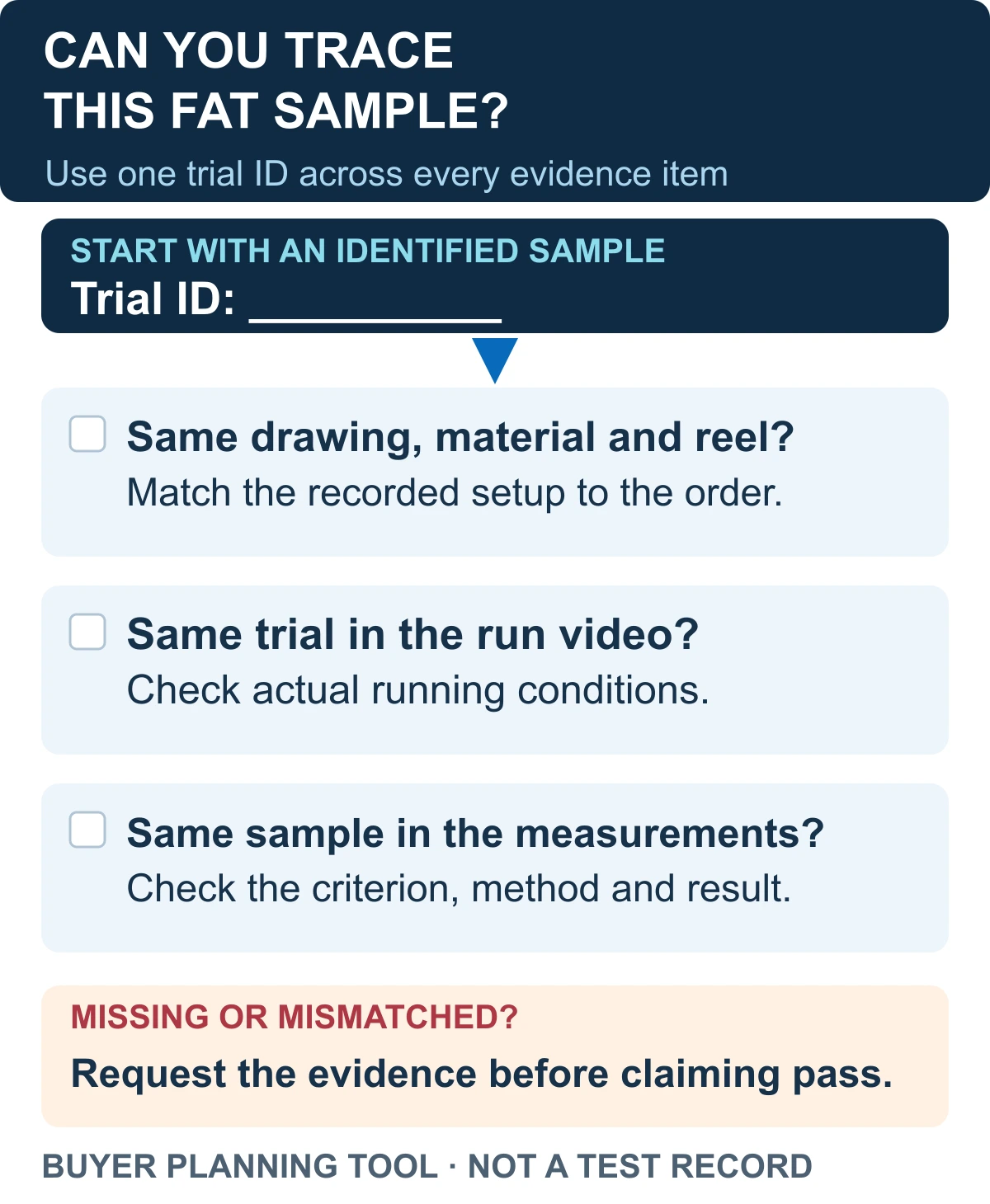
Buyer planning checklist: trace configuration, video and measured samples to one trial ID; request missing or mismatched evidence. Not a completed test record.
A useful record starts with the machine configuration, product revision and trial inputs, then links the operating observations to the sample and its measured quality. Video can show the setup and running sequence; the relevant measurements establish whether the product meets its agreed criteria. For an insulation or sheath process, these may include centering, outside-diameter variation and surface condition. The crosshead tooling and centering guide explains why wall thickness and line setup need attention alongside outside diameter. Other cable structures need their own applicable checks.
| FAT deliverable | What the buyer should be able to establish |
|---|---|
| Identified samples | Which trial produced the retained sample, and which product revision does it represent? |
| Product measurements | Which agreed quality criteria passed, using which method or instrument? |
| Running record and video | What setup and operating conditions produced that sample? |
| Configuration comparison | Đường dây cung cấp có khớp với phạm vi đã đặt hàng, bao gồm các thành phần và thiết bị phụ trợ đã thỏa thuận không? |
| Open-item record | Điều gì vẫn chưa được giải quyết, ai là người chịu trách nhiệm thực hiện hành động và điều gì sẽ chứng minh rằng vấn đề đã được khép lại? |
Keep the sample identity consistent across the video, measurements and trial record. A video of one cable and a measurement sheet from another cannot establish the same result. Likewise, identify the processing stage: accepting a machine that produces a cable component does not establish the quality of downstream operations outside the supplied scope.
The routine FAT evidence package described here focuses on product results, operation and configuration. Define any additional protective-function demonstrations, safety documentation or other special tests separately in the project agreement; this matrix does not represent a complete machinery-safety assessment.
Evidence to request: A deliverables list agreed before FAT, followed by the identified sample results, configuration comparison, running record, video and open-item log for the actual trial.
SAT: Recheck the Installed Line and Factory Interfaces
SAT means site acceptance testing after installation at the customer’s factory. For the cable line described here, verify that the equipment is fixed and aligned, runs properly during acceleration, steady operation and deceleration, and makes products that meet the agreed requirements. Prepare the customer’s utilities, materials and people before that trial.
In the commissioning scope described for this guide, the equipment supplier’s team handles equipment fixing, line leveling/alignment, operating checks and the production trial. The customer prepares the remaining site resources, including the power supply, cooling water and compressed air where needed, trial materials, operators and required measurement facilities. Confirm the exact division in the purchase and commissioning scope; do not infer that a supplier brings every resource needed at the customer’s factory. For an optical-cable project, the fiber line installation and commissioning guide develops the site-readiness and handover sequence in more detail.
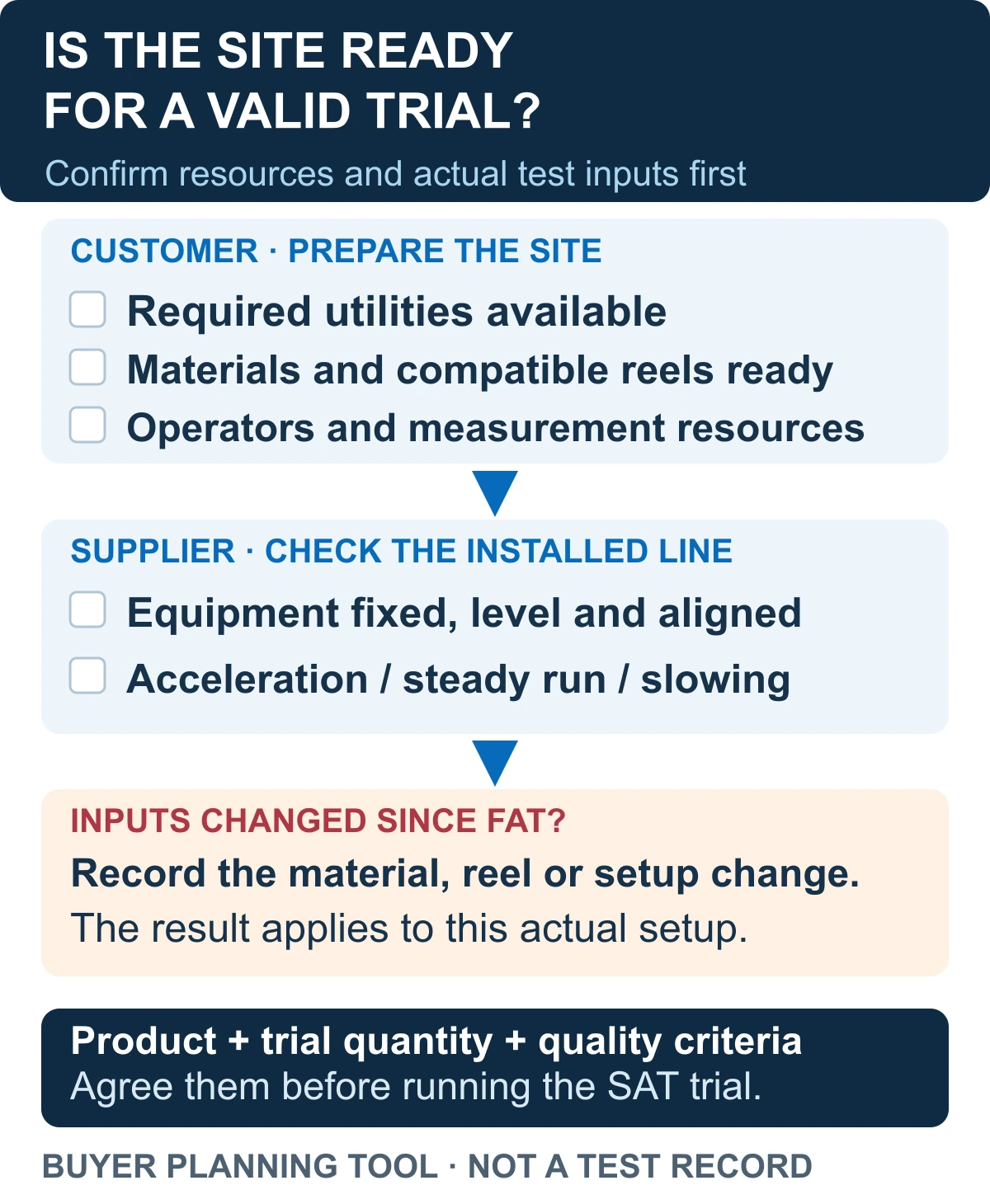
Buyer planning checklist: confirm site inputs, supplier checks and changed trial conditions before SAT. Exact responsibilities remain subject to the agreed commissioning scope.
Use a site trial schedule that identifies each product, its inputs, quantity and acceptance measurements. If the materials, reels or connected equipment differ from FAT, record the differences. This gives both parties a basis for separating an installation problem, a changed input and an equipment defect when a result is unsatisfactory.
| Site-acceptance task | Responsibility in the scope described | Evidence to agree and keep |
|---|---|---|
| Ready the site | Customer | Required utilities available; suitable materials, reels, operators and measurement resources ready |
| Fix and align equipment | Supplier commissioning team, within agreed scope | Installation and line alignment checked |
| Check operating behavior | Supplier commissioning team | Acceleration, steady-running and deceleration observations |
| Verify each trial product | Supplier conducts trial; measurement and approval roles agreed | Identified samples and applicable product-quality results |
| Resolve deviations | Named person for each issue | Action, deadline and repeat-test result |
Agree on Useful Trial Quantities
As a HONGKAI commissioning-planning example, a customer may ask for one to two kilometres of each product. That is a project example, not a standard minimum. Agree on the needed length or duration in light of the product, the available raw material and the evidence required. The purpose is to obtain a meaningful product result without consuming material simply to extend the demonstration.
Normal stops and reel changes should be recorded where they affect the trial. Their role in acceptance depends on the agreed test, rather than an automatic failure rule. If a buyer needs to accept an automatic reel change, a particular restart sequence or another special operating function, specify that demonstration expressly.
A requested endurance run can also be agreed separately. Elapsed running time alone does not establish that the cable meets its quality requirements or that the entire equipment range has been verified. Preserve the relevant product results and operating conditions, whatever trial duration is chosen.
How to verify: For each product in the site plan, compare the measured result with its agreed specification, record the actual setup, and attach any deviation to the responsible person’s corrective action.
Close the Record Without Hiding Open Items
HONGKAI uses a project-management record to trace a test issue to the relevant personnel. The tester reports an issue or changed customer requirement, the responsible engineer carries out the correction within an assigned period, and testing personnel check the result again. The useful buyer question is whether this chain is visible for each open item.
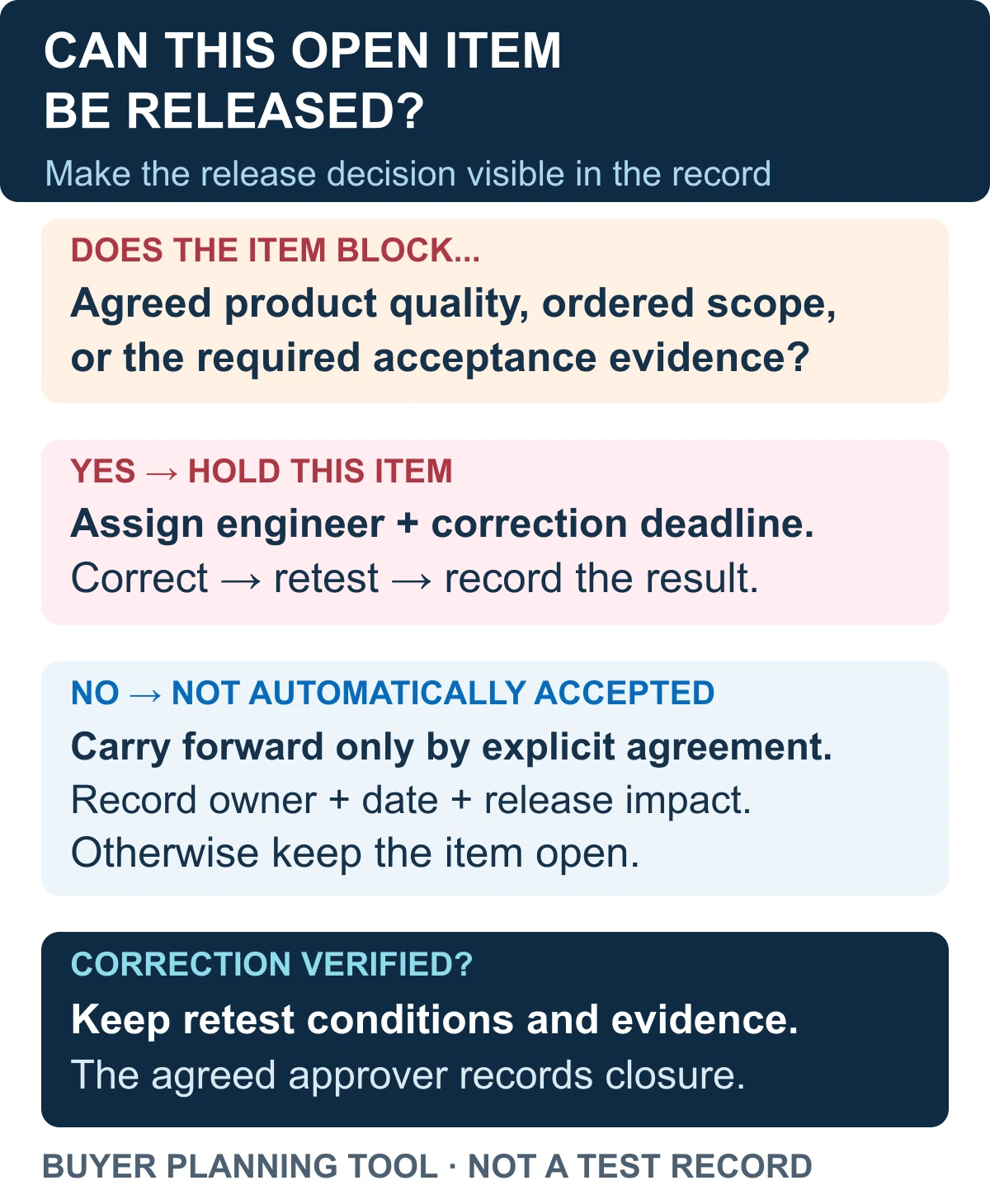
Buyer planning decision path: record the release impact, correction owner, deadline and retest evidence; a non-blocking item is not automatically accepted. Not a completed acceptance record.
| Acceptance issue field | Cần ghi lại những gì |
|---|---|
| Finding | Product or equipment ID, trial conditions, failed criterion and supporting evidence |
| Required action | What must change; whether this is a defect correction or a requested scope revision |
| Trách nhiệm | Assigned engineer or other responsible person, plus the record owner |
| Timing | Agreed correction deadline and planned retest date |
| Retest | Test conditions, measured result and reviewing personnel |
| Release decision | Đã đóng, giữ lại để kiểm tra lại hoặc được chuyển tiếp rõ ràng với chủ sở hữu và ngày đã thỏa thuận |
Agree who has authority to approve acceptance and which items must close before shipment or site handover. If an item prevents the line from meeting an agreed product result, completing the promised configuration or conducting the required test, record the missing evidence and arrange correction and retesting before claiming that item has passed.
Some remaining work may be carried forward when both parties explicitly agree that it does not prevent the relevant release. The record still needs the item, responsible person, deadline and effect on shipment or site handover. Do not turn a requested design change into a quietly altered acceptance target; record the revision and its effect on the test plan.
Before closing FAT or SAT, assemble one connected package: the product and input schedule, ordered-versus-supplied configuration, identified samples, measured results, running records and video, and the corrective-action register. The buyer can then see which products have passed, which still need a trial, and which issues require a retest before the agreed next step.
-
IEC 62381:2024 — Automation systems in the process industry: FAT, SAT and SIT. The official scope describes project-specific acceptance specifications and agreement on test activities and responsibilities for automation systems. This article uses that planning principle only; it does not assert compliance or apply the standard as a universal cable-product acceptance specification. ↩