


A cable factory owner may be offered a single-screw extruder, a twin-screw extruder, or a proposal that uses both terms without defining the process boundary. The important decision is not whether two screws sound more advanced. It is whether the factory needs to apply an approved compound to a conductor or cable, manufacture the compound itself, or do both as separate production stages.
For most insulation and sheathing projects that begin with qualified cable compound, the main production duty is stable cable coating through a crosshead, supported by pay-off, preheating where required, cooling, measurement, testing, traction and take-up. Twin-screw equipment belongs primarily to a compounding process when the factory must feed, disperse, homogenize, vent and pelletize a formulation. A compounding line does not remove the need for a correctly specified cable-coating line.

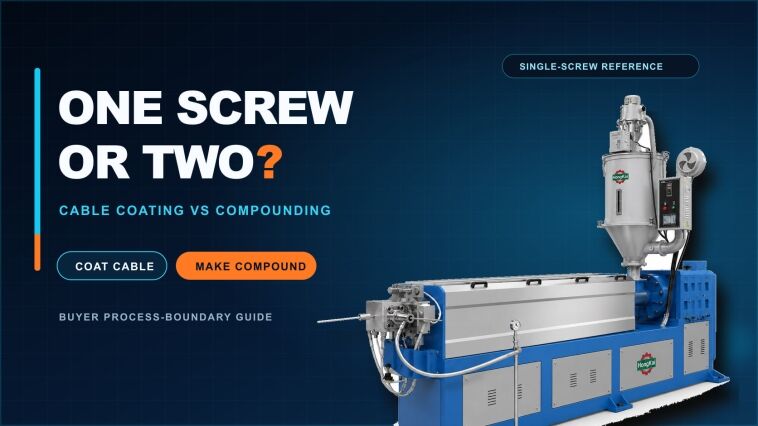
Bản render tham chiếu HONGKAI của một máy đùn phủ cáp. Hình ảnh không mô tả một nhà máy phối trộn trục vít đôi cũng như không ngụ ý rằng hai quy trình này có thể thay thế cho nhau.
This guide is for factory owners, production managers and technical procurement teams deciding what belongs in an extrusion quotation. It compares process duty, incoming material, finished output, auxiliary equipment and acceptance evidence so that screw count does not replace a complete production specification.
Tách riêng quá trình phủ cáp khỏi sản xuất hợp chất
A single-screw-versus-twin-screw comparison is meaningful only after the buyer states what enters the process and what must leave it. Applying insulation or sheath around a moving conductor is a different production boundary from turning polymers, fillers and additives into a controlled cable compound.
The cable-coating boundary starts with an approved material in a defined supply form. The material is prepared as required, melted and delivered through a crosshead around a conductor, insulated core or cable core. The output is a continuously coated wire or cable that must meet dimensional, surface, electrical and handling requirements.
The compounding boundary starts with a formulation and controlled ingredient streams. The process may include feeding, premixing, plasticizing, dispersive and distributive mixing, venting, filtration, pressure building, pelletizing, cooling and packaging. The output is normally an identified compound lot that still needs qualification and must later be processed on the cable extrusion line.
| Process boundary | Trạng thái đầu vào điển hình | Required output | Điều mà thiết bị phải chứng minh |
|---|---|---|---|
| Cách điện hoặc vỏ bọc cáp | Hạt nhựa, viên nhựa đã được phê duyệt hoặc nguyên liệu đầu vào khác đủ điều kiện từ nhà cung cấp | Dây dẫn hoặc cáp có lớp phủ trên bao bì được chỉ định | Kích thước ổn định, bề mặt, tính toàn vẹn của lớp, các kiểm tra trực tuyến yêu cầu và quá trình thu cuộn được kiểm soát |
| Dải màu hoặc một lớp cáp bổ sung | Vật liệu được phê duyệt cho một lớp riêng biệt | Một dải sọc được định rõ hoặc lớp đồng đùn trên cáp | Vị trí lớp, tính liên tục, kích thước, độ bám dính (nơi áp dụng) và khả năng kiểm soát lặp lại |
| Sản xuất hỗn hợp cách điện cáp | Nhựa, chất độn, phụ gia, chất lỏng hoặc hỗn hợp tiền trộn được kiểm soát theo công thức định sẵn | Hạt nhựa đạt tiêu chuẩn hoặc dạng hợp chất được phê duyệt khác | Kiểm soát thành phần, trộn, thoát khí, lịch sử nhiệt, độ đồng đều lô và khả năng gia công ở các công đoạn sau |
| Dự án tích hợp vật liệu và cáp | Nguyên liệu thô cộng với đầu vào dây dẫn hoặc cáp | Hợp chất đạt tiêu chuẩn và cáp thành phẩm được chấp nhận riêng biệt | Hai gói phát hành được kết nối nhưng riêng biệt: bằng chứng vật liệu và bằng chứng cáp |
The official Coperion cable-compound process illustrates the distinction clearly. Its two-stage system uses a twin-screw section for plasticizing, mixing and homogenizing, then a single discharge screw and pelletizing system for the compound-production duty.1 Trục vít đơn trong hệ thống song song đó không phải là ranh giới sản xuất giống như một dây chuyền đầu ép cáp, và các hạt nhựa rời khỏi nhà máy phối trộn chưa phải là cáp thành phẩm.
Decision criterion: Write one sentence for each proposed extruder: “This machine receives [named input] and produces [named output].” If the supplier cannot complete that sentence with a physical input, a controlled output and named acceptance evidence, the screw-count comparison is premature.
For HONGKAI cable-line scoping, the first practical input is the material the buyer intends to run. The material identity alone is still incomplete: the buyer must also state the cable construction and required output so that machine size and screw design can be reviewed together. A separate compounding review begins only when the project input is a formulation or multiple controlled ingredients rather than a ready-to-process cable compound.
So sánh hai tuyến đường trên cùng các kích thước
Single-screw cable coating and twin-screw compounding should be compared by process responsibility, not by a generic claim that one mixes better or runs faster. Each route is optimized around a different transformation and requires different upstream, downstream and quality systems.
| Tiêu chí so sánh | Tuyến phủ cách điện cáp trục vít đơn | Quy trình phối trộn bằng máy đùn hai trục vít |
|---|---|---|
| Primary duty | Nấu chảy và cung cấp đều đặn một hỗn hợp đã được phê duyệt vào đầu chéo cáp | Kết hợp và kiểm soát nhiều thành phần phối trộn thông qua một quy trình phối trộn xác định |
| Đầu vào sản xuất chính | Hợp chất cáp đạt tiêu chuẩn cộng với dây dẫn, lõi cách điện hoặc lõi cáp | Nhựa, chất độn, phụ gia, chất lỏng, hỗn hợp tiền trộn hoặc các thành phần pha chế khác |
| Sản lượng sản xuất chính | Dây dẫn cách điện, lõi được bọc hoặc cáp có vỏ bọc | Lô hợp chất, thường ở dạng viên, để xử lý cáp sau này |
| Mixing requirement | Duy trì dòng chảy nóng ổn định và bảo quản hợp chất đã được phê duyệt trong giới hạn xử lý của nó | Tạo độ phân tán, phân bố và độ đồng nhất theo yêu cầu từ các thành phần được kiểm soát |
| Áp suất và nhiệm vụ tạo hình | Cấp liệu cho đầu ngang tạo thành một lớp bao quanh sản phẩm cáp di chuyển liên tục | Cấp liệu cho một đầu tạo hình và hệ thống xử lý hợp chất phía sau hoặc hệ thống tạo viên; một số hệ thống tách riêng quá trình trộn với quá trình tạo áp suất |
| Essential surrounding equipment | Tháo cuộn, nắn thẳng hoặc gia nhiệt sơ bộ (nếu cần), đầu ghép chéo và khuôn ép, làm nguội, đo kích thước, thiết bị kiểm tra, capstan, bộ tích trữ và thu cuộn | Ingredient storage, accurate feeders, mixers where required, side feeding, liquid dosing, venting, filtration, pelletizing, cooling and lot handling |
| Đối tượng nghiệm thu lõi | An identified cable sample made at a recorded stable condition | Một lô hợp chất đã được xác định, được tạo thành từ các thành phần có thể truy xuất và một công thức được kiểm soát |
| Typical expansion question | Cùng một dây chuyền có thể xử lý một cấu trúc cáp, cấp vật liệu, lớp hoặc gói đã được phê duyệt khác không? | Can the plant produce another qualified formulation without compromising feeding, mixing, venting, cleaning or lot control? |
Sự phân biệt này cũng ngăn ngừa ba lỗi đặt tên phổ biến.
A current Maillefer component index maps screw-diameter extruders to insulation and sheathing duties across building wire, low-voltage, telecom, fiber-optic and other cable applications.2 Tài liệu tham khảo đó hỗ trợ giới hạn lớp phủ cáp, nhưng nó không khiến đường kính vít trở thành phương pháp lựa chọn duy nhất.
First, a main extruder plus a small color-stripe extruder is not a twin-screw extruder. It is a multi-extruder cable line in which separate single-screw units feed different material streams or layers into compatible tooling.
In that arrangement, the main extruder and color-stripe extruder meet at the crosshead. The required stripe proportion is one of the inputs used to size the auxiliary extruder; the presence of two extruder bodies does not establish a twin-screw process.
Second, a multilayer crosshead supplied by two or three extruders does not make those extruders a twin-screw machine. The buyer must specify each layer, material, flow path, interface and control duty independently.
Third, a twin-screw feeder is not automatically a twin-screw process extruder. Ingredient feeding and polymer compounding are separate equipment functions, even when both use rotating screws.
Common mistakes: A quotation uses “double extruder,” “co-extrusion,” “twin screw” and “two-color line” as interchangeable terms. The buyer should require a process diagram that shows the number of extruder barrels, the screw arrangement inside each barrel, the material entering each unit and the die or crosshead receiving each melt stream.
Chọn tuyến đường từ Trạng thái vật liệu và Sản phẩm có thể bán được
The most reliable selection starts with the approved material supply strategy and the first saleable cable. A factory buying qualified compound needs a different project from a factory developing and manufacturing its own cable formulations.
Sử dụng trình tự này trước khi yêu cầu các model máy:
- Đóng băng cấu trúc cáp đầu tiên, thứ tự lớp, đầu vào dây dẫn hoặc lõi, gói thành phẩm và cơ sở nghiệm thu.
- Đặt tên cho từng lớp cách điện, lớp vỏ bọc, dải sọc hoặc vật liệu được áp dụng khác theo cấp đã được phê duyệt và dạng cung cấp.
- Quyết định xem nhà máy sẽ mua hợp chất đạt tiêu chuẩn, tự sản xuất hợp chất được kiểm soát tại chỗ, hay đánh giá cả hai phương án riêng biệt.
- Lập bản đồ mọi quá trình biến đổi vật lý từ nguyên liệu đầu vào đến lô hỗn hợp và từ lô hỗn hợp đến cáp thành phẩm.
- Build separate factory acceptance test plans for any process boundary that creates a separately controlled output.
| Buyer situation | Tuyến đường sơ bộ | Ranh giới vẫn cần xác nhận |
|---|---|---|
| Nhà máy mua hạt nhựa đã được phê duyệt và áp dụng một lớp cách điện hoặc lớp vỏ bọc | Chỉ định dây chuyền phủ lớp cách điện cho cáp xung quanh sản phẩm và vật liệu đã được phê duyệt | Thiết kế trục vít, nòng, đầu chữ thập, dụng cụ, hệ thống làm mát và các thiết bị phụ trợ phải phù hợp chính xác với vật liệu và cáp |
| The cable needs a color stripe or a second material stream | Xem xét một máy đùn phụ riêng biệt và cụm đầu ngang hoặc khuôn phù hợp | This is multiple extrusion duty, not proof that a twin-screw process is required |
| Nhà máy muốn phối trộn nhựa, chất độn và phụ gia thành hợp chất thương mại của riêng mình | Scope a dedicated compounding project before the cable line | Formulation ownership, feeding, mixing, venting, pelletizing, laboratory release and liability must be written |
| Nhà máy muốn sử dụng vật liệu tái chế hoặc vật liệu biến đổi | Do not select by screw count alone | Độ biến đổi đầu vào, nhiễm bẩn, lọc, suy giảm, đủ điều kiện và giới hạn cáp thành phẩm đòi hỏi một kế hoạch phát triển được kiểm soát |
| The project uses a heat-sensitive, highly filled, reactive, foamed, rubber or crosslinkable system | Xử lý quy trình này theo từng loại vật liệu và sản phẩm cụ thể | Obtain material-supplier processing requirements and define residence time, shear, temperature, venting, curing or foaming controls as applicable |
| Nhà cung cấp đề xuất một dây chuyền cho nhiều công thức PVC, PE, XLPE hoặc ít khói | Keep compatibility provisional | Mỗi cấp phối hợp chính xác, vít, dụng cụ, máy sấy hoặc máy nạp cần thiết, quy trình làm sạch và mẫu nghiệm thu đều phải được xem xét |
“PVC,” “PE,” “XLPE” or “LSZH” is not a complete machine input. Commercial grades can differ in additives, fillers, moisture sensitivity, thermal limits, rheology, crosslinking route and required processing controls. A supplier should not convert a material family name into a universal screw geometry or output promise.
The HONGKAI project sequence is to match the required production output to a practical extruder size, then review the intended material against the screw design and the rest of the line. A dryer or additional feeding system is not added merely because the material name changes; those modules remain conditional on the exact grade, supply form and material-supplier processing guidance. The current Φ70 and Φ90 references therefore do not prove universal grade or brand compatibility.
The same caution applies to in-house formulation. Owning a twin-screw compounder creates responsibilities for recipes, ingredient verification, dosing accuracy, lot traceability, laboratory testing, change control, cleaning, nonconforming material and the interaction between compound quality and cable quality. It is a material-manufacturing decision, not merely an extra machine added to the extrusion hall.
Foaming and crosslinkable compounds require their own material-and-screw review because their raw-material behavior and test route differ from ordinary cable compounds. HONGKAI does not extend that confirmed boundary to recycled material or every high-fill low-smoke grade without the exact material data and a representative trial plan.
Red flags: A supplier recommends twin-screw equipment only because the buyer mentions additives; promises that “more mixing” will solve an undefined surface or electrical defect; or quotes a cable line before the compound grade, conductor, layer thickness, package and test basis are available.
Chỉ định toàn bộ dây chuyền, không chỉ số lượng trục vít
A useful cable-extrusion quotation must connect the extruder to the conductor path, crosshead, cooling, measurement, traction, testing and take-up. A useful compounding quotation must connect raw-material control to feeding, mixing, venting, discharge, pelletizing, laboratory release and lot handling.
Đối với một dự án phủ cáp, bên mua cần cung cấp hồ sơ sản phẩm và quy trình với các đầu vào sau:
| Input group | Thông tin tối thiểu cho đánh giá kỹ thuật |
|---|---|
| Finished cable | Bản vẽ, thứ tự lớp, kích thước danh nghĩa và kích thước được kiểm soát, yêu cầu bề mặt, ghi nhãn và đóng gói |
| Lõi dẫn điện hoặc lõi cáp | Vật liệu, cấu tạo, đường kính đầu vào hoặc dải đường kính, kích thước cuộn, lực kéo cho phép và tình trạng bề mặt |
| Applied compound | Nhà cung cấp và cấp độ (khi có), dạng cung cấp, màu sắc, hướng dẫn gia công, yêu cầu sấy hoặc xử lý sơ bộ và kiểm soát lô |
| Extrusion duty | Lớp cách điện, lớp vỏ bọc, lớp lót, sọc hoặc một lớp được đặt tên khác; số lượng dòng vật liệu; khái niệm về dụng cụ; hướng dây chuyền yêu cầu |
| Online control | Phương pháp kiểm soát đường kính hoặc độ dày thành ống, thử nghiệm đánh lửa (nơi áp dụng), xác minh in hoặc đánh dấu, đo chiều dài và truy xuất nguồn gốc |
| Factory interface | Điện, nước làm mát, khí nén (khi cần), hệ thống thoát nước, mặt bằng, thiết bị nâng và di chuyển cuộn cáp, hệ thống điều khiển môi trường và thiết bị hiện có |
| Acceptance | Ra mắt sản phẩm, các lô vật liệu, điều kiện vận hành mục tiêu, phép đo, phương pháp thử nghiệm, hồ sơ lưu trữ và quy trình xử lý các vấn đề chưa giải quyết |
HONGKAI’s verified Φ70 insulation-line and Φ90+50 sheathing-line configuration documents show single-screw cable-coating references with separate material handling, crosshead, cooling, measurement, traction and take-up functions. The “+35” or “+50” designation in these references identifies an additional color-stripe extruder; it does not describe an intermeshing twin-screw barrel. Final screw, barrel, tooling, material and line scope remain project-specific.
For a color-stripe request, the buyer should also define the stripe proportion and visible result. That input affects the auxiliary-extruder size and crosshead arrangement; it should not be translated into a generic request for a “twin-screw cable extruder.”
HONGKAI công cộng dây bọc cáp tương tự trình bày máy đùn như một trạm trong dây chuyền dài hơn, bao gồm các công đoạn xả cuộn, đầu nối ngang (crosshead), làm nguội, đo đường kính, kéo sợi và thu cuộn. HONGKAI hướng dẫn sản xuất điện áp thấp bắt đầu từ các lớp cáp đã được phê duyệt và tuyến đường yêu cầu thay vì coi một mô hình máy đùn như một nhà máy hoàn chỉnh.
Để bảo trì hoặc thay thế, HONGKAI trang phụ kiện đùn cáp lists the measurements needed to confirm a screw and barrel, including diameter, length or L/D information, thread form and material requirement. Those replacement inputs are also useful during a new-line review, but dimensional compatibility alone still does not prove process suitability.
Note: Current HONGKAI evidence supports the cited single-screw cable-coating configurations. It does not by itself establish a HONGKAI twin-screw compounding model, formulation package or compound-performance guarantee. Any in-house compounding scope must identify the responsible specialist, formulation owner, supplied modules and acceptance boundary in writing.
Xây dựng bằng chứng FAT riêng biệt cho Hợp chất và Cáp
Factory acceptance should prove the output of each production boundary. A compounder must release an identified material lot against the agreed formulation and test plan; a cable line must run an identified product at a stable recorded condition and release the cable against the agreed dimensional, electrical, mechanical and handling checks.
| Evidence layer | Dây chuyền phủ lớp cách điện cáp - nghiệm thu chạy thử tại xưởng chế tạo (FAT) | Compounding-line FAT |
|---|---|---|
| Controlled inputs | Dây dẫn hoặc lõi cáp, lô hợp chất, dụng cụ và bao bì đã được phê duyệt | Bản sửa đổi công thức đã được phê duyệt, các lô nguyên liệu, hồ sơ cấp liệu và định lượng |
| Process record | Các vùng nhiệt độ, tình trạng trục vít và dây chuyền, quan sát quá trình hoặc vật liệu nóng chảy, lực kéo, làm mát và các cảnh báo liên quan | Feed rates, screw configuration and condition, temperature, torque or load, venting, pressure, filtration and pelletizing conditions as applicable |
| Physical output | Đã xác định được cáp có cách điện hoặc bọc vỏ trên cuộn cáp hoặc bao bì đã thỏa thuận | Identified compound lot in the agreed pellet or material form |
| Immediate checks | Kích thước, độ đồng tâm hoặc bằng chứng về độ dày thành (nơi yêu cầu), bề mặt, đánh dấu, kiểm tra trực tuyến và chất lượng cuộn | Ngoại quan, độ đồng đều của viên nhựa hoặc đầu ra, kiểm soát nhiễm bẩn và danh tính mẫu phòng thí nghiệm đã thỏa thuận |
| Release evidence | Các thử nghiệm đặc thù sản phẩm liên quan đến bản vẽ cáp, tiêu chuẩn hoặc kế hoạch kiểm soát | Material tests tied to the formulation specification and downstream processing requirement |
| Traceability | Cuộn cáp đến dây dẫn/lõi, lô hợp chất, cài đặt, kiểm tra và hồ sơ vận hành | Compound lot to ingredients, formulation revision, settings, samples, tests and disposition |
| Handover | Công thức hoặc cài đặt theo thỏa thuận, danh sách dụng cụ, bản vẽ, hướng dẫn sử dụng, cảnh báo, đào tạo và các hạng mục chưa hoàn tất | Formulation responsibility, screw configuration record, feeder calibration, cleaning/changeover method, lab methods, traceability and open items |
Open-head output is not enough to accept a cable line. It does not prove that the selected conductor, crosshead, tooling, cooling path, measurement system, traction and take-up can produce the agreed cable continuously. Likewise, a short cable sample cannot prove a compound plant if ingredient control, lot uniformity, venting, filtration, pellet condition and laboratory release remain undefined.
HONGKAI uses two different checks for the cable-extrusion duty. First, the head is opened and the extruder output is weighed under the agreed full-speed test condition to record kilograms per hour. Second, the complete line runs the customer’s specified cable under the agreed full-speed condition to record metres per minute while the finished dimensions and other signed accuracy requirements remain within tolerance. The first check verifies extrusion output; the second verifies that the complete line can make the agreed product. Neither result should substitute for the other.
Người mua có thể sử dụng bảng kiểm sàng lọc cuối cùng này trước khi phê duyệt bất kỳ tuyến đường nào:
- ☐ Đầu vào và đầu ra của quy trình được đặt tên cho từng máy đùn.
- ☐ Các thuật ngữ “Single” (đơn), “twin” (kép), “co-extrusion” (đồng đùn) và “color stripe” (sọc màu) được sử dụng nhất quán trên sơ đồ quy trình và danh sách thiết bị.
- ☐ Loại mác vật liệu chính xác hoặc công thức được kiểm soát thay thế cho cách diễn đạt chung chung về họ polymer.
- ☐ Upstream and downstream modules are included with their interfaces and responsible supplier.
- ☐ Cable-coating FAT and compound-production FAT have separate samples, records and release criteria.
- ☐ Các vật liệu hoặc dòng cáp trong tương lai được liệt kê trong phạm vi tùy chọn cho đến khi các thử nghiệm đại diện và bằng chứng được thống nhất.
- ☐ HONGKAI-manufactured equipment, integrated specialist equipment and buyer-supplied systems are separated in the responsibility matrix.
The correct choice is therefore not “single screw or twin screw” in isolation. It is a verified route from the buyer’s material state to the first saleable cable, with every transformation, interface and acceptance record assigned to the correct production boundary. Twin-screw compounding is included here as buyer education, not as evidence of a current HONGKAI compounding-machine offer. If a project includes pellet production, the specialist compound-equipment and formulation scope must be defined separately from the HONGKAI cable-coating line. The same input dossier can be submitted through the clean trang nhập dự án HONGKAI để việc đánh giá lớp phủ cáp, chuẩn bị vật liệu và bất kỳ phạm vi phối trộn chuyên biệt nào được xem xét riêng biệt.
-
Coperion, STS Mc11 two-stage compounder for cable compounds, mô tả hệ thống sản xuất hợp chất cáp gồm các công đoạn: cấp liệu, trộn và đồng nhất bằng trục vít đôi, chuyển sang trục vít xả đơn và tạo viên.↩
-
Maillefer, Máy đùn dùng cho cách điện và bọc ngoài dây cáp, provides a current manufacturer reference for screw-based extruders used across cable insulation and sheathing applications; final screw and line selection remains application-specific. ↩
