


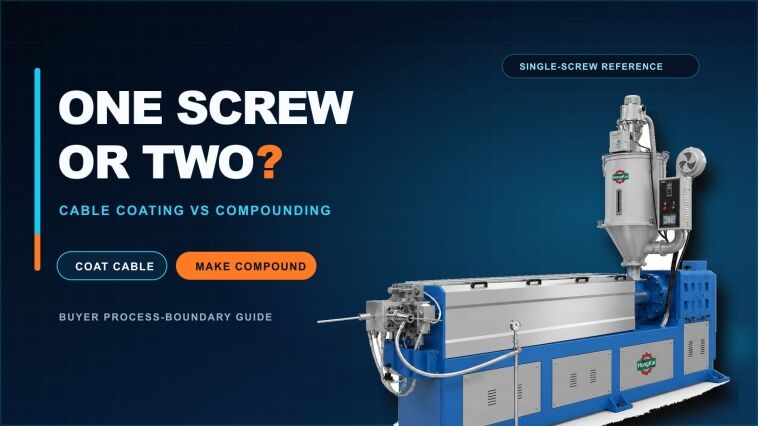
A cable factory owner may be offered a single-screw extruder, a twin-screw extruder, or a proposal that uses both terms without defining the process boundary. The important decision is not whether two screws sound more advanced. It is whether the factory needs to apply an approved compound to a conductor or cable, manufacture the compound itself, or do both as separate production stages.
For most insulation and sheathing projects that begin with qualified cable compound, the main production duty is stable cable coating through a crosshead, supported by pay-off, preheating where required, cooling, measurement, testing, traction and take-up. Twin-screw equipment belongs primarily to a compounding process when the factory must feed, disperse, homogenize, vent and pelletize a formulation. A compounding line does not remove the need for a correctly specified cable-coating line.

مرجع HONGKAI لعرض توضيحي لآلة بثق طلاء الكابلات. لا تُصوَّر الصورة مصنع تجميع ببرغيْن ولا توحي بأن مسارَي العملية قابلين للتبديل.
This guide is for factory owners, production managers and technical procurement teams deciding what belongs in an extrusion quotation. It compares process duty, incoming material, finished output, auxiliary equipment and acceptance evidence so that screw count does not replace a complete production specification.
فصل طلاء الكابلات عن تصنيع المركبات
A single-screw-versus-twin-screw comparison is meaningful only after the buyer states what enters the process and what must leave it. Applying insulation or sheath around a moving conductor is a different production boundary from turning polymers, fillers and additives into a controlled cable compound.
The cable-coating boundary starts with an approved material in a defined supply form. The material is prepared as required, melted and delivered through a crosshead around a conductor, insulated core or cable core. The output is a continuously coated wire or cable that must meet dimensional, surface, electrical and handling requirements.
The compounding boundary starts with a formulation and controlled ingredient streams. The process may include feeding, premixing, plasticizing, dispersive and distributive mixing, venting, filtration, pressure building, pelletizing, cooling and packaging. The output is normally an identified compound lot that still needs qualification and must later be processed on the cable extrusion line.
| حدود العملية | الحالة الواردة النموذجية | Required output | ما يجب أن يثبته المعدات |
|---|---|---|---|
| عازل الكابل أو غلافه | الحبيبات أو الحُبَيْبات أو مادة التغذية المؤهلة من المورد الأخرى المعتمدة | الموصل أو الكابل المغلف على العبوة المحددة | أبعاد مستقرة، سطح، سلامة الطبقة، فحوصات مطلوبة أثناء التشغيل، ولف متحكم به |
| شريط ملون أو طبقة كابل إضافية | مادة معتمدة لطبقة منفصلة | شريط محدد أو طبقة مشتركة البثق على الكابل | موقع الطبقة، الاستمرارية، الأبعاد، الالتصاق حيثما ينطبق والتحكم القابل للتكرار |
| إنتاج مركبات الكابلات | راتنج خاضع للرقابة، ومواد مالئة، ومواد مضافة، وسوائل أو خليط مسبق معرّف بواسطة تركيبة | حبيبات مؤهلة أو شكل مركب آخر معتمد | التحكم في المكونات، الخلط، التهوية، السجل الحراري، تجانس الدُفعات، وقابلية المعالجة في المراحل اللاحقة |
| مشروع متكامل للمواد والكابلات | المكونات الخام بالإضافة إلى موصل أو مدخل الكابل | مركب مؤهل وكابل نهائي مقبول بشكل منفصل | حزمتا إصدار متصلتان ولكن منفصلتان: أدلة المواد وأدلة الكابلات |
The official Coperion cable-compound process illustrates the distinction clearly. Its two-stage system uses a twin-screw section for plasticizing, mixing and homogenizing, then a single discharge screw and pelletizing system for the compound-production duty.1 البرغي الوحيد في ذلك النظام المتسلسل ليس له نفس حدود الإنتاج كخط رأس تشكيل الكابلات، والكريات الخارجة من مصنع الخلط ليست كابلات نهائية.
Decision criterion: Write one sentence for each proposed extruder: “This machine receives [named input] and produces [named output].” If the supplier cannot complete that sentence with a physical input, a controlled output and named acceptance evidence, the screw-count comparison is premature.
For HONGKAI cable-line scoping, the first practical input is the material the buyer intends to run. The material identity alone is still incomplete: the buyer must also state the cable construction and required output so that machine size and screw design can be reviewed together. A separate compounding review begins only when the project input is a formulation or multiple controlled ingredients rather than a ready-to-process cable compound.
قارن بين الطريقتين على نفس الأبعاد
Single-screw cable coating and twin-screw compounding should be compared by process responsibility, not by a generic claim that one mixes better or runs faster. Each route is optimized around a different transformation and requires different upstream, downstream and quality systems.
| بعد المقارنة | مسار طلاء الكابلات ذو برغي واحد | طريق التجميع ذو البرغيين |
|---|---|---|
| Primary duty | قم بصهر وتسليم مركب معتمد بشكل مستقر إلى رأس تشكيل الكابل | اجمع وتحكّم في مكونات التركيبة المتعددة من خلال عملية خلط محددة |
| مدخل الإنتاج الرئيسي | مركب كابل مؤهل بالإضافة إلى الموصل، أو النواة المعزولة، أو نواة الكابل | راتنج، حشوات، مواد مضافة، سوائل، خليط مسبق أو مدخلات تركيب أخرى |
| الإنتاج الرئيسي | سلك معزول، أو سلك مغلف، أو كابل مغمد | خلطة دُفعَة، عادةً على شكل حبيبات، لمعالجة الكابلات لاحقًا |
| Mixing requirement | حافظ على ذوبان مستقر واحفظ المركب المعتمد ضمن نافذة معالجته | إنشاء التشتت والتوزيع والتجانس المحددين من مكونات خاضعة للرقابة |
| واجب الضغط والتشكيل | تغذية رأس عرضي يشكّل طبقة حول منتج كابل يتحرك باستمرار | تغذية القالب ونظام التعامل مع المركب أو التحبيب في المجرى السفلي؛ بعض الأنظمة تفصل الخلط عن بناء الضغط |
| المعدات المحيطة الأساسية | إطلاق، أو التسوية أو التسخين المسبق حسب الطلب، الرأس المتصالب والأدوات، التبريد، المقياس، جهاز الاختبار، البكرة، الخزان المؤقت واللف | تخزين المكونات، ووحدات التغذية الدقيقة، والخلاطات عند الحاجة، والتغذية الجانبية، وجرع السوائل، والتهوية، والترشيح، والتحبيب، والتبريد، ومعالجة الدفعات |
| كائن قبول القلب | عينة كابل محددة تم تصنيعها في ظروف مستقرة مسجّلة | دفعة مركبة محددة مصنوعة من مكونات قابلة للتتبع وتركيبة خاضعة للرقابة |
| سؤال التوسع النموذجي | هل يمكن لنفس الخط معالجة تركيب كابل آخر معتمد، أو درجة مادة، أو طبقة، أو عبوة؟ | هل يمكن للمصنع إنتاج تركيبة مؤهلة أخرى دون المساس بالتغذية أو الخلط أو التهوية أو التنظيف أو التحكم في الدُفعات؟ |
يمنع التمييز أيضًا ثلاثة أخطاء شائعة في التسمية.
A current Maillefer component index maps screw-diameter extruders to insulation and sheathing duties across building wire, low-voltage, telecom, fiber-optic and other cable applications.2 يدعم هذا المرجع حدود طلاء الكابل، لكنه لا يجعل قطر البرغي وحده أسلوب اختيار.
First, a main extruder plus a small color-stripe extruder is not a twin-screw extruder. It is a multi-extruder cable line in which separate single-screw units feed different material streams or layers into compatible tooling.
In that arrangement, the main extruder and color-stripe extruder meet at the crosshead. The required stripe proportion is one of the inputs used to size the auxiliary extruder; the presence of two extruder bodies does not establish a twin-screw process.
Second, a multilayer crosshead supplied by two or three extruders does not make those extruders a twin-screw machine. The buyer must specify each layer, material, flow path, interface and control duty independently.
Third, a twin-screw feeder is not automatically a twin-screw process extruder. Ingredient feeding and polymer compounding are separate equipment functions, even when both use rotating screws.
Common mistakes: A quotation uses “double extruder,” “co-extrusion,” “twin screw” and “two-color line” as interchangeable terms. The buyer should require a process diagram that shows the number of extruder barrels, the screw arrangement inside each barrel, the material entering each unit and the die or crosshead receiving each melt stream.
اختر المسار من حالة المادة والمنتج القابل للبيع
The most reliable selection starts with the approved material supply strategy and the first saleable cable. A factory buying qualified compound needs a different project from a factory developing and manufacturing its own cable formulations.
استخدم هذه التسلسلة قبل طلب طرازات الماكينات:
- تجميد أول تكوين للكابل، وترتيب الطبقات، ومدخل الموصل أو القلب، والعبوة النهائية وأساس القبول.
- قم بتسمية كل عزل، غلاف، شريط أو مادة أخرى مطبقة حسب الدرجة المعتمدة وشكل التوريد.
- قرر ما إذا كانت المصنع ستشتري مركبًا مؤهلاً، أو ستنتج مركبًا خاضعًا للرقابة داخليًا، أو ستقيّم كلا الطريقتين بشكل منفصل.
- قم برسم خريطة لكل تحويل فيزيائي من المادة الواردة إلى دفعة المركب، ومن دفعة المركب إلى الكابل النهائي.
- قم بإعداد خطط اختبار قبول مصنعية منفصلة لأي حدود عملية تُنتج مخرَجًا يتم التحكم به بشكل منفصل.
| Buyer situation | المسار الأولي | الحد الذي لا يزال بحاجة إلى تأكيد |
|---|---|---|
| تشتري المصنع حبيبات معتمدة وتُطبّق طبقة عزل أو غلاف واحدة | حدد خط طلاء الكابل حول المنتج والمادة المعتمدين | Screw design, barrel, crosshead, tooling, cooling and auxiliaries must match the exact material and cable |
| يحتاج الكابل إلى شريط ملون أو تيار مادة ثانٍ | Review a separate auxiliary extruder and compatible crosshead or die arrangement | This is multiple extrusion duty, not proof that a twin-screw process is required |
| تريد المصنع مزج الراتنج والمواد المالئة والإضافات في مركّبه التجاري الخاص به | Scope a dedicated compounding project before the cable line | يجب توثيق ملكية التركيبة، والتغذية، والخلط، والتهوية، وتشكيل الحبيبات، وإصدار المختبر والمسؤولية |
| The factory wants to use reclaimed or variable material | لا تحدد الاختيار بناءً على عدد البراغي وحده | Input variability, contamination, filtration, degradation, qualification and finished-cable limits require a controlled development plan |
| يستخدم المشروع نظامًا مطاطيًا أو نظامًا قابلًا للربط العرضي حساسًا للحرارة، ومملوءًا بكثافة عالية، وتفاعليًا، وموسعًا بالرغوة | Treat the process as material- and product-specific | احصل على متطلبات معالجة مورد المادة وحدد زمن الإقامة، والقص، ودرجة الحرارة، والتهوية، وضوابط المعالجة أو التوسيع حسب الاقتضاء |
| The supplier proposes one line for many PVC, PE, XLPE or low-smoke formulations | أبقِ التوافق مؤقتًا | Each exact compound grade, screw, tooling, dryer or loader need, cleaning route and acceptance sample must be reviewed |
“PVC,” “PE,” “XLPE” or “LSZH” is not a complete machine input. Commercial grades can differ in additives, fillers, moisture sensitivity, thermal limits, rheology, crosslinking route and required processing controls. A supplier should not convert a material family name into a universal screw geometry or output promise.
The HONGKAI project sequence is to match the required production output to a practical extruder size, then review the intended material against the screw design and the rest of the line. A dryer or additional feeding system is not added merely because the material name changes; those modules remain conditional on the exact grade, supply form and material-supplier processing guidance. The current Φ70 and Φ90 references therefore do not prove universal grade or brand compatibility.
The same caution applies to in-house formulation. Owning a twin-screw compounder creates responsibilities for recipes, ingredient verification, dosing accuracy, lot traceability, laboratory testing, change control, cleaning, nonconforming material and the interaction between compound quality and cable quality. It is a material-manufacturing decision, not merely an extra machine added to the extrusion hall.
Foaming and crosslinkable compounds require their own material-and-screw review because their raw-material behavior and test route differ from ordinary cable compounds. HONGKAI does not extend that confirmed boundary to recycled material or every high-fill low-smoke grade without the exact material data and a representative trial plan.
Red flags: A supplier recommends twin-screw equipment only because the buyer mentions additives; promises that “more mixing” will solve an undefined surface or electrical defect; or quotes a cable line before the compound grade, conductor, layer thickness, package and test basis are available.
حدد الخط الكامل، وليس فقط عدد البراغي
A useful cable-extrusion quotation must connect the extruder to the conductor path, crosshead, cooling, measurement, traction, testing and take-up. A useful compounding quotation must connect raw-material control to feeding, mixing, venting, discharge, pelletizing, laboratory release and lot handling.
بالنسبة لمشروع طلاء الكابلات، يجب على المشتري تقديم ملف منتج وعملية يتضمن هذه المدخلات:
| Input group | الحد الأدنى من المعلومات للمراجعة الفنية |
|---|---|
| Finished cable | الرسم، ترتيب الطبقات، الأبعاد الاسمية والمقيدة، متطلبات السطح، الوسم والتغليف |
| الموصل أو لب الكابل | المادة، والبناء، وقطر الدخول أو النطاق، وأبعاد البكرة، والتوتر المسموح به، وحالة السطح |
| Applied compound | المورّد والدرجة عند التوفر، وشكل التوريد، واللون، وإرشادات المعالجة، ومتطلبات التجفيف أو المعالجة المبدئية، وضوابط الدُفعات |
| Extrusion duty | العازل، الغلاف، الطبقة الداخلية، الشريط أو طبقة أخرى مُسماة؛ عدد مجاري المادة؛ مفهوم الأدوات؛ اتجاه الخط المطلوب |
| Online control | طريقة التحكم بالقطر أو الجدار، اختبار الشرارة حيثما ينطبق، التحقق من الطباعة أو العلامات، قياس الطول والتتبع |
| Factory interface | الطاقة، ومياه التبريد، والهواء المضغوط عند الحاجة، والصرف، والمخطط الأرضي، والرفع وحركة البكرات، والضوابط البيئية والمعدات الموجودة |
| القبول | إطلاق المنتج، ودفعات المواد، وظروف التشغيل المستهدفة، والقياسات، وأساليب الاختبار، والسجلات المحفوظة، وعملية البنود غير المحلولة |
HONGKAI’s verified Φ70 insulation-line and Φ90+50 sheathing-line configuration documents show single-screw cable-coating references with separate material handling, crosshead, cooling, measurement, traction and take-up functions. The “+35” or “+50” designation in these references identifies an additional color-stripe extruder; it does not describe an intermeshing twin-screw barrel. Final screw, barrel, tooling, material and line scope remain project-specific.
For a color-stripe request, the buyer should also define the stripe proportion and visible result. That input affects the auxiliary-extruder size and crosshead arrangement; it should not be translated into a generic request for a “twin-screw cable extruder.”
HONGKAI العامة خط تغليف الكابلات يعرض أيضًا الباثق كمحطة واحدة ضمن خط أطول يشمل التفريغ، والرأس المتصالب، والتبريد، وقياس القطر، والجر، واللف. الـ HONGKAI دليل إنتاج الجهد المنخفض تبدأ من طبقات الكابل المعتمدة والمسار المطلوب بدلاً من التعامل مع طراز الباثقة كمصنع كامل.
لأعمال الصيانة أو الاستبدال، HONGKAI صفحة قطع بثق الكابلات lists the measurements needed to confirm a screw and barrel, including diameter, length or L/D information, thread form and material requirement. Those replacement inputs are also useful during a new-line review, but dimensional compatibility alone still does not prove process suitability.
Note: Current HONGKAI evidence supports the cited single-screw cable-coating configurations. It does not by itself establish a HONGKAI twin-screw compounding model, formulation package or compound-performance guarantee. Any in-house compounding scope must identify the responsible specialist, formulation owner, supplied modules and acceptance boundary in writing.
إنشاء أدلة FAT منفصلة للمادة المركبة والكابل
Factory acceptance should prove the output of each production boundary. A compounder must release an identified material lot against the agreed formulation and test plan; a cable line must run an identified product at a stable recorded condition and release the cable against the agreed dimensional, electrical, mechanical and handling checks.
| Evidence layer | خط طلاء الكابلات FAT | FAT خط الخلط |
|---|---|---|
| Controlled inputs | الموصل أو لب الكابل المعتمد، ودفعة المركب، والأدوات والتعبئة والتغليف | مراجعة التركيبة المعتمدة، ودفعات المكونات، وسجلات المغذيات والجرعات |
| Process record | مناطق درجة الحرارة، حالة البرغي والخط، ملاحظات الذوبان أو التشغيل، الجرّ، التبريد والإنذارات ذات الصلة | سرعات التغذية، تكوين البرغي وحالته، درجة الحرارة، عزم الدوران أو الحمل، التهوية، الضغط، الترشيح وظروف التحبيب حسب الاقتضاء |
| Physical output | الكابل المعزول أو المغلف المحدد على البكرة أو العبوة المتفق عليها | الدفعة المركبة المحددة في شكل الحبيبات أو المادة المتفق عليها |
| Immediate checks | الأبعاد، والتمركز أو دليل السُمك حيثما يُطلب، والسطح، والوسم، والاختبار أثناء التشغيل، وجودة اللف | المظهر، اتساق الحبيبات أو المخرجات، التحكم في التلوث وهوية العينة المختبرية المتفق عليها |
| Release evidence | اختبارات خاصة بالمنتج مرتبطة برسم الكابل أو المعيار أو خطة التحكم | اختبارات المواد المرتبطة بمواصفات التركيبة ومتطلبات المعالجة اللاحقة |
| Traceability | بكرة الكابل إلى الموصل/النواة، الدفعة المركبة، الإعدادات، الاختبارات وسجل المشغّل | ربط دفعة المركب بالمكونات، ومراجعة التركيبة، والإعدادات، والعينات، والاختبارات والتصرف |
| Handover | الوصفات أو الإعدادات حسب الاتفاق، قائمة الأدوات، الرسومات، الكتيبات، التنبيهات، التدريب والبنود المفتوحة | مسؤولية التركيبة، سجل تكوين اللولب، معايرة المغذّي، طريقة التنظيف/التحويل، طرق المختبر، إمكانية التتبع والبنود المفتوحة |
Open-head output is not enough to accept a cable line. It does not prove that the selected conductor, crosshead, tooling, cooling path, measurement system, traction and take-up can produce the agreed cable continuously. Likewise, a short cable sample cannot prove a compound plant if ingredient control, lot uniformity, venting, filtration, pellet condition and laboratory release remain undefined.
HONGKAI uses two different checks for the cable-extrusion duty. First, the head is opened and the extruder output is weighed under the agreed full-speed test condition to record kilograms per hour. Second, the complete line runs the customer’s specified cable under the agreed full-speed condition to record metres per minute while the finished dimensions and other signed accuracy requirements remain within tolerance. The first check verifies extrusion output; the second verifies that the complete line can make the agreed product. Neither result should substitute for the other.
يمكن للمشتري استخدام قائمة التحقق النهائية هذه قبل الموافقة على أيٍّ من الطريقتين:
- ☐ تُسمَّى مدخلات ومخرجات العملية لكل جهاز بثق.
- ☐ تُستخدم مصطلحات “فردي” و“مزدوج” و“بثق مشترك” و“شريط ملون” بشكلٍ ثابت في مخطط العملية وقائمة المعدات.
- ☐ يحلّ تحديد درجة المادة بدقة أو الصيغة الخاضعة للرقابة محل العبارات العامة المتعلقة بعائلة البوليمر.
- ☐ تشمل الوحدات المنبعية والمصبّية واجهاتها والمورّد المسؤول عنها.
- ☐ لدى اختبار القبول النهائي (FAT) للطلاء الكابلات واختبار القبول النهائي (FAT) لإنتاج المركب عينات وسجلات ومعايير إصدار منفصلة.
- ☐ Future materials or cable families are listed as optional scope until representative trials and evidence are agreed.
- ☐ HONGKAI-manufactured equipment, integrated specialist equipment and buyer-supplied systems are separated in the responsibility matrix.
The correct choice is therefore not “single screw or twin screw” in isolation. It is a verified route from the buyer’s material state to the first saleable cable, with every transformation, interface and acceptance record assigned to the correct production boundary. Twin-screw compounding is included here as buyer education, not as evidence of a current HONGKAI compounding-machine offer. If a project includes pellet production, the specialist compound-equipment and formulation scope must be defined separately from the HONGKAI cable-coating line. The same input dossier can be submitted through the clean صفحة استقبال مشروع HONGKAI حتى يتم مراجعة طلاء الكابل، وإعداد المواد، وأي نطاق متخصص للخلط بشكل منفصل.
-
Coperion, STS Mc11 خلاط مركب ثنائي المرحلة لمطابخ الكابلات, describes feeding, twin-screw mixing and homogenizing, transfer to a single discharge screw, and pelletizing as one cable-compound production system. ↩
-
Maillefer, ماكينات بثق العزل والغلاف الخارجي للأسلاك والكابلات, provides a current manufacturer reference for screw-based extruders used across cable insulation and sheathing applications; final screw and line selection remains application-specific. ↩
