

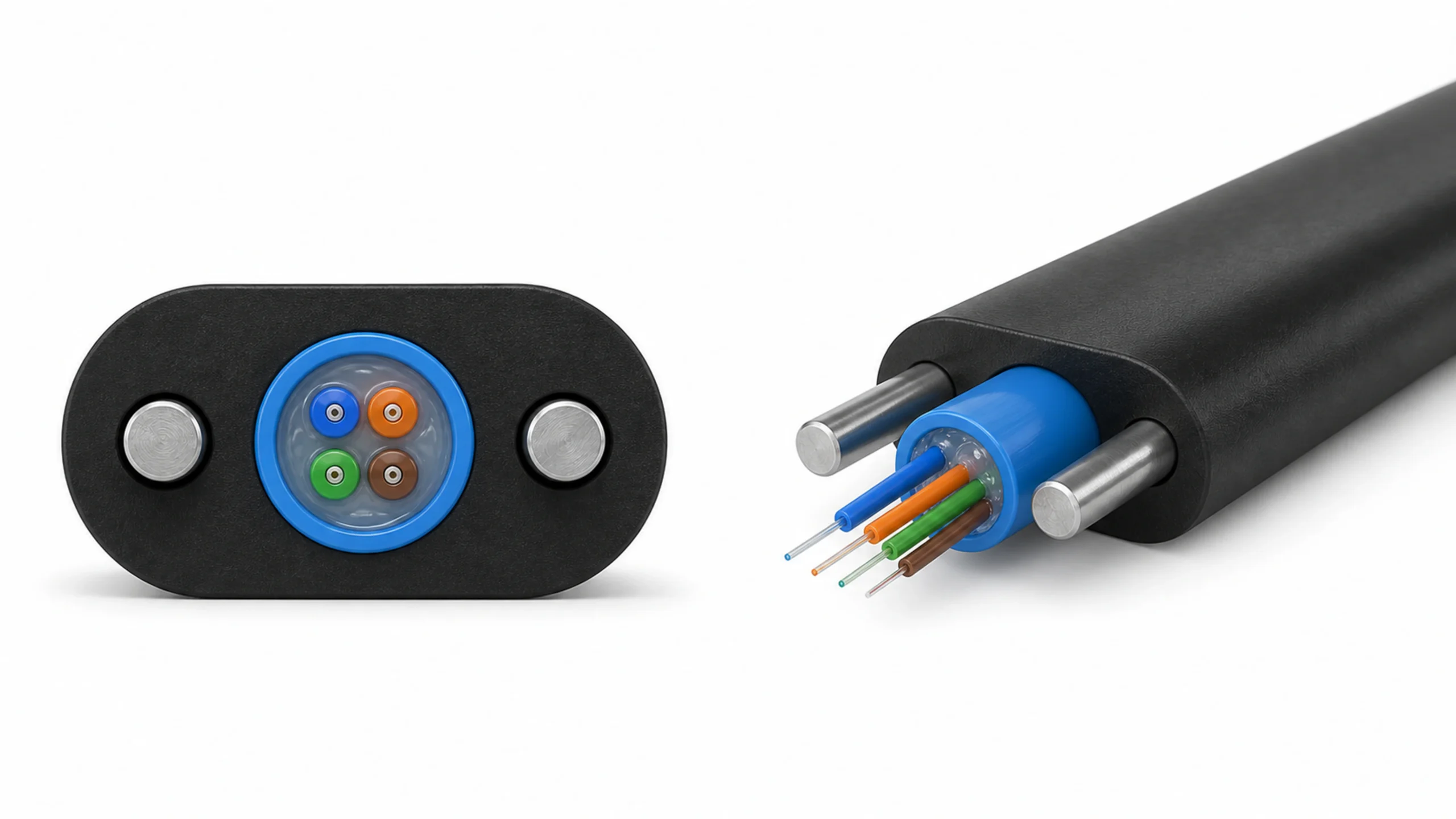












A fiber optic cable factory owner, production manager or technical buyer planning an ADSS cable production line must connect the approved cable design to every manufacturing stage. The practical question is not whether a supplier offers an “ADSS line,” but whether the proposed route can control each component, interface and acceptance result required by the target cable.
A defensible ADSS production route begins with the finished cable specification and works backward through outer sheathing, aramid reinforcement, cable-core stranding, loose-tube formation and fiber preparation. Existing equipment can remain in scope only when its material handling, package, tension, process window and test evidence match the approved ADSS construction.
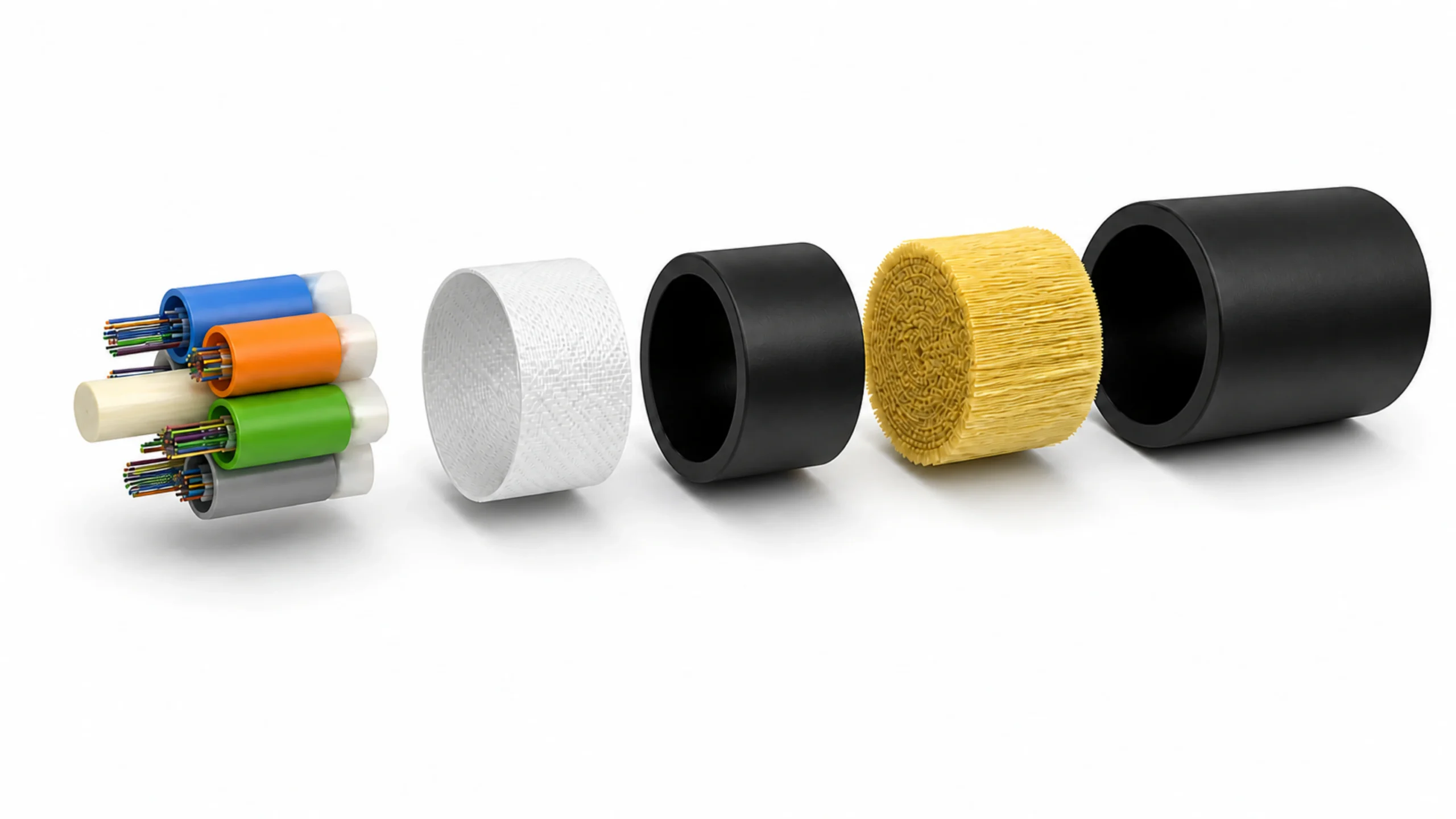
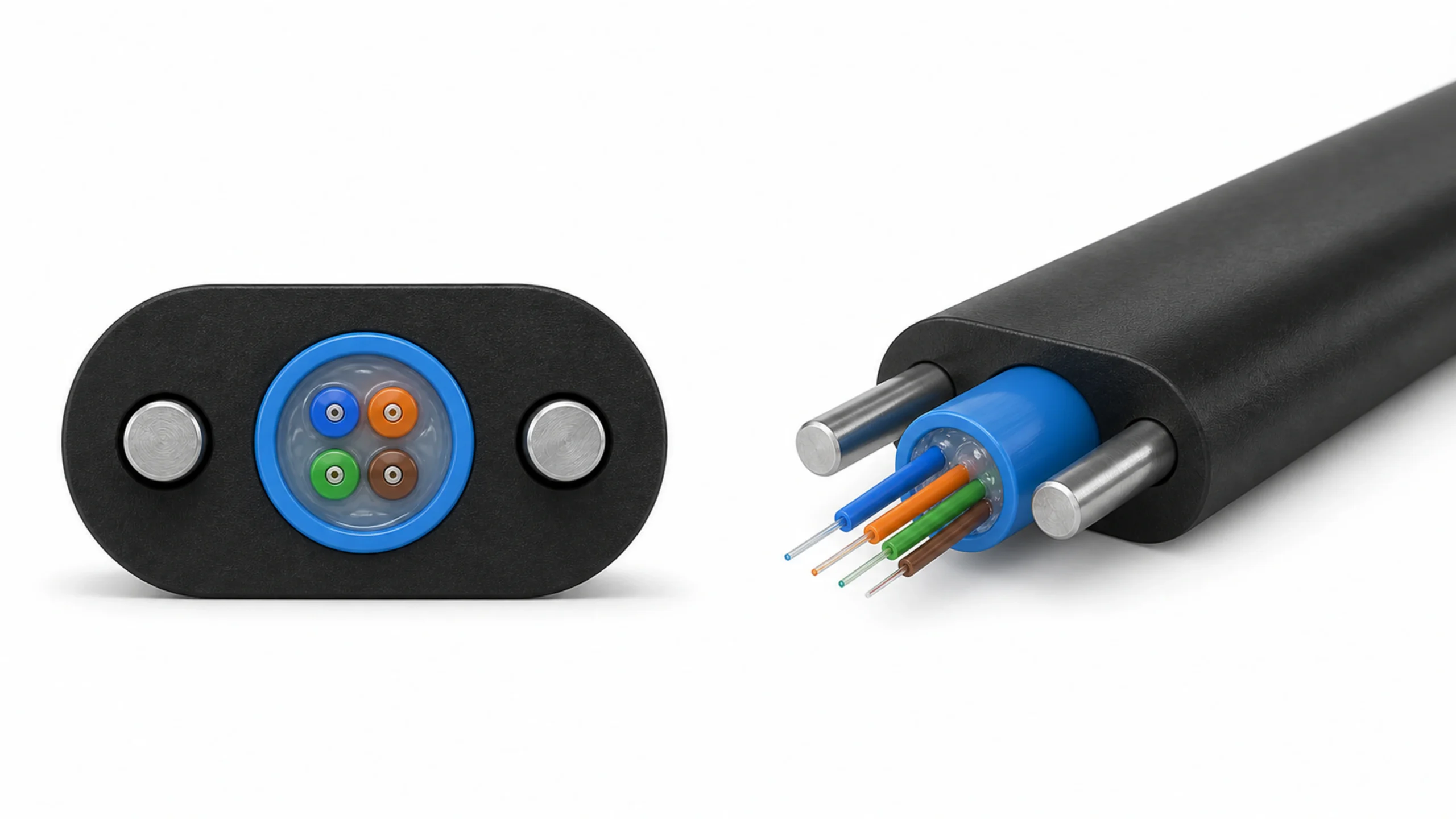
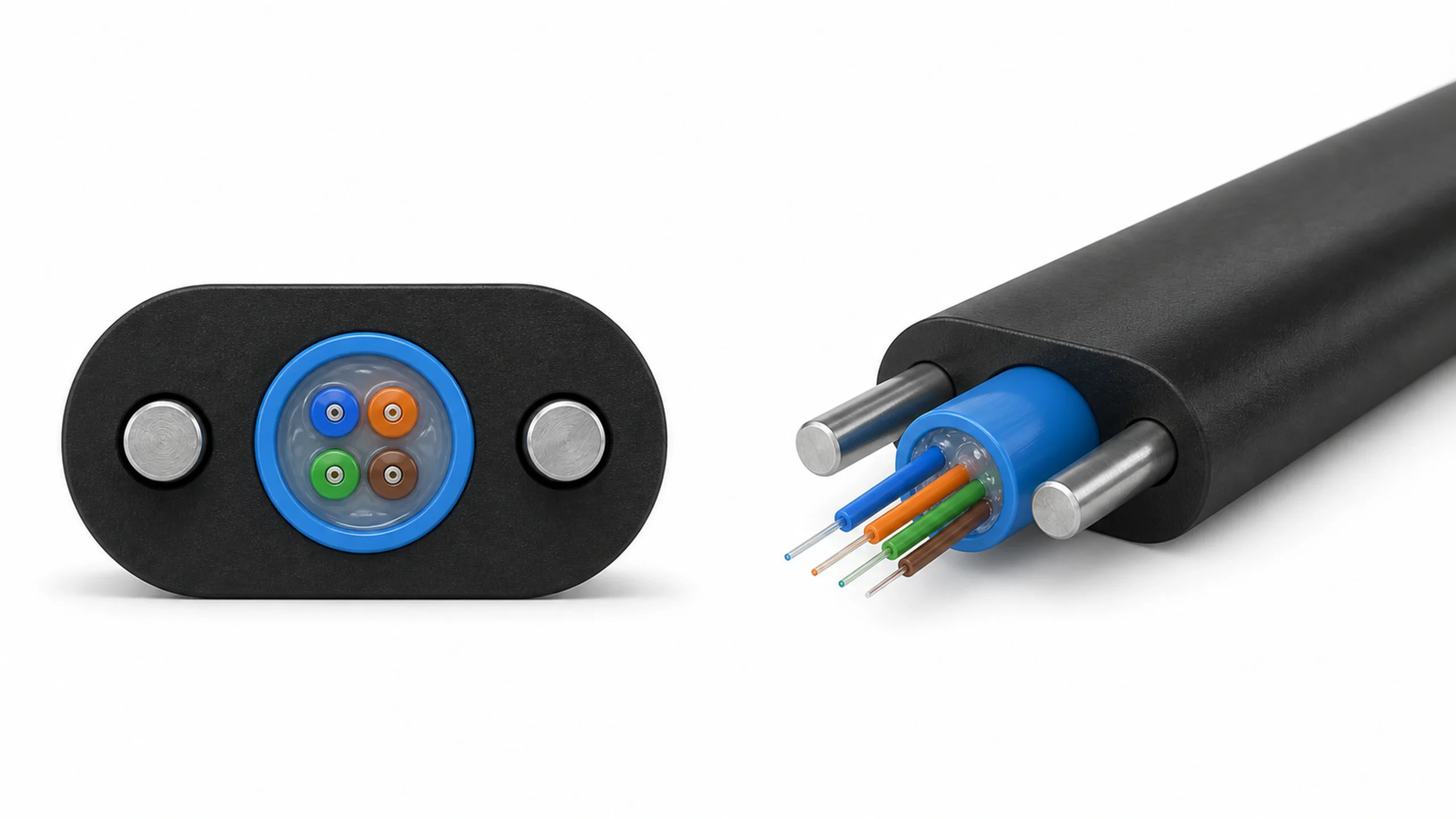
Verified reference illustration of a stranded loose-tube ADSS construction. Final layer count, dimensions, materials and performance requirements must follow the approved cable drawing.
This guide replaces HONGKAI’s older process article at the same URL. It separates product requirements from machine claims, treats the current HONGKAI ADSS cable production line as a reference route, and keeps machine quantities and operating values project-specific.
What Must Be Defined Before Choosing an ADSS Production Route?
Start with the target cable, installation environment and acceptance specification. Fiber count or finished diameter alone cannot determine the loose-tube design, cable-core arrangement, aramid requirement, sheath compound, production equipment or FAT program.
ADSS means all-dielectric self-supporting cable. The tensile reinforcement is non-metallic, and the finished design must support itself under the specified aerial installation and operating loads. The current IEC 60794-4-20:2018 scope covers ADSS construction as well as mechanical, electrical, optical, environmental, installation and acceptance requirements. The standard does not certify a machine or define one universal factory configuration.
The buyer’s first engineering package should include:
- the approved cable cross-section and material schedule;
- fiber type, fiber count, color sequence and supply reel format;
- loose-tube count, tube dimensions, fibers per tube and filler arrangement;
- central dielectric member, water-blocking and binder construction;
- inner-sheath requirement, aramid layer design, ripcord and outer-sheath construction;
- the applicable product standard, project specification and installation environment;
- the intended span, route type and application scenario, together with the customer’s product-specific dimensional and performance limits;
- các bài kiểm tra cơ học, quang học, môi trường và điện cần thiết;
- bản vẽ gói đầu vào và đầu ra cho từng giai đoạn sản xuất.
An aerial cable used near power lines and a self-supporting cable used on a telecommunication pole route may fall under different performance and sheath-design requirements. For example, IEC 60794-3-20:2016 covers self-supporting aerial telecommunication cables but explicitly excludes ADSS constructions on power lines that require special tracking- and erosion-resistant sheath materials. The project specification must identify the applicable route rather than using “aerial cable” as a complete design input.
Common mistakes: A buyer sends only fiber count, span or finished diameter and asks for a complete machine list. Another mistake is to copy a previous ADSS bill of materials without confirming line voltage, environmental exposure, loading, cable diameter, tensile design and required test program.
Decision criterion: Treat “ADSS + fiber count + span” as an incomplete input set. Request the detailed product construction and specification before validating a production route, because those inputs define both the machine configuration and the acceptance basis for the trial. A machine’s theoretical capability does not by itself prove that the customer’s target cable has been validated.
Cấu trúc cáp được ánh xạ như thế nào đến các giai đoạn sản xuất?
Map each material layer to the stage that creates or integrates it, then define the handoff between stages. A reference stranded loose-tube ADSS route normally includes fiber preparation, loose-tube extrusion, SZ core stranding, aramid reinforcement and outer sheathing, followed by product testing and packing.
| Phần tử cáp hoặc đầu ra | Manufacturing responsibility | Tham chiếu mô-đun HONGKAI | Bằng chứng từ người mua trước khi lựa chọn |
|---|---|---|---|
| Sợi quang có màu | Chuẩn bị các cuộn dây có nhận dạng và được kiểm soát khi không sử dụng sợi đã được nhuộm màu sẵn | HK-235 nhuộm màu và quấn lại | Thông số sợi quang, trình tự màu, định dạng cuộn và hồ sơ đủ điều kiện |
| Ống lỏng có độn | Cấp sợi, đo lượng hợp chất điền đầy, đùn và làm nguội ống, kiểm soát hình học và thu cuộn ống đạt tiêu chuẩn | HK-50 loose-tube production line | Vật liệu ống, số sợi trên mỗi ống, bản vẽ ống, phương pháp và kế hoạch kiểm tra độ dài dư |
| Lõi cáp xoắn | Xả sợi FRP trung tâm và các ống lỏng, thực hiện bện SZ, buộc chặt và thêm các thành phần chống thấm nước theo quy định | HK-SZ / HK-800-12 reference route | Số lượng phần tử, kích thước, sơ đồ bện, yêu cầu đảo chiều, khoảng lực kéo và hồ sơ kiểm tra lõi |
| Lõi gia cường bằng sợi aramid | Áp dụng lớp gia cường chịu kéo điện môi được chỉ định với sự phân bố và lực căng được kiểm soát | Hệ thống gia cường aramid chuyên biệt cho dự án | Loại sợi, kiểu cuộn, thiết kế lớp, số lượng, phương pháp căng và bằng chứng về độ phủ |
| Lớp vỏ bọc ngoài hoàn thiện | Trả hết lõi đã được phê duyệt, tích hợp các giao diện cốt gia cường/dây kéo, đùn, làm nguội, đo, kéo và thu cuộn | đường dẫn lớp bao bọc HK-90 ADSS | hợp chất, cấu trúc lớp bao bọc, đánh dấu, hình học, kiểm tra điện áp/đường tuyến và cuộn cuối |
| dây cáp đã được giải phóng ADSS | kiểm tra các yêu cầu về quang học, kích thước, cơ học và môi trường đã thống nhất | phòng thí nghiệm người mua, bên thứ ba được chứng nhận hoặc phạm vi kiểm tra đã thống nhất | phương pháp kiểm tra, mẫu, thiết bị, giới hạn, bên chứng kiến và báo cáo lưu trữ |
Ma trận này là bản đồ quy trình, không phải danh sách thiết bị phổ quát. Một nhà máy mua sợi đã nhuộm màu sẵn có thể không cần dây chuyền nhuộm màu. Một nhà máy có dây chuyền ống lỏng đã được xác minh hoặc dây chuyền SZ có thể tái sử dụng nếu vật liệu, bao bì, giới hạn quy trình và bằng chứng chất lượng được phê duyệt phù hợp với dải ADSS mới.
- Process names alone do not prove equipment reuse. An existing optical-cable plant may already have coloring, loose-tube extrusion, SZ stranding or sheathing equipment, but the decision must still be made against the target product and required operating tier. Low-, medium- and higher-throughput configurations can differ in control scope and line capability even when the process names are the same.
-
::flow
01 · DEFINE|Phê duyệt cáp
cố định cấu trúc, vật liệu, tiêu chuẩn áp dụng, sản phẩm đưa ra và yêu cầu chấp nhận.
02 · MAP|Gán cho từng lớp
xác định giai đoạn nào tạo ra hoặc tích hợp từng sợi, ống, thành phần chịu lực, thành phần chống thấm nước, sợi, dây rút và lớp bao bọc.
03 · MATCH|Kiểm tra thiết bị
so sánh máy móc hiện có và đề xuất với các gói yêu cầu, lực căng, hình học, điều khiển và giao diện nhà máy.
04 · PROVE|Chạy kiểm tra chấp nhận
- sử dụng vật liệu có thể truy xuất nguồn gốc và cáp đại diện để xác minh cửa sổ quy trình đã thống nhất và bằng chứng sản phẩm hoàn thiện.
-
::
Tiêu chí quyết định: Đừng mua một “dây chuyền ADSS hoàn chỉnh” cho đến khi mỗi hàng trong ma trận cấu trúc-quy trình có máy được gán, bên chịu trách nhiệm, thông số đầu vào, bản ghi đầu ra và phương pháp chấp nhận.
Những giao diện quy trình nào có khả năng làm gián đoạn tuyến đường nhất?
Các điểm rủi ro cao nhất thường là các điểm chuyển giao giữa các giai đoạn, chứ không phải sự hiện diện của các máy móc chính. Một ống lỏng đạt tiêu chuẩn vẫn có thể bị hư hại trong quá trình cấp liệu hoặc xoắn SZ; lõi cáp ổn định vẫn có thể thất bại nếu phân bố sợi aramid, đùn lớp bao bọc hoặc xử lý cuộn lấy không được phối hợp.
Chuẩn bị sợi quang đến quá trình đùn ống lỏng
Confirm whether the plant will use pre-colored fiber or color and rewind it in-house. The handoff must preserve fiber identification, coating condition, reel build and payoff behavior. The loose-tube line then needs the correct fiber reel interface, filling system, tube material preparation, extrusion tooling, cooling path, online geometry check and take-up package.
The tube drawing should define more than nominal outside diameter. It should state wall construction, fiber count, fiber excess-length requirement, filling condition and test method. A stable-looking tube is not sufficient if the optical result changes after cabling, temperature conditioning or mechanical loading.
Ống lỏng để bện lõi cáp kiểu SZ
The SZ stage must receive loose tubes and the central FRP in compatible packages and controlled condition. Confirm element diameters, counts, fillers, central-member interface, lay or reversal program, binder and water-blocking materials, tension method, capstan and output reel. These variables are connected; they should not be approved as separate catalog options.
Check the cable core after stranding for geometry, tube condition, binding stability and the agreed optical evidence. The line trial should also show starts, stops, reversal behavior, acceleration and the reel build required by the next stage. A short no-load rotation test cannot prove the cable-core handoff.
Lõi cáp đến lớp gia cường aramid và lớp vỏ bọc
The final-stage proposal must show where the cable core is paid off, where aramid is applied, how the yarn packages are loaded and controlled, where ripcords or other specified elements enter, and how the reinforced core reaches the crosshead. The downstream extruder, cooling path, diameter measurement, traction and take-up must follow the same coordinated line-speed reference.
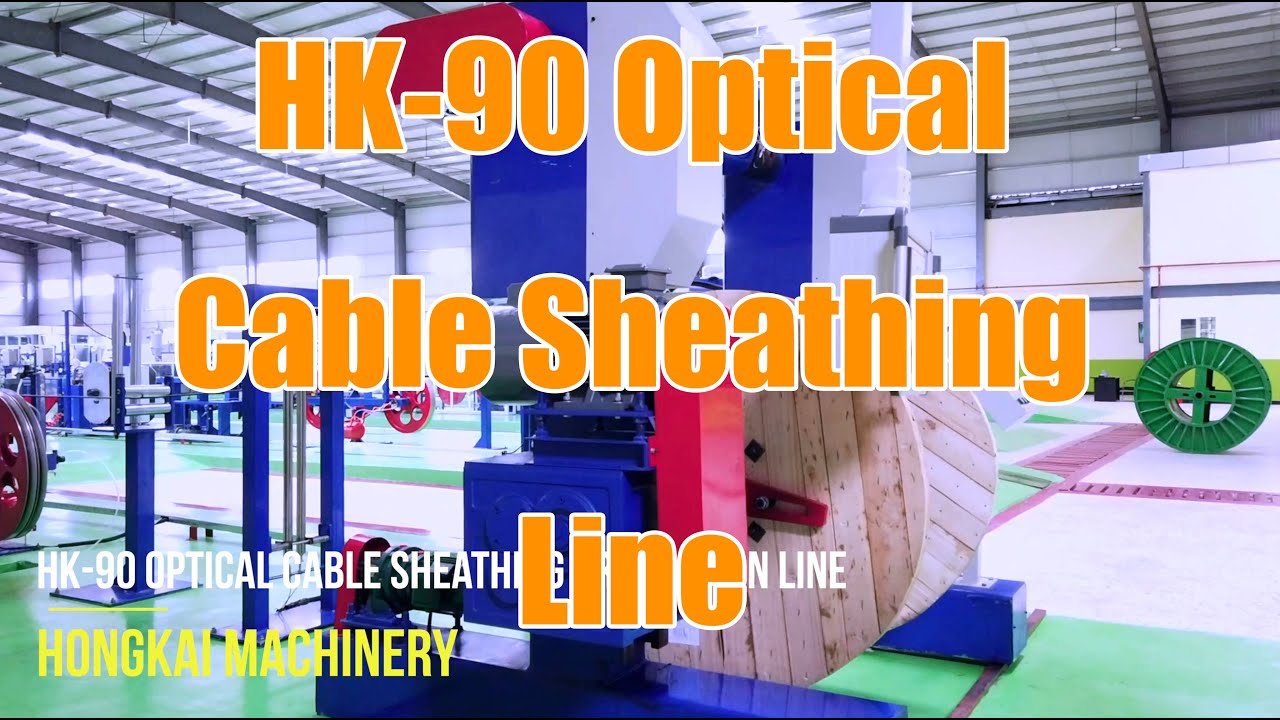
Real HONGKAI HK-90 optical cable sheathing-stage reference. The complete aramid arrangement, line interfaces, dimensions and operating range require project confirmation.
Note: The product page groups aramid reinforcement and final sheathing into the last reference stage. The signed proposal must still state whether the reinforcement system is a separate machine, an inline module or another verified arrangement and how its controls interlock with the sheathing line.
Quy trình gia cường Aramid phải kiểm soát những gì?
Aramid is a structural input, not decorative yarn added before the jacket. The process must distribute the specified reinforcement around the cable core without unacceptable local stress, gaps, overlap, twist, yarn damage or unstable handoff into the sheath crosshead.
The required yarn type, linear density, treatment, package, number of ends and layer design come from the approved cable construction. Machine selection must then address package dimensions, loading, individual or grouped tension control, yarn path, guiding, break detection, stranding direction or application pattern, changeover and line synchronization. Do not infer these values from cable diameter alone.
Derive the required number of aramid ends from the approved cable construction; a structure needing more reinforcement may require more active yarn packages. For ADSS projects with multiple yarn ends, evaluate an active payoff with tension control rather than assuming that passive line pull will be adequate. A cage-type arrangement is a HONGKAI reference configuration, but its head count, layer pattern and suitability must be confirmed for the approved cable.
The aramid system and sheathing process must be reviewed together. A mismatch can disturb the reinforced-core diameter, yarn distribution, crosshead entry, jacket concentricity, surface appearance or take-up behavior. The FAT should therefore capture evidence before, during and after sheathing rather than hiding the reinforcement layer inside the finished sample.
Some approved constructions include an inner and outer sheath, while others do not. The application scenario—including whether the cable is intended for a backbone route or another installation environment—must therefore be supplied before HONGKAI freezes the sheath and aramid arrangement. This project-specific review must not be replaced by the assumption that every ADSS cable uses the same final-stage configuration.
Bằng chứng cần yêu cầu:
- thông tin nhận dạng sợi đã được phê duyệt và chi tiết cuộn sợi;
- sơ đồ xỏ chỉ và phương pháp điều khiển lực căng đã ghi lại;
- xác minh số sợi chỉ đang hoạt động và cách sắp xếp lớp;
- hình ảnh hoặc mẫu lưu giữ thể hiện sự phân bố trước khi bọc vỏ;
- thiết lập đường dây đã ghi lại cho sản phẩm đại diện;
- hình học cáp thành phẩm và kết quả quang học được liên kết với cùng một lần chạy;
- các thử nghiệm cơ học đã thỏa thuận hoặc báo cáo bên ngoài đủ điều kiện cho thiết kế cuối cùng.
Red flags: The proposal states only a head count, treats all yarn packages as interchangeable or claims one tension value for every ADSS design. Another warning is an FAT plan that inspects only the outer jacket and never records the reinforced core before it enters the crosshead.
Bằng chứng Chất lượng Nào Thuộc về Từng Giai đoạn?
Separate process checks from finished-cable qualification. Factory acceptance can prove machine assembly, interfaces, repeatable settings and representative production evidence, but the finished ADSS design may also require mechanical, optical, environmental and electrical tests that are not practical on the production floor.
| Stage | Bằng chứng trong quá trình | Output evidence | Ranh giới để ghi lại |
|---|---|---|---|
| Chuẩn bị sợi quang | Thông tin cuộn dây, trình tự màu sắc, tình trạng quấn và đặc tính xả cuộn | Bằng chứng về độ bám màu/không bị phai màu và cuộn sợi đã được chuẩn bị đạt tiêu chuẩn | Việc sợi quang do người mua cung cấp, đã được nhuộm màu sẵn hay được xử lý tại chỗ |
| Đùn ống lỏng | Lô vật liệu, cấp sợi, độn, công thức nhiệt độ/áp suất, làm nguội và hình học trực tuyến | Độ dài dư sợi quang được kiểm soát, đường kính ngoài ống ổn định, bằng chứng quang học và cuộn dây | Những phép thử nào là kiểm tra trên dây chuyền và những phép thử nào yêu cầu phương pháp phòng thí nghiệm |
| SZ mắc cạn | Định danh phần tử, phương pháp điều chỉnh lực căng đầu ra, thiết lập bước xoắn/đảo chiều, ứng dụng dây buộc và vật liệu chống thấm nước | Hình thành lõi cáp bình thường, tình trạng ống, độ ổn định của lớp bọc, kết quả quang học và cuộn đầu ra | Sản phẩm và điều kiện vận hành nào thể hiện sự chấp nhận |
| Aramid application | Định danh sợi, số sợi đang hoạt động, tình trạng cuộn sợi, phương pháp căng, đường đi và phân bố | Đường kính lõi gia cường, bằng chứng về độ bao phủ và mẫu lưu giữ | Thiết kế lớp và giới hạn vượt qua từ đặc tả cáp đã được phê duyệt |
| Lớp vỏ ngoài | Định danh hợp chất, đầu nối/dụng cụ, thiết lập đùn/làm nguội, ứng dụng aramid, đường kính trực tuyến và đồng bộ hóa dây chuyền | Bề mặt lớp vỏ, đường kính ngoài, độ lệch tâm/độ sai lệch, đánh dấu, chiều dài, cấu trúc cuộn dây và các phép thử trực tuyến đã thỏa thuận | Các yêu cầu về hợp chất và môi trường điện là đặc thù theo từng dự án |
| Finished cable | Khả năng truy xuất nguồn gốc từ nguyên vật liệu và công thức đến mẫu thử | Báo cáo quang học, kích thước, cơ học, môi trường và điện áp dụng | Vị trí thử nghiệm, nhân chứng, chiều dài mẫu, phương pháp, giới hạn và trách nhiệm |
IEC 60794-4-20:2018 bao gồm các yêu cầu nghiệm thu và thử nghiệm ADSS ở cấp độ sản phẩm. ITU-T L.102 (11/2025) defines ADSS as a self-supporting cable whose tensile element is non-metallic reinforcement under or within the plastic sheath and discusses aerial-cable construction and performance considerations. Newer test-method publications can also apply to specific phenomena: IEC 60794-1-119:2025 xác định phương pháp thử nghiệm rung động do gió (aeolian vibration) cho cáp quang treo bao gồm cả cáp ADSS.
These sources help define what the cable must prove. They do not establish that every test belongs inside a machinery FAT or that HONGKAI supplies every laboratory. The RFQ should assign each required result to machine FAT, buyer laboratory, independent laboratory, type-test evidence or another agreed verification route.
How to verify: Select the FAT cable from the customer’s approved product specification, then keep stage-linked evidence: color adhesion after coloring; fiber excess length, optical result and outside-diameter stability after loose-tube extrusion; normal cable-core formation after SZ stranding; and aramid application, sheath surface, diameter and eccentricity/deviation at the final stage. Exact limits remain those of the agreed product specification. If the complete line does not produce a conforming cable, start with the failed finished-cable characteristic and trace it backward—for example, color loss, poor excess-length control or excessive loose-tube diameter variation—to the responsible upstream process.
Làm thế nào để kiểm tra thiết bị hiện có trước khi mua một dây chuyền hoàn chỉnh?
Audit the plant stage by stage and keep only equipment that can prove the required input, process and output window. Reusing a machine because its nominal diameter or speed appears sufficient can leave hidden gaps in yarn handling, package interfaces, controls, test capability or downstream compatibility.
For each existing line, collect the nameplate and configuration, general arrangement, payoff/take-up drawings, tooling, control architecture, material limitations, maintenance condition and recent qualified product records. Then compare those records with the launch ADSS matrix. Mark each stage as reusable, reusable with modification, new equipment required or external responsibility.
Các HONGKAI hướng dẫn dây chuyền sản xuất ống lỏng có thể giúp xác định các đầu vào giai đoạn ống, trong khi hướng dẫn lắp đặt dây chuyền sản xuất cáp quang giải thích các giao diện dự án cần được cố định trước khi đưa vào vận hành. Sử dụng các trang này làm tài liệu tham khảo lập kế hoạch, không thay thế cho các thỏa thuận kỹ thuật.
Danh sách kiểm tra:
- ☐ Ma trận sản phẩm ADSS đã được phê duyệt và các tiêu chuẩn áp dụng
- ☐ Hồ sơ cấu hình và tình trạng máy hiện có
- ☐ Bản vẽ cuộn đầu vào và đầu ra cho từng giai đoạn
- ☐ Các cấp vật liệu, định dạng bao bì và điều kiện lưu trữ
- ☐ Dâydẫnđiệnlýtính, được sử dụng trong các thiết bị điện tử, dùng để truyền tải dữ liệu, được bảo vệ bởi các lớp cách điện và vỏ bọc bên ngoài. Các bộ phận này đóng vai trò quan trọng trong việc đảm bảo tính ổn định của hệ thống điện và truyền dữ.
- ☐ Giao diện điều khiển đường dây, đồng bộ hóa và ghi dữ liệu
- ☐ Tiện ích, bố trí mặt bằng, nâng hạ, che chắn và lối tiếp cận cho người vận hành
- ☐ Trách nhiệm kiểm tra trong quá trình và kiểm tra cuối cùng đã được phân công
- ☐ Sản phẩm FAT tiêu biểu, giới hạn đạt và hồ sơ lưu giữ
- ☐ Phạm vi điều chỉnh, lắp đặt, đào tạo và bàn giao
Common mistakes: A factory counts machines instead of verifying stage interfaces, or assumes the existing laboratory can perform every project-specific ADSS qualification test. A gap register is more useful than an optimistic “complete line” label.
Gói RFQ và FAT nên bao gồm những gì?
The RFQ should make the supplier map the cable construction to the proposed route, and the FAT should prove the agreed representative operating conditions with traceable records. Commercial comparison should begin only after the technical scope and evidence matrix are aligned.
Send the supplier a controlled input pack containing the cable drawing, material schedule, product matrix, standards, stage capacities required by the production plan, package drawings, factory utilities, existing-equipment interfaces and acceptance matrix. Ask for a returned line-by-line responsibility schedule that identifies every supplied machine, optional module, buyer item, utility, test instrument and excluded scope.
For FAT, select products that exercise the important boundaries of the proposed route. The chosen sample should be stated by construction, materials, package, lay/reversal program, aramid layer, sheath and test method—not merely “one ADSS cable.” Record material lots, setup, recipes, line condition, sample length, measuring instruments, pass limits, deviations and retained samples or files.
Các HONGKAI trang giải pháp ADSS uses HK-235 fiber preparation, HK-50 loose-tube extrusion, HK-SZ core stranding and HK-90 reinforcement/sheathing as a reference route. HONGKAI can use the buyer’s approved product matrix to review which modules are new, which can be integrated with existing equipment and which tests remain the buyer’s or a laboratory’s responsibility.
Note: No machine list, head count, speed, output or test package is universal for ADSS cable. Final values and responsibilities belong in the mutually approved technical proposal and FAT plan.