










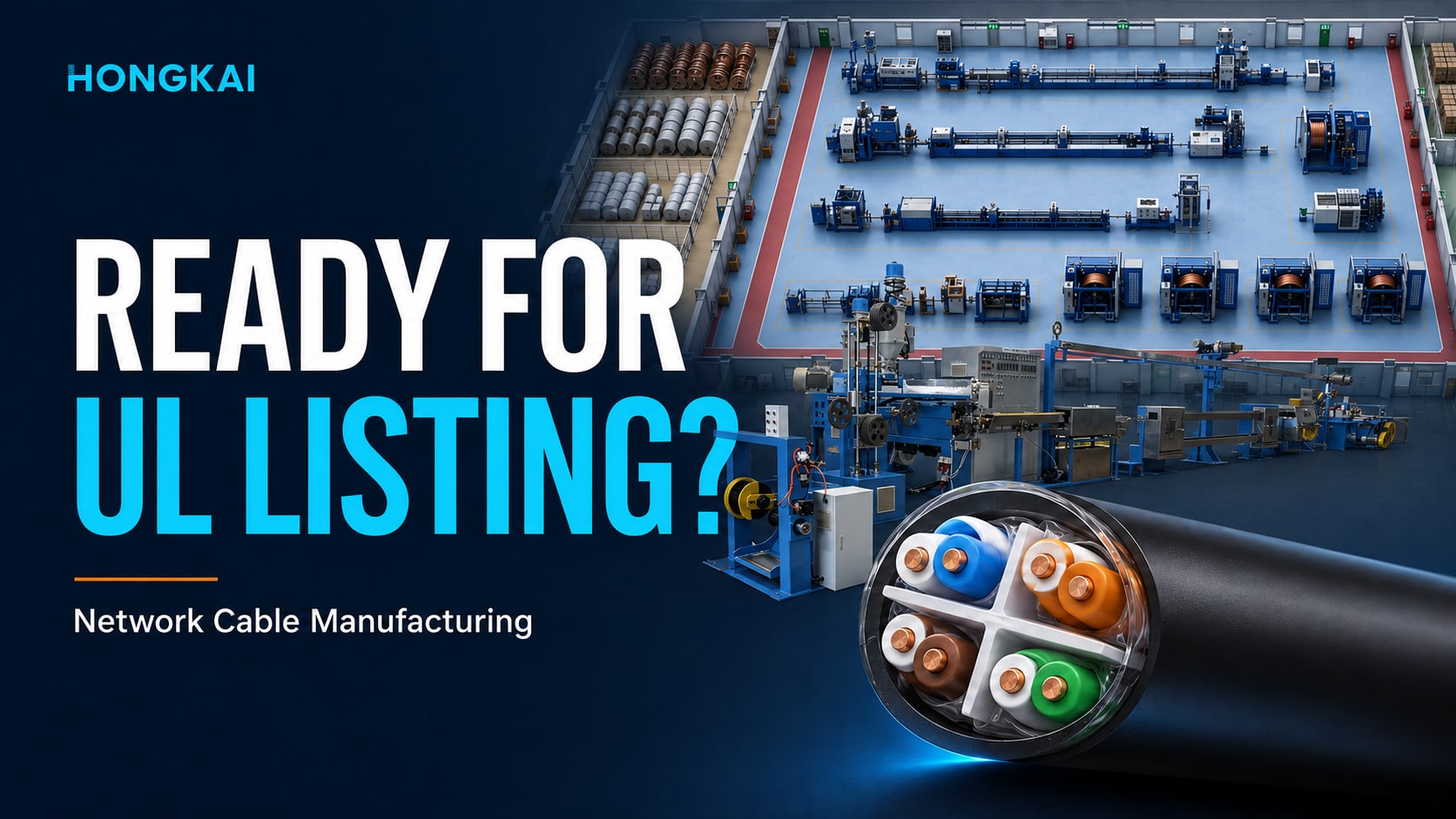
Preparing for network cable UL Listing starts with the exact cable, intended installation type, manufacturing site and certification scope, before testing becomes the main task. The practical decision is not which machine can “make a UL cable,” but which controlled product and production system will be submitted and maintained.
UL Listing is a product-and-factory control program, not a one-time machine setting or a logo added after production. A factory should freeze the construction, confirm the applicable UL category with UL Solutions, prepare representative samples and evidence, and build ongoing material, process, marking and change controls before formal evaluation.
Itu HONGKAI rute produksi kabel LAN connects conductor preparation, insulation, pair twisting, cabling, optional shielding, sheathing, testing and packing. UL Solutions remains responsible for determining the applicable certification program, investigation requirements, authorized markings and follow-up obligations. HONGKAI equipment configuration and factory trials should therefore support the approved cable specification; they cannot replace the certification body’s decision.
Mulai dengan Objek Sertifikasi yang Tepat
The first document should name what will be certified or verified. “Cat6 with UL” is incomplete because safety Listing, transmission-performance Verification, cable assemblies and installed cabling are different objects with different evidence.
UL Solutions states that communications cable types such as CMP, CMR and CM may be certified to UL 444, while performance verification can be provided separately when required.1 Panduan Aplikasi Kabel dan Kawatnya juga membedakan produk yang Terdaftar, Diklasifikasikan, Disertifikasi, dan Diverifikasi serta menginstruksikan pengguna untuk memeriksa kategori produk yang berlaku dan tanda-tandanya.2
| Requested object | Keputusan yang harus dibekukan | Bukti utama setelah persetujuan | Apa yang tidak secara otomatis dicakup oleh bukti tersebut |
|---|---|---|---|
| Kabel komunikasi yang terdaftar | Jenis kabel yang dimaksudkan, konstruksi, rating, lokasi pabrik, dan kategori yang berlaku | Informasi Daftar Resmi, tanda-tanda, dan catatan Product iQ terkini | Setiap jaket, konduktor, pabrik, atau keluarga kabel lainnya |
| Kabel LAN dengan performa terverifikasi | Spesifikasi kinerja transmisi yang tepat dan konstruksi produk | Tanda Verifikasi dan cakupan direktori atau sertifikat spesifik produk | Daftar penggunaan untuk kebakaran atau instalasi kecuali disertakan secara terpisah |
| Rakitan kabel komunikasi | Konstruksi rakitan selesai, komponen, dan evaluasi yang diperlukan | Bukti Pendaftaran atau Verifikasi Spesifik Perakitan | Kinerja kabel horizontal massal atau saluran terpasang |
| Tautan permanen atau saluran yang terpasang | Desain lokasi, komponen, pengerjaan, dan batas uji lapangan | Laporan uji coba lapangan proyek | Sertifikasi pabrik dari kabel itu sendiri |
Decision criterion: Ask the certifier to write the product category, target market, standard or program, cable type, manufacturing location, sample family and permitted marking. Keep safety Listing and performance Verification on separate lines even when the final product will carry both.
Common mistakes: A buyer asks for a “UL machine,” treats a Cat6 field-test PASS as a cable Listing, or assumes that a UL logo printed on the jacket proves current coverage. None of these defines the actual certification object.
Bekukan Kabel yang Dapat Dijual Sebelum Memilih Pengujian
The factory should submit a controlled saleable construction, not a broad marketing family. The conductor, insulation system, pair design, separator or shielding, jacket compound, cable type, manufacturing site and markings all need an identified revision.
Ikhtisar kabel dan kawat terkini dari UL Solutions menyebut CMP, CMR, dan CM sebagai jenis kabel komunikasi yang berbeda yang dievaluasi berdasarkan penggunaan yang dimaksudkan.1 The target cable type affects construction and evaluation; a factory should not select a jacket only by colour, processing convenience or a supplier’s generic “UL material” description.
Dalam diskusi penentuan cakupan peralatan HONGKAI, lima pertanyaan mengubah “Saya ingin membuat kabel jaringan UL” menjadi brief awal yang dapat digunakan:
| First question | Apa yang harus disediakan oleh pembeli | Keputusan peralatan atau bukti |
|---|---|---|
| Apakah produk yang dapat dijual berupa kabel curah atau kabel patch jadi? | Panjang kotak/gulungan, konstruksi konduktor, fleksibilitas, dan apakah rakitan konektor disertakan | Pembuatan kabel saja dibandingkan dengan pengujian terminasi dan perakitan tambahan |
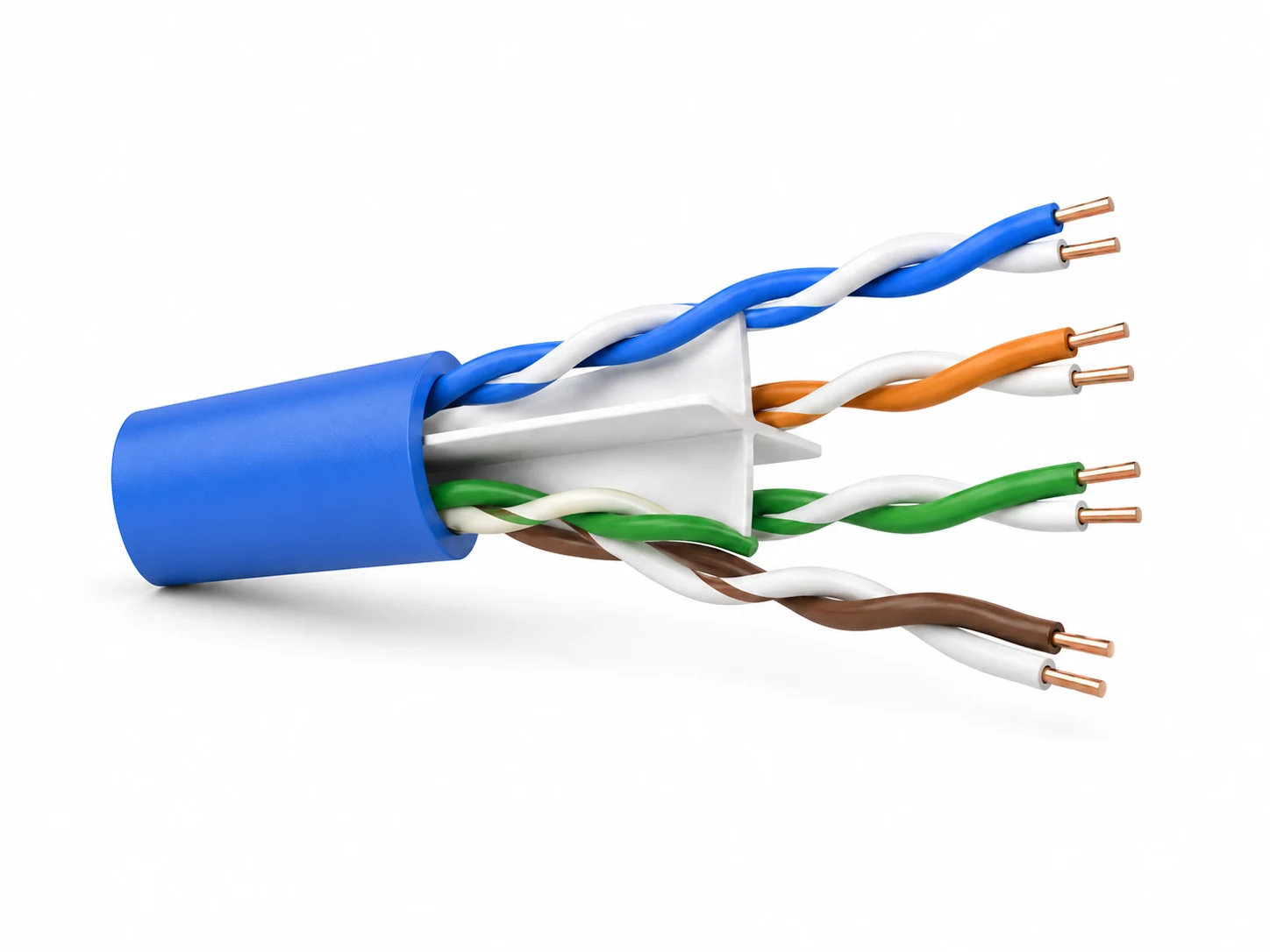
| Which constructions and categories are required now? | A drawing for each UTP, FTP, STP or SFTP request, with the exact pair/overall shield arrangement and present category range | Pair twisting, separator handling, foil wrapping, braiding and cabling route |
| What does “UL” mean in this purchase? | Target market, installation-use cable type, requested safety Listing and any separate performance Verification | Certification category and applicable test program to confirm with the certifier |
| What materials and geometry define the sample? | Identitas konduktor, isolasi, dan jaket; isolasi padat atau berbusa; dimensi dan revisi gambar terkendali/BOM | Extrusion, drawing interfaces, tooling, process controls and material trials |
| Apa yang harus disampaikan oleh lini awal, dan apa yang hanya merupakan target di masa depan? | Launch products, later variants, required output, manufacturing site and available laboratory capability | Lingkup peralatan awal, opsi berharga terpisah, antarmuka uji spesialis, dan rencana penerimaan FAT |
Bulk packaging length is not a certification category. A customer’s shorthand such as a “300 m box” or a connection “within 100 m” must be replaced by the actual ordered length and test object. A patch cord is not simply every cable shorter than 100 m: Fluke Networks distinguishes the complete channel, including cords, from the fixed permanent link.3
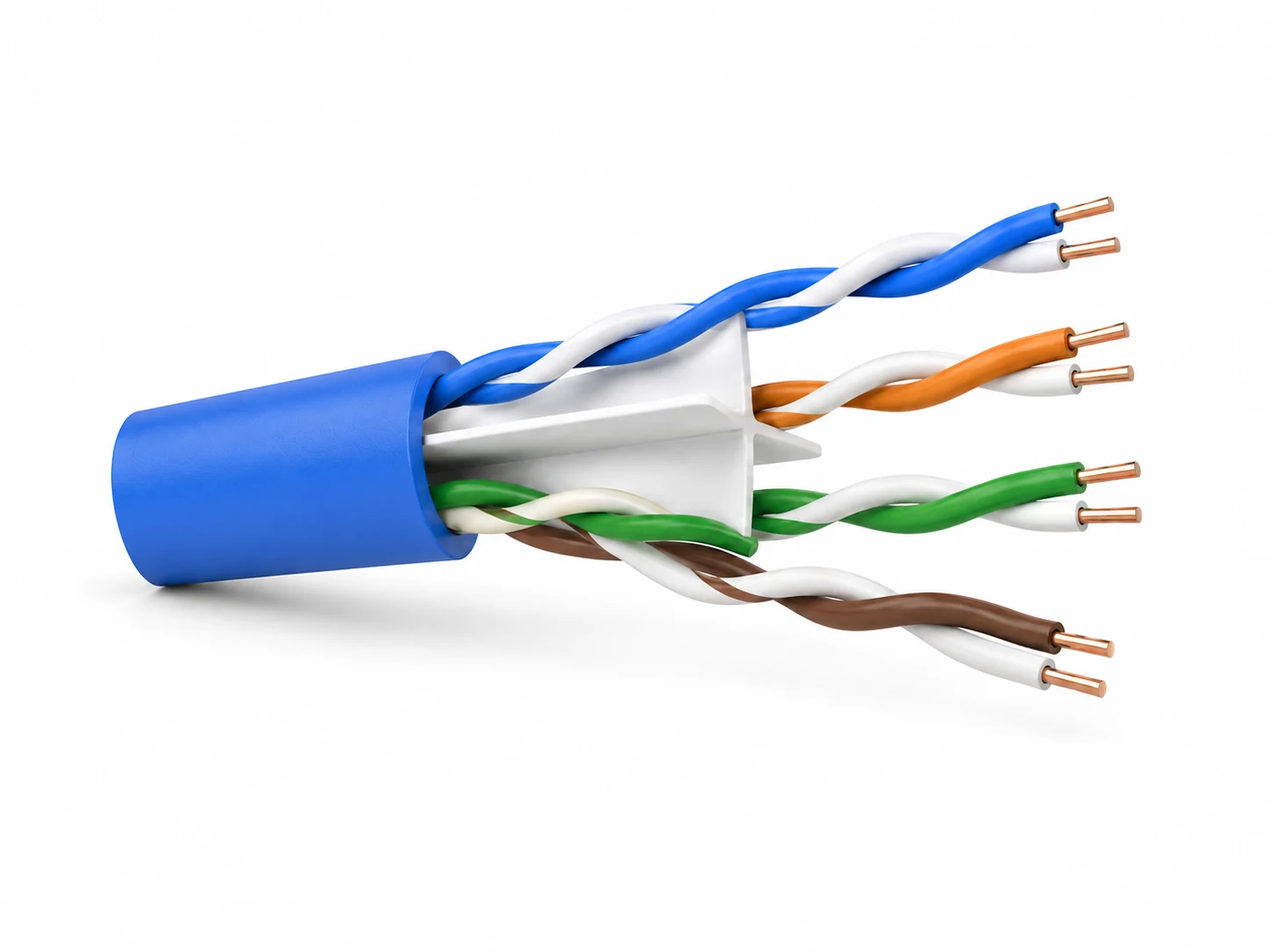
Likewise, commercial shield abbreviations are not enough for machine selection. The approved cross-section must show whether shielding is around each pair, around the cabled core, or both, and identify foil, braid and drain-wire details. Keep each approved variant and its proposed print legend, reel/box label, packaging, manufacturing site and subcontracted stages in the product-definition record.
Rute mesin mengikuti definisi ini. The rute referensi HONGKAI Cat5/Cat5e shows insulation, pair twisting, cabling, sheathing, testing and packing as a connected process, with final construction and acceptance tied to the approved specification. A Cat6 or shielded construction may change separator handling, shielding equipment, process controls and laboratory scope; no common machine list proves that all variants belong in one certification family.
What to ask: Request written confirmation from UL Solutions about the applicable category and the documents, samples and manufacturing-site information required for the proposed construction. Do this before purchasing certification labels or promising a launch date.
Sesuaikan Puntiran Pasangan dan Isolasi dengan Konstruksi yang Ditetapkan
Pair geometry and insulation stability deserve attention before the final cable is tested. Changing the twisting route, conductor, insulation compound or foaming process after sample confirmation can change the product being submitted, even if the finished jacket still looks the same.
For pair twisting, compare the actual machine design, tension path, back-twist capability where required, payoff/take-up handling and demonstrated lay control. HONGKAI’s project experience includes triple-twist and other pair-twisting routes. For demanding constructions, Peter’s equipment-selection preference is to evaluate a suitable horizontal arrangement, but orientation alone is not proof of higher performance. Require trials on the intended conductor and insulation, agreed pitch measurements and downstream cable results before accepting a configuration.
Conductor consistency and insulation geometry are separate acceptance items. The conductor’s material, dimensions, surface condition and electrical checks should follow the product specification. For the insulating layer around each conductor, specify the compound and whether the design uses solid insulation, chemical foaming or physical foaming. Do not confuse core-wire insulation with the finished outer jacket, or assume that a familiar PVC grade is suitable for every LAN construction or cable fire rating.
Foaming is a process choice, not an automatic category upgrade or UL approval. Maillefer’s telecom-insulation documentation independently illustrates that solid and chemical-foam constructions require defined materials and line configurations, with drawing, extrusion and measurement functions coordinated as a system.4 Those examples are technical context, not HONGKAI model specifications. A HONGKAI proposal must separately confirm its compound compatibility, extrusion/foaming arrangement, tooling, concentricity control and agreed measurement provision. Moving between solid, chemical-foam and physical-foam designs requires a new compatibility and evidence review; it should not be treated as a recipe-only substitution.
Evidence to request: Freeze the conductor and compound identities, pair lay plan, insulation dimensions, concentricity definition and, for a foamed construction, the foaming-degree definition and test method. Define acceptance limits from the approved product and trial plan; do not copy a generic machine brochure value into the certification specification.
One project described by HONGKAI illustrates why the product range must precede the machine list: it covers UTP and SFTP constructions through Cat6A, with Cat7 as a later target. The discussed route combines drawing with chemical-foam insulation, triple twisting, active foil wrapping at cabling and a separately configured sheathing route. Different constructions may require different tape-handling provisions. This is a configuration example, not evidence that every variant was produced, that Cat7 was achieved, or that any product obtained UL Listing. Shielding and any protective metal-tape layer must be shown separately on the approved drawing.
Bangun Paket Evaluasi dalam Urutan Terkendali
The certification project should move from scope to construction evidence, representative samples, formal evaluation and production authorization. Individual projects vary, and UL Solutions describes the typical lifecycle as quote, testing and follow-up rather than a universal fixed timetable.5
| Sequence | Controlled output | Pertanyaan sebelum tahap berikutnya |
|---|---|---|
| 01 — Scope | Jenis kabel, pasar target, lokasi pabrik, sertifikasi keselamatan, dan verifikasi kinerja terpisah apa pun | Apakah lembaga sertifikasi telah mengonfirmasi program yang dimaksud? |
| 02 — Construction | Gambar, BOM, rute proses, proposal penandaan, pemasok, dan prosedur perubahan | Apakah spesifikasi uji coba mengidentifikasi revisi konstruksi? |
| 03 — Evidence | Sampel representatif dengan catatan material, dimensi, kelistrikan, dan proses | Dapatkah setiap sampel yang diajukan dilacak ke pembuatan aktualnya? |
| 04 — Continuing control | Temuan evaluasi formal, persiapan inspeksi awal, dan penandaan resmi/kontrol tindak lanjut yang sah | Apakah pabrik siap mempertahankan lingkup yang telah disetujui? |
Evidence to request: Keep the certifier’s proposal, product-category decision, sample instructions, construction description, test plan, findings, approved revisions, follow-up procedure, marking authorization and factory-inspection records under one controlled project number.
Catatan: Sampel pra-sertifikasi yang lulus pemeriksaan laboratorium internal atau eksternal merupakan bukti teknis yang berguna. Namun, hal ini bukan merupakan otorisasi untuk menggunakan Tanda UL.
Hubungkan Setiap Tahap Produksi dengan Kepatuhan Berkelanjutan
A factory needs a control plan that can reproduce the evaluated construction. The useful question for each stage is: what product characteristic is created here, what record proves control, and what change requires technical review?
The production route can be designed backward from the approved cable. The table below is a proposed control map for the factory and certifier to review; it is not a substitute for the UL Follow-Up Services procedure.
| Production stage | Input atau pengaturan yang dikontrol | Retained evidence | Perubahan yang harus memicu tinjauan |
|---|---|---|---|
| Persiapan konduktor | Material, konstruksi, sumber, dan kondisi konduktor jadi | Catatan identitas masuk, lot, dimensi, dan resistansi yang dipersyaratkan oleh rencana pengendalian | Material, sumber, pelapisan, atau konstruksi konduktor |
| Isolasi kawat inti | Senyawa, perkakas, diameter, konsentrisitas, warna, dan sistem pembusaan yang disetujui jika digunakan | Lot kompon, penyetelan lini, data dimensi, hasil tingkat pembusaan jika berlaku, dan catatan ketidaksesuaian | Jenis kompon atau pemasok, konstruksi padat/busa, metode pembusaan atau perkakas |
| Pemutaran pasangan | Identitas pasangan, rencana pilinan, rute tegangan, dan ketertelusuran gulungan | Lembar setup, pitch yang diukur, ID pasangan/gulungan, dan pemeriksaan proses yang disepakati | Rencana penghamparan, rute mesin, atau metode pengaturan tegangan |
| Kabel dan perisai | Konstruksi posisi pasangan, pemisah, foil, kawat drainase, atau jalinan | Traveler, lot material, geometri inti, dan catatan kontinuitas jika berlaku | Pemisah, bahan perisai, tumpang tindih, desain kawat drainase atau jalinan |
| Selubung dan penandaan | Senyawa jaket yang disetujui, dinding, ukuran jadi, legenda cetak, dan kondisi permukaan | Lot jaket, catatan dimensi, persetujuan cetak, dan identitas gulungan | Jenis jaket atau pemasok, tipe kabel, rating, atau legenda cetak |
| Uji akhir dan pengemasan | Sampel yang ditentukan, metode, sumber penerimaan, dan label kemasan | Hasil mentah, disposisi, ketertelusuran gulungan/kotak, dan kontrol label | Metode pengujian, dasar sampel, batas perangkat lunak, kemasan atau isi label |
The earlier Panduan kepatuhan pabrik Cat6 explains why a final analyzer cannot repair uncontrolled conductor, insulation or pair geometry. The same logic matters here: certification evidence must be linked to the process that made the sample and to the production records that will continue after approval.
How to verify: Select one finished reel or box and trace it backward to the approved construction, material lots, process records, inspection results, final test and authorized label. Then select one material or process change and show who decides whether certification review is required before production resumes.
Pisahkan Pemeriksaan Awal Pabrik dari Keputusan UL
Factory and third-party prechecks reduce avoidable risk, but UL Solutions controls the formal investigation scope, sample requirements, acceptance decision and authorization to use its Mark. The factory laboratory should support the submission without describing itself as the certifier.
Before formal evaluation, the factory can check whether the proposed construction is stable enough to submit. Useful preparation may include dimensional checks, conductor and insulation records, electrical prechecks, fire-test preparation by an appropriate laboratory, marking review and repeat builds from more than one production run. The exact method, equipment, sample count and pass/fail source must come from the agreed certification plan and applicable requirements.
For the equipment FAT, HONGKAI’s practical record priorities are measured pair lay/pitch, insulation concentricity and foaming degree whenever foamed insulation is used. Do not replace the last item with an operator’s observation that the insulation “looks foamed.” Agree the measurement definition, method, instrument and sampling locations before the trial, then retain actual results, units, acceptance source, instrument identity, operator/date and disposition.
Link these records to the drawing revision, machine setup, conductor and compound lots, trial reel and retained sample IDs. Record the trial conditions actually demonstrated; one successful sample is not evidence of an untested speed, material or product range. These FAT measurements support sample preparation and repeatability, but they are not a complete UL test program.

Ilustrasi penjelasan 3D, bukan laporan pengujian atau hasil sertifikasi yang sebenarnya. Pertahankan pitch terukur, konsentrisitas, dan tingkat pengembangan busa jika berlaku, yang dikaitkan dengan sampel aktual.
Lihat ilustrasi rantai catatan ukuran penuh.
| Evidence layer | Responsible party | Keputusan yang didukungnya |
|---|---|---|
| Pengaturan mesin dan catatan proses | Pabrik kabel dengan masukan dari pemasok peralatan | Apakah konstruksi yang dievaluasi dapat direproduksi dalam kondisi yang telah ditentukan |
| Pemeriksaan awal di laboratorium internal | Pabrik kabel atau laboratorium yang memenuhi syarat | Apakah sampel tampak siap untuk pengajuan formal dan di mana prosesnya tidak stabil |
| Evaluasi formal dan keputusan sertifikasi | UL Solutions di bawah program yang disepakati | Apakah produk dan lokasi yang diidentifikasi memenuhi syarat untuk cakupan sertifikasi resmi |
| Verifikasi Kinerja Transmisi Independen | UL Solutions atau program bernama lainnya, jika diminta | Apakah kabel yang diidentifikasi memenuhi spesifikasi kinerja yang disebutkan dalam cakupan program tersebut |
| Pengujian lapangan kabel terpasang | Instalator, tim uji proyek, atau layanan lapangan yang memenuhi syarat | Apakah tautan atau saluran yang terpasang memenuhi batas lapangan proyek |
Red flags: The submission sample was made with unrecorded hand adjustments; the production BOM differs from the tested sample; a third-party report does not identify the exact construction; or the factory plans to replace compounds after approval without a documented review path.
Persiapkan Pabrik untuk Penandaan dan Layanan Tindak Lanjut
UL Listing continues after the initial evaluation. The factory must protect the approved construction, authorized labels, production records, inspection access and change-control process for as long as it produces marked cable.
UL Solutions states that the complete Listing Mark on the tag attached to the reel or smallest unit container is the proof that a particular wire or cable unit is UL Listed; surface printing is supplemental.2 The same guide says holographic labels are required for Listed communications cable and several related wire-and-cable categories. UL Solutions also explains that initial product inspection and follow-up services are part of the customer lifecycle.5
File kesiapan pabrik harus mengidentifikasi:
- siapa yang mengontrol akses ke label dan merekonsiliasi penggunaannya;
- tempat konstruksi yang disetujui dan karya seni penandaan disimpan;
- bagaimana bahan masuk diperiksa terhadap identitas yang telah disetujui;
- bagaimana catatan produksi dan inspeksi dikaitkan dengan gulungan atau kotak;
- bagaimana material yang tidak sesuai dan produk yang ditandai dipisahkan;
- bagaimana inspektur pabrik menerima catatan terkini dan akses produksi;
- bagaimana perubahan produk, material, pemasok, proses, lokasi, atau penandaan ditinjau;
- bagaimana gambar, label, dan instruksi kerja yang sudah usang dihapus dari penggunaan.
In HONGKAI’s preparation discussions, the easily missed items are raw-material traceability, retrievable production/test data and usable work instructions. Test that system before preparing the submission: ask an operator to retrieve the instruction revision used for one sample, identify its material lots and locate the corresponding raw results. A folder of disconnected screenshots does not establish that chain.
Common mistakes: The jacket print is treated as the only Listing evidence; labels can be taken without reconciliation; approved and unapproved compounds share the same internal name; or production changes are implemented before the certification owner reviews their effect.
Tulis RFQ dan Matriks Tanggung Jawab Berdasarkan Bukti
The cable factory, machinery supplier, material suppliers, laboratories and UL Solutions have different responsibilities. A complete project defines the handoffs instead of asking one party to promise “UL approval.”
| Deliverable | Pabrik kabel | Lingkup peralatan HONGKAI | UL Solutions atau pihak spesialis |
|---|---|---|---|
| Ruang lingkup sertifikasi dan kabel target | Memiliki keputusan dan aplikasi produk yang dapat dijual | Terjemahkan rute kabel yang telah disetujui menjadi pertanyaan mengenai peralatan dan antarmuka | Konfirmasi kategori sertifikasi yang berlaku dan program evaluasi |
| Konstruksi dan BOM yang Dikendalikan | Gambar, material, pemasok, dan revisi sendiri | Konfirmasi kompatibilitas mesin dengan input proses yang telah ditandatangani | Tinjau konstruksi dalam lingkup proyek resmi |
| Produksi percobaan dan catatan | Sediakan bahan, operator, dan ketertelusuran produk | Mendukung pengaturan mesin yang disepakati, hasil FAT, dan catatan proses | Tentukan atau saksikan bukti formal hanya jika telah dikontrak untuk melakukannya |
| Laboratory evidence | Identitas sampel sendiri dan catatan rilis internal | Sediakan antarmuka pengukuran yang disepakati; peralatan uji khusus tetap dalam lingkup terpisah | Lakukan evaluasi formal atau pengujian spesialis di bawah tanggung jawabnya sendiri |
| Kontrol pabrik dan perubahan | Jalankan prosedur yang disetujui, label, dan tinjauan perubahan | Dokumentasikan konfigurasi mesin dan modifikasi yang telah disetujui | Lakukan inspeksi yang berlaku, tindak lanjut, dan tinjauan sertifikasi |
HONGKAI can develop the overall manufacturing-equipment proposal, configure the relevant LAN stages and document agreed FAT outputs. Its own delivery responsibility is the equipment scope stated in the contract. Specialist laboratory and inspection equipment must be separately sourced and assigned; inclusion in an overall project proposal does not mean HONGKAI manufactures every instrument or acts as the certification body. Certification decisions, authorized UL markings and Follow-Up Services remain with UL Solutions under the applicable program, not with a machinery FAT.
Evidence to request: Add a certification-readiness appendix to the RFQ. It should list the target cable, product category to be confirmed, controlled materials, process route, trial samples, factory records, laboratory boundaries, label responsibility, factory-inspection preparation, change-review owner and all explicit exclusions.
Note: The strongest purchase specification does not promise that a machine will obtain UL Listing. It requires a reproducible cable route and evidence system that the factory can submit, audit and maintain under the certification body’s approved scope.
-
Ikhtisar kabel dan kawat UL Solutions, describing communications-cable certification for CMP, CMR and CM under UL 444 and separate performance-verification services. ↩ ↩
-
UL Panduan Aplikasi Kabel dan Kawat, menjelaskan kategori produk, tanda sertifikasi, Product iQ, dan bukti penandaan kabel serta kawat.↩ ↩
-
Fluke Networks tentang pengujian saluran dan tautan permanen, membedakan saluran lengkap dari kabel tetap dan kabel patch-nya.↩
-
Isolasi kabel telekomunikasi Maillefer, menggambarkan insulasi busa padat/kimia serta fungsi gambar terkoordinasi, ekstrusi, dan pengukuran; bukan spesifikasi untuk peralatan HONGKAI. ↩
-
Selamat Datang Klien Baru UL Solutions dan Sumber Daya, menggambarkan siklus khas dari penawaran ke pengujian hingga tindak lanjut, inspeksi produk awal, dan Layanan Tindak Lanjut.↩ ↩

 English
 हिन्दी
 فارسی