

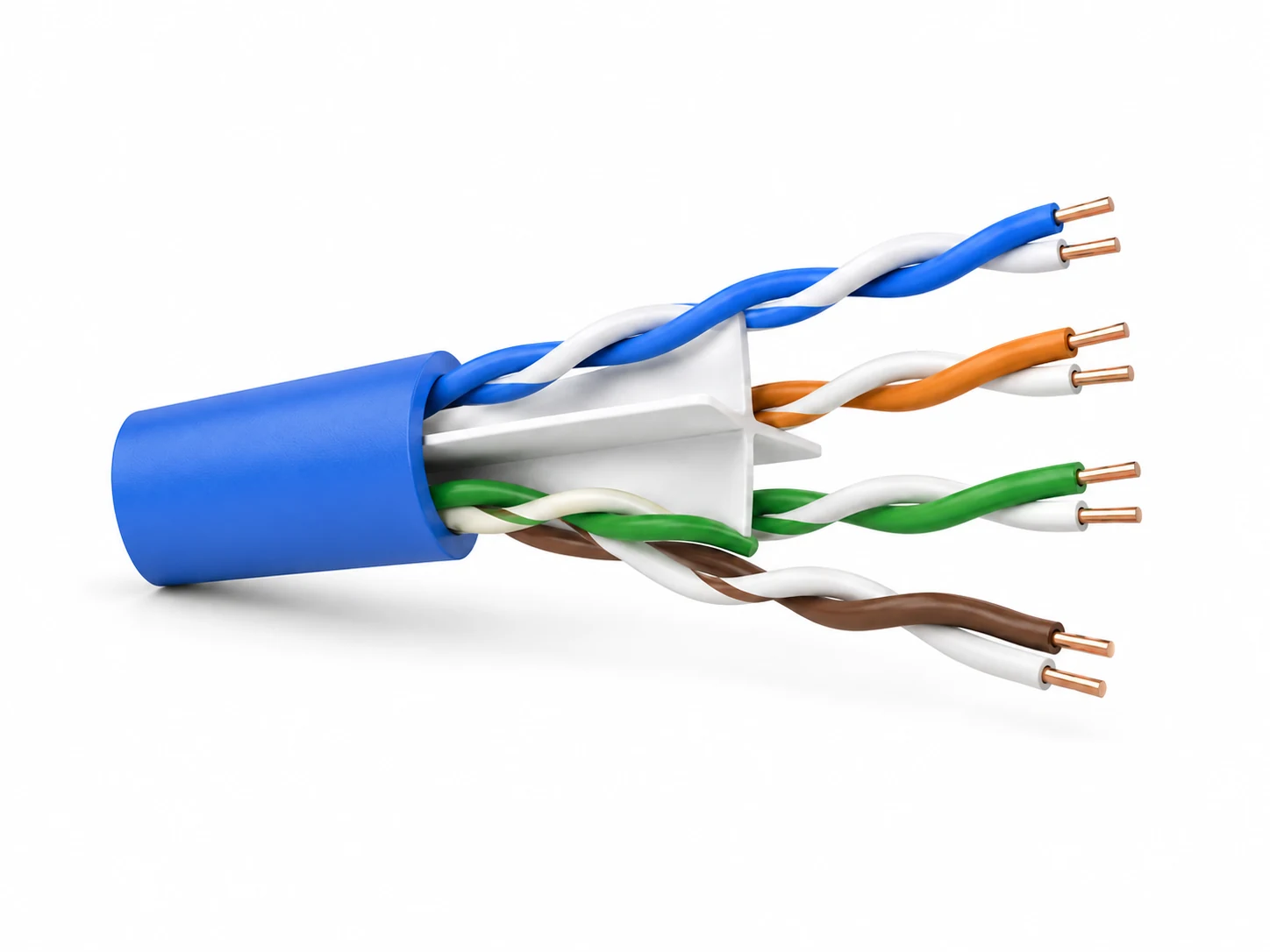










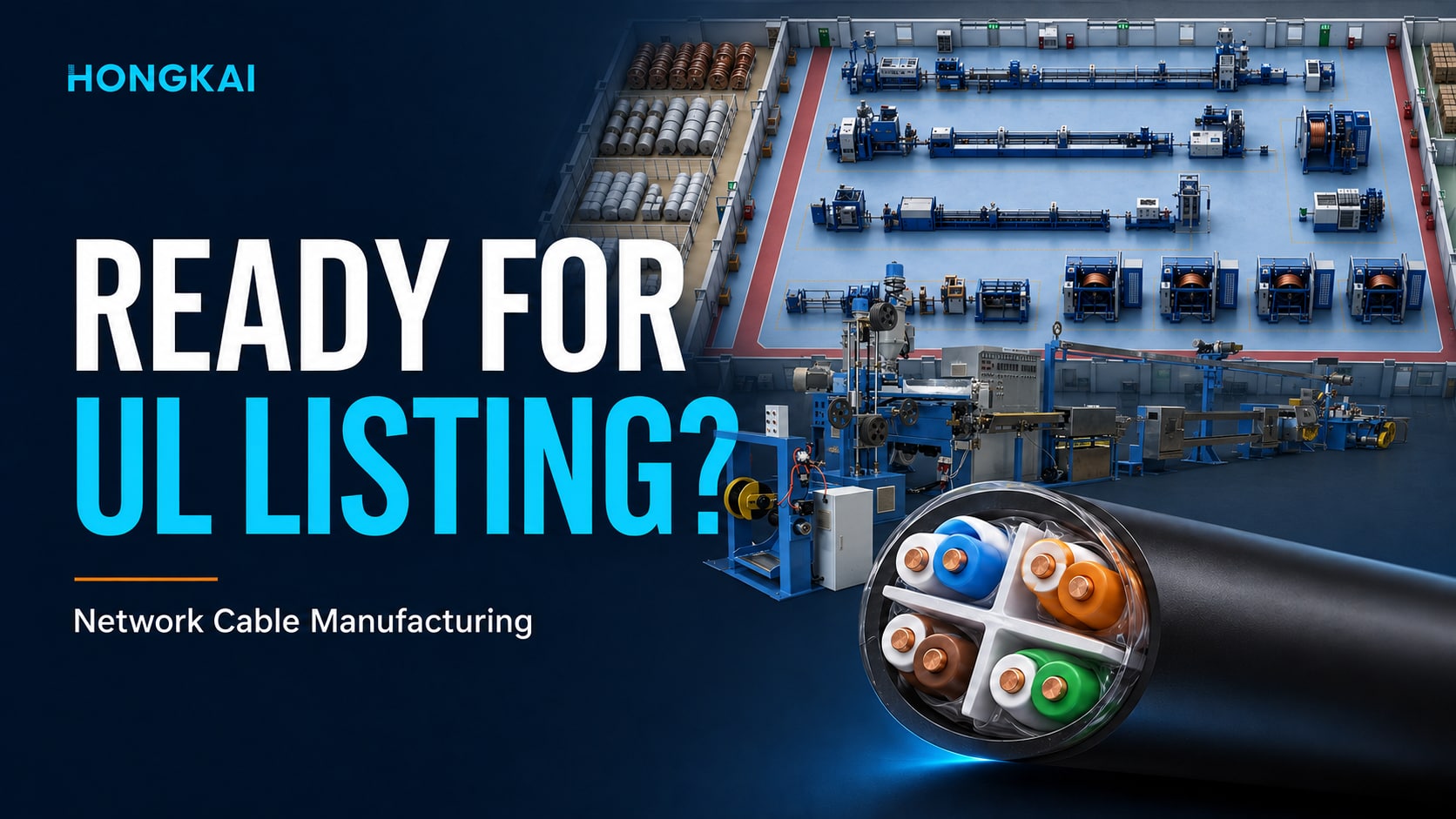
Preparing for network cable UL Listing starts with the exact cable, intended installation type, manufacturing site and certification scope, before testing becomes the main task. The practical decision is not which machine can “make a UL cable,” but which controlled product and production system will be submitted and maintained.
UL Listing is a product-and-factory control program, not a one-time machine setting or a logo added after production. A factory should freeze the construction, confirm the applicable UL category with UL Solutions, prepare representative samples and evidence, and build ongoing material, process, marking and change controls before formal evaluation.
The HONGKAI LAN केबल उत्पादन मार्ग connects conductor preparation, insulation, pair twisting, cabling, optional shielding, sheathing, testing and packing. UL Solutions remains responsible for determining the applicable certification program, investigation requirements, authorized markings and follow-up obligations. HONGKAI equipment configuration and factory trials should therefore support the approved cable specification; they cannot replace the certification body’s decision.
सटीक प्रमाणन ऑब्जेक्ट से शुरू करें
The first document should name what will be certified or verified. “Cat6 with UL” is incomplete because safety Listing, transmission-performance Verification, cable assemblies and installed cabling are different objects with different evidence.
UL Solutions states that communications cable types such as CMP, CMR and CM may be certified to UL 444, while performance verification can be provided separately when required.1 इसकी वायर और केबल एप्लीकेशन गाइड में सूचीबद्ध, वर्गीकृत, प्रमाणित और सत्यापित उत्पादों में भी अंतर किया गया है और उपयोगकर्ताओं को लागू उत्पाद श्रेणी और अंकन की जाँच करने के लिए कहा गया है।.2
| Requested object | निर्णय जिसे फ्रीज कर दिया जाना चाहिए | अनुमोदन के बाद प्राथमिक साक्ष्य | वह क्या है जो साक्ष्य स्वचालित रूप से शामिल नहीं करता |
|---|---|---|---|
| सूचीबद्ध संचार केबल | इच्छित केबल प्रकार, निर्माण, रेटिंग, विनिर्माण स्थल और लागू श्रेणी | अधिकृत सूची जानकारी, अंकन और वर्तमान उत्पाद iQ रिकॉर्ड | हर दूसरा जैकेट, कंडक्टर, फैक्ट्री या केबल परिवार |
| प्रदर्शन-सत्यापित LAN केबल | सटीक ट्रांसमिशन-प्रदर्शन विशिष्टता और उत्पाद निर्माण | सत्यापन चिह्न और उत्पाद-विशिष्ट निर्देशिका या प्रमाणपत्र का दायरा | अग्नि या स्थापना-उपयोग सूची जब तक अलग से शामिल न किया गया हो |
| संचार केबल असेंबली | समाप्त असेंबली निर्माण, घटक और आवश्यक मूल्यांकन | असेंबली-विशिष्ट सूची या सत्यापन प्रमाण | बल्क क्षैतिज केबल या स्थापित चैनल प्रदर्शन |
| स्थापित स्थायी लिंक या चैनल | साइट डिज़ाइन, घटक, कार्यकुशलता और फ़ील्ड-टेस्ट सीमा | परियोजना क्षेत्र-परीक्षण रिपोर्ट | केबल स्वयं का फैक्टरी प्रमाणन |
Decision criterion: Ask the certifier to write the product category, target market, standard or program, cable type, manufacturing location, sample family and permitted marking. Keep safety Listing and performance Verification on separate lines even when the final product will carry both.
Common mistakes: A buyer asks for a “UL machine,” treats a Cat6 field-test PASS as a cable Listing, or assumes that a UL logo printed on the jacket proves current coverage. None of these defines the actual certification object.
परीक्षणों का चयन करने से पहले विक्रय योग्य केबल को फ्रीज़ करें
The factory should submit a controlled saleable construction, not a broad marketing family. The conductor, insulation system, pair design, separator or shielding, jacket compound, cable type, manufacturing site and markings all need an identified revision.
UL Solutions के वर्तमान तार और केबल अवलोकन में CMP, CMR और CM को उनके इच्छित उपयोगों के लिए मूल्यांकन किए गए विभिन्न संचार केबल प्रकारों के रूप में नामित किया गया है।.1 The target cable type affects construction and evaluation; a factory should not select a jacket only by colour, processing convenience or a supplier’s generic “UL material” description.
HONGKAI की उपकरण-परिभाषा चर्चाओं में, पाँच प्रश्न “मैं UL नेटवर्क केबल बनाना चाहता हूँ” को एक उपयोगी प्रारंभिक संक्षिप्त विवरण में बदल देते हैं:
| First question | What the buyer should provide | Equipment or evidence decision |
|---|---|---|
| Is the saleable product bulk cable or a finished patch cord? | Box/reel length, conductor construction, flexibility, and whether connector assembly is included | Cable manufacture alone versus additional termination and assembly testing |
| Which constructions and categories are required now? | A drawing for each UTP, FTP, STP or SFTP request, with the exact pair/overall shield arrangement and present category range | Pair twisting, separator handling, foil wrapping, braiding and cabling route |
| What does “UL” mean in this purchase? | Target market, installation-use cable type, requested safety Listing and any separate performance Verification | Certification category and applicable test program to confirm with the certifier |
| What materials and geometry define the sample? | चालक, इन्सुलेशन और जैकेट की पहचान; ठोस या फोम इन्सुलेशन; आयाम और नियंत्रित ड्रॉइंग/BOM संशोधन | एक्सट्रूज़न, ड्रॉइंग इंटरफेस, टूलिंग, प्रक्रिया नियंत्रण और सामग्री परीक्षण |
| प्रारंभिक लाइन को क्या प्रदान करना चाहिए, और क्या केवल भविष्य का लक्ष्य है? | उत्पाद लॉन्च करें, बाद के वेरिएंट, आवश्यक आउटपुट, विनिर्माण स्थल और उपलब्ध प्रयोगशाला क्षमता | प्रारंभिक उपकरण क्षेत्र, अलग से मूल्य निर्धारित विकल्प, विशेषज्ञ-परीक्षण इंटरफेस और FAT स्वीकृति योजना |
Bulk packaging length is not a certification category. A customer’s shorthand such as a “300 m box” or a connection “within 100 m” must be replaced by the actual ordered length and test object. A patch cord is not simply every cable shorter than 100 m: Fluke Networks distinguishes the complete channel, including cords, from the fixed permanent link.3
Likewise, commercial shield abbreviations are not enough for machine selection. The approved cross-section must show whether shielding is around each pair, around the cabled core, or both, and identify foil, braid and drain-wire details. Keep each approved variant and its proposed print legend, reel/box label, packaging, manufacturing site and subcontracted stages in the product-definition record.
मशीन रूट इस परिभाषा का अनुसरण करता है। The HONGKAI Cat5/Cat5e संदर्भ मार्ग shows insulation, pair twisting, cabling, sheathing, testing and packing as a connected process, with final construction and acceptance tied to the approved specification. A Cat6 or shielded construction may change separator handling, shielding equipment, process controls and laboratory scope; no common machine list proves that all variants belong in one certification family.
What to ask: Request written confirmation from UL Solutions about the applicable category and the documents, samples and manufacturing-site information required for the proposed construction. Do this before purchasing certification labels or promising a launch date.
जमे हुए कंस्ट्रक्शन के अनुसार मैच पेयर ट्विस्टिंग और इंसुलेशन करें
Pair geometry and insulation stability deserve attention before the final cable is tested. Changing the twisting route, conductor, insulation compound or foaming process after sample confirmation can change the product being submitted, even if the finished jacket still looks the same.
For pair twisting, compare the actual machine design, tension path, back-twist capability where required, payoff/take-up handling and demonstrated lay control. HONGKAI’s project experience includes triple-twist and other pair-twisting routes. For demanding constructions, Peter’s equipment-selection preference is to evaluate a suitable horizontal arrangement, but orientation alone is not proof of higher performance. Require trials on the intended conductor and insulation, agreed pitch measurements and downstream cable results before accepting a configuration.
Conductor consistency and insulation geometry are separate acceptance items. The conductor’s material, dimensions, surface condition and electrical checks should follow the product specification. For the insulating layer around each conductor, specify the compound and whether the design uses solid insulation, chemical foaming or physical foaming. Do not confuse core-wire insulation with the finished outer jacket, or assume that a familiar PVC grade is suitable for every LAN construction or cable fire rating.
Foaming is a process choice, not an automatic category upgrade or UL approval. Maillefer’s telecom-insulation documentation independently illustrates that solid and chemical-foam constructions require defined materials and line configurations, with drawing, extrusion and measurement functions coordinated as a system.4 Those examples are technical context, not HONGKAI model specifications. A HONGKAI proposal must separately confirm its compound compatibility, extrusion/foaming arrangement, tooling, concentricity control and agreed measurement provision. Moving between solid, chemical-foam and physical-foam designs requires a new compatibility and evidence review; it should not be treated as a recipe-only substitution.
Evidence to request: Freeze the conductor and compound identities, pair lay plan, insulation dimensions, concentricity definition and, for a foamed construction, the foaming-degree definition and test method. Define acceptance limits from the approved product and trial plan; do not copy a generic machine brochure value into the certification specification.
One project described by HONGKAI illustrates why the product range must precede the machine list: it covers UTP and SFTP constructions through Cat6A, with Cat7 as a later target. The discussed route combines drawing with chemical-foam insulation, triple twisting, active foil wrapping at cabling and a separately configured sheathing route. Different constructions may require different tape-handling provisions. This is a configuration example, not evidence that every variant was produced, that Cat7 was achieved, or that any product obtained UL Listing. Shielding and any protective metal-tape layer must be shown separately on the approved drawing.
मूल्यांकन पैकेज को एक नियंत्रित अनुक्रम में बनाएं
The certification project should move from scope to construction evidence, representative samples, formal evaluation and production authorization. Individual projects vary, and UL Solutions describes the typical lifecycle as quote, testing and follow-up rather than a universal fixed timetable.5
| Sequence | Controlled output | अगले चरण से पहले प्रश्न |
|---|---|---|
| 01 — Scope | केबल प्रकार, लक्षित बाज़ार, विनिर्माण स्थल, सुरक्षा सूची और कोई अलग प्रदर्शन सत्यापन | क्या प्रमाणन निकाय ने इच्छित कार्यक्रम की पुष्टि की है? |
| 02 — Construction | Drawing, BOM, process route, marking proposal, suppliers and change procedure | क्या परीक्षण विनिर्देश निर्माण संशोधन की पहचान करता है? |
| 03 — Evidence | प्रतिनिधि नमूने सामग्री, आयामी, विद्युत और प्रक्रिया रिकॉर्ड के साथ | क्या प्रत्येक प्रस्तुत नमूने को वास्तविक निर्माण से जोड़ा जा सकता है? |
| 04 — Continuing control | औपचारिक मूल्यांकन निष्कर्ष, प्रारंभिक निरीक्षण तैयारी और अधिकृत अंकन/अनुवर्ती नियंत्रण | क्या कारखाना अनुमोदित दायरा बनाए रखने के लिए तैयार है? |
Evidence to request: Keep the certifier’s proposal, product-category decision, sample instructions, construction description, test plan, findings, approved revisions, follow-up procedure, marking authorization and factory-inspection records under one controlled project number.
नोट: एक पूर्व-प्रमाणन नमूना जो आंतरिक या बाहरी प्रयोगशाला जाँच में उत्तीर्ण होता है, वह उपयोगी अभियांत्रिकी साक्ष्य है। यह UL मार्क लगाने का अधिकृत अनुमोदन नहीं है।.
Connect Every Production Stage to Continuing Compliance
A factory needs a control plan that can reproduce the evaluated construction. The useful question for each stage is: what product characteristic is created here, what record proves control, and what change requires technical review?
The production route can be designed backward from the approved cable. The table below is a proposed control map for the factory and certifier to review; it is not a substitute for the UL Follow-Up Services procedure.
| Production stage | नियंत्रित इनपुट या सेटिंग | Retained evidence | समीक्षा को ट्रिगर करने वाला परिवर्तन |
|---|---|---|---|
| चालक तैयारी | सामग्री, निर्माण, स्रोत और तैयार कंडक्टर की स्थिति | नियंत्रण योजना द्वारा आवश्यक आगमन पहचान, लॉट, आयामी और प्रतिरोध रिकॉर्ड | सामग्री, स्रोत, प्लेटिंग या चालक निर्माण |
| कोर-वायर इन्सुलेशन | Approved compound, tooling, diameter, concentricity, colour and foaming system if used | कंपाउंड लॉट, लाइन सेटअप, आयामी डेटा, जहां लागू हो, फोमिंग-डिग्री के परिणाम और अनुपालन रिकॉर्ड | Compound grade or supplier, solid/foam construction, foaming route or tooling |
| जोड़े का घुमाव | Pair identity, lay plan, tension route and reel traceability | Setup sheet, measured pitch, pair/reel ID and agreed in-process checks | Lay plan, machine route or tension-control method |
| Cabling and shielding | Pair position, separator, foil, drain wire or braid construction | Traveler, material lots, core geometry and continuity records where applicable | Separator, shield material, overlap, drain wire or braid design |
| Sheathing and marking | Approved jacket compound, wall, finished size, print legend and surface condition | Jacket lot, dimensional record, print approval and reel identity | Jacket grade or supplier, cable type, rating or print legend |
| अंतिम परीक्षण और पैकिंग | Defined sample, method, acceptance source and packaging label | Raw results, disposition, reel/box traceability and label control | परीक्षण विधि, नमूना आधार, सॉफ्टवेयर सीमा, पैकेजिंग या लेबल सामग्री |
The earlier Cat6 फैक्टरी अनुपालन गाइड explains why a final analyzer cannot repair uncontrolled conductor, insulation or pair geometry. The same logic matters here: certification evidence must be linked to the process that made the sample and to the production records that will continue after approval.
How to verify: Select one finished reel or box and trace it backward to the approved construction, material lots, process records, inspection results, final test and authorized label. Then select one material or process change and show who decides whether certification review is required before production resumes.
UL निर्णय से अलग कारखाना पूर्व-जांच
Factory and third-party prechecks reduce avoidable risk, but UL Solutions controls the formal investigation scope, sample requirements, acceptance decision and authorization to use its Mark. The factory laboratory should support the submission without describing itself as the certifier.
Before formal evaluation, the factory can check whether the proposed construction is stable enough to submit. Useful preparation may include dimensional checks, conductor and insulation records, electrical prechecks, fire-test preparation by an appropriate laboratory, marking review and repeat builds from more than one production run. The exact method, equipment, sample count and pass/fail source must come from the agreed certification plan and applicable requirements.
For the equipment FAT, HONGKAI’s practical record priorities are measured pair lay/pitch, insulation concentricity and foaming degree whenever foamed insulation is used. Do not replace the last item with an operator’s observation that the insulation “looks foamed.” Agree the measurement definition, method, instrument and sampling locations before the trial, then retain actual results, units, acceptance source, instrument identity, operator/date and disposition.
Link these records to the drawing revision, machine setup, conductor and compound lots, trial reel and retained sample IDs. Record the trial conditions actually demonstrated; one successful sample is not evidence of an untested speed, material or product range. These FAT measurements support sample preparation and repeatability, but they are not a complete UL test program.

Explanatory 3D illustration, not a real test report or certification result. Retain measured pitch, concentricity and foaming degree when applicable, linked to the actual sample.
पूर्ण-आकार की रिकॉर्ड-चेन चित्रण देखें.
| Evidence layer | Responsible party | निर्णय जिसे यह समर्थन करता है |
|---|---|---|
| मशीन सेटअप और प्रक्रिया में रिकॉर्ड | उपकरण-आपूर्तिकर्ता के इनपुट वाला केबल कारखाना | क्या मूल्यांकित निर्माण को परिभाषित परिस्थितियों के तहत पुन: प्रस्तुत किया जा सकता है |
| आंतरिक प्रयोगशाला पूर्व-जाँच | Cable factory or qualified laboratory | क्या सैंपल औपचारिक प्रस्तुति के लिए तैयार दिखते हैं और प्रक्रिया कहाँ अस्थिर है |
| Formal evaluation and certification decision | सहमत कार्यक्रम के तहत UL सॉल्यूशंस | Whether the identified product and site qualify for the authorized certification scope |
| स्वतंत्र संचरण-प्रदर्शन सत्यापन | UL Solutions or another named program, when requested | Whether the identified cable meets the named performance specification within that program’s scope |
| स्थापित केबलिंग फ़ील्ड परीक्षण | Installer, project test team or qualified field service | क्या स्थापित लिंक या चैनल परियोजना की फ़ील्ड सीमाओं को पूरा करता है |
Red flags: The submission sample was made with unrecorded hand adjustments; the production BOM differs from the tested sample; a third-party report does not identify the exact construction; or the factory plans to replace compounds after approval without a documented review path.
मार्किंग और फॉलो-अप सेवाओं के लिए फैक्ट्री की तैयारी करें
UL Listing continues after the initial evaluation. The factory must protect the approved construction, authorized labels, production records, inspection access and change-control process for as long as it produces marked cable.
UL Solutions states that the complete Listing Mark on the tag attached to the reel or smallest unit container is the proof that a particular wire or cable unit is UL Listed; surface printing is supplemental.2 The same guide says holographic labels are required for Listed communications cable and several related wire-and-cable categories. UL Solutions also explains that initial product inspection and follow-up services are part of the customer lifecycle.5
The factory-readiness file should identify:
- who controls access to labels and reconciles usage;
- where approved constructions and marking artwork are stored;
- how incoming materials are checked against approved identities;
- how production and inspection records are linked to reels or boxes;
- how nonconforming material and marked product are segregated;
- कारखाना निरीक्षक वर्तमान रिकॉर्ड और उत्पादन पहुँच कैसे प्राप्त करते हैं;
- how product, material, supplier, process, site or marking changes are reviewed;
- अप्रचलित ड्रॉइंग्स, लेबल और कार्य निर्देशों को उपयोग से कैसे हटाया जाता है।.
In HONGKAI’s preparation discussions, the easily missed items are raw-material traceability, retrievable production/test data and usable work instructions. Test that system before preparing the submission: ask an operator to retrieve the instruction revision used for one sample, identify its material lots and locate the corresponding raw results. A folder of disconnected screenshots does not establish that chain.
Common mistakes: The jacket print is treated as the only Listing evidence; labels can be taken without reconciliation; approved and unapproved compounds share the same internal name; or production changes are implemented before the certification owner reviews their effect.
Write the RFQ and Responsibility Matrix Around Evidence
The cable factory, machinery supplier, material suppliers, laboratories and UL Solutions have different responsibilities. A complete project defines the handoffs instead of asking one party to promise “UL approval.”
| Deliverable | केबल फैक्ट्री | HONGKAI उपकरण क्षेत्र | UL Solutions या विशेषज्ञ पक्ष |
|---|---|---|---|
| Target cable and certification scope | विक्रय योग्य उत्पाद के निर्णय और अनुप्रयोग का स्वामित्व लें | Translate the approved cable route into equipment and interface questions | Confirm applicable certification category and evaluation program |
| Controlled construction and BOM | Own drawings, materials, suppliers and revisions | Confirm machine compatibility with the signed process inputs | औपचारिक परियोजना क्षेत्र के भीतर निर्माण की समीक्षा करें |
| Trial production and records | Provide materials, operators and product traceability | सहमत मशीन सेटअप, FAT और प्रक्रिया-रिकॉर्ड आउटपुट का समर्थन करें | Define or witness formal evidence only when contracted to do so |
| Laboratory evidence | Own sample identity and internal release records | सहमति प्राप्त मापन इंटरफेस प्रदान करें; विशेषज्ञ परीक्षण उपकरण अलग से परिभाषित रहता है | Perform formal evaluation or specialist testing under its own responsibility |
| Factory control and changes | Operate approved procedures, labels and change review | Document machine configuration and approved modifications | Conduct applicable inspection, follow-up and certification review |
HONGKAI can develop the overall manufacturing-equipment proposal, configure the relevant LAN stages and document agreed FAT outputs. Its own delivery responsibility is the equipment scope stated in the contract. Specialist laboratory and inspection equipment must be separately sourced and assigned; inclusion in an overall project proposal does not mean HONGKAI manufactures every instrument or acts as the certification body. Certification decisions, authorized UL markings and Follow-Up Services remain with UL Solutions under the applicable program, not with a machinery FAT.
Evidence to request: Add a certification-readiness appendix to the RFQ. It should list the target cable, product category to be confirmed, controlled materials, process route, trial samples, factory records, laboratory boundaries, label responsibility, factory-inspection preparation, change-review owner and all explicit exclusions.
Note: The strongest purchase specification does not promise that a machine will obtain UL Listing. It requires a reproducible cable route and evidence system that the factory can submit, audit and maintain under the certification body’s approved scope.
-
UL Solutions wire and cable overview, describing communications-cable certification for CMP, CMR and CM under UL 444 and separate performance-verification services. ↩ ↩
-
UL समाधान तार और केबल अनुप्रयोग मार्गदर्शिका, उत्पाद श्रेणियों, प्रमाणन चिह्नों, उत्पाद iQ और तार-एवं-केबल अंकन साक्ष्य की व्याख्या करते हुए।↩ ↩
-
Fluke Networks on channel testing and permanent links, distinguishing the complete channel from fixed cabling and its patch cords. ↩
-
Maillefer telecom cable insulation, illustrating solid/chemical-foam insulation and coordinated drawing, extrusion and measurement functions; not a specification for HONGKAI equipment. ↩
-
UL Solutions नए ग्राहक स्वागत और संसाधन, describing the typical quote-to-testing-to-follow-up lifecycle, initial product inspection and Follow-Up Services. ↩ ↩

 English
  हिन्दी
  فارسی
فارسی