
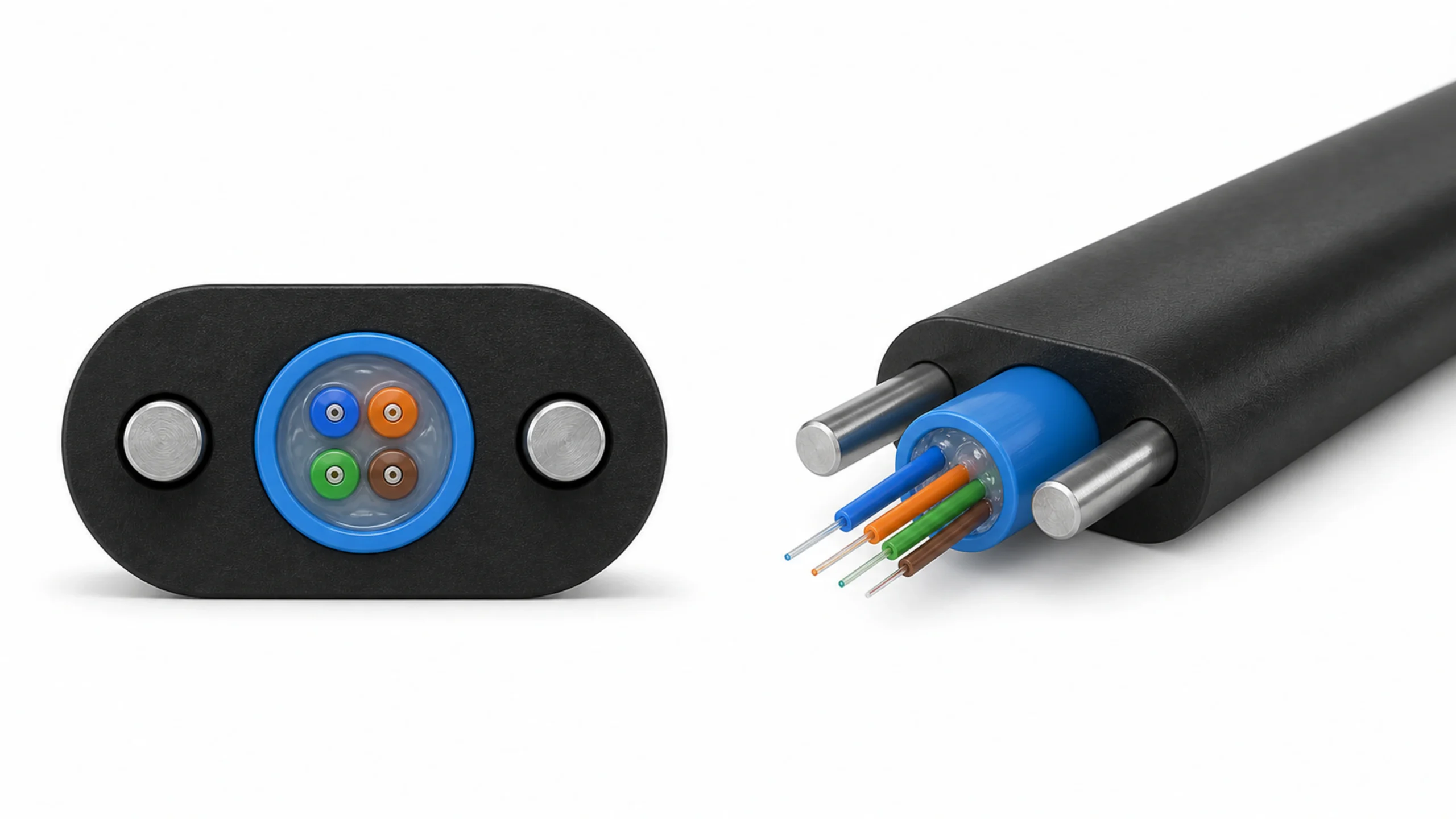
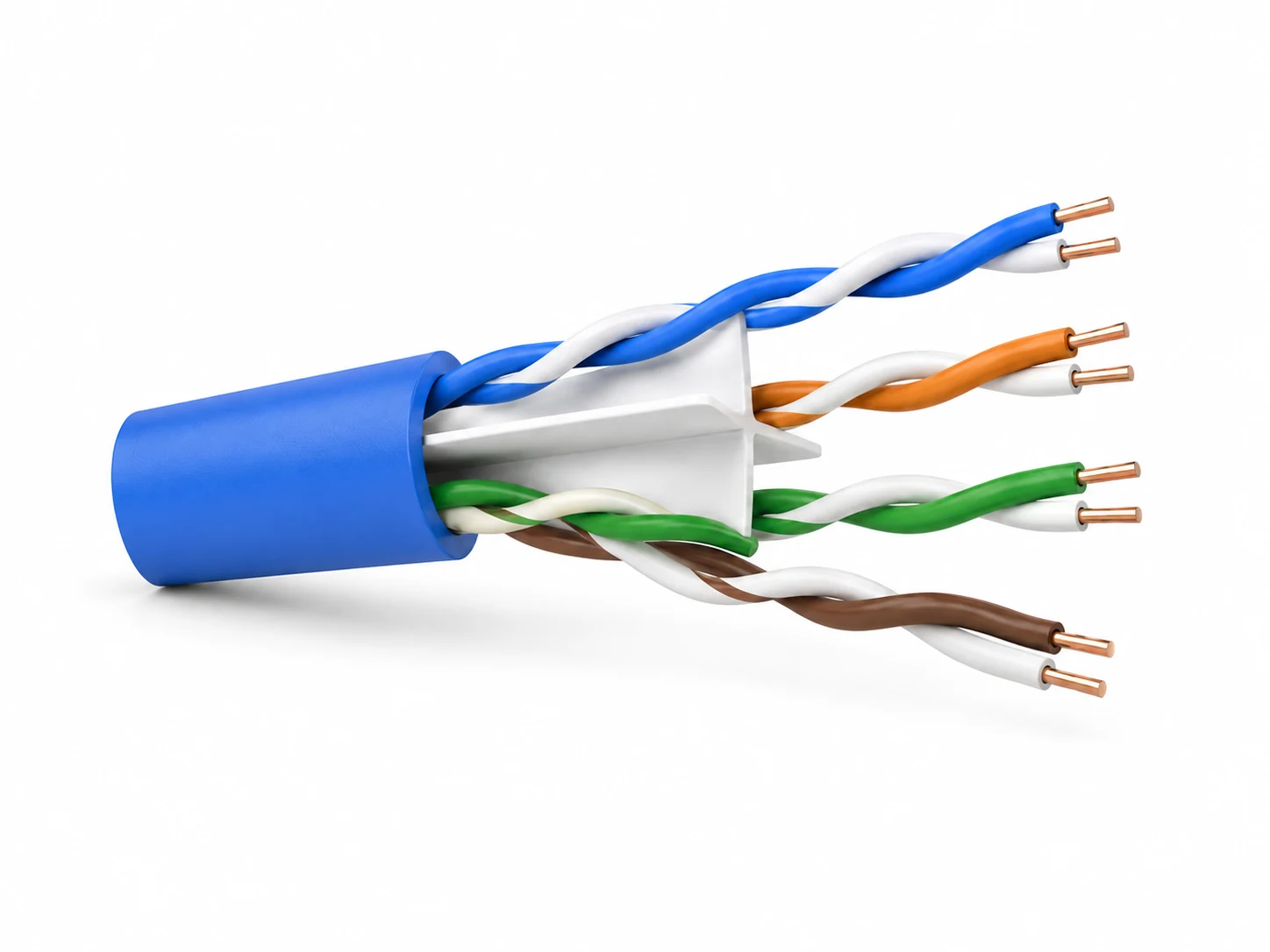
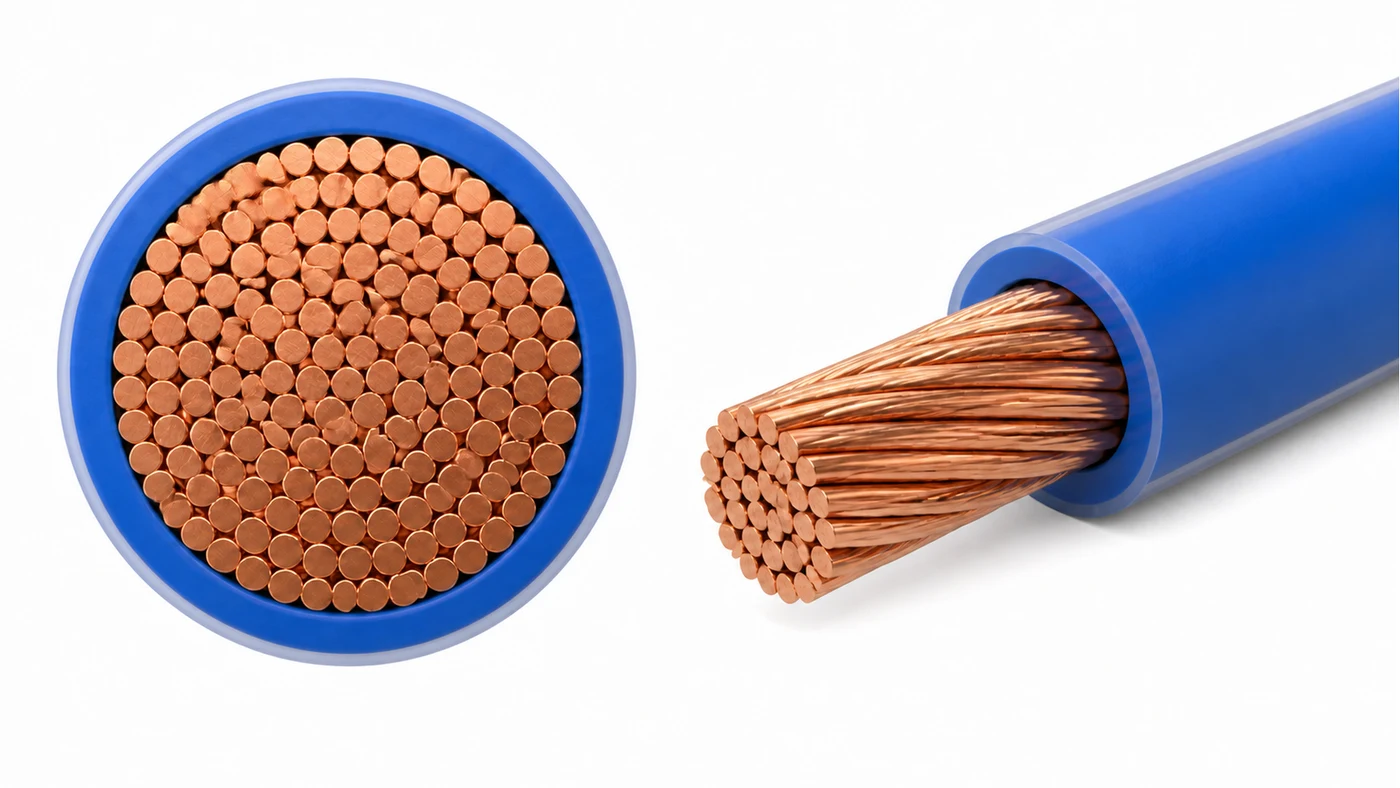
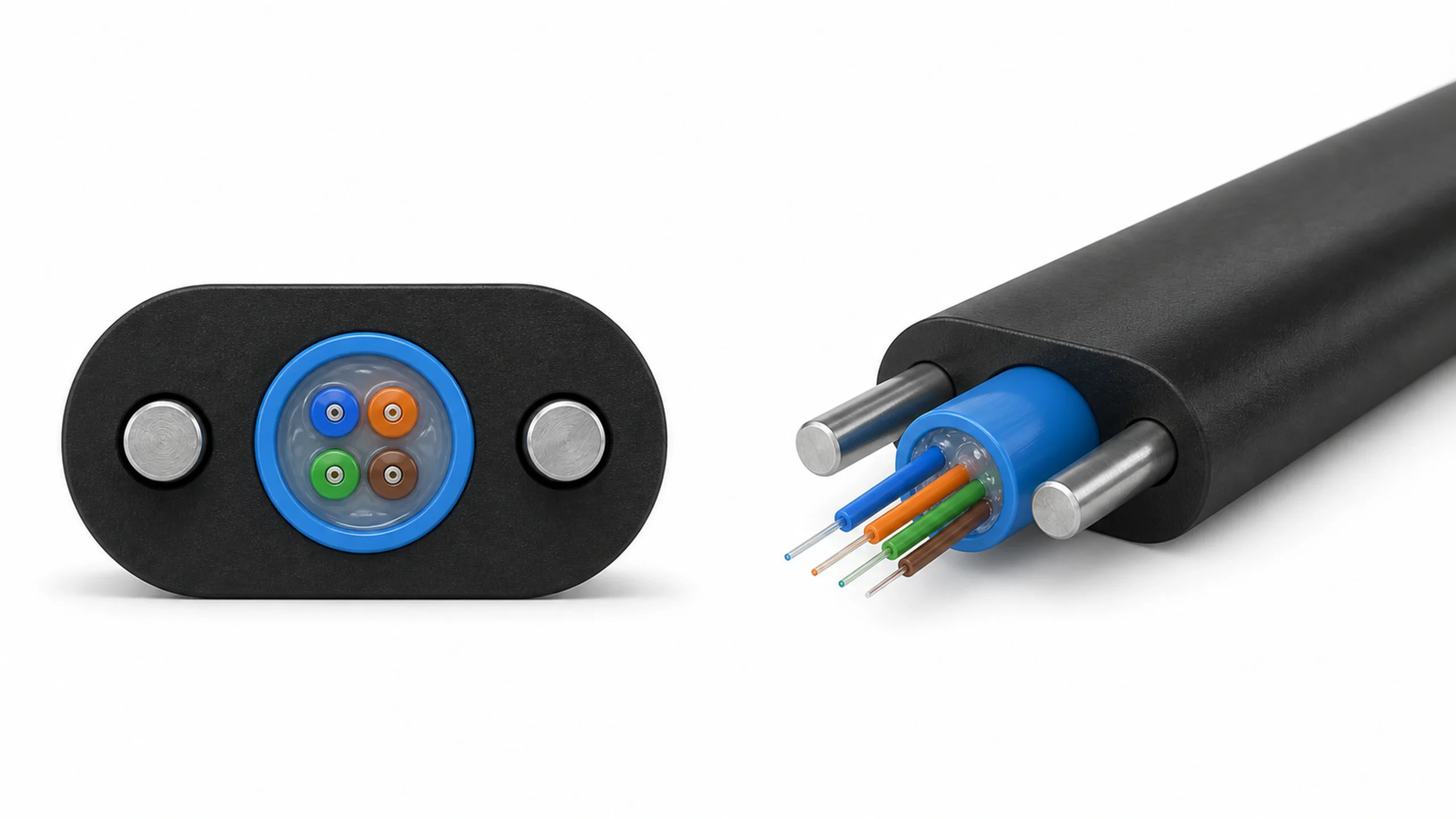

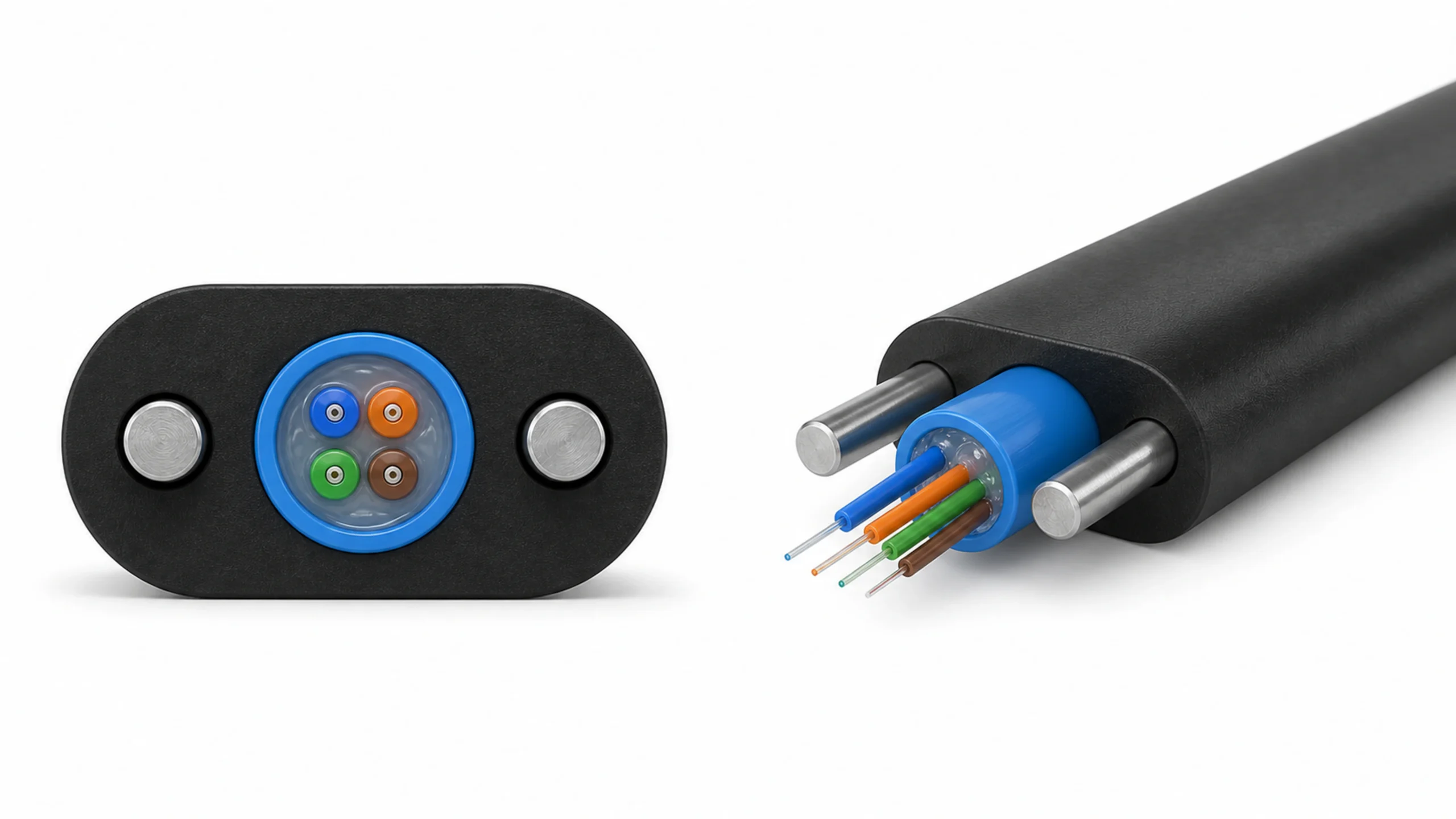

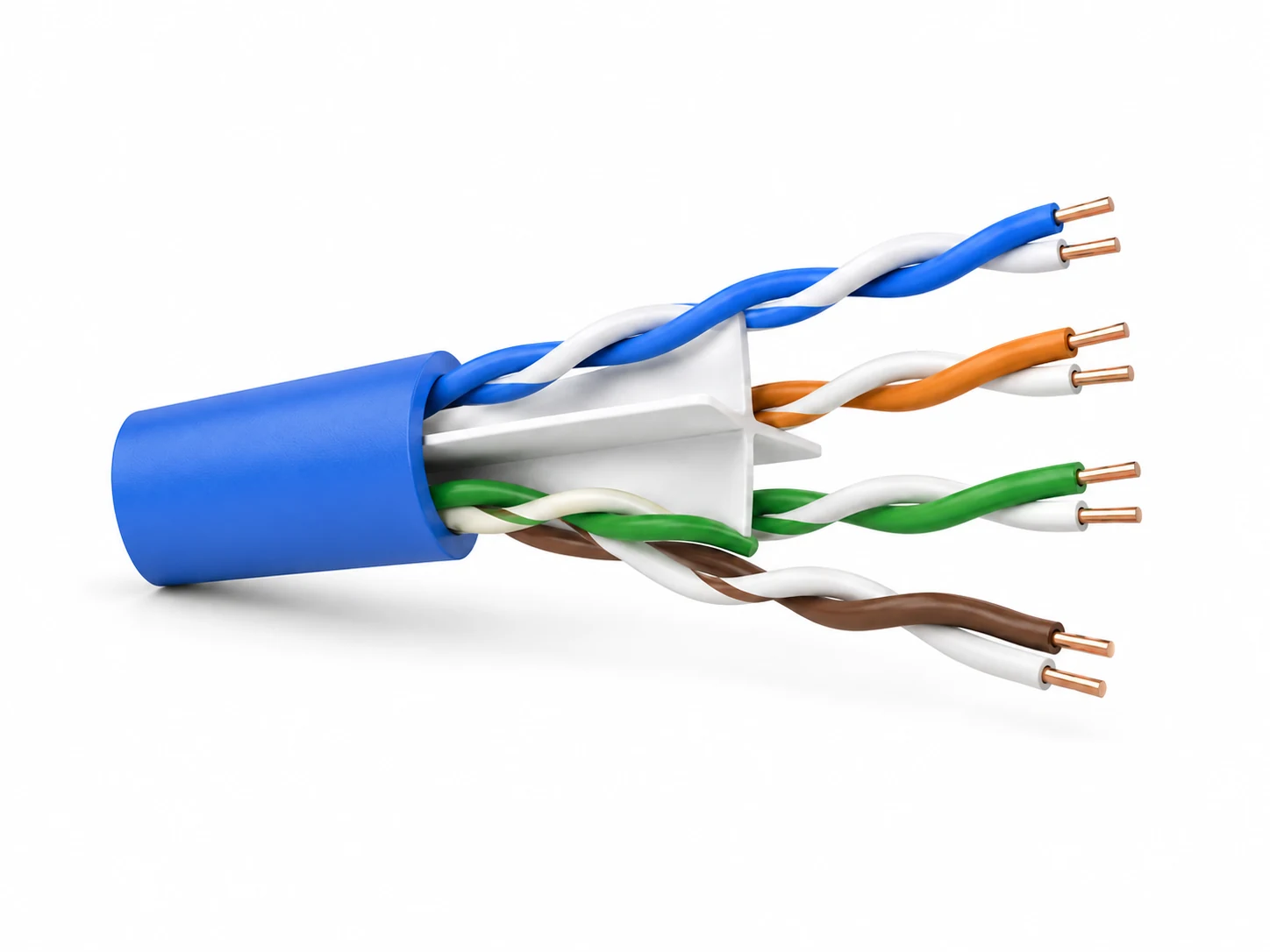











A buyer may ask several suppliers for a “complete cable production line” and receive equipment lists that cannot be compared. First establish whether the buyer has a real order or is only exploring an investment. A request for quotation (RFQ) for a specific project needs the cable construction, output target and problem the equipment must solve.
A price enquiry without an order or defined product can support only an early discussion, not a precise equipment configuration. For a project RFQ, describe the target cable, its structure and diameter range, the required capacity and the existing factory situation. Ask every supplier to quote against the same assumptions and acceptance conditions.
This guide is for a new factory defining its first production route and for an existing factory solving a capacity or product problem. It explains what to send, what to leave explicitly open and how to compare replies without treating a budgetary concept as a final equipment list.
सबसे पहले यह तय करें कि पूछताछ कॉन्फ़िगरेशन के लिए तैयार है या नहीं
A buyer with a real customer order should send its cable specification, construction and required capacity before requesting the first equipment configuration. A trader asking only what machinery costs, without an order or defined product, cannot expect the same level of configuration or quotation accuracy.
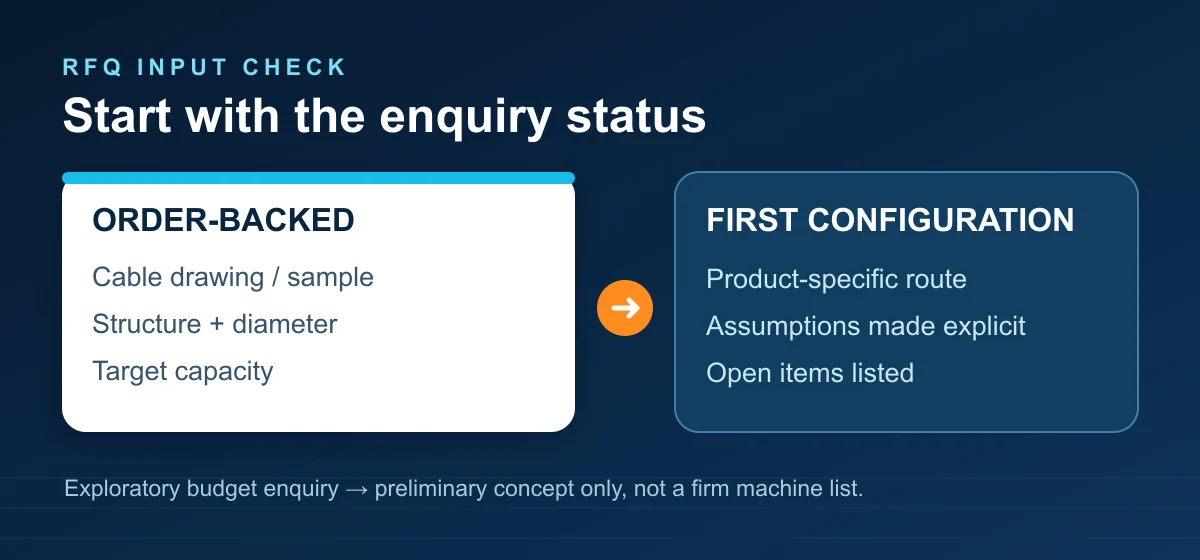
संपादकीय आरेख: प्रथम उपकरण विन्यास के लिए एक परिभाषित केबल और क्षमता की आवश्यकता होती है; एक अन्वेषणात्मक मूल्य पूछताछ प्रारंभिक अवस्था में ही रहती है।.
HONGKAI first asks what situation the enquiry represents: an existing customer order, an identified product for a planned factory, or an exploratory price check. Even when a buyer can name a cable but has not confirmed the order, investment range and output, the response may remain an initial route or budgetary concept rather than a settled machine list. That boundary should be stated in the reply, not hidden behind a precise-looking price.
For an order-backed project, send the customer specification or an approved cable drawing. If there is no formal drawing, provide a physical sample or clear cross-section and identify which dimensions and materials are confirmed. “Power cable,” “network cable,” and “optical cable” are product families, not full equipment specifications. The buyer and supplier must resolve the missing construction decisions before a final configuration.
| Product input | यदि ज्ञात हो तो क्या प्रदान करना है | यदि यह अभी भी खुला है |
|---|---|---|
| Enquiry basis | ग्राहक आदेश या परियोजना चरण, इच्छित केबल और लक्षित बाजार | एक अन्वेषणात्मक बजट चर्चा को प्रारंभिक रूप से लेबल करें |
| Product identity | केबल का नाम, अनुप्रयोग और चित्र या नमूना संशोधन | अभिप्रेत अनुप्रयोग को चिह्नित करें और निर्माण समीक्षा का अनुरोध करें |
| Components | कंडक्टर या कोटेड-फाइबर इनपुट, कोर काउंट और असेंबली संरचना | पूछें कि उद्धृत मार्ग किस इनपुट या मध्यवर्ती उत्पाद को मानता है |
| Material layers | इन्सुलेशन, बफर, सुदृढीकरण, शील्ड, आर्मर और शीथ जहाँ लागू हो | प्रत्येक अनिर्णीत परत को अलग-अलग रिकॉर्ड करें; सामान्य “मानक सामग्री” धारणा को स्वीकार न करें |
| Finished form | आवश्यक बाहरी आयाम, आकृति, अंकन और डिलीवरी पैकेज | टूलिंग के अंतिम रूप देने से पहले एक नमूना-आधारित स्पष्टीकरण का अनुरोध करें |
| आउटपुट लक्ष्य | आवश्यक पूर्ण मात्रा और संचालन अनुसूची | क्षमता-निर्भर मशीन गिनती और प्रदर्शन को खुला रखें |
जब निर्माण बदलता है तो समान केबल परिवार को अलग उपकरणों की आवश्यकता हो सकती है। उदाहरण के लिए, एक low-voltage cable production route depends on its conductor, applied layers and testing boundary; an optical-fiber route starts from different purchased inputs and process stages. The RFQ should not merge those routes because both end with a cable on a drum.
What to ask: “Is this a quotation for a confirmed order, or an early budgetary discussion? Which cable drawing, sample and output target does the proposed configuration cover?”
Convert Sales Demand Into a Testable Output Requirement
Specify the cable structure, the actual diameter range, the technical requirements and the required finished output before asking for a speed. “High speed” alone is not a production target: the stable speed must be calculated for the product that will actually run.

Editorial diagram: A stated running speed is meaningful only with its cable construction, diameter and quality conditions.
When a customer requests a “high-capacity” line, HONGKAI’s first follow-up is the product’s construction, diameter and required technical result. Those conditions determine a realistic production-speed discussion. Ask for the product mix, expected order quantities, batch lengths, shifts, reel sizes and planned changeovers. An existing factory should add actual stop and quality-loss records; a new factory should ask suppliers to label any availability or yield assumption that has not yet been tested. The fiber-optic capacity-planning guide explains why the slowest required stage can limit finished-cable output in a multi-stage optical project.
Use one capacity statement for all quotations:
| RFQ field | Buyer entry | Supplier must state |
|---|---|---|
| Finished product and mix | Named cable revisions, constructions, diameter ranges and expected proportions | Which products were included in the sizing calculation |
| Demand period | Required conforming length or quantity per period | Assumed shift calendar and running time |
| बैच और पैकेज | Typical order length and take-up drum or reel | चेंजओवर और पैकेज सीमाएं |
| Stable production condition | सहमत प्रतिनिधि उत्पाद के लिए लक्ष्य | Material, tooling, diameter, construction and quality conditions behind the proposed speed |
| Factory result | खरीदार का उत्पादन लक्ष्य | कौन से चरण, नुकसान या अतिरिक्त लाइनें परिणाम को प्रतिबंधित करती हैं |
Decision criterion: Separate mechanical design speed, stable speed for the approved sample, and expected factory output. They answer different questions and must not appear as one unexplained number.
उस समस्या को परिभाषित करें जिसे एक मौजूदा फैक्ट्री को हल करने की आवश्यकता है
For an existing factory, start with the past order mix and the reason for adding equipment. Is the buyer trying to increase output, make a new cable or remove a bottleneck? The proposed line and investment range should answer that problem, not simply duplicate the machines already on site.
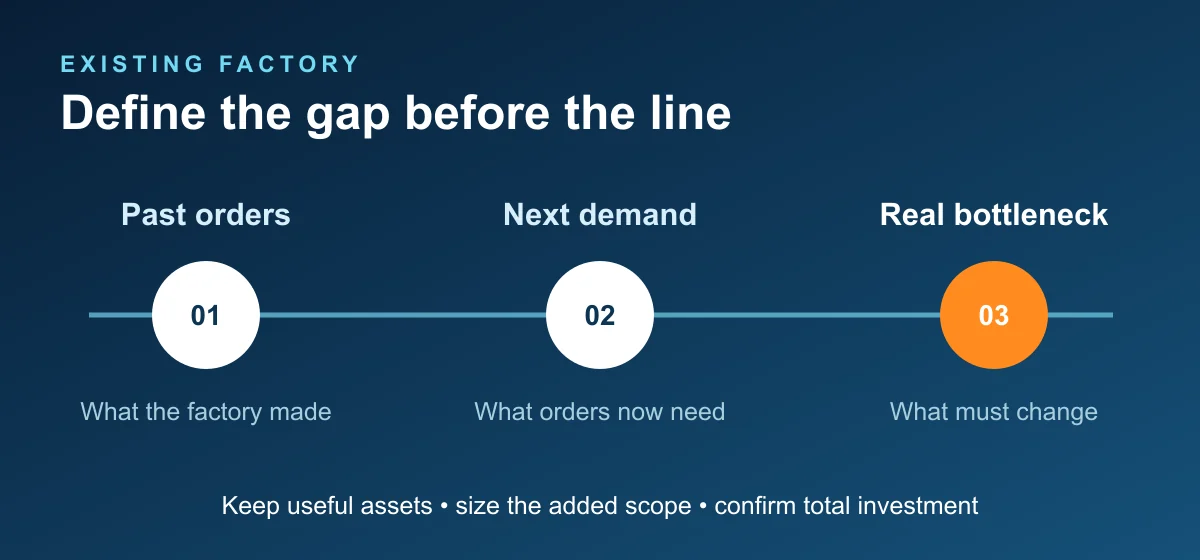
संपादकीय आरेख: उपकरण जोड़ने से पहले वर्तमान क्षमता और नए ऑर्डर के बीच का अंतर पहचानें।.
HONGKAI asks what the factory used to produce, what current orders require and what the proposed investment is meant to change. The buyer should state the target capacity and approximate total project investment, not only a preferred machine price. An equipment-interface review then checks which existing process and factory assets can actually support the new route. This review is project-specific; Peter’s answer did not establish one universal list of interfaces for every factory.
Show the machines that remain in service and the handoff to new equipment: incoming reel sizes, output package sizes, line direction, floor space, utilities and controls. For a new plant, ask for a staged scope that distinguishes launch-critical machines from later expansion. The फाइबर-ऑप्टिक फैक्ट्री चेकलिस्ट दर्शाता है कि उत्पाद, क्षमता, अनुसूची, बजट और सेवा सीमा एक ऑप्टिकल प्रोजेक्ट को कैसे प्रभावित करते हैं; एक पावर-केबल या LAN-केबल प्रोजेक्ट को अपना स्वयं का प्रक्रिया मानचित्र (प्रोसेस मैप) चाहिए।.
| Boundary | RFQ में शामिल करें | Require in each supplier reply |
|---|---|---|
| Incoming material | खरीदा गया इनपुट फॉर्म, पैकेज और गुणवत्ता उत्तरदायित्व | आवश्यक इनपुट विशिष्टता और पे-ऑफ़ इंटरफ़ेस |
| मुख्य प्रक्रियाएँ | Existing and new production stages | Included machines, excluded stages and any outsourced process |
| Factory services | उपलब्ध बिजली, पानी, शीतलन, संपीड़ित वायु और स्थान | प्रस्तावित कॉन्फ़िगरेशन के लिए उपयोगिता मांग और स्थापना की स्थितियाँ |
| गुणवत्ता | In-line measurement and final laboratory scope | शामिल उपकरण, क्रेता-आपूर्तित परीक्षण और मापदर सीमा |
| Delivery and support | स्थापना स्थल, कार्यक्रम और ऑपरेटर टीम | Installation, training, documentation and after-sales responsibility |
Note: Do not infer an equipment capability from a drawing of the final cable. Ask the supplier to map every required process stage to the machine or existing factory asset that performs it.
क्षेत्र और परिकल्पनाओं के आधार पर उद्धरणों की तुलना करें
Compare the actual machine configuration before deciding that the higher or lower price is better. The electrical and electronic components, installed power and demonstrated production condition may differ even when two quotations use the same machine name.
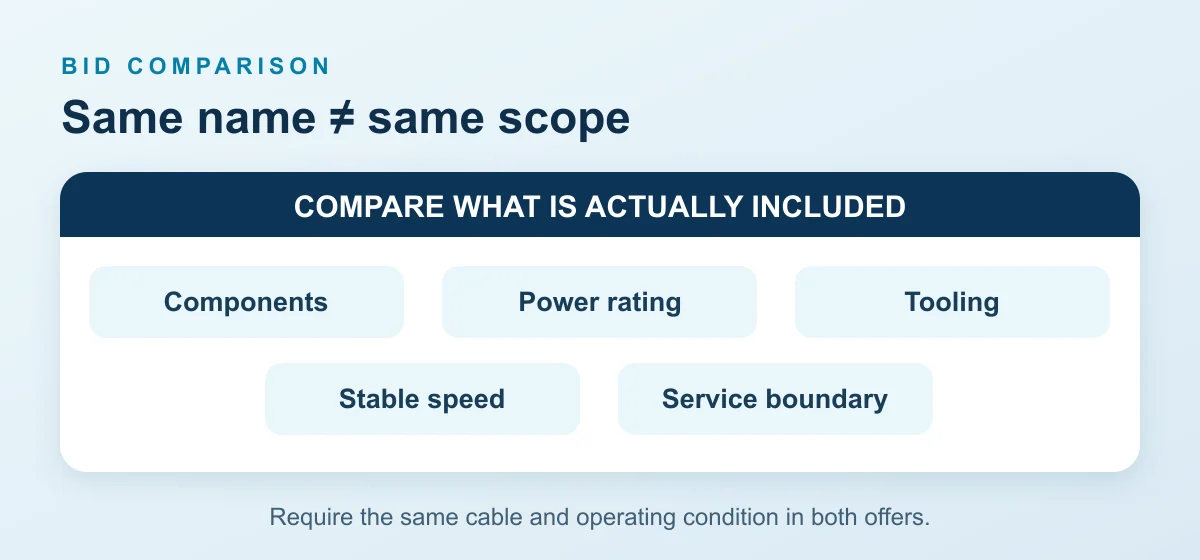
Editorial diagram: A shared machine name does not prove that two quotations include the same technical and service scope.
When HONGKAI reviews a large price difference, the first check is what each configuration contains: the specified electrical and control components, power ratings, product range and actual speed under the relevant cable condition. These are possible reasons for a difference, not proof that the more expensive offer is better. Keep one bid-comparison sheet with a column for each supplier. Record the offered model or configuration, component specifications, included tooling, supported product range, operating assumptions, testing, services, exclusions and open points. Ask the supplier to label every deviation from the RFQ rather than burying it in a brochure or email.
| Compare on the same line | Supplier A | Supplier B | Decision needed |
|---|---|---|---|
| Approved product and drawing revision | To be completed | To be completed | Are both offers based on the same cable? |
| Included process stages and tooling | To be completed | To be completed | Is any intermediate process missing? |
| Electrical/control components and power ratings | To be completed | To be completed | Are models, ratings and control functions equivalent? |
| Stable output condition at the specified diameter and structure | To be completed | To be completed | कौन सा उत्पाद और रन रिकॉर्ड दावे का समर्थन करता है? |
| Utilities and existing-machine interface | To be completed | To be completed | Who supplies each missing interface? |
| निरीक्षण, FAT और साइट स्वीकृति | To be completed | To be completed | Is the same finished sample tested? |
| Installation, training and exclusions | To be completed | To be completed | खरीदार के साथ कौन सा काम रहता है? |
Evidence to request: A revised technical schedule and a marked deviation list. A supplier who proposes a sensible alternative should explain which product requirement it changes and obtain approval before that alternative becomes the comparison baseline.
Write Acceptance Evidence Into the RFQ
Agree on a representative cable and the basic quality checks before factory acceptance testing (FAT). For an applicable insulated or sheathed cable, HONGKAI commonly checks centering or concentricity, outside-diameter stability and whether the surface is damaged. The product specification must set the actual limits and methods.

संपादकीय आरेख: सहमत नमूना, रन रिकॉर्ड, माप और हस्तांतरण को एक ही उत्पाद विशिष्टता को संदर्भित करना चाहिए।.
Concentricity, outside diameter and ovality are distinct measurements, even when a single in-line system reports all three.1 If a customer’s specification calls for concentricity above 95%, use that figure only for the specified product and measurement method. It is नहीं a universal cable requirement; “eccentricity” should not be treated as a higher-is-better percentage. Before using the figure in a contract, identify the applicable product, calculation, measuring position and pass limit. For optical or other products where centering is not the relevant finished-cable criterion, specify the tests appropriate to that construction instead.
The RFQ should identify the sample construction, who supplies qualified materials, what will be measured, the pass limits and the documents the buyer will receive. It does not need to invent a universal test duration or speed. If the full product range cannot be run at FAT, list the untested products as open site-validation items. Do not turn one successful sample into a claim for every cable in the catalogue.
| Acceptance record | इसे क्या जोड़ना चाहिए |
|---|---|
| अनुमोदित नमूना पहचान | ड्रॉइंग संशोधन, इनपुट सामग्री, टूलिंग और पैकेज |
| Run record | Recipe or settings, operating period, stops and measured output |
| Product measurements | सहमत बाहरी व्यास परिवर्तन, जहां लागू हो, केंद्रता/समकेंद्रिता, सतह की स्थिति और अन्य उत्पाद-विशिष्ट परिणाम |
| Scope record | Installed machines, instruments, utilities and unresolved interfaces |
| Handover | मैनुअल, प्रशिक्षण, स्पेयर-पार्ट्स का दायरा और खुले मदों के मालिक |
How to verify: Use the same product and acceptance schedule for the RFQ, technical agreement, FAT and site handover. Amend a field by revision instead of silently changing the product after prices arrive.
An RFQ is ready to send when a supplier can identify the finished cable, calculate the required route and output, see the factory boundary, and explain how its proposal will be accepted. Any open field should have an owner and a date for resolution. That is more useful to a buyer than a longer list of unqualified machine names.
-
SIKORA, "केबल और तारों के इन्सुलेशन में कंडक्टर की सटीक समकेंद्रिता माप और संबंधित पैरामीटर के लिए तकनीक". The source describes conductor-in-insulation concentricity together with outer-diameter and ovality measurements; it does not set a universal 95% acceptance limit. ↩

 English
  हिन्दी
  فارسی
فارسی