











با پیچیدگی تولید هسته فیبر درگیر هستید؟ کنترل ضعیف کیفیت منجر به تلفات سیگنال و شکستهای تولیدی میشود.
Optical-fiber production starts with a glass preform, followed by heating, drawing, diameter control and protective coating. The drawn glass contains both core and cladding; it is not an isolated core. Confirm the preform route, furnace settings and finished-fiber specification for the selected process.
When assessing a fiber core manufacturing project, distinguish glass preform fabrication and fiber drawing from downstream cable production. Use this guide to identify the process stages, equipment interfaces and evidence to request from suppliers. For a HONGKAI Cable Machinery enquiry, confirm the proposed equipment scope, responsible manufacturer and acceptance requirements in the project documents.
برای تولید هسته فیبر به چه موادی نیاز دارید؟
Raw-material composition and contamination control are part of fiber quality, but they are not the only factors. Assess material records together with preform inspection and finished-fiber tests; do not diagnose optical loss or fiber breaks from a nominal purity grade alone.
Define the intended fiber and preform route before specifying chemical inputs. A chloride-based MCVD process uses volatile glass-forming precursors, but material grades, dopants, gases and thermal settings must match the qualified process. Buying finished preforms is a different supply scope from manufacturing them.
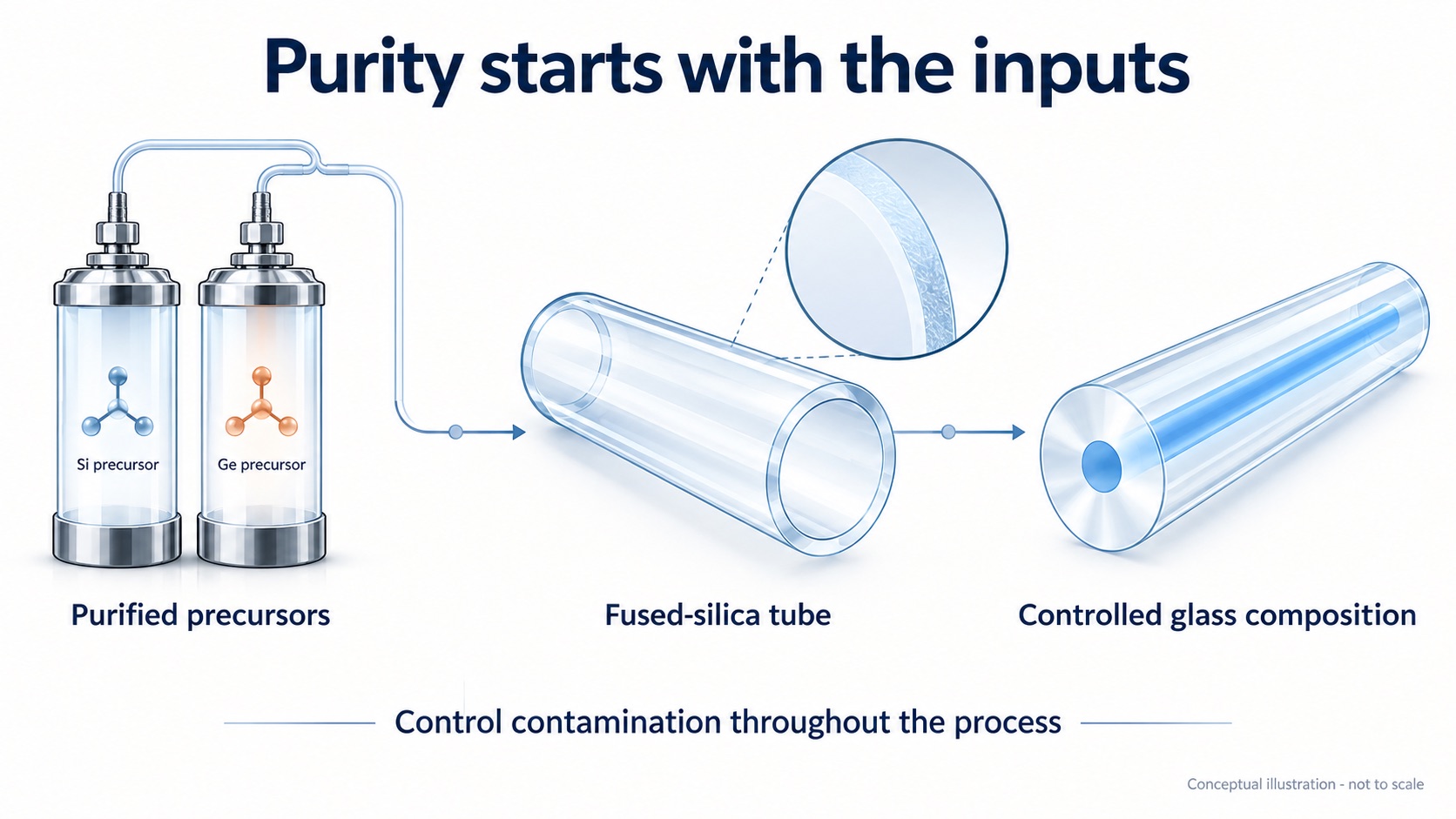
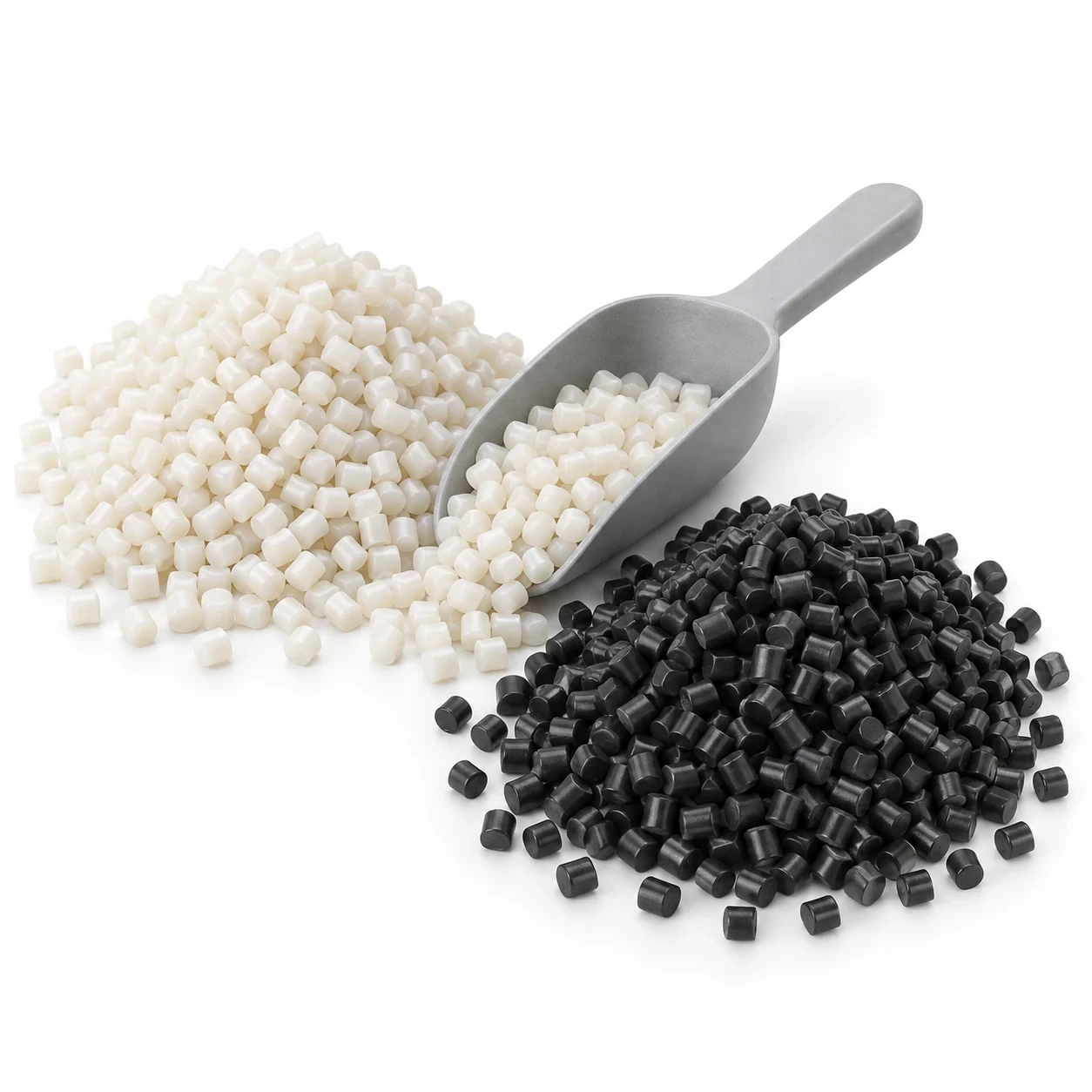
تصویر مفهومی ورودیهای مواد و کنترل آلودگی در تهیه پیشفرم؛ نه یک عکس آزمایشگاهی.
Raw-material selection and contamination control belong in the project’s quality plan. Request material specifications and batch records from the proposed producer, and confirm how nonconforming batches are handled. مروری بر تولید فیبر نوری هراوس نقش ترکیب مواد، هندسه و پروفایل ضریب شکست را توضیح میدهد. تنها درصد خلوص، عملکرد فیبر نهایی را مشخص نمیکند.
اجزای شیمیایی اولیه
The توضیحات MCVD دانشگاه لایبنیتس هانوفر identifies SiCl4, GeCl4 and POCl3 as examples of volatile glass-forming precursors. This is not a mandatory ingredient list for every fiber. For each selected chemical, request the supplier’s grade specification, batch certificate and relevant trace-impurity results; the process owner must approve its suitability.
Germanium doping can raise the refractive index of silica, but the finished fiber must be defined by its complete core-and-cladding design. Do not infer numerical aperture or other optical performance from a germanium concentration alone. Confirm the intended refractive-index profile, dopant formulation and applicable measurements with the preform producer.
فرآیند واکنش شیمیایی
In the MCVD route described by Leibniz University Hannover, precursor vapors pass through a fused-silica tube and an external traversing burner initiates glass formation. Particles deposit on the tube’s inner wall. Deposition, consolidation and tube collapse are distinct stages; one generic reaction-temperature range is not an operating specification for all of them.
Require the process owner to define and qualify the temperature and gas-delivery settings for each stage. The production record should identify the recipe version, measured variables, permitted deviations and response to an excursion. Do not adopt an unsourced temperature-change threshold or flow-stability percentage as proof of complete reaction or acceptable fiber.
الزامات خلوص و آزمایش
Define impurity limits for the specific input material and intended fiber, not by comparison with another industry. Heraeus’ overview distinguishes hydroxyl-content requirements for UV and infrared transmission, illustrating why application matters. For moisture, metals and other specified impurities, identify the material being tested, concentration units, analytical method and reporting limit. Do not interchange a precursor-gas specification with a finished-glass measurement.
Request the producer’s incoming-material inspection plan, batch certificates and laboratory reports. Ask which analytical methods are used, which contaminants are assessed and how each result is compared with the agreed material specification. Confirm the responsible laboratory and traceability arrangements rather than assuming that the equipment supplier performs these tests.
از این ماتریس برای تعریف اسناد پذیرش مواد ورودی استفاده کنید. این ماتریس یک مشخصهی عمومی خلوص شیمیایی یا یک روش آزمایش آزمایشگاهی نیست.
| ورودی برای صلاحیتیابی | مشخصات مورد نیاز | مدارک انبوه یا تأمین | Acceptance decision |
|---|---|---|---|
| SiCl4، در صورت استفاده | درجهبندی واجد شرایط و حدود ناخالصیهای نامگذاریشده با واحدها | گواهی دسته، نتایج تحلیلی مربوطه و حدود گزارشدهی | مالک فرآیند ماده را برای دستورالعمل مورد نظر تأیید میکند |
| GeCl4 یا سایر پیشمادههای آلاینده، در صورت استفاده | ترکیب شیمیایی، درجه و حدود ناخالصی انتخابشده برای طراحی فیبر | نتایج ردیابیپذیر بر اساس روشهای مناسب برای آن ماده | با مشخصات ماده دوپانت تأییدشده مقایسه کنید |
| O2, if used | درجه گاز و حدود آلاینده مورد نیاز فرآیند | ارائه گواهی تأمین و بازرسیهای توافقشده در نقطه مصرف | شرایط مشخصشده تحویل گاز را بررسی کنید |
| گازهای حامل یا فرآیند، در صورت استفاده | نیازمندیهای هویت گاز، خلوص و تحویل برای مسیر واقعی | سوابق تأمینکننده و بررسیهای توافقشده وضعیت خط | بر اساس مشخصات ابزار فرآیند تأیید کنید |
ملاحظات نگهداری و جابجایی
Before specifying chemical storage, request the current safety data sheets and the chemical supplier’s storage and compatibility requirements. Have the proposed facility design reviewed by qualified personnel. Container materials, atmosphere controls and environmental limits must be established for the actual chemicals and process, not inferred from a generic article.
Require documented procedures for chemical transfer, contamination control, personnel protection and emergency response. Confirm tubing and fitting compatibility, any purge requirements and the applicable training with the responsible process and safety specialists. This overview is not an operating procedure for chemical handling.
Include the required material-handling facilities, inspection work and maintenance in the project scope and cost comparison. Ask for the proposed producer’s contamination-control records, and confirm which safeguards and records are included before comparing quotations.
چگونه پیش فرم شیشه ای را ایجاد می کنید؟
کیفیت پیشفرم بهطور مستقیم بر ویژگیهای فیبر تأثیر میگذارد. رسوبدهی نامنظم منجر به تغییرات قطر و تلفات نوری در سراسر طول فیبر میشود.
MCVD deposits glass on the inside wall of a silica tube. OVD builds a porous soot preform around the outside of a target rod before consolidation. These are different fabrication routes; preform dimensions depend on the selected process and equipment.
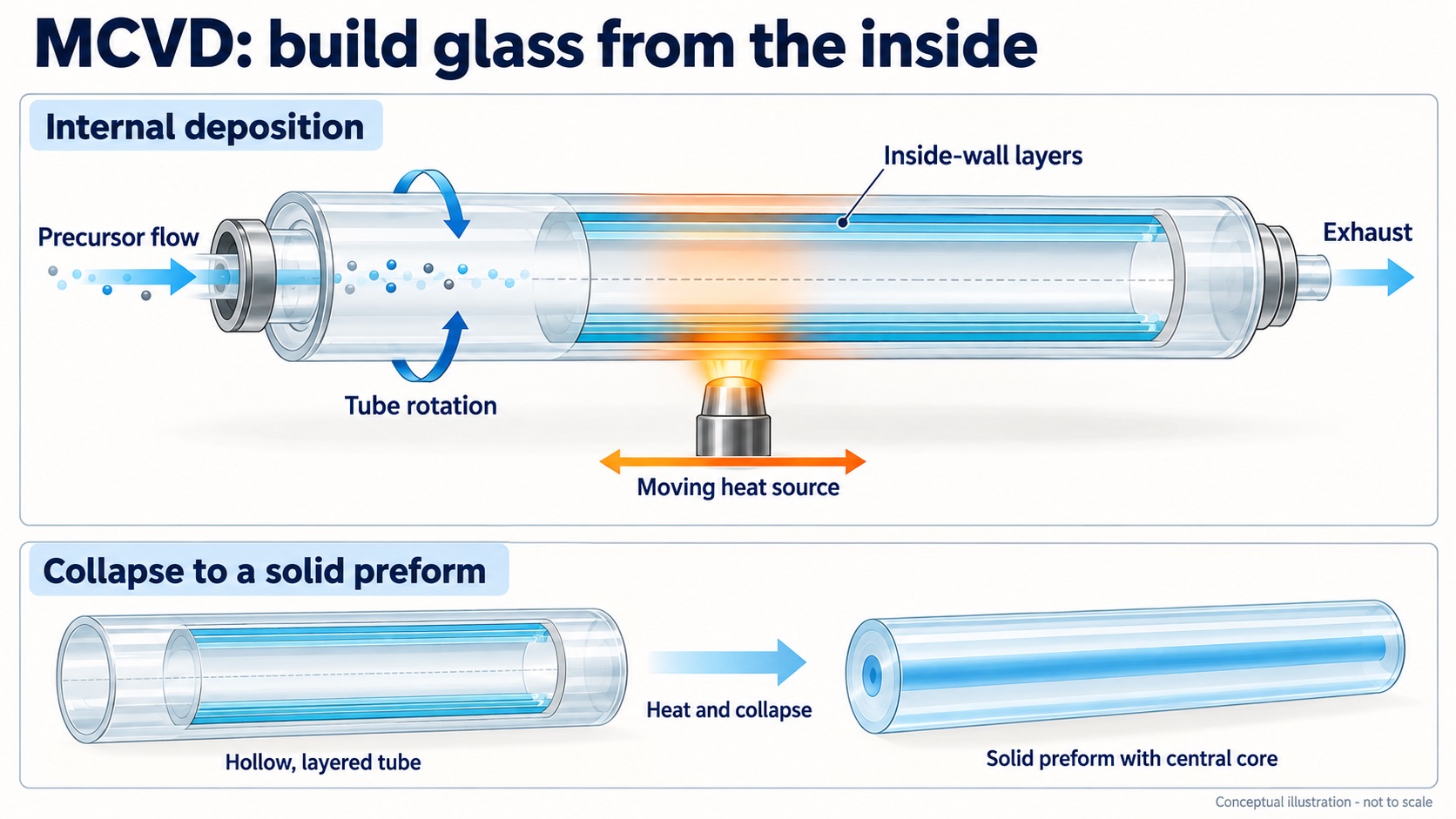
تصویر مفهومی MCVD: شیشه قبل از فروریزش به یک پیشفرم جامد، در داخل لوله رسوب داده میشود. بدون رعایت مقیاس.
For a fiber core manufacturing project, confirm whether preforms will be purchased or fabricated as part of the proposed scope. Request the preform specification, inspection records and compatibility requirements for the drawing equipment. Identify the party responsible for preform production separately from the equipment supplier.
فرآیند رسوب شیمیایی بخار اصلاحشده (MCVD)
In the فرآیند MCVD توصیفشده توسط دانشگاه لایبنیتس هانوفر, precursor gases flow through a fused-silica tube while an external burner travels along it. Glass particles form and deposit on the tube’s inner wall. The gas composition and deposition conditions control the refractive-index profile; tube dimensions must match the specific process and equipment.
For the proposed MCVD lathe and traversing burner, obtain the qualified tube-size range, rotation and traverse settings, alignment requirements and thermal-control method. Identify whether a reported temperature refers to the flame, tube surface or another target. Treat rotation speed and temperature as equipment- and recipe-specific values rather than universal MCVD settings.
Review the gas-delivery sequence and control arrangement for the proposed MCVD process. Require calibrated flow measurement, a documented deposition schedule and traceable process records. The number of passes, deposited-layer dimensions and permitted flow variation must come from the qualified preform design and demonstrated process, not an assumed standard cycle.
The deposition process creates "soot" – submicron glass particles that form in the hot zone and deposit on the inner wall of the tube. The high temperature consolidates these particles into dense, transparent glass as the burner passes over the deposited soot. The consolidation temperature must be carefully controlled to prevent bubble formation while ensuring complete densification.
فرآیند رسوب بخار خارجی (OVD)
In توضیحات کورنینگ دربارهٔ رسوب بخار خارجی, ، ذرات ریز شیشهای، که به عنوان دوده شناخته میشوند، در اطراف خارج یک هدف یا "میله طعمه" انباشته میشوند. برخلاف MCVD، این رسوبگذاری در دیواره داخلی لوله زیرلایه رخ نمیدهد.
Successive soot layers build outward around the target. The deposition equipment and dopant delivery must follow the intended preform design. This is an external buildup of soot, not deposition within a hollow tube.
Preform size and production output are equipment-specific. Do not use one diameter or length as a universal OVD capability; confirm the qualified preform range with the process-equipment supplier.
در مسیر توصیفشده توسط کورنینگ، میله طعمه قبل از تثبیت حذف میشود. در طول مرحله تثبیت OVD, حرارت، بدنهٔ دودهای متخلخل را به شیشهای متراکم و شفاف تبدیل میکند. شرایط تثبیت باید از فرآیند واجد شرایط پیروی کند، نه یک دستورالعمل دمایی عمومی.
کنترل کیفیت در حین ساخت پریفرم
For thermal monitoring during preform fabrication, specify the actual measurement target and the instrument suitable for it. Ask the supplier to state calibration, measurement uncertainty and relevant operating limitations. A non-contact temperature reading should not be treated automatically as an accurate flame-temperature or glass-temperature measurement.
Ask the preform producer for refractive-index profile measurements and the stated test method. The report should identify the measured preform, instrument, calibration status and acceptance criteria. Agree how out-of-specification results are handled before the preform is released for drawing.
Include preform diameter, concentricity, straightness and roundness in the agreed dimensional inspection plan. Require the supplier to state the measurement method, units and acceptance tolerances for the specified preform and drawing equipment. Do not adopt an unsourced percentage as a universal limit.
Compare MCVD and OVD proposals against the same intended fiber design and supply scope. Route names alone do not establish fixed core diameters, numerical apertures or attenuation limits. Keep preform inspection separate from acceptance of the fiber drawn from it.
| مورد مقایسه | مدارک پیشنهاد MCVD | مدارک پیشنهاد OVD | Acceptance boundary |
|---|---|---|---|
| مسیر رسوب و مرحله تأمینشده | لوله زیرلایه، رسوب داخلی و مرحله پیشفرم تأمینشده را شناسایی کنید | شناسایی رسوبات خارجی دوده، تثبیت و مرحله پیشفرم تأمینشده | مراحل تأمین معادل را مقایسه کنید، نه فقط برچسبهای مسیر را |
| Preform geometry | نتایج نقشهکشی و بازرسی برای پیشفرم پیشنهادی | نتایج نقشهکشی و بازرسی برای پیشفرم پیشنهادی | مشخص کنید که هر بعد مربوط به پیشفرم یا فیبر کشیدهشده است و واحد آن را ذکر کنید. |
| Refractive-index profile and fiber design | مشخصات پروفایل اندازهگیریشده و فیبر هدف | مشخصات پروفایل اندازهگیریشده و فیبر هدف | Agree the profile and any applicable numerical-aperture test separately |
| هممحوری، استقامت و گردی | Inspection method, measured results and proposed tolerances | Inspection method, measured results and proposed tolerances | برنامه کشیدن و بازرسی پیشفرم تأییدشده را اعمال کنید |
| Finished-fiber optical performance | Traceable results from fiber drawn from the proposed preform | Traceable results from fiber drawn from the proposed preform | از مشخصات فیبر انتخابشده و شرایط آزمون توافقشده استفاده کنید، نه یک حد عمومی MCVD/OVD |
بهینهسازی فرآیند و عیبیابی
Require a documented trial plan before changing preform-fabrication parameters. Identify the variables, permitted operating boundaries, measurements and approval responsibilities with the process owner. Keep trial results traceable to the material batch and equipment settings, and record the process owner’s approval.
For a suspected preform defect, first identify the measured feature: interface condition, refractive-index profile or geometry. Compare inspection results with the approved preform design and the corresponding material, deposition and equipment records. A defect name alone does not establish whether contamination, thermal conditions, gas delivery or alignment caused it. Ask the process owner to document the evidence for the proposed cause before changing the recipe.
Request the equipment manufacturer’s preventive-maintenance schedule and calibration requirements. Confirm which burner components, flow controllers and alignment checks are included, who performs each task and what records are required. Agree the maintenance scope before equipment acceptance.
Preform acceptance is one checkpoint, not a guarantee of trouble-free drawing. Link each preform’s inspection record to the drawing run and finished-fiber results so a defect can be investigated across stages. Release the fiber only against the agreed geometry, optical and mechanical requirements.
چه تجهیزاتی برای کشش الیاف ضروری است؟
انتخاب نادرست تجهیزات منجر به شکست در تولید میشود. سیستمهای کشش نامناسب باعث شکستگی الیاف، تغییرات قطر و نقص پوشش میشوند که محصول را غیرقابل استفاده میکند.
Specify the drawing system as a complete process: preform feed, furnace, cooling, diameter measurement, coating, curing and take-up. Require the supplier to demonstrate the agreed fiber dimensions and quality at the proposed production speed; a speed figure alone is not an acceptance criterion.
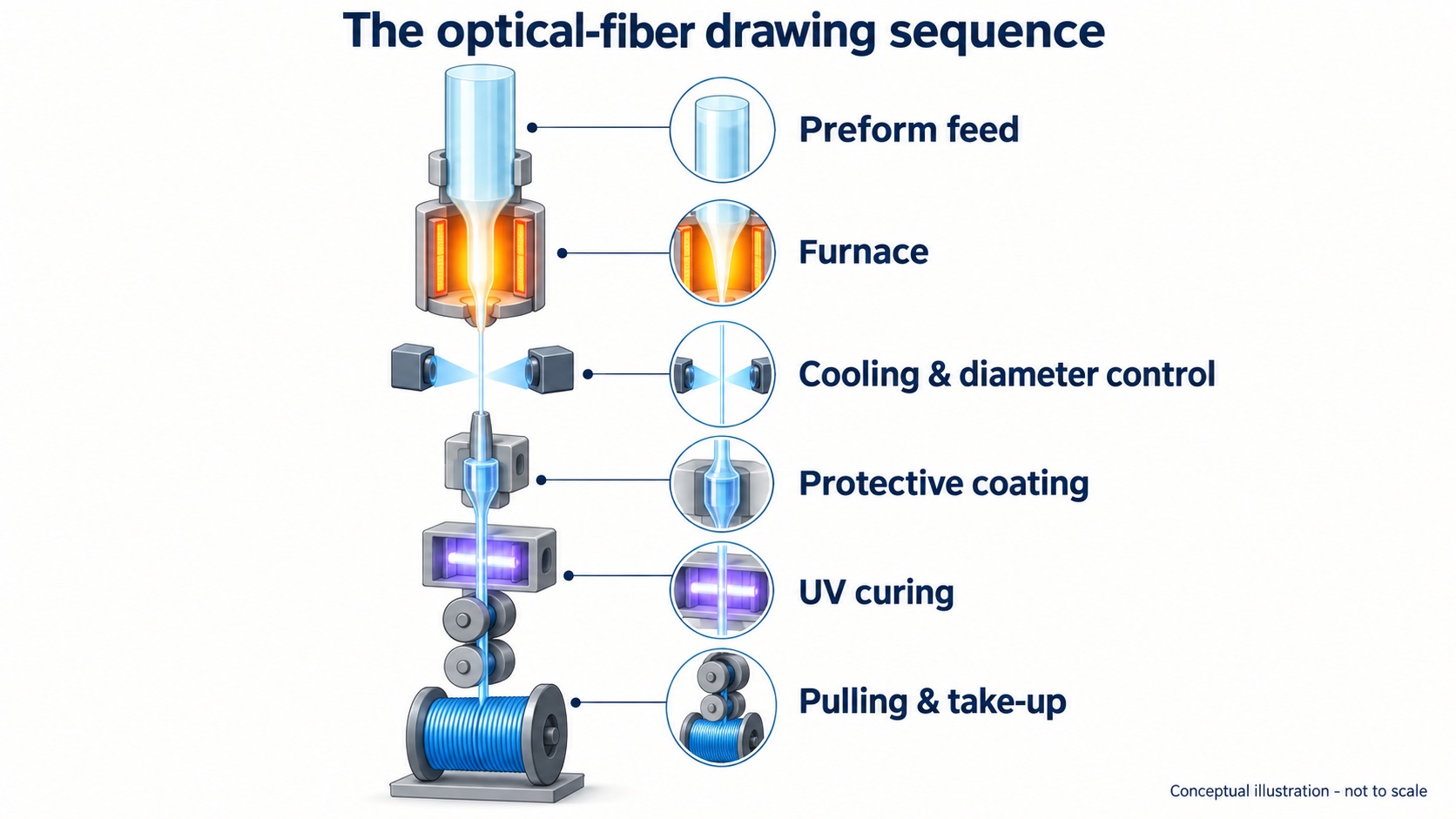
دنبالهی مرحلهای نقشهی مفهومی، نه نقشهی یک دستگاه خاص تأمینشده. بدون رعایت مقیاس.
Coordinate the interfaces between the preform, drawing equipment and coating system before accepting a line proposal. Record the target fiber type, glass-cladding diameter, coated-fiber outer diameter and test conditions so each supplier works to the same product definition.
سازه و طراحی برج نقشه کشی
When reviewing a برج کشش فیبر, request the supplier’s layout, structural requirements and vibration-control provisions for the proposed configuration. Confirm the required building height, foundations, service access and utility interfaces from the actual equipment drawings rather than assuming a standard tower size.
این برج شامل چندین ناحیه است که هر کدام وظیفه خاصی را در فرآیند کشش انجام میدهند. بخش بالایی شامل مکانیزم تغذیه پیشسازه و کوره است. بخش میانی فضایی برای خنکسازی الیاف و اندازهگیری قطر فراهم میکند. بخش پایینی شامل سیستم اعمال پوشش، کورههای پخت و تجهیزات برداشت است.
Ask the drawing-equipment and coating suppliers to specify the required cleanliness, temperature, humidity and ventilation conditions. Record operating and shutdown requirements in the utility schedule, together with monitoring methods and acceptance limits. Assign responsibility for establishing and maintaining these conditions.
سیستمهای کوره با دمای بالا
Confirm the furnace heating technology, usable hot zone, preform-size range and qualified operating window with the equipment manufacturer. Furnace dimensions and maximum temperature must come from the proposed equipment specification, not a generic production-line example.
Request the furnace supplier’s temperature-measurement and control specification, including sensor type, calibration, measurement uncertainty and demonstrated control performance. Distinguish a stated controller resolution from verified furnace stability, and agree the acceptance test for the supplied system.
Confirm furnace-gas requirements with the furnace manufacturer and responsible process engineer. The utility specification should identify gas type, quality, flow requirements, monitoring and safety provisions for the actual system. Do not use a generic oxygen limit or gas selection as an approved operating recipe.
For the preform-feed system, request the supported preform dimensions and mass, feed range, positioning performance and coordination with draw control. Agree a test using the intended preform rather than assuming a universal positioning tolerance.
اندازهگیری و کنترل قطر
Specify what each gauge measures: bare-glass outer diameter, coated-fiber outer diameter or another defined feature. Request the instrument’s measurement range, accuracy, repeatability, sampling rate and calibration requirements. Do not treat resolution, response time and achieved production tolerance as interchangeable specifications.
Draw speed is one control variable used to regulate bare-glass diameter, but it interacts with preform feed, thermal conditions and tension. Confirm which variables the proposed controller actually adjusts, where the diameter is measured and how transport delay is handled. Require a recorded trial showing diameter and tension together during steady running and approved speed changes; a simple ‘speed up when thick’ rule is not a complete control specification.
کنترل پیشبینانه و مبتنی بر یادگیری باید بهعنوان توابع پیشنهادی خاص در نظر گرفته شوند، نه ویژگیهای استاندارد هر خط ترسیم. بهعنوان مثال، مقاله پژوهشی کنترل پویای فرآیند تولید فیبر با استفاده از یادگیری تقویتی عمیق reports tests on a compact fiber-drawing system. It does not establish deployment or performance on the production line being quoted. Request the actual control architecture, operating limits and acceptance demonstration for any such claim.
| پارامتر | در پیشنهاد تعریف کنید | پایه پذیرش | مدارک درخواستی |
|---|---|---|---|
| Furnace operation | فناوری گرمایش، منطقه داغ قابل استفاده و پنجره عملیاتی | تنظیمات واجد شرایط برای پیشفرم انتخابشده | مشخصات تجهیزات و شرایط آزمایش ثبتشده |
| قطر روکش شیشهای | قطر خارجی شیشهی بدون پوشش، متمایز از قطر هسته | هدف و تحمل در مشخصات فیبر انتخابشده | دادههای کالیبرهشده اندازهگیری و روش بازرسی توافقشده |
| سرعت رسم | سرعت تولید توافقشده برای فیبر مشخصشده | Quality demonstrated at that speed | ثبت آزمایشی پیوند سرعت با هندسه و نتایج نوری |
| Coated-fiber outer diameter | قطر روی پوشش سختشده، نه ضخامت شعاعی پوشش | هدف و تحمل برای طراحی پوشش انتخابشده | نتایج قطر و هممرکزی از آزمون توافقشده |
سیستمهای اعمال پوشش
سیستم پوششدهی، لایههای پلیمری محافظ را بلافاصله پس از تشکیل، روی فیبر شیشهای لخت اعمال میکند. پوششدهی باید به صورت متحدالمرکز و یکنواخت انجام شود تا از تلفات خمیدگی میکرو جلوگیری شود و محافظت مکانیکی فراهم شود. اکثر سیستمها از اعمالکنندههای قالب فشاری استفاده میکنند که مواد پوششدهنده مایع را با فشار در اطراف فیبر پخش میکنند.
The primary coating is the polymer layer next to the glass. Confirm its material, cured outer diameter and acceptance requirements in the qualified coating design. Do not assume a fixed radial thickness for every optical-fiber product.
The secondary coating surrounds the primary layer. Distinguish its outer diameter from the thickness of either layer. For concentric circular layers, total radial coating thickness = (coated-fiber outer diameter – glass-cladding diameter) / 2. This relation alone does not determine how the thickness is divided between primary and secondary coatings.
برای یک مثال خاص از محصول،, Corning’s SMF-28 Ultra product sheet, July 2025, page 2 lists a glass-cladding diameter of 125.0 ± 0.7 μm and coated diameters of 242 ± 5 μm or 200 ± 5 μm, depending on the option. Using nominal diameters gives combined radial coating thicknesses of 58.5 μm and 37.5 μm respectively. These are calculated examples for that product, not universal coating recipes or HONGKAI equipment guarantees.
Request the proposed coating-concentricity measurement method and die-alignment procedure, with acceptance limits tied to the specified fiber and coating system. Keep geometry checks and optical-performance tests separate: a concentricity result alone does not establish the fiber’s polarization-mode-dispersion performance.
سیستمهای پخت UV
سیستمهای پخت فرابنفش، پوششهای آکریلات مایع را به لایههای محافظ جامد پلیمریزه میکنند. فرآیند پخت باید کامل و یکنواخت باشد تا خواص مناسب پوشش تضمین شود. پخت ناقص میتواند منجر به سطوح چسبناک و خواص مکانیکی ضعیف شود.
سختشدن پوشش فیبر محدود به یک فناوری لامپ نیست. یادداشت کاربردی خشککردن فیبر با UV-LED شرکت Excelitas describes conventional arc/microwave lamp systems and UV LED systems, and stresses testing the coating with the selected light source. Ask the coating and equipment suppliers to qualify the spectral match, exposure, optical arrangement and thermal conditions at the proposed line speed; lamp layout alone does not prove uniform cure.
If the proposed curing system uses nitrogen inerting, obtain the required gas specification, chamber conditions, monitoring and alarm limits from the coating and curing-equipment suppliers. Verify the cured coating against an agreed test method. Nitrogen supply alone is not evidence that the coating has reached its required cure state.
سیستمهای کنترل کشش و جمعشوندگی
Tension control throughout the drawing process is essential for consistent fiber properties. Excessive tension can cause fiber breaks or diameter variations, while insufficient tension can lead to loose winding and handling problems. Agree the drawing-tension range, force units, measurement method and acceptance conditions for the actual fiber and drawing system.
For the capstan system, request the drive-control specification, fiber-contact surface details and maintenance requirements. Ask the supplier to demonstrate the proposed speed-control performance and fiber-handling results under agreed test conditions rather than relying on an unsupported accuracy figure.
Take-up systems wind the finished fiber onto spools for storage and shipping. The winding pattern must prevent fiber damage while allowing easy unwinding for subsequent processing. Confirm the traverse mechanism, winding pattern and take-up tension requirements with the supplier, then verify the result using the agreed spool and fiber specification.
If the take-up uses a dancer, confirm its loading method, usable travel, position feedback and connection to reel-speed control. Verify winding tension during acceleration, steady running and spool build-up with the intended fiber and reel. A dancer’s presence does not guarantee constant tension, and take-up tension must not be confused with the tension measured in the hot drawing zone.
چگونه کیفیت الیاف را در طول تولید کنترل میکنید؟
کنترل کیفیت از نقصهای پرهزینه تولید جلوگیری میکند. بدون نظارت مناسب، کل چرخه تولید میتواند الزامات مشخصات را برآورده نکند و منجر به اتلاف قابل توجه مواد و زمان شود.
Use a quality plan that separates inline process measurements from optical and mechanical acceptance tests. Define each measured feature, test method, inspection frequency and acceptance limit; inline diameter feedback alone does not verify every finished-fiber requirement.
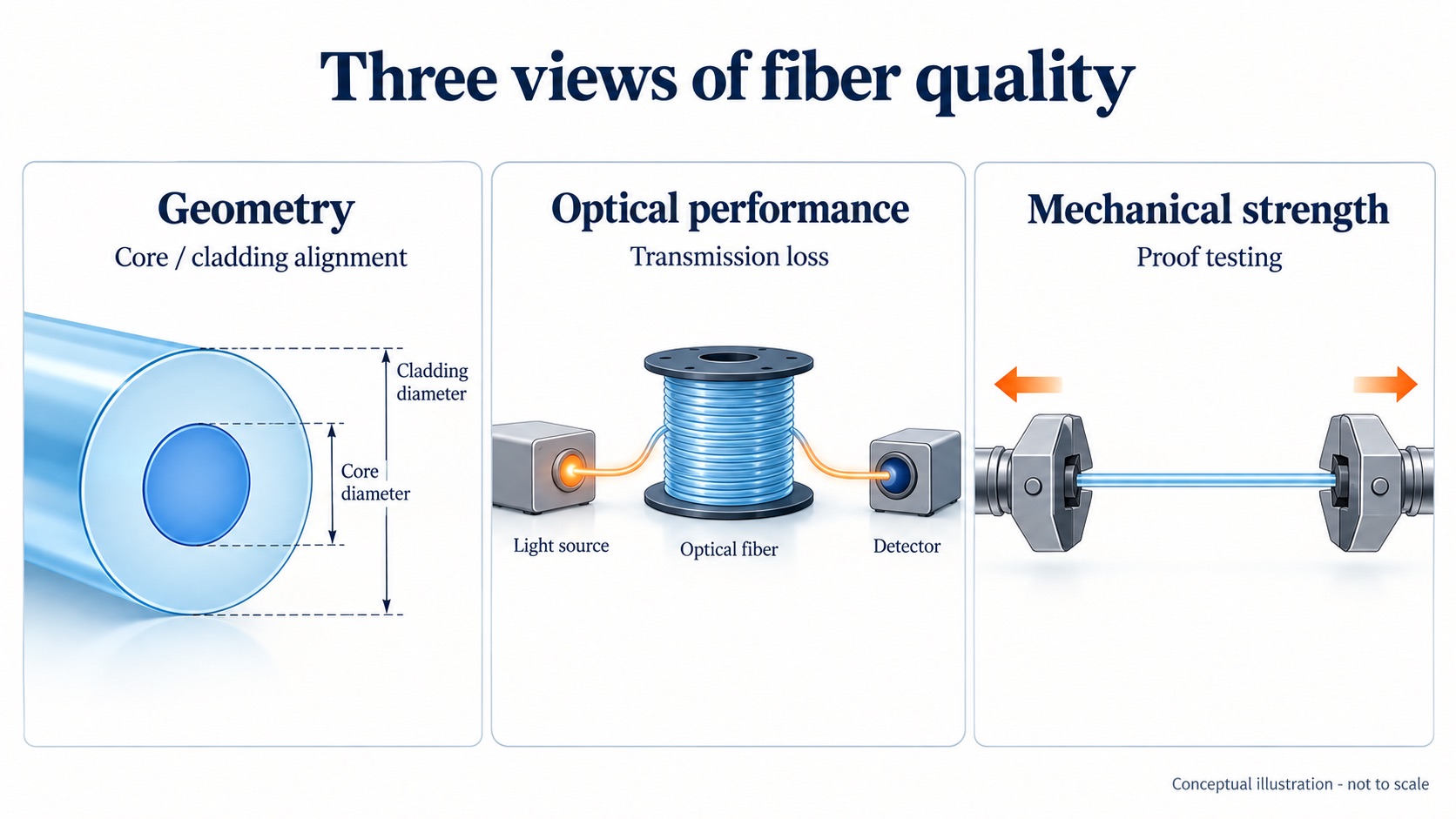
تصویر مفهومی از بررسیهای هندسی، نوری و مکانیکی؛ بدون نمایش نتایج آزمون اندازهگیریشده.
Define the fiber-production quality plan before accepting the equipment. Identify the measurements, inspection frequency, acceptance criteria and responsibility for nonconforming material at each stage. Request sample records from the proposed producer and agree which checks are included in the supplied scope.
نظارت بر فرآیند در زمان واقعی
For each inline measurement, record the sensor principle, accuracy, sampling rate, filtering and position on the line. Ask the supplier to demonstrate which defects the complete measurement-and-control system can detect at the proposed draw speed. Do not infer a minimum detectable defect length or closed-loop response from the gauge resolution alone.
For coating inspection, ask whether the proposed instrument reports coated outer diameter, concentricity or individual-layer geometry. An outer-diameter reading alone does not establish the separate primary and secondary layer thicknesses. Document which features are measured, the calibration method and how the results are checked against the selected coating design.
فرض نکنید که هر اندازهگیری کشش طراحی از یک سلول بار استفاده میکند. شرح SIKORA از اندازهگیری کشش فیبر نوری discusses vibration-based measurement and a birefringence-based optical method. Confirm the proposed instrument, measurement location, units and validation procedure. Define separately whether its signal is displayed, logged, used for an alarm or connected to an automatic control loop; measurement alone does not prove automatic break prevention.
List the thermal and environmental measurements actually included in the proposed line, such as fiber temperature before coating and conditions in the coating or curing area. Identify each measurement target, sensor, logging interval and alarm boundary. Verify any thermal-imaging or contamination-monitoring function explicitly rather than assuming it is supplied with the tower.
آزمایش خواص نوری
روش آزمون تضعیف مناسب برای فیبر و گزارش مورد نیاز را انتخاب کنید. این IEC 60793-1-40:2024 attenuation-method overview lists cut-back, insertion-loss and backscattering methods, as well as spectral modelling with a narrower scope. Record the selected method, test wavelengths, launch conditions, sample identification and acceptance limits; do not assume every production test uses cut-back.
برای فیبر چندحالته، معیار پهنای باند مورد نیاز و شرایط راهاندازی را تعریف کنید. IEC 60793-1-41:2024 distinguishes time-domain, frequency-domain and DMD-derived overfilled-launch bandwidth methods. IEC 60793-1-49:2018 describes DMD characterization of graded-index multimode fiber for bandwidth assessment under different launch conditions. Do not describe a DMD report as a direct refractive-index-profile measurement. Ask the laboratory to identify the fiber category, wavelength, method and reported bandwidth metric.
عدد دیافراگم اندازهگیریشده را از مقدار محاسبهشده با استفاده از ضرایب شکست تمیز کنید. این IEC 60793-1-43:2015 overview covers specified multimode-fiber categories and distinguishes far-field numerical aperture from theoretical numerical aperture. Ask the laboratory to state the applicable fiber category, sample length, measurement threshold and uncertainty. Do not use a numerical-aperture result as a substitute for a required single-mode cutoff-wavelength test.
برای فیبر تکمد، روش آزمون قطر میدان مد (MFD) و طولموج گزارشدهی را همراه با یکدیگر مشخص کنید. IEC 60793-1-45:2024 addresses MFD measurement. Compare results with the selected fiber specification at the same stated wavelength; do not treat an MFD value without its wavelength as a complete acceptance requirement.
آزمایش خواص مکانیکی
Proof testing applies a specified tensile stress to screen fiber for weak sections. As one documented example, section 1.4 of مشخصات فیبر PGSF001 شرکت Corning حداقل را مشخص میکند 100 kpsi (approximately 0.69 GPa) for the fibers covered by that document. Here, 100 kpsi means 100,000 psi. Use the applicable fiber specification and test procedure for the product being manufactured.
Coating adhesion testing verifies that the polymer coatings bond properly to the glass surface and to each other. Poor adhesion can lead to coating delamination during handling or environmental exposure. Request the applicable coating-adhesion and stripping test procedures, reported results and acceptance criteria from the fiber producer.
آزمایش خمش، مقاومت فیبر را در برابر تلفات خمش ماکرو و میکرو ارزیابی میکند. در آزمایشهای خمش ماکرو، فیبر به دور مندرلهایی با قطرهای مختلف پیچیده میشود تا شرایط نصب شبیهسازی شود. در آزمایشهای خمش میکرو، فشار جانبی کنترلشدهای اعمال میشود تا اثرات تولید کابل و تنشهای محیطی شبیهسازی شود.
آزمایشهای محیطی، نمونههای فیبر را در معرض چرخههای دمایی، رطوبت و محیطهای شیمیایی که ممکن است در حین کار با آنها مواجه شوند، قرار میدهند. این آزمایشها به پیشبینی قابلیت اطمینان بلندمدت و شناسایی حالتهای خرابی بالقوه قبل از وقوع در محل کمک میکنند.
Use the following planning matrix to agree the product-specific quality plan. A measurement standard defines how a test is performed; it is not, by itself, a universal product limit or a sampling plan. Adapt the wavelength rows to the selected fiber rather than applying them to every fiber type.
| Test parameter | روش تعیین | پوشش یا نمونهبرداری باید توافق شود | پایه پذیرش |
|---|---|---|---|
| Attenuation at 1310 nm, if specified | Applicable method under IEC 60793-1-40:2024 | در برنامه کیفیت محصول تعریف شده است | حداکثر تلفات برای فیبر انتخابشده در این طول موج |
| Attenuation at 1550 nm, if specified | Applicable method under IEC 60793-1-40:2024 | در برنامه کیفیت محصول تعریف شده است | حداکثر تلفات برای فیبر انتخابشده در این طول موج |
| MFD تکمدی در طولموج ذکر شده | Applicable method under IEC 60793-1-45:2024 | در برنامه کیفیت محصول تعریف شده است | مقدار نامی و تحمل در همان طول موج |
| آزمون اثبات | IEC 60793-1-30:2010 fibre proof-test procedure | طول آزمایششده مورد نیاز و سوابق قابل ردیابی کلاف | سطح تنش و قوانین پذیرش از مشخصات فیبر انتخابشده |
| Coated-fiber outer diameter | روش آزمون ابعادی توافقشده | در برنامه کیفیت تعریف شده است | هدف و تحمل از مشخصات فیبر/پوشش انتخابشده |
کنترل فرآیند آماری
Statistical process control (SPC) can help identify changes in recorded process measurements. NIST’s control-chart guidance explains that both points outside control limits and non-random patterns can warrant investigation. Control limits describe process behavior; they are not the product’s specification limits. A stable process can still produce nonconforming fiber. For the proposed quality system, identify the measured feature, chart type, sampling method, investigation rules and responsible person. Confirm whether alerts are actually implemented; a chart alone does not prevent defects or release a spool for shipment.
پیش از تفسیر Cp یا Cpk، مطمئن شوید که فرآیند پایدار است و دادهها و روش محاسبه مناسب هستند. مرور کلی قابلیت فرآیند NIST compares stable-process variation with specification limits and states the normal-distribution assumption of the conventional indices. Cp compares specification width with process spread; Cpk also accounts for an off-center process mean. Ask for the underlying measurements, units, sampling period, specification limits and statistical assumptions, not just an index on a dashboard. Agree any required capability criterion for the project; do not substitute an unsourced universal threshold for the fiber’s acceptance tests.
Design of experiments (DOE) techniques help optimize process parameters and understand the relationships between different variables. For any proposed optimization trial, agree the factors, response measurements and permitted operating boundaries with the process owner, and require a traceable report of the results.
Correlation analysis helps identify relationships between different measurements that might not be obvious. Treat a measured correlation as a finding to investigate, not proof of a causal relationship or a guaranteed process improvement.
سیستمهای کیفیت خودکار
For an automated quality-control proposal, require a list of measured inputs, controlled outputs, alarm actions and operator responsibilities. Ask the supplier to demonstrate each promised feedback or predictive function on the proposed system. Do not assume that machine-learning prediction or automatic defect prevention is included in a standard drawing line.
Specify which process and test data will actually be recorded, with timestamps, length or spool references, retention and export requirements. Check a sample production record before acceptance; an automation interface does not establish that every quality parameter is captured or traceable.
Ask the supplier to demonstrate how an out-of-specification segment is identified, located, segregated and documented. State whether handling requires stopping, cutting, transfer or later rewinding, and define the restart and retest procedure. Do not assume defective fiber can be removed while drawing continues without interruption.
If ERP or other factory-system integration is required, define the data fields, spool identifiers, interfaces, access rights and responsibility for failed transfers. Test a sample record from measurement through export and retrieval before acceptance. An available interface does not by itself establish end-to-end traceability or regulatory compliance.
مشکلات و راهحلهای رایج تولید چیست؟
مشکلات تولید میتواند کل خطوط تولید را متوقف کند. مشکلات حل نشده منجر به آسیب به تجهیزات، ضایعات مواد و عدم انجام تعهدات تحویل میشود که به روابط با مشتری آسیب میرساند.
شکستگی فیبر، تغییرات قطر و نقصهای روکش نیازمند عیبیابی سیستماتیک و پروتکلهای نگهداری پیشگیرانه برای حفظ کیفیت تولید یکنواخت هستند.
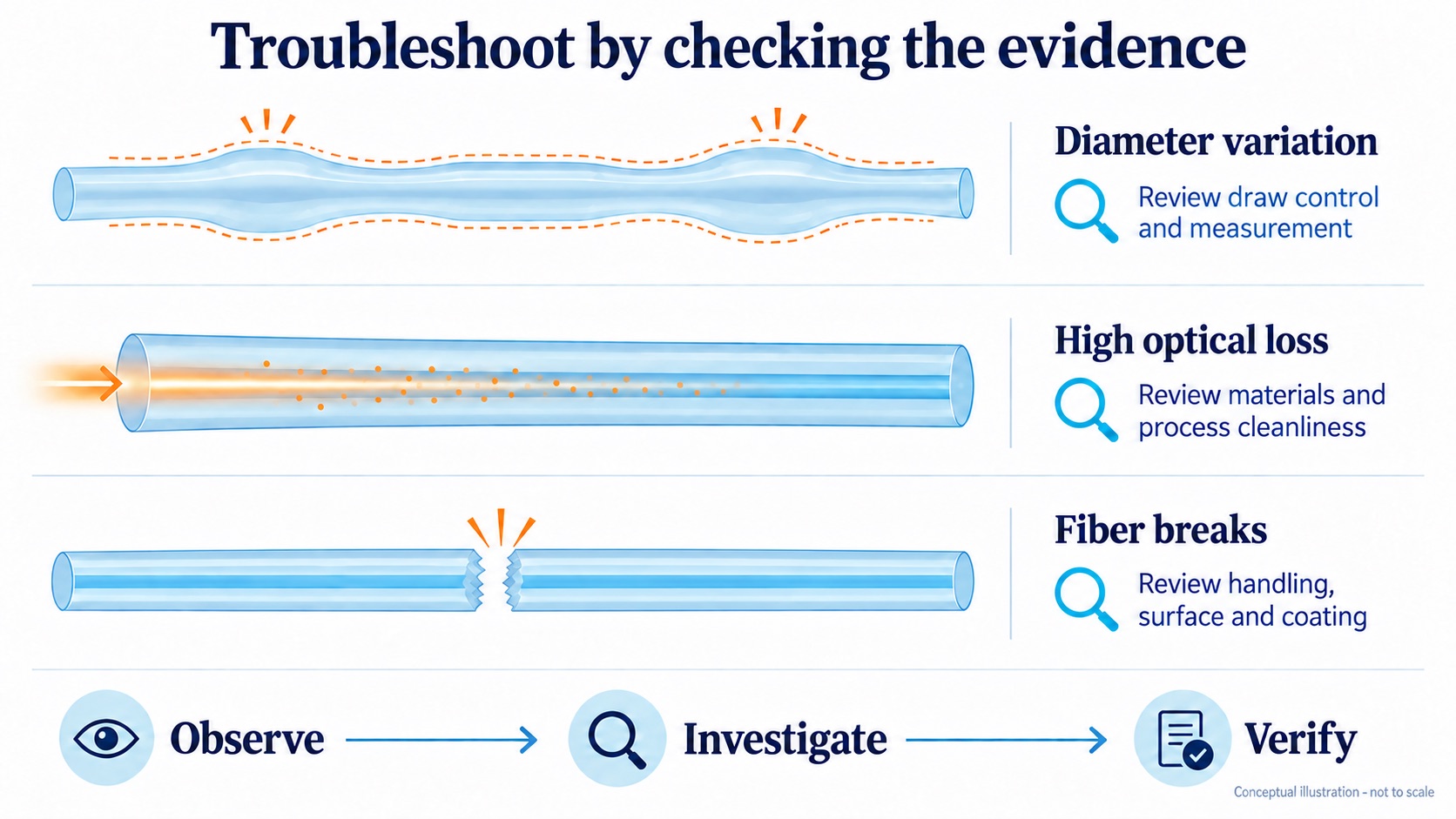
تصویر راهنمای عیبیابی مفهومی. بررسیهای ذکر شده سرنخهای تحقیق هستند، نه علل تأییدشده یا راهحلهای تضمینشده.
Use production records, alarms, inspection results and supplier procedures to investigate fiber-manufacturing problems. Establish the observed symptom and operating conditions before proposing a cause. Follow the applicable manufacturer’s safety and maintenance instructions before making adjustments.
مشکلات پارگی فیبر
Fiber breaks represent one of the most common and disruptive problems in fiber manufacturing. These breaks can occur at any point in the drawing process, from the furnace exit to the take-up reel. Understanding the different types of breaks and their causes is essential for effective troubleshooting.
For a break near the furnace exit, preserve the time, preform identity, break location and preceding thermal, feed and tension records. Review relevant preform inspections and furnace alarms with the process owner. Do not diagnose ‘thermal shock’ or contamination solely from the break location. Inspection of the furnace or hot-zone components must follow the manufacturer’s safe shutdown and maintenance procedure.
For a suspected tension-related break, compare the tension trace with capstan speed, dancer position, reel events and the recorded break time. First confirm the measurement location and signal validity. A tension change after the fiber has broken may be a consequence, not its cause. Have qualified personnel review the evidence before changing control settings or inspecting the fiber path.
If breaks appear near coating or downstream handling equipment, retain representative samples and record their position relative to dies, guides, capstan and take-up. Check the applicable coating-geometry, cure, adhesion and mechanical-test results with the suppliers. Neither an eccentric coating nor a tacky surface alone proves the failure mechanism; compare the findings with the actual break evidence.
مشکلات کنترل قطر
تغییرات قطر میتواند فیبر را برای کاربردهای دقیق غیرقابل استفاده کند. این تغییرات میتوانند در فواصل کوتاه (ریزتغییرات) یا فواصل طولانی (ماکروتغییرات) رخ دهند که هر کدام نیاز به رویکردهای عیبیابی متفاوتی دارند.
Compare a diameter excursion with the identified preform, feed position and preform inspection records, but do not assume that a preform dimension transfers directly into the finished-fiber diameter. The drawing process and its control response also matter. Confirm the measured feature and units before comparing preform geometry, glass-cladding diameter or core geometry.
When investigating thermal conditions, compare the diameter trace with the furnace setpoint, measured temperature, power and relevant utility records. Distinguish the controller reading from the actual temperature of the glass. Check timing and measurement limitations before assigning a thermal cause or approving a recipe change.
For a suspected control problem, compare commanded and measured speed with the raw and filtered diameter signals. Ask the controls specialist to check sensor validity, delay, output limits and interactions between loops. Do not begin with arbitrary PID changes; use the approved trial procedure and retain before-and-after records.
If the diameter signal is periodic, compare its timing with known equipment cycles and environmental measurements. Check whether the pattern is present in an independent measurement or is an artefact of the gauge, filtering or sampling. A frequency match is an investigation lead, not proof that vibration or airflow caused the product defect.
از این ماتریس تشخیصی برای جمعآوری شواهد قبل از انتخاب یک مداخله استفاده کنید. بررسیهای آن علل تأییدشده یا دستورالعملهای عملیاتی جهانی نیستند.
| Observed symptom | مدارکی برای حفظ | بررسیهای اولیه با متخصص مسئول | Recovery evidence |
|---|---|---|---|
| شکستگی فیبر | محل و زمان شکست، شناسهٔ پیشفرم/کلاف و سیگنالهای قبلی | اعتبارسنجی نمودار کشش و همبستگی آن با رویدادهای حرارتی، تغذیه و جابجایی | راهاندازی مجدد تأییدشده به همراه نتایج مورد نیاز هندسی، مکانیکی و نوری برای ماده تحت تأثیر |
| تغییر قطر | Raw gauge trace, units, speed/feed records and event times | Validate the gauge and separate measurement artefacts from process changes before tuning | Agreed diameter tolerance demonstrated under the documented trial conditions |
| نقص پوشش | نمونهها، محموله مواد، هندسه پوشش، سوابق عملیات خشککردن و رسیدگی | Check the specified geometry and cure tests; review alignment and exposure only within supplier procedures | Results meeting the selected coating specification, with traceability to the trial |
| افزایش میرایی | Test method, wavelength, sample identity, launch conditions and handling history | قبل از بررسی عوامل مربوط به مواد یا فرآیند، تنظیمات آزمایش و قابلیت تکرار را تأیید کنید | Repeatable results meeting the fiber specification and documented disposition of affected spools |
مشکلات کاربرد پوشش
نقصهای پوشش میتوانند بر خواص نوری و مکانیکی فیبر نهایی تأثیر بگذارند. این مشکلات اغلب به تدریج ایجاد میشوند، و تشخیص زودهنگام آنها برای جلوگیری از تولید مقادیر زیادی از محصولات معیوب ضروری است.
For a coating-dimension change, establish whether the measurement concerns total coated diameter, an individual layer or concentricity. Compare the validated trace with coating pressure, material temperature, lot history and die inspection records. The rate of change alone does not distinguish die wear from pressure, material or measurement issues.
When coating concentricity is outside the agreed limit, inspect fiber centering, die alignment and the measurement setup using the supplier’s procedure. Record the geometry results and perform any required optical tests separately. Do not diagnose polarization-mode dispersion from coating eccentricity alone.
For a suspected cure problem, record the coating formulation and lot, light-source type, exposure conditions, line speed and any specified inerting conditions. Compare the agreed cure and mechanical tests with the qualified coating process. A tacky surface or brittle sample is a symptom, not a complete diagnosis. Do not prescribe more UV exposure or attribute cracking to excessive cure without the coating supplier’s assessment.
When adhesion or stripping results are out of specification, confirm the test method and sample conditioning before comparing material, surface-handling and cure records. Ask the coating supplier to assess retained samples. Record the evidence and disposition rather than assuming contamination or material degradation is the cause.
رویکرد عیبیابی سیستماتیک
Effective troubleshooting requires a systematic approach that considers all possible causes and uses data to guide the investigation. Start by reviewing when the problem began, the recorded operating conditions and any changes made before the symptom appeared.
تحلیل دادهها نقش حیاتی در شناسایی الگوهای مشکل ایفا میکند. نمودارهای روند میتوانند تغییرات تدریجی را که ممکن است از اندازهگیریهای فردی آشکار نباشند، آشکار کنند. تحلیل همبستگی میتواند روابط بین پارامترهای مختلف را که نشاندهنده علل ریشهای هستند، شناسایی کند.
Use batch comparisons to narrow the investigation, not to assign blame. If an excursion occurs with one preform batch, check whether recipe, operator, instrument, equipment or environmental conditions also changed. Compare equivalent runs and record which alternative explanations the evidence actually excludes.
A fishbone diagram or five-why review can organize hypotheses, but the diagram is not proof of root cause. Assign an owner to each check, document supporting and conflicting evidence, and verify the approved corrective action against the agreed acceptance criteria. Continue monitoring after restart; one successful trial does not guarantee that the problem cannot recur.
استراتژیهای نگهداری پیشگیرانه
برنامههای نگهداری پیشگیرانه با پرداختن به مسائل بالقوه قبل از اینکه باعث اختلال در تولید شوند، به جلوگیری از بسیاری از مشکلات رایج تولید کمک میکنند. این برنامهها باید بر اساس توصیههای سازنده تجهیزات، دادههای خرابیهای قبلی و الزامات فرآیند باشند.
فعالیتهای تعمیر و نگهداری برنامهریزیشده شامل کالیبراسیون منظم سیستمهای اندازهگیری، تعویض قطعات فرسوده و تمیز کردن نواحی بحرانی است. برنامه تعمیر و نگهداری باید فواصل زمانی و فواصل زمانی مبتنی بر میزان استفاده را برای بهینهسازی قابلیت اطمینان تجهیزات در نظر بگیرد.
تکنیکهای پایش وضعیت میتوانند مشکلات در حال توسعه را قبل از ایجاد خرابی شناسایی کنند. آنالیز ارتعاش میتواند سایش یاتاقان یا مشکلات تنظیم را تشخیص دهد. تصویربرداری حرارتی میتواند مشکلات الکتریکی یا مشکلات سیستم خنککننده را پیدا کند. آنالیز روغن میتواند سایش داخلی در سیستمهای هیدرولیک یا روانکاری را آشکار کند.
مدیریت موجودی قطعات یدکی تضمین میکند که اجزای حیاتی در صورت نیاز برای تعمیر و نگهداری یا تعمیرات اضطراری در دسترس باشند. موجودی باید شامل اقلام تعمیر و نگهداری روتین و قطعات یدکی ضروری باشد که در صورت عدم وجود میتوانند باعث طولانی شدن زمان از کار افتادگی شوند.
برنامههای آموزشی تضمین میکنند که اپراتورها و پرسنل تعمیر و نگهداری، رویههای مناسب را درک کرده و میتوانند علائم اولیه مشکلات در حال توسعه را تشخیص دهند. بهروزرسانیهای منظم آموزشی به حفظ مهارتها و معرفی تکنیکها یا فناوریهای جدید کمک میکند.
سیستمهای مستندسازی، فعالیتهای تعمیر و نگهداری، تاریخچه مشکلات و روند عملکرد تجهیزات را پیگیری میکنند. این اطلاعات به بهینهسازی برنامههای تعمیر و نگهداری، شناسایی مشکلات مکرر و پشتیبانی از تلاشهای بهبود مستمر کمک میکند.
نتیجهگیری
تولید موفقیتآمیز هسته فیبر نیازمند کنترل دقیق مواد، تجهیزات و فرآیندها در کل زنجیره تولید است.
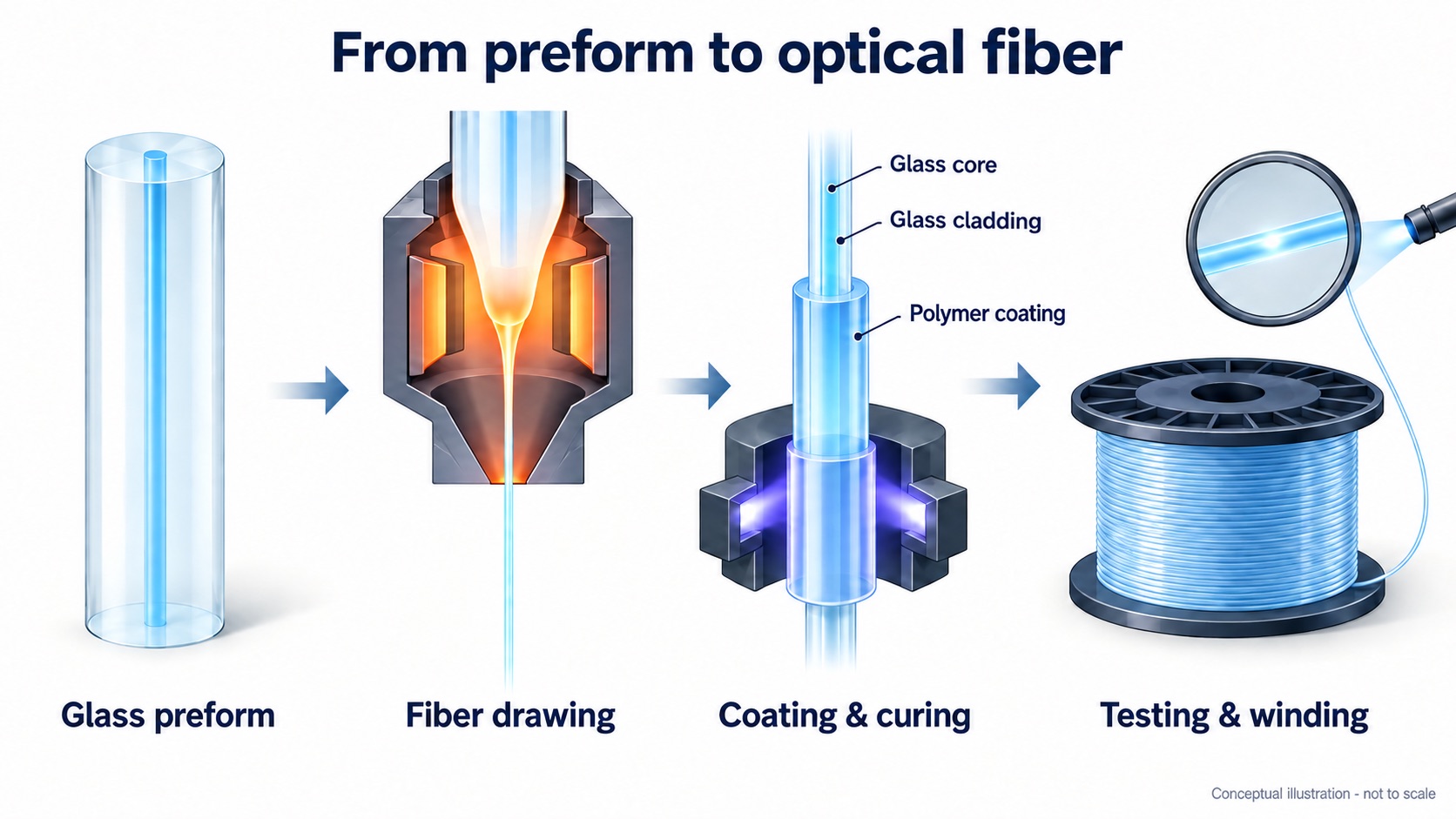
تصویر مفهومی مراحل اصلی تولید فیبر نوری؛ بدون رعایت مقیاس.

 English
 हिन्दी
 فارسی