











Kesulitan menghadapi kompleksitas produksi inti serat? Kontrol kualitas yang buruk menyebabkan kehilangan sinyal dan kegagalan produksi.
Optical-fiber production starts with a glass preform, followed by heating, drawing, diameter control and protective coating. The drawn glass contains both core and cladding; it is not an isolated core. Confirm the preform route, furnace settings and finished-fiber specification for the selected process.
When assessing a fiber core manufacturing project, distinguish glass preform fabrication and fiber drawing from downstream cable production. Use this guide to identify the process stages, equipment interfaces and evidence to request from suppliers. For a HONGKAI Cable Machinery enquiry, confirm the proposed equipment scope, responsible manufacturer and acceptance requirements in the project documents.
Bahan Apa yang Anda Butuhkan untuk Produksi Inti Serat?
Raw-material composition and contamination control are part of fiber quality, but they are not the only factors. Assess material records together with preform inspection and finished-fiber tests; do not diagnose optical loss or fiber breaks from a nominal purity grade alone.
Define the intended fiber and preform route before specifying chemical inputs. A chloride-based MCVD process uses volatile glass-forming precursors, but material grades, dopants, gases and thermal settings must match the qualified process. Buying finished preforms is a different supply scope from manufacturing them.
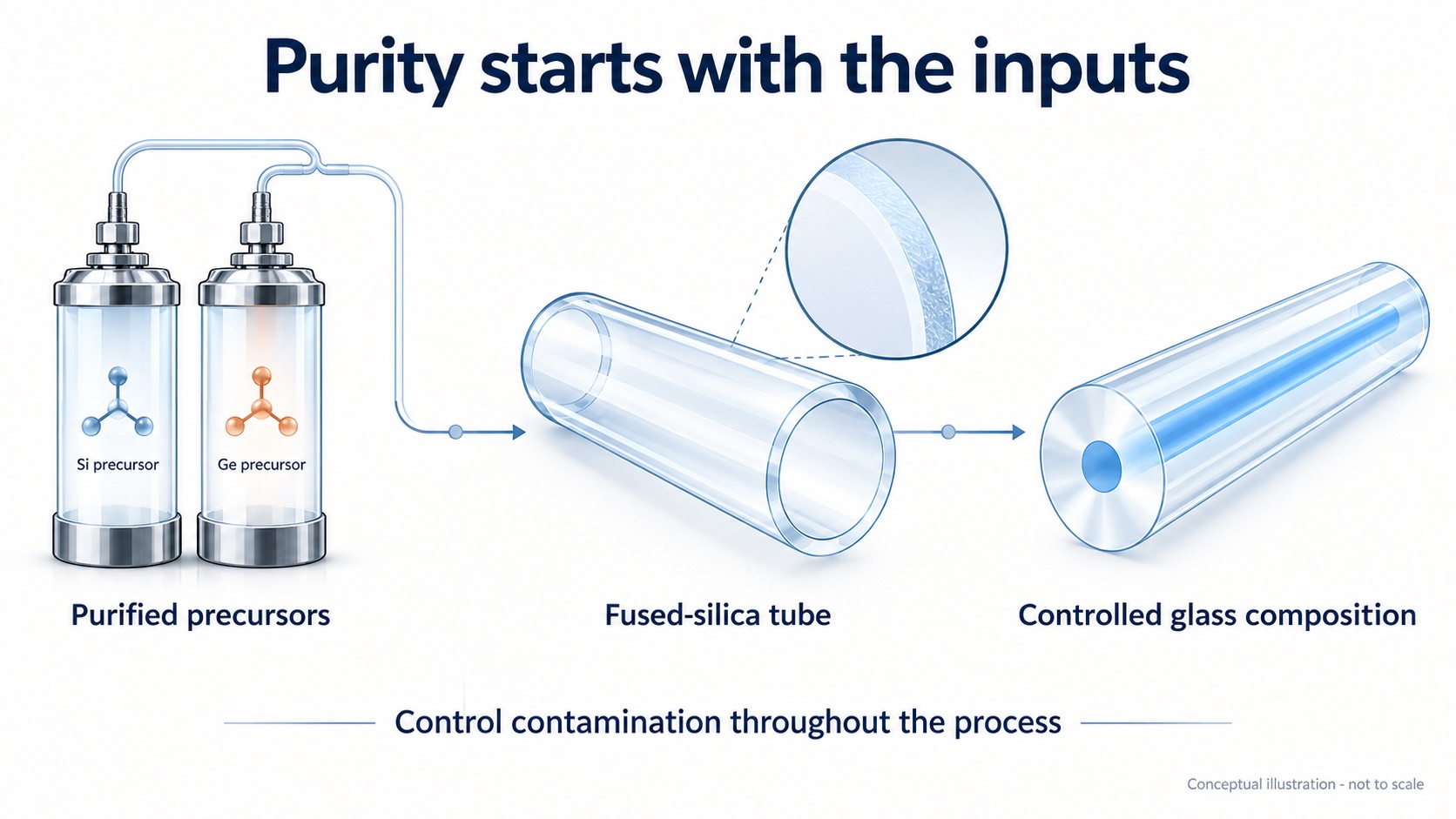
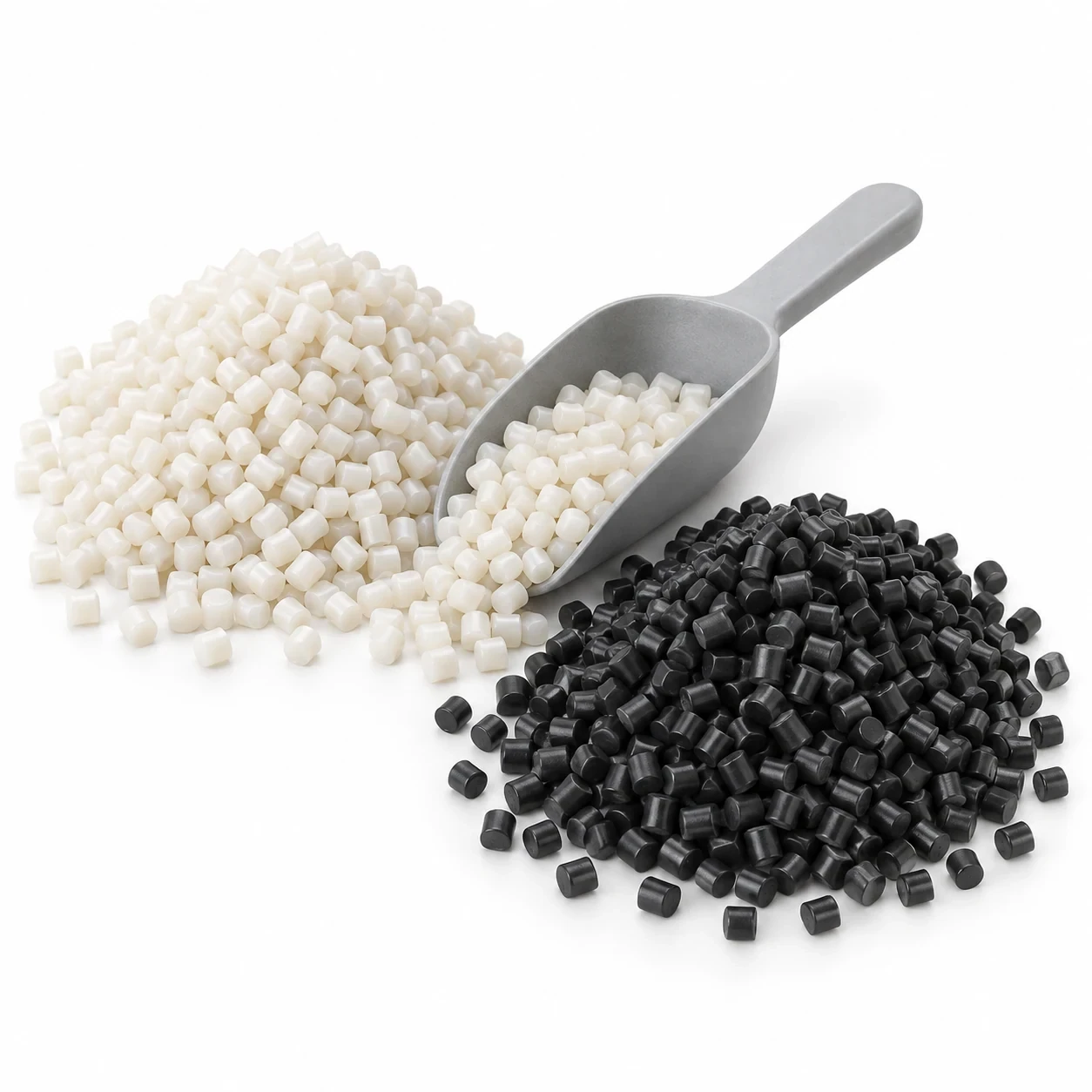
Ilustrasi konseptual mengenai input material dan pengendalian kontaminasi dalam persiapan preform; bukan foto laboratorium.
Raw-material selection and contamination control belong in the project’s quality plan. Request material specifications and batch records from the proposed producer, and confirm how nonconforming batches are handled. Ikhtisar produksi serat optik Heraeus menjelaskan peran komposisi material, geometri, dan profil indeks bias. Persentase kemurnian saja tidak menentukan kinerja serat jadi.
Komponen Kimia Primer
Itu Deskripsi MCVD Universitas Leibniz Hannover identifies SiCl4, GeCl4 and POCl3 as examples of volatile glass-forming precursors. This is not a mandatory ingredient list for every fiber. For each selected chemical, request the supplier’s grade specification, batch certificate and relevant trace-impurity results; the process owner must approve its suitability.
Germanium doping can raise the refractive index of silica, but the finished fiber must be defined by its complete core-and-cladding design. Do not infer numerical aperture or other optical performance from a germanium concentration alone. Confirm the intended refractive-index profile, dopant formulation and applicable measurements with the preform producer.
Proses Reaksi Kimia
In the MCVD route described by Leibniz University Hannover, precursor vapors pass through a fused-silica tube and an external traversing burner initiates glass formation. Particles deposit on the tube’s inner wall. Deposition, consolidation and tube collapse are distinct stages; one generic reaction-temperature range is not an operating specification for all of them.
Require the process owner to define and qualify the temperature and gas-delivery settings for each stage. The production record should identify the recipe version, measured variables, permitted deviations and response to an excursion. Do not adopt an unsourced temperature-change threshold or flow-stability percentage as proof of complete reaction or acceptable fiber.
Persyaratan Kemurnian dan Pengujian
Define impurity limits for the specific input material and intended fiber, not by comparison with another industry. Heraeus’ overview distinguishes hydroxyl-content requirements for UV and infrared transmission, illustrating why application matters. For moisture, metals and other specified impurities, identify the material being tested, concentration units, analytical method and reporting limit. Do not interchange a precursor-gas specification with a finished-glass measurement.
Request the producer’s incoming-material inspection plan, batch certificates and laboratory reports. Ask which analytical methods are used, which contaminants are assessed and how each result is compared with the agreed material specification. Confirm the responsible laboratory and traceability arrangements rather than assuming that the equipment supplier performs these tests.
Gunakan matriks ini untuk menentukan dokumen penerimaan material masuk. Ini bukan spesifikasi kemurnian kimia universal atau prosedur uji laboratorium.
| Masukan untuk memenuhi syarat | Spesifikasi untuk diperoleh | Bukti batch atau pasokan | Acceptance decision |
|---|---|---|---|
| SiCl4, jika digunakan | Grade yang memenuhi syarat dan batas cemaran tertentu dengan satuan | Sertifikat batch, hasil analisis yang relevan, dan batas pelaporan | Pemilik proses menyetujui material untuk resep yang dimaksud |
| GeCl4 atau prekursor dopan lainnya, jika digunakan | Kimia, tingkat, dan batas ketidakmurnian yang dipilih untuk desain serat | Hasil lot yang dapat dilacak menggunakan metode yang sesuai untuk material tersebut | Bandingkan dengan spesifikasi bahan dopan yang telah disetujui |
| O2, if used | Kelas gas dan batas kontaminan yang dipersyaratkan oleh proses | Sertifikat pasokan dan pemeriksaan titik-penggunaan yang disepakati | Verifikasi kondisi pengiriman gas yang ditentukan |
| Gas pembawa atau gas proses, jika digunakan | Identitas gas, kemurnian, dan persyaratan pengiriman untuk rute aktual | Catatan pemasok dan pemeriksaan kondisi jalur yang disepakati | Approve against the process utility specification |
Pertimbangan Penyimpanan dan Penanganan
Before specifying chemical storage, request the current safety data sheets and the chemical supplier’s storage and compatibility requirements. Have the proposed facility design reviewed by qualified personnel. Container materials, atmosphere controls and environmental limits must be established for the actual chemicals and process, not inferred from a generic article.
Require documented procedures for chemical transfer, contamination control, personnel protection and emergency response. Confirm tubing and fitting compatibility, any purge requirements and the applicable training with the responsible process and safety specialists. This overview is not an operating procedure for chemical handling.
Include the required material-handling facilities, inspection work and maintenance in the project scope and cost comparison. Ask for the proposed producer’s contamination-control records, and confirm which safeguards and records are included before comparing quotations.
Bagaimana Anda Membuat Preform Kaca?
Kualitas preform secara langsung memengaruhi karakteristik serat. Pengendapan yang tidak konsisten menyebabkan variasi diameter dan kehilangan optik sepanjang panjang serat.
MCVD deposits glass on the inside wall of a silica tube. OVD builds a porous soot preform around the outside of a target rod before consolidation. These are different fabrication routes; preform dimensions depend on the selected process and equipment.
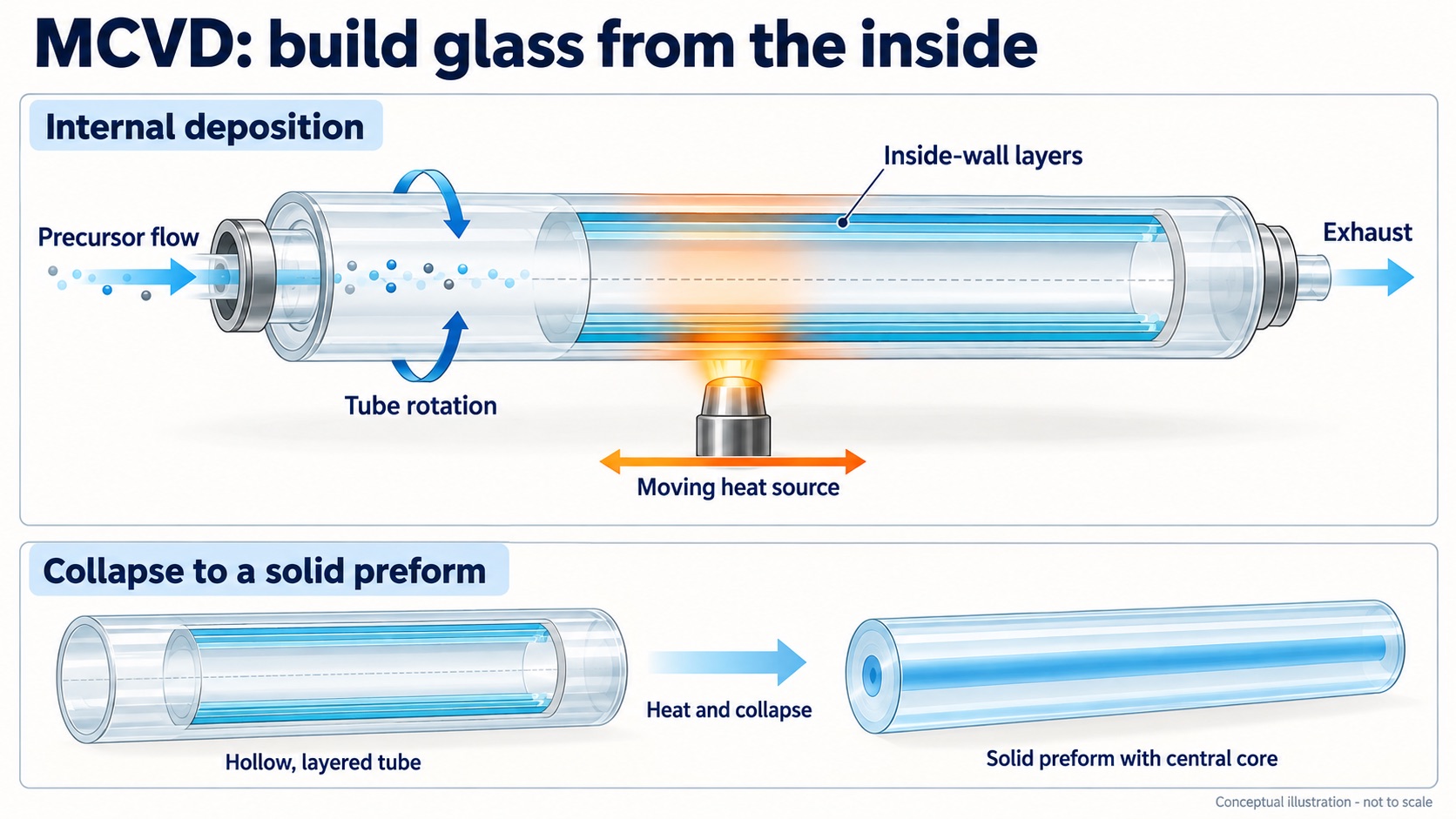
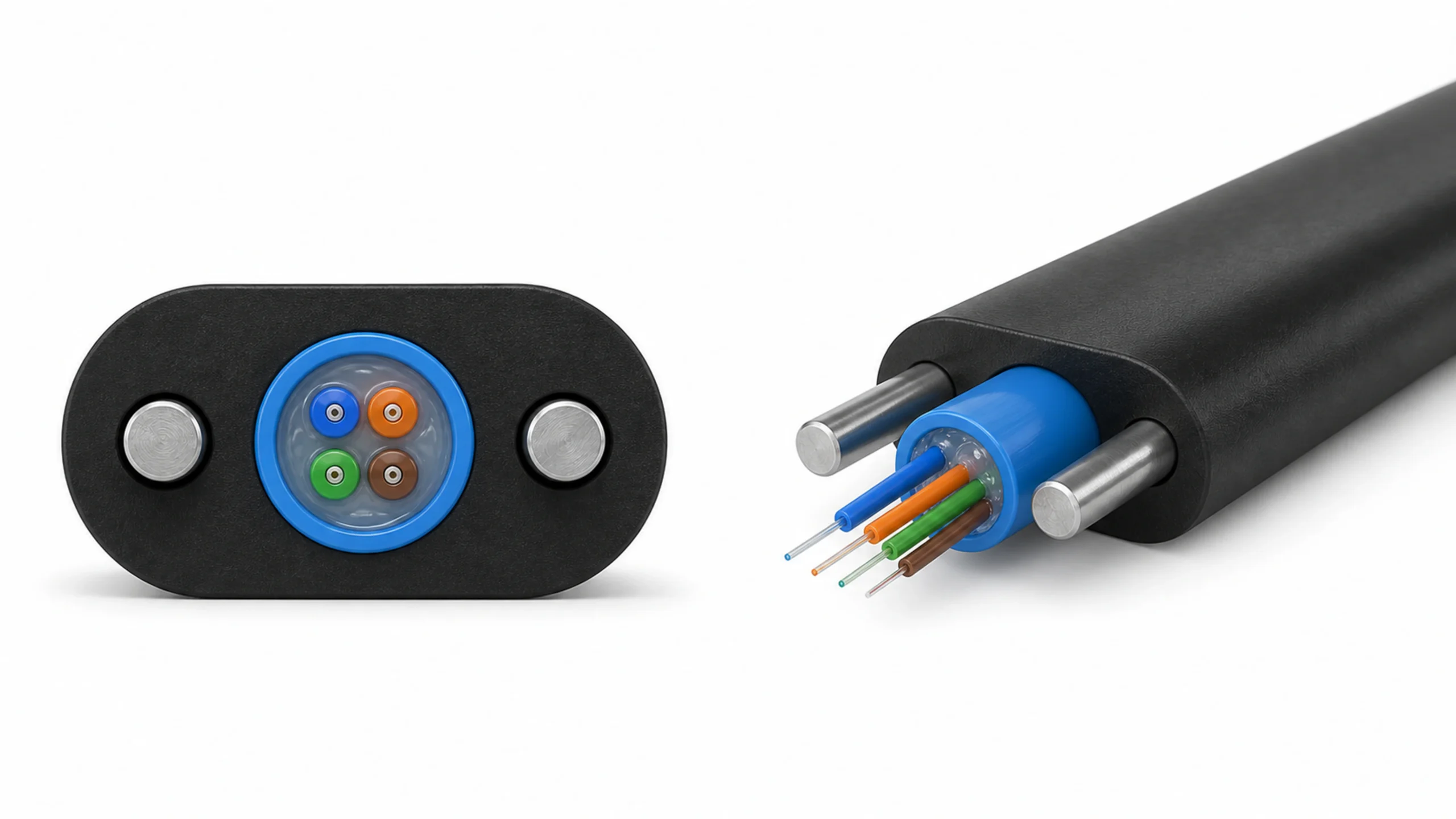
Ilustrasi konseptual MCVD: kaca diendapkan di dalam tabung sebelum diregangkan menjadi preform padat. Tidak sesuai skala.
For a fiber core manufacturing project, confirm whether preforms will be purchased or fabricated as part of the proposed scope. Request the preform specification, inspection records and compatibility requirements for the drawing equipment. Identify the party responsible for preform production separately from the equipment supplier.
Proses Deposisi Uap Kimia Termodifikasi (MCVD)
In the Proses MCVD yang dijelaskan oleh Universitas Leibniz Hannover, precursor gases flow through a fused-silica tube while an external burner travels along it. Glass particles form and deposit on the tube’s inner wall. The gas composition and deposition conditions control the refractive-index profile; tube dimensions must match the specific process and equipment.
For the proposed MCVD lathe and traversing burner, obtain the qualified tube-size range, rotation and traverse settings, alignment requirements and thermal-control method. Identify whether a reported temperature refers to the flame, tube surface or another target. Treat rotation speed and temperature as equipment- and recipe-specific values rather than universal MCVD settings.
Review the gas-delivery sequence and control arrangement for the proposed MCVD process. Require calibrated flow measurement, a documented deposition schedule and traceable process records. The number of passes, deposited-layer dimensions and permitted flow variation must come from the qualified preform design and demonstrated process, not an assumed standard cycle.
The deposition process creates "soot" – submicron glass particles that form in the hot zone and deposit on the inner wall of the tube. The high temperature consolidates these particles into dense, transparent glass as the burner passes over the deposited soot. The consolidation temperature must be carefully controlled to prevent bubble formation while ensuring complete densification.
Proses Deposisi Uap Luar (OVD)
In Penjelasan Corning mengenai Deposisi Uap Luar, partikel kaca halus, yang dikenal sebagai jelaga, menumpuk di sekitar bagian luar target atau "batang umpan." Berbeda dengan MCVD, pengendapan ini tidak terjadi pada dinding dalam tabung substrat.
Successive soot layers build outward around the target. The deposition equipment and dopant delivery must follow the intended preform design. This is an external buildup of soot, not deposition within a hollow tube.
Preform size and production output are equipment-specific. Do not use one diameter or length as a universal OVD capability; confirm the qualified preform range with the process-equipment supplier.
Pada rute yang dijelaskan oleh Corning, batang umpan dilepas sebelum konsolidasi. Selama Tahap konsolidasi OVD, , panas mengubah badan jelaga berpori menjadi kaca transparan yang padat. Kondisi konsolidasi harus mengikuti proses yang telah memenuhi syarat, bukan resep temperatur generik.
Kontrol Kualitas Selama Pembuatan Preform
For thermal monitoring during preform fabrication, specify the actual measurement target and the instrument suitable for it. Ask the supplier to state calibration, measurement uncertainty and relevant operating limitations. A non-contact temperature reading should not be treated automatically as an accurate flame-temperature or glass-temperature measurement.
Ask the preform producer for refractive-index profile measurements and the stated test method. The report should identify the measured preform, instrument, calibration status and acceptance criteria. Agree how out-of-specification results are handled before the preform is released for drawing.
Include preform diameter, concentricity, straightness and roundness in the agreed dimensional inspection plan. Require the supplier to state the measurement method, units and acceptance tolerances for the specified preform and drawing equipment. Do not adopt an unsourced percentage as a universal limit.
Compare MCVD and OVD proposals against the same intended fiber design and supply scope. Route names alone do not establish fixed core diameters, numerical apertures or attenuation limits. Keep preform inspection separate from acceptance of the fiber drawn from it.
| Item untuk dibandingkan | Bukti proposal MCVD | Bukti proposal OVD | Acceptance boundary |
|---|---|---|---|
| Rute deposisi dan tahap yang disediakan | Identifikasi tabung substrat, deposisi internal, dan tahap preform yang disediakan | Identifikasi deposisi jelaga eksternal, konsolidasi, dan tahap preform yang disediakan | Compare equivalent supply stages, not route labels alone |
| Preform geometry | Gambar dan hasil inspeksi untuk preform yang diusulkan | Gambar dan hasil inspeksi untuk preform yang diusulkan | Nyatakan apakah setiap dimensi mengacu pada preform atau serat yang ditarik, dengan satuan |
| Refractive-index profile and fiber design | Profil terukur dan spesifikasi serat target | Profil terukur dan spesifikasi serat target | Agree the profile and any applicable numerical-aperture test separately |
| Konsentrisitas, kelurusan, dan kebulatan | Inspection method, measured results and proposed tolerances | Inspection method, measured results and proposed tolerances | Terapkan gambar preform dan rencana inspeksi yang telah disetujui |
| Finished-fiber optical performance | Hasil yang dapat dilacak dari serat yang ditarik dari preform yang diusulkan | Hasil yang dapat dilacak dari serat yang ditarik dari preform yang diusulkan | Use the selected fiber specification and agreed test conditions, not a generic MCVD/OVD limit |
Optimasi Proses dan Pemecahan Masalah
Require a documented trial plan before changing preform-fabrication parameters. Identify the variables, permitted operating boundaries, measurements and approval responsibilities with the process owner. Keep trial results traceable to the material batch and equipment settings, and record the process owner’s approval.
For a suspected preform defect, first identify the measured feature: interface condition, refractive-index profile or geometry. Compare inspection results with the approved preform design and the corresponding material, deposition and equipment records. A defect name alone does not establish whether contamination, thermal conditions, gas delivery or alignment caused it. Ask the process owner to document the evidence for the proposed cause before changing the recipe.
Request the equipment manufacturer’s preventive-maintenance schedule and calibration requirements. Confirm which burner components, flow controllers and alignment checks are included, who performs each task and what records are required. Agree the maintenance scope before equipment acceptance.
Preform acceptance is one checkpoint, not a guarantee of trouble-free drawing. Link each preform’s inspection record to the drawing run and finished-fiber results so a defect can be investigated across stages. Release the fiber only against the agreed geometry, optical and mechanical requirements.
Peralatan Apa yang Penting untuk Penarikan Serat?
Pilihan peralatan yang salah menyebabkan kegagalan produksi. Sistem penarikan yang tidak memadai menyebabkan serat putus, variasi diameter, dan cacat pelapisan yang membuat produk tidak dapat digunakan.
Specify the drawing system as a complete process: preform feed, furnace, cooling, diameter measurement, coating, curing and take-up. Require the supplier to demonstrate the agreed fiber dimensions and quality at the proposed production speed; a speed figure alone is not an acceptance criterion.
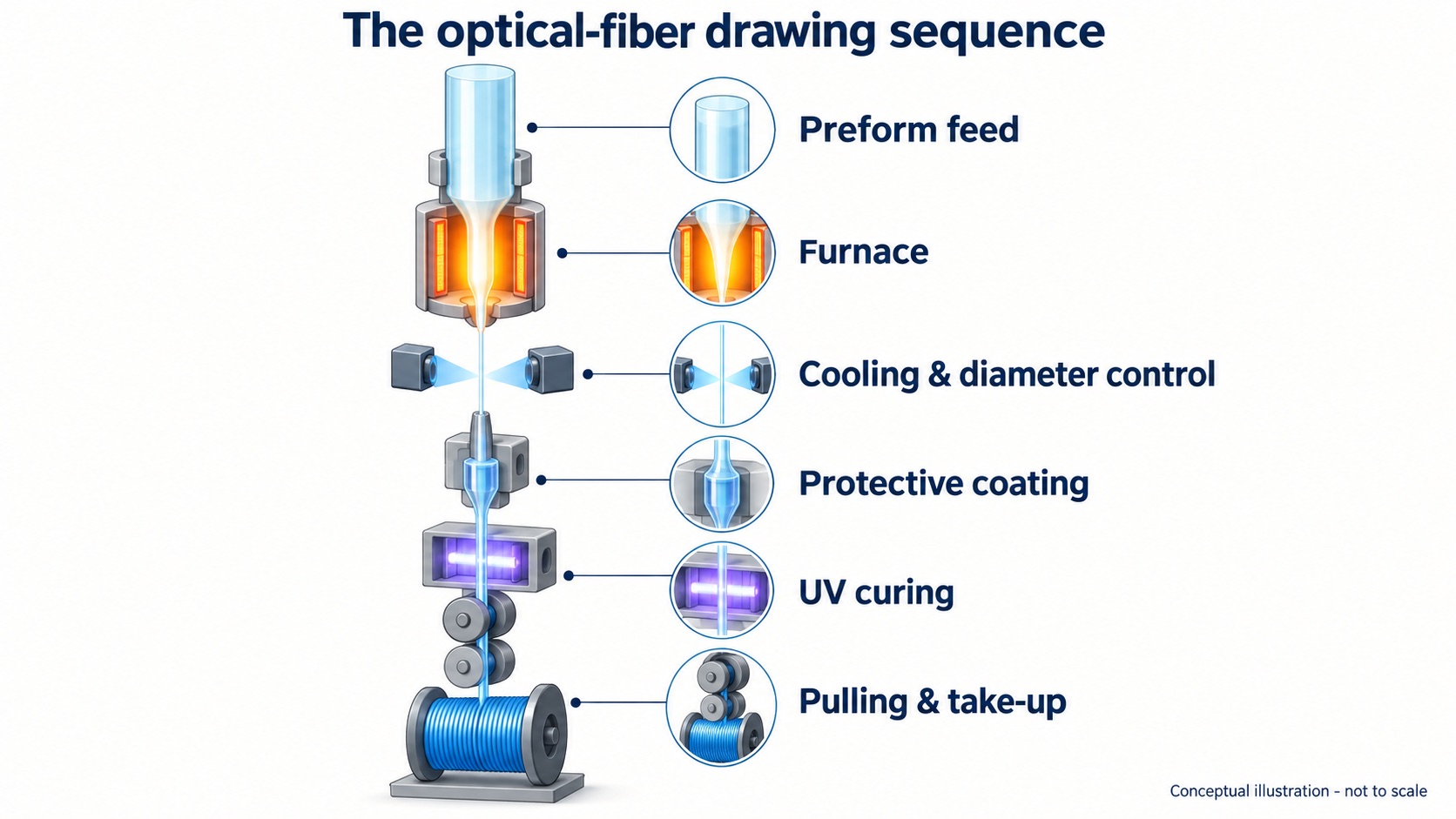
Urutan tahap gambar konseptual, bukan gambar mesin spesifik yang disuplai. Tidak sesuai skala.
Coordinate the interfaces between the preform, drawing equipment and coating system before accepting a line proposal. Record the target fiber type, glass-cladding diameter, coated-fiber outer diameter and test conditions so each supplier works to the same product definition.
Menggambar Struktur dan Desain Menara
When reviewing a menara gambar serat, request the supplier’s layout, structural requirements and vibration-control provisions for the proposed configuration. Confirm the required building height, foundations, service access and utility interfaces from the actual equipment drawings rather than assuming a standard tower size.
Menara ini memiliki beberapa zona, yang masing-masing memiliki fungsi khusus dalam proses penarikan. Bagian atas berisi mekanisme umpan preform dan tungku. Bagian tengah menyediakan ruang untuk pendinginan serat dan pengukuran diameter. Bagian bawah berisi sistem aplikasi pelapisan, oven curing, dan peralatan pengambilan.
Ask the drawing-equipment and coating suppliers to specify the required cleanliness, temperature, humidity and ventilation conditions. Record operating and shutdown requirements in the utility schedule, together with monitoring methods and acceptance limits. Assign responsibility for establishing and maintaining these conditions.
Sistem Tungku Suhu Tinggi
Confirm the furnace heating technology, usable hot zone, preform-size range and qualified operating window with the equipment manufacturer. Furnace dimensions and maximum temperature must come from the proposed equipment specification, not a generic production-line example.
Request the furnace supplier’s temperature-measurement and control specification, including sensor type, calibration, measurement uncertainty and demonstrated control performance. Distinguish a stated controller resolution from verified furnace stability, and agree the acceptance test for the supplied system.
Confirm furnace-gas requirements with the furnace manufacturer and responsible process engineer. The utility specification should identify gas type, quality, flow requirements, monitoring and safety provisions for the actual system. Do not use a generic oxygen limit or gas selection as an approved operating recipe.
For the preform-feed system, request the supported preform dimensions and mass, feed range, positioning performance and coordination with draw control. Agree a test using the intended preform rather than assuming a universal positioning tolerance.
Pengukuran dan Kontrol Diameter
Specify what each gauge measures: bare-glass outer diameter, coated-fiber outer diameter or another defined feature. Request the instrument’s measurement range, accuracy, repeatability, sampling rate and calibration requirements. Do not treat resolution, response time and achieved production tolerance as interchangeable specifications.
Draw speed is one control variable used to regulate bare-glass diameter, but it interacts with preform feed, thermal conditions and tension. Confirm which variables the proposed controller actually adjusts, where the diameter is measured and how transport delay is handled. Require a recorded trial showing diameter and tension together during steady running and approved speed changes; a simple ‘speed up when thick’ rule is not a complete control specification.
Kontrol prediktif dan berbasis pembelajaran harus dianggap sebagai fungsi usulan yang spesifik, bukan fitur standar dari setiap jalur penggambaran. Sebagai contoh, makalah penelitian tersebut Kontrol Dinamis Proses Manufaktur Serat Menggunakan Pembelajaran Penguatan Mendalam reports tests on a compact fiber-drawing system. It does not establish deployment or performance on the production line being quoted. Request the actual control architecture, operating limits and acceptance demonstration for any such claim.
| Parameter | Tentukan dalam proposal | Dasar penerimaan | Bukti yang diminta |
|---|---|---|---|
| Furnace operation | Teknologi pemanasan, zona panas yang dapat digunakan, dan jendela operasi | Pengaturan yang memenuhi syarat untuk preform yang dipilih | Spesifikasi peralatan dan kondisi uji coba yang terekam |
| Diameter kelongsong kaca | Diameter luar kaca telanjang, berbeda dari diameter inti | Target dan toleransi dalam spesifikasi serat yang dipilih | Data pengukur terkalibrasi dan metode inspeksi yang disepakati |
| Kecepatan menggambar | Agreed production speed for the specified fiber | Quality demonstrated at that speed | Catatan uji coba yang menghubungkan kecepatan dengan geometri dan hasil optik |
| Coated-fiber outer diameter | Diameter di atas lapisan yang telah mengeras, bukan ketebalan lapisan radial | Target dan toleransi untuk desain pelapisan yang dipilih | Hasil diameter dan konsentrisitas dari pengujian yang disepakati |
Sistem Aplikasi Pelapisan
Sistem pelapisan menerapkan lapisan polimer pelindung pada serat kaca polos segera setelah terbentuk. Pelapisan harus diterapkan secara konsentris dan seragam untuk mencegah kerusakan akibat tekukan mikro dan memberikan perlindungan mekanis. Sebagian besar sistem menggunakan aplikator cetakan bertekanan yang memaksa bahan pelapis cair di sekitar serat.
The primary coating is the polymer layer next to the glass. Confirm its material, cured outer diameter and acceptance requirements in the qualified coating design. Do not assume a fixed radial thickness for every optical-fiber product.
The secondary coating surrounds the primary layer. Distinguish its outer diameter from the thickness of either layer. For concentric circular layers, total radial coating thickness = (coated-fiber outer diameter – glass-cladding diameter) / 2. This relation alone does not determine how the thickness is divided between primary and secondary coatings.
Untuk contoh spesifik produk, Corning’s SMF-28 Ultra product sheet, July 2025, page 2 lists a glass-cladding diameter of 125.0 ± 0.7 μm and coated diameters of 242 ± 5 μm or 200 ± 5 μm, depending on the option. Using nominal diameters gives combined radial coating thicknesses of 58.5 μm and 37.5 μm respectively. These are calculated examples for that product, not universal coating recipes or HONGKAI equipment guarantees.
Request the proposed coating-concentricity measurement method and die-alignment procedure, with acceptance limits tied to the specified fiber and coating system. Keep geometry checks and optical-performance tests separate: a concentricity result alone does not establish the fiber’s polarization-mode-dispersion performance.
Sistem Pengeringan UV
Sistem pengawetan ultraviolet mempolimerkan lapisan akrilat cair menjadi lapisan pelindung yang padat. Proses pengawetan harus tuntas dan seragam untuk memastikan sifat pelapisan yang tepat. Pengawetan yang tidak tuntas dapat menyebabkan permukaan lengket dan sifat mekanis yang buruk.
Pengawetan lapisan serat tidak terbatas pada satu teknologi lampu. Catatan aplikasi pengawetan serat UV-LED Excelitas describes conventional arc/microwave lamp systems and UV LED systems, and stresses testing the coating with the selected light source. Ask the coating and equipment suppliers to qualify the spectral match, exposure, optical arrangement and thermal conditions at the proposed line speed; lamp layout alone does not prove uniform cure.
If the proposed curing system uses nitrogen inerting, obtain the required gas specification, chamber conditions, monitoring and alarm limits from the coating and curing-equipment suppliers. Verify the cured coating against an agreed test method. Nitrogen supply alone is not evidence that the coating has reached its required cure state.
Sistem Kontrol Ketegangan dan Pengambilan
Tension control throughout the drawing process is essential for consistent fiber properties. Excessive tension can cause fiber breaks or diameter variations, while insufficient tension can lead to loose winding and handling problems. Agree the drawing-tension range, force units, measurement method and acceptance conditions for the actual fiber and drawing system.
For the capstan system, request the drive-control specification, fiber-contact surface details and maintenance requirements. Ask the supplier to demonstrate the proposed speed-control performance and fiber-handling results under agreed test conditions rather than relying on an unsupported accuracy figure.
Take-up systems wind the finished fiber onto spools for storage and shipping. The winding pattern must prevent fiber damage while allowing easy unwinding for subsequent processing. Confirm the traverse mechanism, winding pattern and take-up tension requirements with the supplier, then verify the result using the agreed spool and fiber specification.
If the take-up uses a dancer, confirm its loading method, usable travel, position feedback and connection to reel-speed control. Verify winding tension during acceleration, steady running and spool build-up with the intended fiber and reel. A dancer’s presence does not guarantee constant tension, and take-up tension must not be confused with the tension measured in the hot drawing zone.
Bagaimana Anda Mengontrol Kualitas Serat Selama Produksi?
Kontrol kualitas mencegah cacat produksi yang mahal. Tanpa pemantauan yang tepat, seluruh proses produksi dapat gagal memenuhi persyaratan spesifikasi, yang mengakibatkan kerugian material dan waktu yang signifikan.
Use a quality plan that separates inline process measurements from optical and mechanical acceptance tests. Define each measured feature, test method, inspection frequency and acceptance limit; inline diameter feedback alone does not verify every finished-fiber requirement.
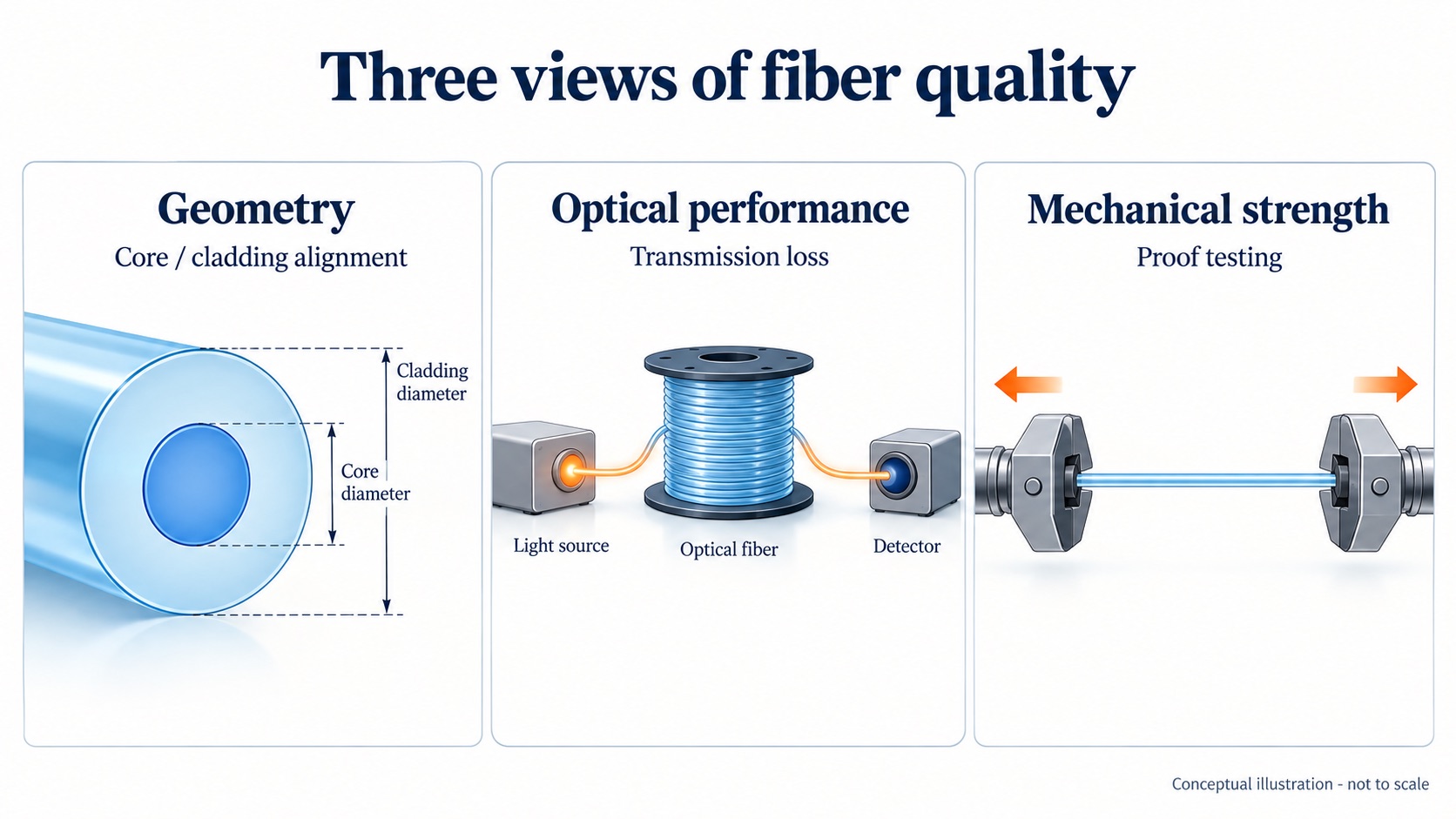
Ilustrasi konseptual mengenai pemeriksaan geometri, optik, dan mekanis; tidak ditampilkan hasil pengukuran uji.
Define the fiber-production quality plan before accepting the equipment. Identify the measurements, inspection frequency, acceptance criteria and responsibility for nonconforming material at each stage. Request sample records from the proposed producer and agree which checks are included in the supplied scope.
Pemantauan Proses Waktu Nyata
For each inline measurement, record the sensor principle, accuracy, sampling rate, filtering and position on the line. Ask the supplier to demonstrate which defects the complete measurement-and-control system can detect at the proposed draw speed. Do not infer a minimum detectable defect length or closed-loop response from the gauge resolution alone.
For coating inspection, ask whether the proposed instrument reports coated outer diameter, concentricity or individual-layer geometry. An outer-diameter reading alone does not establish the separate primary and secondary layer thicknesses. Document which features are measured, the calibration method and how the results are checked against the selected coating design.
Jangan mengasumsikan bahwa setiap pengukuran tegangan tarik gambar menggunakan sel beban. Deskripsi SIKORA mengenai pengukuran tegangan serat optik discusses vibration-based measurement and a birefringence-based optical method. Confirm the proposed instrument, measurement location, units and validation procedure. Define separately whether its signal is displayed, logged, used for an alarm or connected to an automatic control loop; measurement alone does not prove automatic break prevention.
List the thermal and environmental measurements actually included in the proposed line, such as fiber temperature before coating and conditions in the coating or curing area. Identify each measurement target, sensor, logging interval and alarm boundary. Verify any thermal-imaging or contamination-monitoring function explicitly rather than assuming it is supplied with the tower.
Pengujian Properti Optik
Pilih metode uji redaman yang sesuai dengan serat dan laporan yang diminta. The IEC 60793-1-40:2024 attenuation-method overview lists cut-back, insertion-loss and backscattering methods, as well as spectral modelling with a narrower scope. Record the selected method, test wavelengths, launch conditions, sample identification and acceptance limits; do not assume every production test uses cut-back.
Untuk serat multimode, tentukan metrik bandwidth yang diperlukan dan kondisi peluncuran. IEC 60793-1-41:2024 distinguishes time-domain, frequency-domain and DMD-derived overfilled-launch bandwidth methods. IEC 60793-1-49:2018 describes DMD characterization of graded-index multimode fiber for bandwidth assessment under different launch conditions. Do not describe a DMD report as a direct refractive-index-profile measurement. Ask the laboratory to identify the fiber category, wavelength, method and reported bandwidth metric.
Bedakan bukaan numerik yang diukur dari nilai yang dihitung menggunakan indeks bias. The IEC 60793-1-43:2015 overview covers specified multimode-fiber categories and distinguishes far-field numerical aperture from theoretical numerical aperture. Ask the laboratory to state the applicable fiber category, sample length, measurement threshold and uncertainty. Do not use a numerical-aperture result as a substitute for a required single-mode cutoff-wavelength test.
Untuk serat mode tunggal, tentukan metode pengujian diameter medan mode (MFD) dan panjang gelombang pelaporan secara bersamaan. IEC 60793-1-45:2024 addresses MFD measurement. Compare results with the selected fiber specification at the same stated wavelength; do not treat an MFD value without its wavelength as a complete acceptance requirement.
Pengujian Sifat Mekanik
Proof testing applies a specified tensile stress to screen fiber for weak sections. As one documented example, section 1.4 of Spesifikasi serat PGSF001 Corning menetapkan minimal 100 kpsi (approximately 0.69 GPa) for the fibers covered by that document. Here, 100 kpsi means 100,000 psi. Use the applicable fiber specification and test procedure for the product being manufactured.
Coating adhesion testing verifies that the polymer coatings bond properly to the glass surface and to each other. Poor adhesion can lead to coating delamination during handling or environmental exposure. Request the applicable coating-adhesion and stripping test procedures, reported results and acceptance criteria from the fiber producer.
Pengujian tekukan mengevaluasi ketahanan serat terhadap kerugian akibat tekukan makro dan tekukan mikro. Pengujian tekukan makro melilitkan serat di sekitar mandrel dengan berbagai diameter untuk mensimulasikan kondisi pemasangan. Pengujian tekukan mikro menerapkan tekanan lateral yang terkontrol untuk meniru efek produksi kabel dan tekanan lingkungan.
Pengujian lingkungan memaparkan sampel serat pada siklus suhu, paparan kelembapan, dan lingkungan kimia yang mungkin ditemui dalam layanan. Pengujian ini membantu memprediksi keandalan jangka panjang dan mengidentifikasi potensi mode kegagalan sebelum terjadi di lapangan.
Use the following planning matrix to agree the product-specific quality plan. A measurement standard defines how a test is performed; it is not, by itself, a universal product limit or a sampling plan. Adapt the wavelength rows to the selected fiber rather than applying them to every fiber type.
| Test parameter | Metode untuk menentukan | Cakupan atau pengambilan sampel harus disepakati | Dasar penerimaan |
|---|---|---|---|
| Attenuation at 1310 nm, if specified | Applicable method under IEC 60793-1-40:2024 | Ditetapkan dalam rencana kualitas produk | Kerugian maksimum untuk serat yang dipilih pada panjang gelombang ini |
| Attenuation at 1550 nm, if specified | Applicable method under IEC 60793-1-40:2024 | Ditetapkan dalam rencana kualitas produk | Kerugian maksimum untuk serat yang dipilih pada panjang gelombang ini |
| MFD single-mode pada panjang gelombang yang dinyatakan | Applicable method under IEC 60793-1-45:2024 | Ditetapkan dalam rencana kualitas produk | Nilai nominal dan toleransi pada panjang gelombang yang sama tersebut |
| Uji bukti | IEC 60793-1-30:2010 fibre proof-test procedure | Panjang yang diuji dan catatan gulungan yang dapat dilacak | Tingkat tegangan dan aturan penerimaan dari spesifikasi serat yang dipilih |
| Coated-fiber outer diameter | Metode uji dimensi yang disepakati | Ditetapkan dalam rencana kualitas | Target dan toleransi dari spesifikasi serat/lapisan yang dipilih |
Kontrol Proses Statistik
Statistical process control (SPC) can help identify changes in recorded process measurements. NIST’s control-chart guidance explains that both points outside control limits and non-random patterns can warrant investigation. Control limits describe process behavior; they are not the product’s specification limits. A stable process can still produce nonconforming fiber. For the proposed quality system, identify the measured feature, chart type, sampling method, investigation rules and responsible person. Confirm whether alerts are actually implemented; a chart alone does not prevent defects or release a spool for shipment.
Before interpreting Cp or Cpk, establish that the process is stable and that the data and calculation method are suitable. NIST’s process-capability overview compares stable-process variation with specification limits and states the normal-distribution assumption of the conventional indices. Cp compares specification width with process spread; Cpk also accounts for an off-center process mean. Ask for the underlying measurements, units, sampling period, specification limits and statistical assumptions, not just an index on a dashboard. Agree any required capability criterion for the project; do not substitute an unsourced universal threshold for the fiber’s acceptance tests.
Design of experiments (DOE) techniques help optimize process parameters and understand the relationships between different variables. For any proposed optimization trial, agree the factors, response measurements and permitted operating boundaries with the process owner, and require a traceable report of the results.
Correlation analysis helps identify relationships between different measurements that might not be obvious. Treat a measured correlation as a finding to investigate, not proof of a causal relationship or a guaranteed process improvement.
Sistem Mutu Otomatis
For an automated quality-control proposal, require a list of measured inputs, controlled outputs, alarm actions and operator responsibilities. Ask the supplier to demonstrate each promised feedback or predictive function on the proposed system. Do not assume that machine-learning prediction or automatic defect prevention is included in a standard drawing line.
Specify which process and test data will actually be recorded, with timestamps, length or spool references, retention and export requirements. Check a sample production record before acceptance; an automation interface does not establish that every quality parameter is captured or traceable.
Ask the supplier to demonstrate how an out-of-specification segment is identified, located, segregated and documented. State whether handling requires stopping, cutting, transfer or later rewinding, and define the restart and retest procedure. Do not assume defective fiber can be removed while drawing continues without interruption.
If ERP or other factory-system integration is required, define the data fields, spool identifiers, interfaces, access rights and responsibility for failed transfers. Test a sample record from measurement through export and retrieval before acceptance. An available interface does not by itself establish end-to-end traceability or regulatory compliance.
Apa Saja Masalah Umum dalam Manufaktur dan Solusinya?
Masalah produksi dapat menghentikan seluruh lini produksi. Masalah yang tidak terselesaikan menyebabkan kerusakan peralatan, pemborosan material, dan komitmen pengiriman yang tidak terpenuhi yang merusak hubungan dengan pelanggan.
Putusnya serat, variasi diameter, dan cacat lapisan memerlukan pemecahan masalah secara sistematis serta protokol perawatan preventif untuk menjaga konsistensi kualitas produksi.
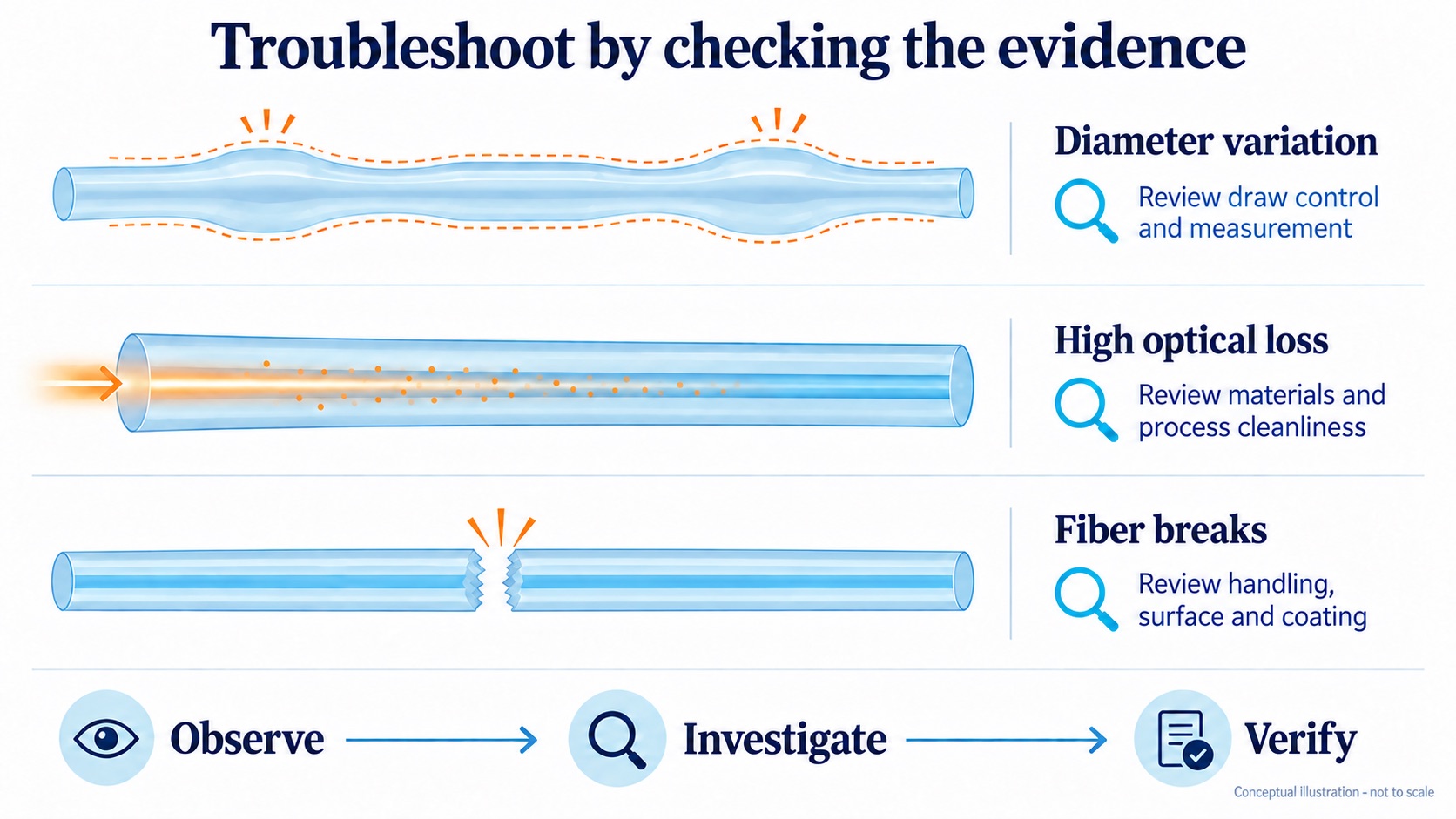
Ilustrasi pemecahan masalah secara konseptual. Pemeriksaan yang tercantum merupakan petunjuk investigasi, bukan penyebab yang telah dikonfirmasi atau perbaikan yang dijamin.
Use production records, alarms, inspection results and supplier procedures to investigate fiber-manufacturing problems. Establish the observed symptom and operating conditions before proposing a cause. Follow the applicable manufacturer’s safety and maintenance instructions before making adjustments.
Masalah Putusnya Serat
Fiber breaks represent one of the most common and disruptive problems in fiber manufacturing. These breaks can occur at any point in the drawing process, from the furnace exit to the take-up reel. Understanding the different types of breaks and their causes is essential for effective troubleshooting.
For a break near the furnace exit, preserve the time, preform identity, break location and preceding thermal, feed and tension records. Review relevant preform inspections and furnace alarms with the process owner. Do not diagnose ‘thermal shock’ or contamination solely from the break location. Inspection of the furnace or hot-zone components must follow the manufacturer’s safe shutdown and maintenance procedure.
For a suspected tension-related break, compare the tension trace with capstan speed, dancer position, reel events and the recorded break time. First confirm the measurement location and signal validity. A tension change after the fiber has broken may be a consequence, not its cause. Have qualified personnel review the evidence before changing control settings or inspecting the fiber path.
If breaks appear near coating or downstream handling equipment, retain representative samples and record their position relative to dies, guides, capstan and take-up. Check the applicable coating-geometry, cure, adhesion and mechanical-test results with the suppliers. Neither an eccentric coating nor a tacky surface alone proves the failure mechanism; compare the findings with the actual break evidence.
Masalah Kontrol Diameter
Variasi diameter dapat membuat serat tidak dapat digunakan untuk aplikasi presisi. Variasi ini dapat terjadi pada jarak pendek (mikrovariasi) atau jarak jauh (makrovariasi), yang masing-masing memerlukan pendekatan pemecahan masalah yang berbeda.
Compare a diameter excursion with the identified preform, feed position and preform inspection records, but do not assume that a preform dimension transfers directly into the finished-fiber diameter. The drawing process and its control response also matter. Confirm the measured feature and units before comparing preform geometry, glass-cladding diameter or core geometry.
When investigating thermal conditions, compare the diameter trace with the furnace setpoint, measured temperature, power and relevant utility records. Distinguish the controller reading from the actual temperature of the glass. Check timing and measurement limitations before assigning a thermal cause or approving a recipe change.
For a suspected control problem, compare commanded and measured speed with the raw and filtered diameter signals. Ask the controls specialist to check sensor validity, delay, output limits and interactions between loops. Do not begin with arbitrary PID changes; use the approved trial procedure and retain before-and-after records.
If the diameter signal is periodic, compare its timing with known equipment cycles and environmental measurements. Check whether the pattern is present in an independent measurement or is an artefact of the gauge, filtering or sampling. A frequency match is an investigation lead, not proof that vibration or airflow caused the product defect.
Gunakan matriks diagnostik ini untuk mengumpulkan bukti sebelum memilih intervensi. Pemeriksaannya bukan penyebab yang telah dikonfirmasi atau instruksi operasional universal.
| Observed symptom | Bukti yang harus disimpan | Pemeriksaan awal dengan spesialis yang bertanggung jawab | Recovery evidence |
|---|---|---|---|
| Putusnya serat | Lokasi putus, waktu, identitas preform/spool, dan sinyal sebelumnya | Validasi jejak tegangan dan korelasikan dengan peristiwa termal, umpan, dan penanganan | Persetujuan restart ditambah hasil geometri, mekanis, dan optik yang diperlukan untuk material yang terdampak |
| Variasi diameter | Jejak pengukuran mentah, satuan, catatan kecepatan/laju pakan, dan waktu kejadian | Validasi pengukur dan pisahkan artefak pengukuran dari perubahan proses sebelum melakukan penyetelan | Agreed diameter tolerance demonstrated under the documented trial conditions |
| Cacat pelapisan | Samples, material lot, coating geometry, curing and handling records | Periksa geometri yang ditentukan dan uji pematangan; tinjau perataan dan paparan hanya dalam prosedur pemasok | Results meeting the selected coating specification, with traceability to the trial |
| Peningkatan redaman | Test method, wavelength, sample identity, launch conditions and handling history | Confirm the test setup and repeatability before investigating material or process causes | Hasil yang dapat diulang sesuai spesifikasi serat dan disposisi terdokumentasi dari gulungan yang terdampak |
Masalah Aplikasi Pelapisan
Cacat pelapisan dapat memengaruhi sifat optik dan mekanis serat yang telah selesai. Masalah ini sering kali berkembang secara bertahap, sehingga deteksi dini sangat penting untuk mencegah sejumlah besar produk cacat.
For a coating-dimension change, establish whether the measurement concerns total coated diameter, an individual layer or concentricity. Compare the validated trace with coating pressure, material temperature, lot history and die inspection records. The rate of change alone does not distinguish die wear from pressure, material or measurement issues.
When coating concentricity is outside the agreed limit, inspect fiber centering, die alignment and the measurement setup using the supplier’s procedure. Record the geometry results and perform any required optical tests separately. Do not diagnose polarization-mode dispersion from coating eccentricity alone.
For a suspected cure problem, record the coating formulation and lot, light-source type, exposure conditions, line speed and any specified inerting conditions. Compare the agreed cure and mechanical tests with the qualified coating process. A tacky surface or brittle sample is a symptom, not a complete diagnosis. Do not prescribe more UV exposure or attribute cracking to excessive cure without the coating supplier’s assessment.
When adhesion or stripping results are out of specification, confirm the test method and sample conditioning before comparing material, surface-handling and cure records. Ask the coating supplier to assess retained samples. Record the evidence and disposition rather than assuming contamination or material degradation is the cause.
Pendekatan Pemecahan Masalah Sistematis
Effective troubleshooting requires a systematic approach that considers all possible causes and uses data to guide the investigation. Start by reviewing when the problem began, the recorded operating conditions and any changes made before the symptom appeared.
Analisis data memainkan peran penting dalam mengidentifikasi pola masalah. Grafik tren dapat mengungkap perubahan bertahap yang mungkin tidak terlihat dari pengukuran individual. Analisis korelasi dapat mengidentifikasi hubungan antara berbagai parameter yang menunjukkan akar penyebabnya.
Use batch comparisons to narrow the investigation, not to assign blame. If an excursion occurs with one preform batch, check whether recipe, operator, instrument, equipment or environmental conditions also changed. Compare equivalent runs and record which alternative explanations the evidence actually excludes.
A fishbone diagram or five-why review can organize hypotheses, but the diagram is not proof of root cause. Assign an owner to each check, document supporting and conflicting evidence, and verify the approved corrective action against the agreed acceptance criteria. Continue monitoring after restart; one successful trial does not guarantee that the problem cannot recur.
Strategi Pemeliharaan Preventif
Program pemeliharaan preventif membantu menghindari banyak masalah produksi umum dengan mengatasi masalah potensial sebelum menyebabkan gangguan produksi. Program ini harus didasarkan pada rekomendasi produsen peralatan, data kegagalan historis, dan persyaratan proses.
Aktivitas perawatan terjadwal meliputi kalibrasi sistem pengukuran secara berkala, penggantian komponen yang aus, dan pembersihan area kritis. Jadwal perawatan harus mempertimbangkan interval waktu dan penggunaan untuk mengoptimalkan keandalan peralatan.
Teknik pemantauan kondisi dapat mengidentifikasi masalah yang berkembang sebelum menyebabkan kegagalan. Analisis getaran dapat mendeteksi keausan bantalan atau masalah penyelarasan. Pencitraan termal dapat menemukan masalah kelistrikan atau masalah sistem pendingin. Analisis oli dapat mengungkap keausan internal dalam sistem hidrolik atau pelumasan.
Manajemen inventaris suku cadang memastikan bahwa komponen penting tersedia saat dibutuhkan untuk perawatan atau perbaikan darurat. Inventaris harus mencakup item perawatan rutin dan suku cadang yang diperlukan yang dapat menyebabkan waktu henti yang lama jika tidak tersedia.
Program pelatihan memastikan bahwa operator dan personel pemeliharaan memahami prosedur yang tepat dan dapat mengenali tanda-tanda awal munculnya masalah. Pembaruan pelatihan rutin membantu mempertahankan keterampilan dan memperkenalkan teknik atau teknologi baru.
Sistem dokumentasi melacak aktivitas pemeliharaan, riwayat masalah, dan tren kinerja peralatan. Informasi ini membantu mengoptimalkan jadwal pemeliharaan, mengidentifikasi masalah yang berulang, dan mendukung upaya perbaikan berkelanjutan.
Kesimpulan
Pembuatan inti serat yang sukses memerlukan pengendalian yang cermat terhadap bahan, peralatan, dan proses di seluruh rantai produksi.
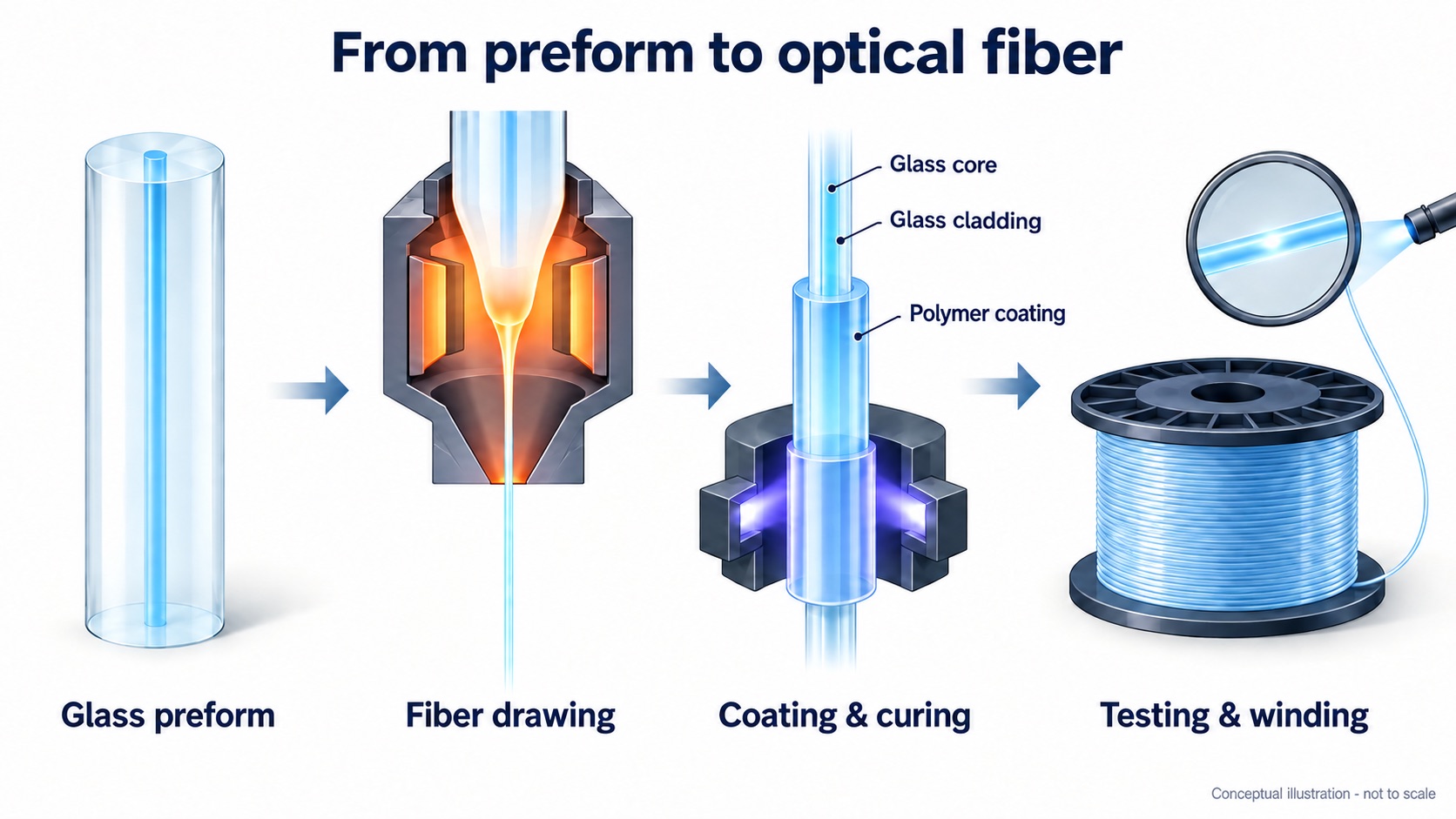
Ilustrasi konseptual tahapan utama pembuatan serat optik; tidak sesuai skala.

 English
  हिन्दी
  فارسی
فارسی