


A fiber optic cable factory can buy tensile, crush, impact, bending, environmental and optical test equipment and still fail a customer audit. The missing element is often not another machine. It is a signed test plan that connects the cable construction, applicable specification, test method, acceptance limit and recorded evidence.
Factory owners, production managers and technical procurement teams should select a fiber optic cable test laboratory from the approved product scope backward. First identify what is being accepted, then name the governing product requirement, current test method, specimen and conditioning rules, pass/fail limit, measuring equipment and required record. IEC, TIA and ISO/IEC documents cover different objects and cannot be treated as interchangeable certificates.

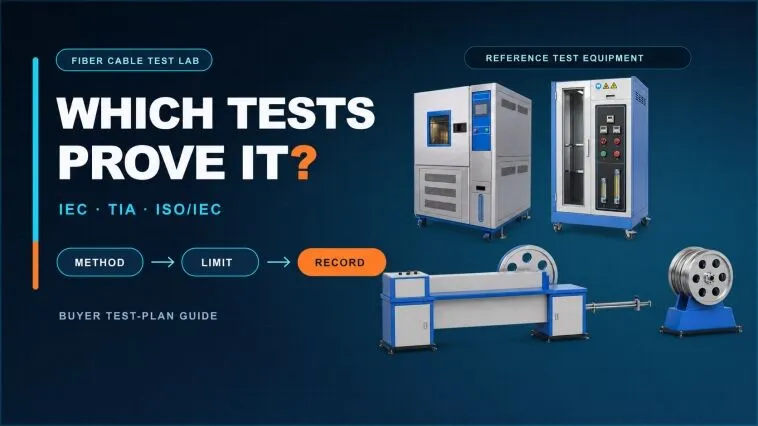
Reference test-equipment images from a HONGKAI optical-cable mechanical-performance equipment proposal. The final fixtures, ranges, methods and acceptance limits must be confirmed for the signed cable specification.
This guide explains how to convert fiber testing standards into a laboratory scope, equipment requirement and FAT evidence package. It does not publish universal loads, wavelengths, cycle counts or pass limits because those values depend on the product specification, cable construction, customer contract and current edition of the selected method.
Đầu tiên, xác định rõ những gì đang được chấp nhận
The phrase “fiber test” is incomplete until the buyer identifies the object under acceptance. Bare optical fiber, finished cable, a connectorized assembly, an installed link and a testing machine require different standards and different evidence.
A cable factory normally receives qualified optical fiber and other materials, transforms them through coloring, buffering, stranding and sheathing, and releases a finished cable on a reel. A vertically integrated project may cover more stages, but the acceptance boundary must still be explicit.
| Acceptance object | Quyết định của người mua | Bằng chứng thuộc về ranh giới này | Bằng chứng không thay thế được nó |
|---|---|---|---|
| Sợi quang đầu vào hoặc vật liệu khác | Tài liệu từ nhà cung cấp đã đủ chưa, hay cần phải xác minh đầu vào? | Thông tin định danh vật liệu, khả năng truy xuất lô hàng, chứng chỉ nhà cung cấp và các kiểm tra đầu vào đã thỏa thuận | Báo cáo kéo hoặc ép cáp thành phẩm |
| Cáp quang thành phẩm | Yêu cầu nào về kết cấu, ứng dụng và sản phẩm được áp dụng? | Kích thước, hồ sơ quang học và các bằng chứng cơ học, môi trường hoặc cháy được quy định | An ISO 9001 certificate by itself |
| Bộ dây cáp có đầu nối | Giao diện đầu nối, cực tính và các phép thử lắp ráp hoàn chỉnh nào được áp dụng? | Hồ sơ kiểm tra đầu nối, hình học, cực tính/kênh và quang học khi cần thiết | Chỉ riêng một bản ghi suy hao cáp cơ sở |
| Hệ thống cáp đã lắp đặt | Liên kết hoặc hiệu suất kênh nào phải được chứng minh sau khi lắp đặt? | Hồ sơ kiểm tra hệ thống đã lắp đặt được thực hiện bằng phương pháp tham chiếu quy định | Chỉ các thử nghiệm kiểu cáp tại nhà máy |
| Máy thử hoặc phòng thí nghiệm | Thiết bị có thể tái tạo phương pháp yêu cầu và lưu giữ dữ liệu kiểm toán được không? | Thiết bị cố định, phạm vi, điều khiển, trạng thái hiệu chuẩn, hồ sơ phần mềm và chạy mẫu được chứng kiến | Một brochure máy chỉ nêu tên một dòng tiêu chuẩn |
Sự tách biệt này ngăn ngừa một lỗi mua sắm phổ biến: yêu cầu một máy OTDR, một thiết bị kiểm tra lực kéo hoặc một “phòng thí nghiệm IEC tổng quát” duy nhất để chứng minh mọi giai đoạn. HONGKAI tổng quan dây chuyền sản xuất cáp quang cho thấy lý do vì sao các giai đoạn quy trình và bằng chứng về cáp thành phẩm nên được lập kế hoạch cùng nhau nhưng được nghiệm thu riêng biệt.
Decision criterion: Write a one-line acceptance statement before selecting equipment: “This test releases [named object] against [named requirement] using [method and edition], with [pass/fail source] recorded in [required report].” Any blank field is a procurement question, not a detail to resolve after installation.
Xây dựng Bộ đặc tả kỹ thuật trước khi chọn thiết bị
A test method explains how to perform a test; it does not automatically define which cable must be tested or what value constitutes a pass. The buyer needs a complete specification stack from the approved cable application down to the final record.
The generic IEC 60794-1-1 document establishes broad requirements for optical fibre cables and cable elements.1 IEC 60794-1-2 provides general requirements, methodology guidance and an overview of the test methods in the IEC 60794-1 series.2 Không được sao chép bất kỳ tài liệu nào vào báo giá như một chứng chỉ thông hành phổ quát mà không kèm theo các yêu cầu sản phẩm áp dụng và giới hạn hợp đồng tương ứng.
| Specification layer | Điều mà nó quyết định | Những gì cần được ghi lại trong RFQ hoặc kế hoạch thử nghiệm |
|---|---|---|
| Yêu cầu của khách hàng và ứng dụng | Nơi cáp sẽ được sử dụng và những rủi ro nào là quan trọng | Mã cáp, kết cấu, môi trường lắp đặt, điều kiện vận hành và đặc tả của khách hàng |
| Product requirement | Những đặc tính và phép thử định mức nào áp dụng cho dòng cáp đó? | Tham chiếu đầy đủ tài liệu, ấn bản, điều khoản, sửa đổi và bất kỳ sai lệch nào của khách hàng |
| Phương pháp thử nghiệm | Cách chuẩn bị, lắp đặt, xử lý điều kiện và đo mẫu thử | Tham chiếu phương pháp hiện hành, chiều dài mẫu thử, thiết bị kẹp, trình tự, quy tắc giám sát và báo cáo |
| Giới hạn chấp nhận hợp đồng | Cái gì đạt, cái gì không đạt và ai phê duyệt một độ lệch | Nguồn giá trị, số lượng mẫu, quy tắc làm tròn, quy tắc kiểm tra lại và thẩm quyền xử lý |
| Evidence package | Cách kết quả vẫn được truy xuất đến sản phẩm đã xuất xưởng | ID cuộn/lô, ID mẫu, ID thiết bị, trạng thái hiệu chuẩn, dữ liệu thô, ảnh chụp và chữ ký |
The IEC mechanical-test collection is also changing from one broad document toward individual method publications. The official IEC page for IEC 60794-1-21 states that it has been partially replaced by newer method-specific documents.3 A 2015 method number copied from an old machine proposal may therefore be an unsafe contract reference in a new project.
Note: Freeze the edition and amendment status at the quotation or contract stage. Writing only “latest IEC standard” creates a moving target for equipment design, FAT preparation and dispute resolution.
IEC, TIA và ISO/IEC thực sự kiểm soát những gì?
IEC, TIA and ISO/IEC documents overlap around optical communications, but their scopes are not identical. The correct family depends on whether the buyer is qualifying cable, testing a component, designing premises cabling, measuring an installed system or auditing a management system.
| Standards family | Đối tượng chính trong quyết định mua hàng này | Useful role | Điều mà bản thân nó không chứng minh được |
|---|---|---|---|
| IEC 60794-1-1 and the IEC 60794 cable series | Cáp sợi quang và các thành phần cáp | Yêu cầu chung, yêu cầu theo nhóm sản phẩm và khung thử nghiệm cáp | Rằng bất kỳ máy móc hoặc cáp nào đều đạt mọi loại cáp theo tiêu chuẩn IEC |
| IEC 60794-1-2 and current IEC 60794-1 test-method documents | Phương pháp thử nghiệm cáp quang | Hướng dẫn phương pháp và quy trình cơ học, môi trường, thành phần cáp hoặc điện áp dụng được | Một giới hạn tải, thời gian hoặc suy hao được chấp nhận phổ quát cho mọi loại cáp |
| TIA-455 series | Sợi quang, cáp, đầu dò và các thành phần quang học khác | Standard Fiber Optic Test Procedures where the contract selects them | Hiệu suất hệ thống đã lắp đặt hoặc chứng nhận sản phẩm toàn diện |
| ANSI/TIA-568.3-E | Các thành phần cáp quang trong khuôn viên và các bố trí liên quan | Component and premises-cabling requirements for applicable projects | Mọi yêu cầu về cáp ngoài trời, trên không, dưới nước hoặc cáp tiện ích |
| TIA-526 series | Các hệ thống sợi quang hoặc hệ thống cáp đã lắp đặt | Phép đo quang học ở cấp hệ thống, trong đó dự án lựa chọn phương pháp phù hợp | Đánh giá cơ học của cáp nhà máy hoặc thử nghiệm chấp nhận tại xưởng (FAT) cuộn cáp |
| ISO/IEC 11801 series | Cáp tổng quát cho cơ sở khách hàng | Multi-vendor premises-cabling system requirements | Một kế hoạch thử nghiệm kiểu đầy đủ tại nhà máy cho tất cả các sản phẩm cáp quang |
| ISO/IEC 14763-3 | Cáp sợi quang đã lắp đặt | Inspection and testing after installation | Chứng nhận đủ điều kiện của nhà máy đối với kết cấu cáp |
| ISO 9001 | An organization’s quality management system | Kiểm soát quá trình, thông tin được lập thành văn bản, đánh giá và cải tiến | Product approval, a cable pass result or proof that a named test was performed |
TIA identifies the TIA-455 series as standards for Fiber Optic Test Procedures.4 TIA’s own release for TIA-455-C states that the procedures apply to fibres, cables, transducers, sensors, connecting and terminating devices and other components, while system or subsystem testing belongs to the TIA-526 series.5 TIA also describes ANSI/TIA-568.3-E as its Optical Fiber Cabling Component Standard for premises cabling.6
ISO/IEC 11801-1 defines general requirements for generic customer-premises cabling and has a published 2025 amendment.7 ISO/IEC 14763-3 covers inspection and testing of installed optical-fibre cabling, reinforcing the boundary between factory cable evidence and site-link evidence.8 ISO 9001, by contrast, specifies quality-management-system requirements that can apply to organizations in many sectors.9 A factory may use ISO 9001 controls to manage calibration, traceability and nonconforming output, but the certificate does not replace a cable product requirement or test report. ISO itself does not perform certification or issue certificates; any management-system certificate must be attributed to the issuing certification body and its stated scope.10
Red flags: A supplier writes “IEC/TIA/ISO compliant” without naming the document, edition, acceptance object, test clause and pass/fail source. That phrase is not specific enough to select laboratory equipment or release finished cable.
Liên kết rủi ro cáp với các bài kiểm tra, thiết bị và hồ sơ
The laboratory scope should follow the risks created by the cable construction and its application. Online measurements control the manufacturing process; routine reel tests release production; qualification tests challenge representative samples; project-specific tests address requirements that do not apply to every cable.
| Rủi ro hoặc đặc tính | Chức năng kiểm tra điển hình | Thiết bị hoặc giao diện cần xác định | Bằng chứng tối thiểu để yêu cầu |
|---|---|---|---|
| Đường kính, độ dày thành ống, độ đồng tâm, đánh dấu và chiều dài | Xác minh kích thước và quy trình | Đồng hồ đo đường kính trực tuyến, dụng cụ đo kích thước ngoại tuyến, ghi dấu/ghi chiều dài và kế hoạch lấy mẫu | ID sản phẩm/lô hàng, giá trị đặt, giá trị đo được, nguồn dung sai và xử lý |
| Liên tục quang học và suy hao | Tháo quang sợi hoặc cuộn hoàn thiện | Sơ đồ nguồn/máy đo công suất hoặc OTDR đã được phê duyệt, thiết lập khởi động/thu và kế hoạch bước sóng | Raw trace or readings, reel/fibre ID, method, equipment ID and acceptance limit |
| Tensile loading | Phản ứng của cáp trong điều kiện kéo cụ thể | Khung tải, đường cáp, kẹp, chiều dài mẫu và giao diện giám sát quang học | Lịch sử tải/thời gian, hồ sơ biến dạng sợi hoặc suy hao khi cần thiết và kiểm tra sau thử nghiệm |
| Nghiền nát hoặc va đập | Khả năng chịu được sự nén hoặc va đập theo quy định | Correct plates, impact surface, mass/load, energy or control sequence for the selected method | Thiết lập danh tính, điều kiện áp dụng, giám sát quang học và ghi nhận hư hại nhìn thấy được |
| Uốn, uốn lặp lại, uốn cong hoặc xoắn | Response to routing, handling or service motion | Mandrel, ròng rọc, quả nặng, kẹp, góc và điều khiển chu kỳ chuyên dụng cho cáp | Kích thước đồ gá, trình tự, số lượng, dữ liệu quang học và kiểm tra trước/trong/sau |
| Longitudinal water penetration | Hiệu suất chống thấm nước của cấu trúc cáp áp dụng | Giao diện mẫu được bịt kín, bố trí cột nước hoặc áp suất và quan sát theo thời gian | Specimen preparation, water condition, duration, migration result and photos |
| Tiếp xúc với nhiệt độ hoặc độ ẩm | Environmental response of cable and materials | Chamber range, sample routing, feed-through and optical monitoring arrangement | Hồ sơ chương trình, ID buồng/thiết bị, nhật ký thực tế và kết quả trước/trong/sau |
| Flame or fire performance | Fire behaviour required by a specific product or installation rule | Thiết bị thử nghiệm, giá lắp mẫu, đèn đốt và hệ thống thông gió phù hợp với phương pháp được chỉ định | Exact fire method, conditioning, specimen, observed result and authorised report |
An archived HONGKAI full-factory configuration contains equipment categories for tensile, crush/impact, repeated bending, torsion, flexing, water penetration and environmental conditioning, while another confirmed full-line project scope includes OTDR and a broader test-device package. Those records support a real integration boundary: HONGKAI can review production-line and specialist laboratory equipment together for a project. They do not establish one universal fixture, range or test limit for every optical cable.
The standards structure also prevents one fixed “indoor and outdoor” machine list. ITU-T L.103:2024 makes indoor-cable test selection and frequency dependent on the application and agreement, rather than requiring every listed test for every cable.11 IEC 60794-3:2022 covers outdoor uses as different as ducts, direct burial, aerial routes, water crossings, sewers and utility pipes, with additional requirements possible for some applications.12
HONGKAI insight: HONGKAI treats laboratory investment as a conditional project scope, not a universal machine list. A buyer planning both indoor and outdoor cable families may evaluate a broader in-house equipment package when the approved product scope and budget support it. With a limited budget, the first phase should cover the tests required to release the launch products and satisfy the signed customer specification; lower-frequency, specialist or currently non-applicable tests can be deferred or assigned to an external laboratory. “Lower priority” means outside the present launch and contract scope, not technically unimportant.
| Tuyến đầu tư phòng thí nghiệm | Best fit | Điều gì cần được bảo đảm trước tiên | Ranh giới cần giữ rõ ràng |
|---|---|---|---|
| Broader in-house package | A defined indoor-and-outdoor portfolio, recurring test demand, trained staff and sufficient budget | Mọi trạm được ánh xạ tới các dòng sản phẩm đã được phê duyệt, phương pháp và hồ sơ lưu giữ | Một gói đầy đủ không phải là giấy phép để áp dụng mọi bài kiểm tra cho mọi loại cáp |
| Gói nội bộ được triển khai theo từng giai đoạn | A narrow launch portfolio or constrained first-stage budget | Các kiểm tra xuất xưởng định kỳ và bằng chứng đủ điều kiện theo yêu cầu hợp đồng cho cáp phóng | Add stations when a new product or customer requirement creates a documented need |
| Phòng thí nghiệm nội bộ cộng với phòng thí nghiệm bên ngoài | Infrequent, long-duration, destructive, specialist or independently witnessed work | Chuẩn bị mẫu, khả năng truy xuất nguồn gốc, phương pháp bên ngoài đã thỏa thuận và chấp nhận báo cáo | External evidence does not remove the factory’s routine process and reel-release controls |
When external evidence is required, verify that the laboratory’s competence or accreditation scope includes the exact selected method. ISO/IEC 17025:2017 addresses laboratory competence, impartiality and consistent operation, but its name alone does not show that every optical-cable test is inside one laboratory’s approved scope.13
Hiện tại HONGKAI hướng dẫn dây chuyền sản xuất ống lỏng applies the same principle at process level: the cable construction, material system, packages and acceptance evidence must be defined before a machine configuration becomes auditable.
Note: Fire testing is not a default requirement for every optical cable, and a generic vertical burner image is not proof of compliance. IEC 60332-1-2:2025 covers a single vertical cable and explicitly separates that result from grouped-cable fire propagation, while IEC 60332-3-24:2018 addresses a defined bunched-cable Category C type-approval test.1415 Do đó, RFQ phải nêu rõ tài liệu phòng cháy áp dụng, thiết bị, cách bố trí mẫu thử và yêu cầu báo cáo trước khi đưa trạm đó vào.
Chuyển đổi Tiêu chuẩn thành Kế hoạch Thử nghiệm trong Phòng thí nghiệm
A useful laboratory plan is executable by an operator and auditable by a buyer. It must define the sample, method, setup, equipment status, acceptance source and record before the first test begins.
Đối với mỗi phép thử, hãy sử dụng trình tự sau.
- Xác định mẫu. Ghi lại model cáp, cấu trúc, cuộn hoặc lô hàng, số sợi quang, vật liệu liên quan và vị trí mẫu thử.
- Freeze the requirement. Record the customer specification, product requirement, test method, edition, amendment and contract deviation if any.
- Xác định điều kiện và thiết lập. Nêu rõ chiều dài mẫu, điều kiện xử lý trước, thiết bị kẹp giữ, cách bố trí cáp, điều kiện môi trường, các điểm giám sát và trình tự thử nghiệm.
- Confirm measurement capability. Match force, displacement, temperature, optical wavelength, resolution, data acquisition and software output to the selected method without assuming that a larger machine is automatically suitable.
- Đặt quy tắc chấp nhận. Xác định nguồn gốc của mọi giới hạn, quy tắc lấy mẫu, làm tròn, điều kiện thử lại và thẩm quyền ra quyết định xử lý.
- Build the record before the run. Prepare fields for operator, witness, date/time, sample and equipment IDs, calibration status, raw data, photos, result and signatures.
This plan should also state who owns specialist items such as optical instruments, reference cords, fixtures, calibration services, chamber feed-throughs, test software and computer interfaces. A complete machine price without these interfaces can still leave the factory unable to execute the signed method.
Evidence to request: Ask for a method-to-equipment matrix before purchase. Each row should name the cable scope, method/edition, required fixture and range, monitoring instruments, report output, calibration responsibility, FAT sample and items excluded from the supplier’s scope.
Nhà máy có thể chứng minh điều gì qua thử nghiệm FAT?
Factory acceptance testing can prove that the contracted equipment functions with the agreed sample and produces the specified records. It does not automatically replace cable qualification, long-duration environmental testing, an accredited third-party report or installed-system acceptance.
| Evidence gate | Primary question | Representative proof | Ranh giới đến trạng thái |
|---|---|---|---|
| FAT thiết bị thử nghiệm | Does the contracted station execute the agreed function safely and repeatably? | Các thiết bị điều khiển, đồ gá, cảm biến, cảnh báo, thu thập dữ liệu, trạng thái hiệu chuẩn và quá trình chạy mẫu đã được chứng kiến | FAT bị giới hạn ở trạm đã ký, mẫu và giao thức |
| FAT dây chuyền sản xuất | Liệu dây chuyền có thể sản xuất được loại cáp đại diện đã thỏa thuận theo các điều kiện đã ký kết không? | Vận hành ổn định, kích thước, hồ sơ trực tuyến, cảnh báo, cáp mẫu và dữ liệu kiểm tra đã thỏa thuận | One FAT sample is not approval for every future cable construction |
| Routine cable release | Cuộn hoặc lô đã xác định có đáp ứng các kiểm tra xuất xưởng không? | Hồ sơ thường quy có thể truy xuất được về quang học, kích thước, thị giác và các hồ sơ khác | Routine tests do not replace type or qualification tests |
| Thử nghiệm định mức hoặc thử nghiệm kiểu | Liệu một thiết kế đại diện có vượt qua được thử thách đã nêu không? | Phương pháp đầy đủ, mẫu, xử lý điều hòa, dữ liệu thô, kết quả và báo cáo được phê duyệt | Applicability to design changes must be defined |
| Bằng chứng từ bên thứ ba hoặc theo sơ đồ | Có yêu cầu bằng chứng phù hợp độc lập từ khách hàng hoặc thị trường không? | Report or certificate from the required competent body and scope | Hồ sơ tự kiểm tra của nhà cung cấp không thể được dán nhãn lại thành chứng nhận của bên thứ ba |
| Site acceptance | Thiết bị được giao có hoạt động đúng sau khi lắp đặt và tích hợp không? | Tiện ích, an toàn, chức năng, chạy thử mẫu, đào tạo và đóng các hạng mục mở | SAT does not prove an installed telecom link unless that scope is contracted |
The HONGKAI hướng dẫn lắp đặt và chạy thử separates equipment readiness, product evidence, training and unresolved alarms for the same reason. Test records are meaningful only when the acceptance gate and responsibility owner are clear.
The laboratory plan must also include calibration and maintenance status. Test equipment can produce a plausible number while a sensor, reference cord, fixture or software configuration is outside its valid control. The HONGKAI hướng dẫn bảo trì và phụ tùng thay thế giải thích cách nhận dạng và hồ sơ cụ thể theo cấu hình nên hỗ trợ các quyết định bảo trì thay vì dựa vào danh sách phụ tùng thay thế chung chung.
Viết RFQ dưới dạng Gói Hồ sơ Chứng cứ
A strong fiber optic cable laboratory RFQ asks the supplier to prove a complete test-and-record chain, not merely to quote a list of machines. The final scope should be specific enough that the buyer, supplier and future laboratory operator would execute the same test plan.
Trước khi phát hành RFQ, hãy xác nhận:
- ☐ Mỗi dòng cáp và đối tượng nghiệm thu đều được đặt tên.
- ☐ Every product requirement, test method, edition and amendment is recorded.
- ☐ Các độ lệch của khách hàng và giới hạn đạt/không đạt có nguồn gốc được xác định rõ ràng.
- ☐ Các quy định về chuẩn bị mẫu, xử lý điều kiện, thiết bị gá và giám sát đã được xác định.
- ☐ Dải thiết bị và các giao diện được khớp với các phương pháp đã chọn.
- ☐ Các thiết bị quang học, thiết bị phát/thu và phụ kiện tham chiếu đã được phân công.
- ☐ Calibration, software, raw-data export and record retention responsibilities are assigned.
- ☐ FAT samples, witnesses, test sequence and acceptance evidence are agreed.
- ☐ Các thử nghiệm kéo dài, mang tính phá hủy hoặc của bên thứ ba được tách biệt khỏi FAT thông thường.
- ☐ Đào tạo bao gồm thiết lập, khôi phục báo động, lựa chọn phương pháp, tạo hồ sơ và báo cáo sự cố.
The resulting laboratory may be a phased first-stage package, a broader indoor-and-outdoor facility or an in-house system supported by external specialist testing. The correct scope is not the longest equipment list. It is the route that releases the approved cable under the signed requirement, while giving the buyer a documented trigger for adding the next station.
-
IEC 60794-1-1:2023, Optical fibre cables – Generic specification – General, IEC.↩
-
IEC 60794-1-2:2021, Thủ tục thử nghiệm cáp quang cơ bản – Hướng dẫn chung, IEC.↩
-
IEC 60794-1-21:2015+A1:2020, Mechanical tests methods, IEC; trang vòng đời chính thức liệt kê các bản thay thế một phần bằng các ấn phẩm mới hơn theo từng phương pháp cụ thể.↩
-
TIA reaffirmations for the TIA-455 Fiber Optic Test Procedure series, Hiệp hội Công nghiệp Viễn thông.↩
-
TIA-455-C general requirements announcement, Hiệp hội Công nghiệp Viễn thông.↩
-
Thông báo Tiêu chuẩn Thành phần Cáp Sợi Quang ANSI/TIA-568.3-E, Hiệp hội Công nghiệp Viễn thông.↩
-
ISO/IEC 11801-1:2017, Generic cabling for customer premises – General requirements, bao gồm lịch sử sửa đổi được hiển thị bởi ISO.↩
-
ISO/IEC 14763-3:2024, Testing of optical fibre cabling, ISO. ↩
-
ISO 9001:2015, Hệ thống quản lý chất lượng – Yêu cầu, ISO. ↩
-
Giải thích của ISO về chứng nhận và đánh giá sự phù hợp, ISO. ↩
-
ITU-T L.103 (08/2024), Optical fibre cables for indoor applications, Liên minh Viễn thông Quốc tế.↩
-
IEC 60794-3:2022, Outdoor cables – Sectional specification, IEC.↩
-
ISO/IEC 17025:2017, General requirements for the competence of testing and calibration laboratories, ISO. ↩
-
IEC 60332-1-2:2025, Thử nghiệm lan truyền ngọn lửa theo phương thẳng đứng cho dây hoặc cáp cách điện đơn, IEC.↩
-
IEC 60332-3-24:2018, Vertical flame spread of bunched wires or cables – Category C, IEC.↩
