











A fiber optic cable factory can buy tensile, crush, impact, bending, environmental and optical test equipment and still fail a customer audit. The missing element is often not another machine. It is a signed test plan that connects the cable construction, applicable specification, test method, acceptance limit and recorded evidence.
Factory owners, production managers and technical procurement teams should select a fiber optic cable test laboratory from the approved product scope backward. First identify what is being accepted, then name the governing product requirement, current test method, specimen and conditioning rules, pass/fail limit, measuring equipment and required record. IEC, TIA and ISO/IEC documents cover different objects and cannot be treated as interchangeable certificates.
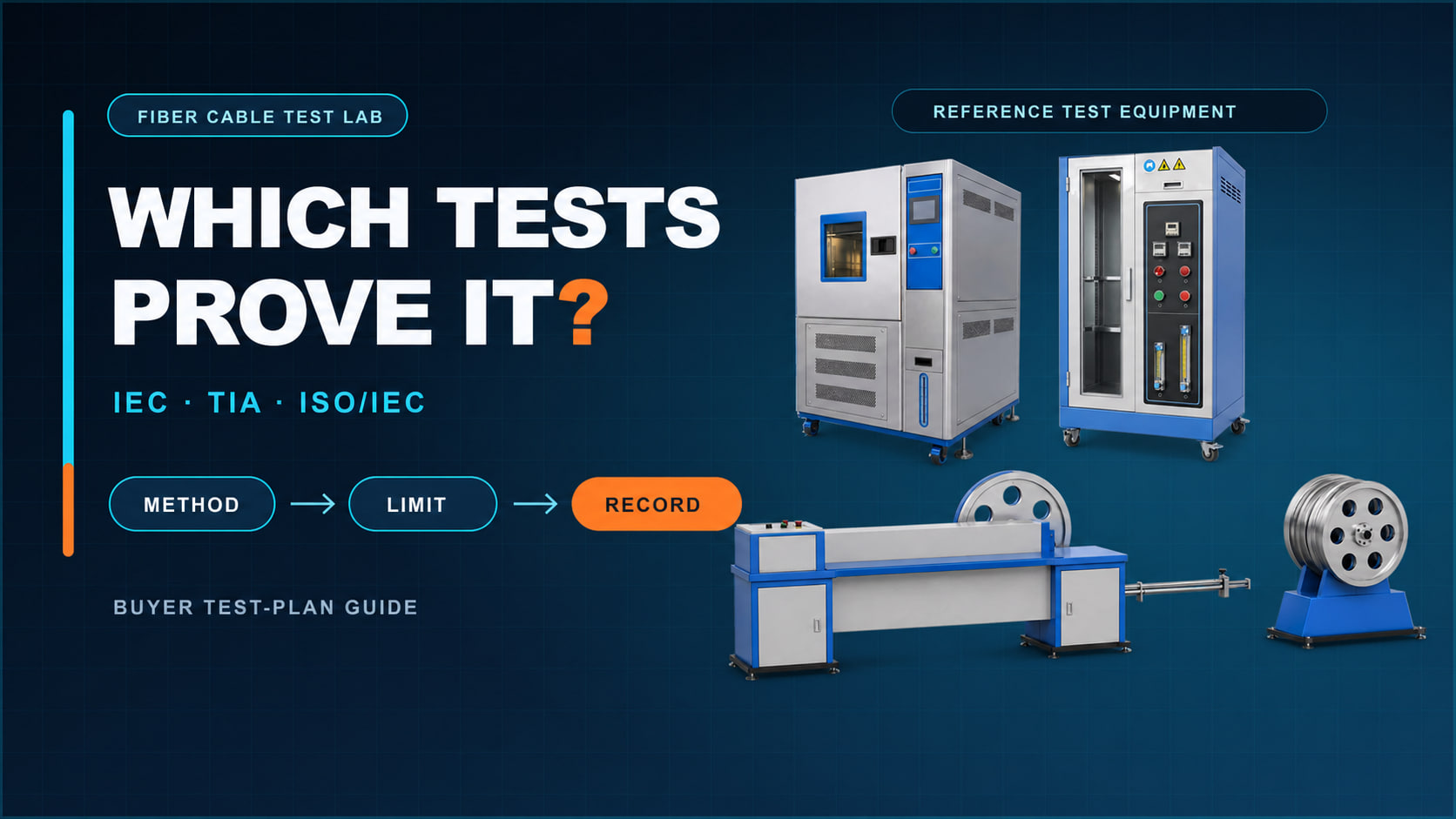
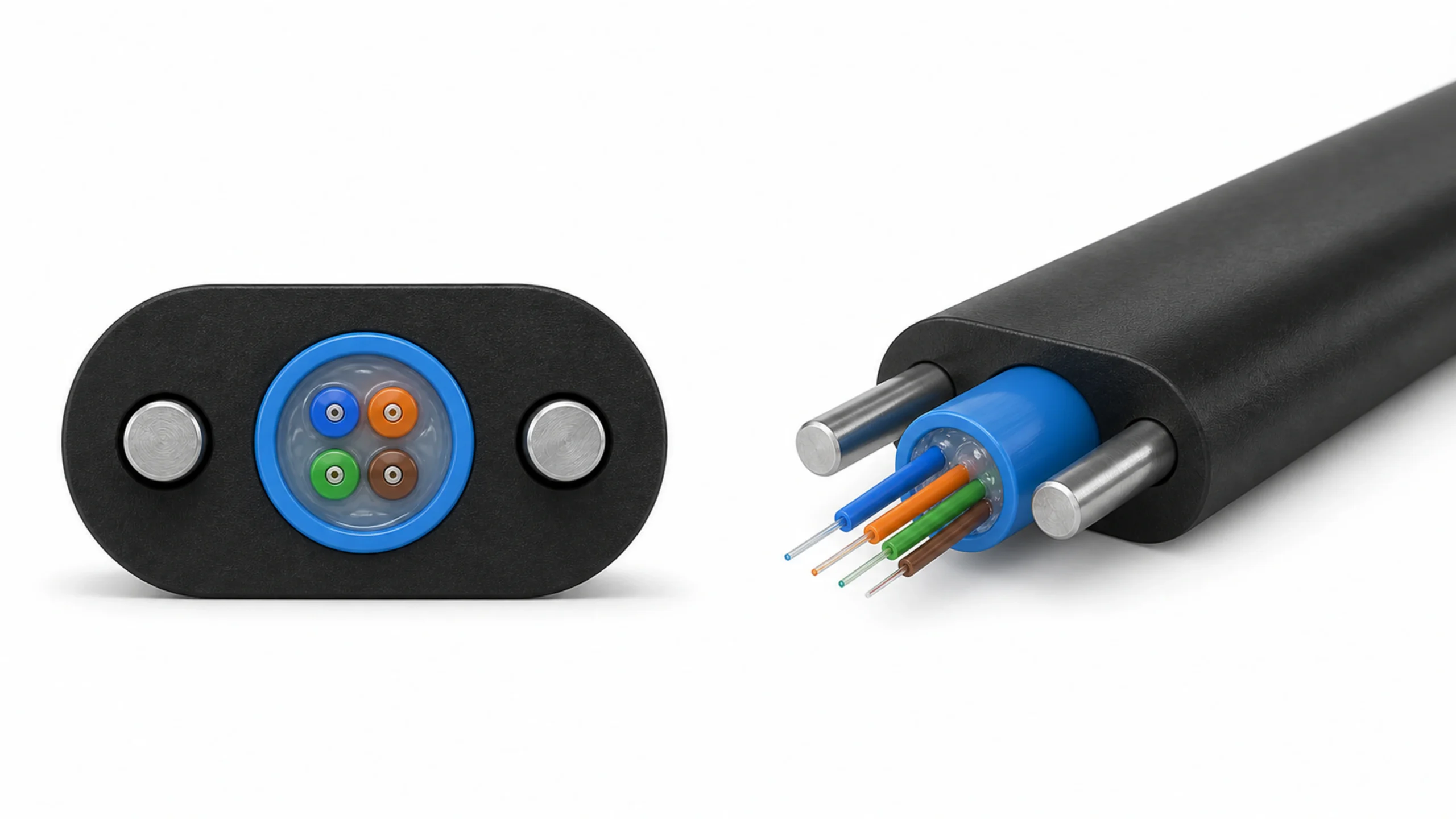
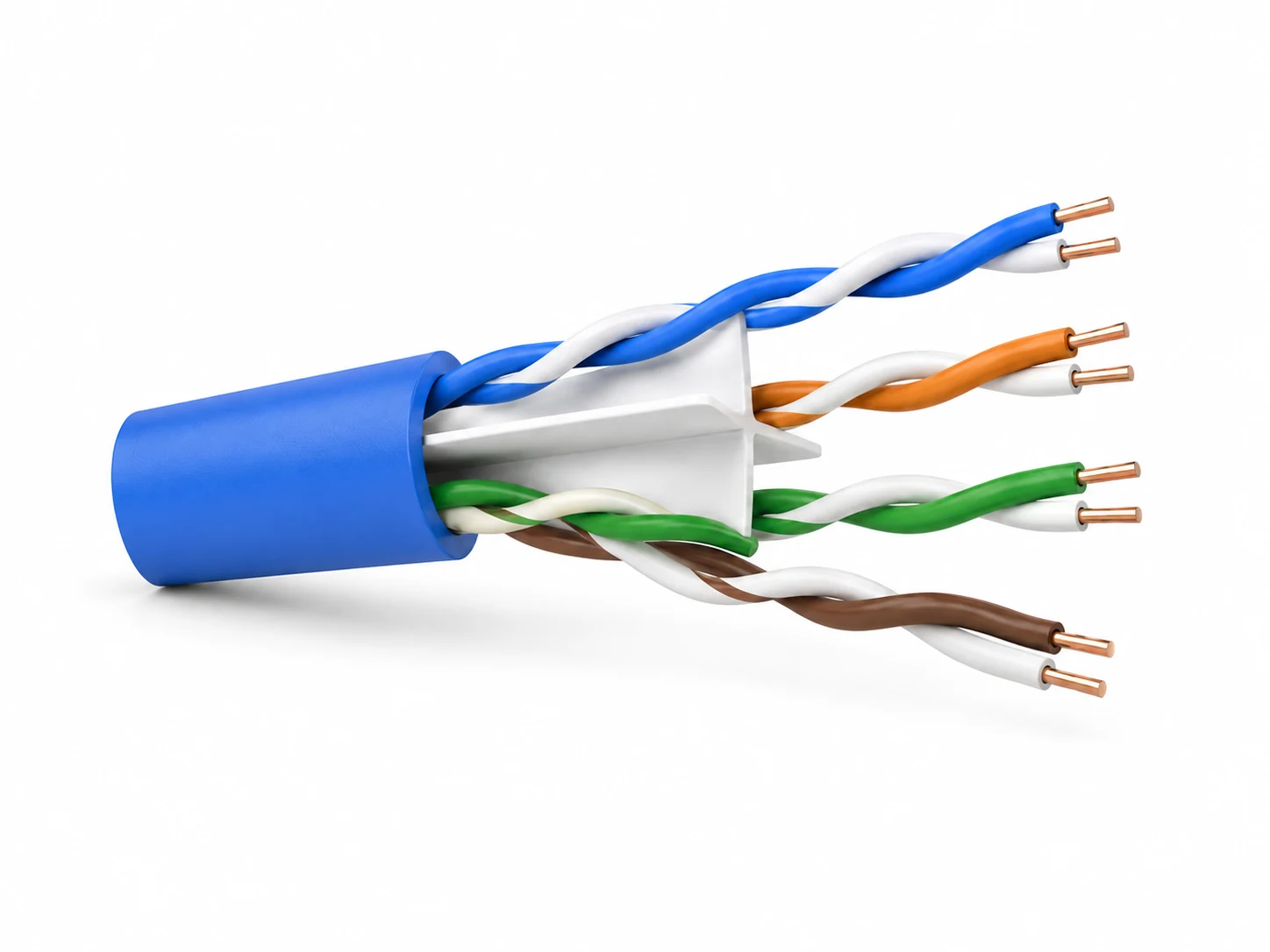
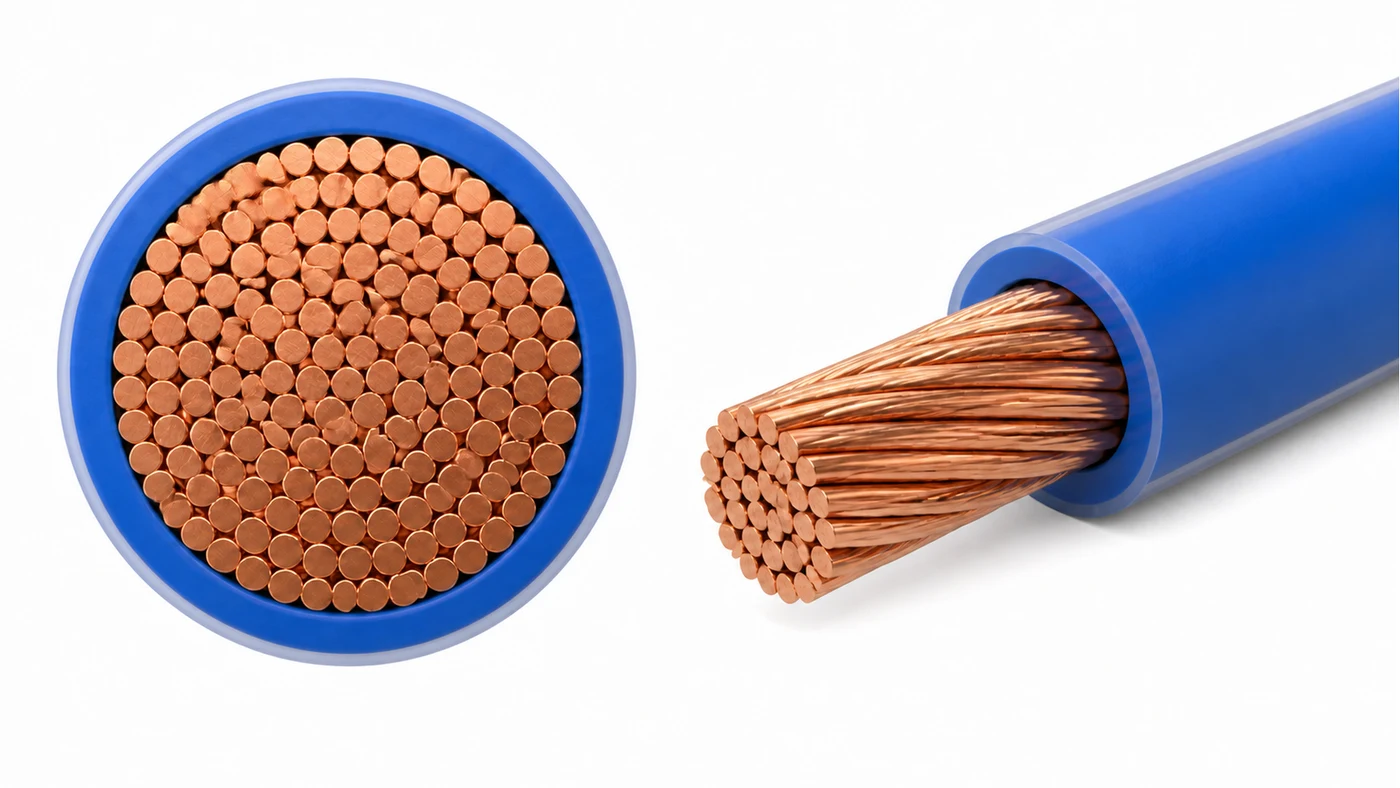
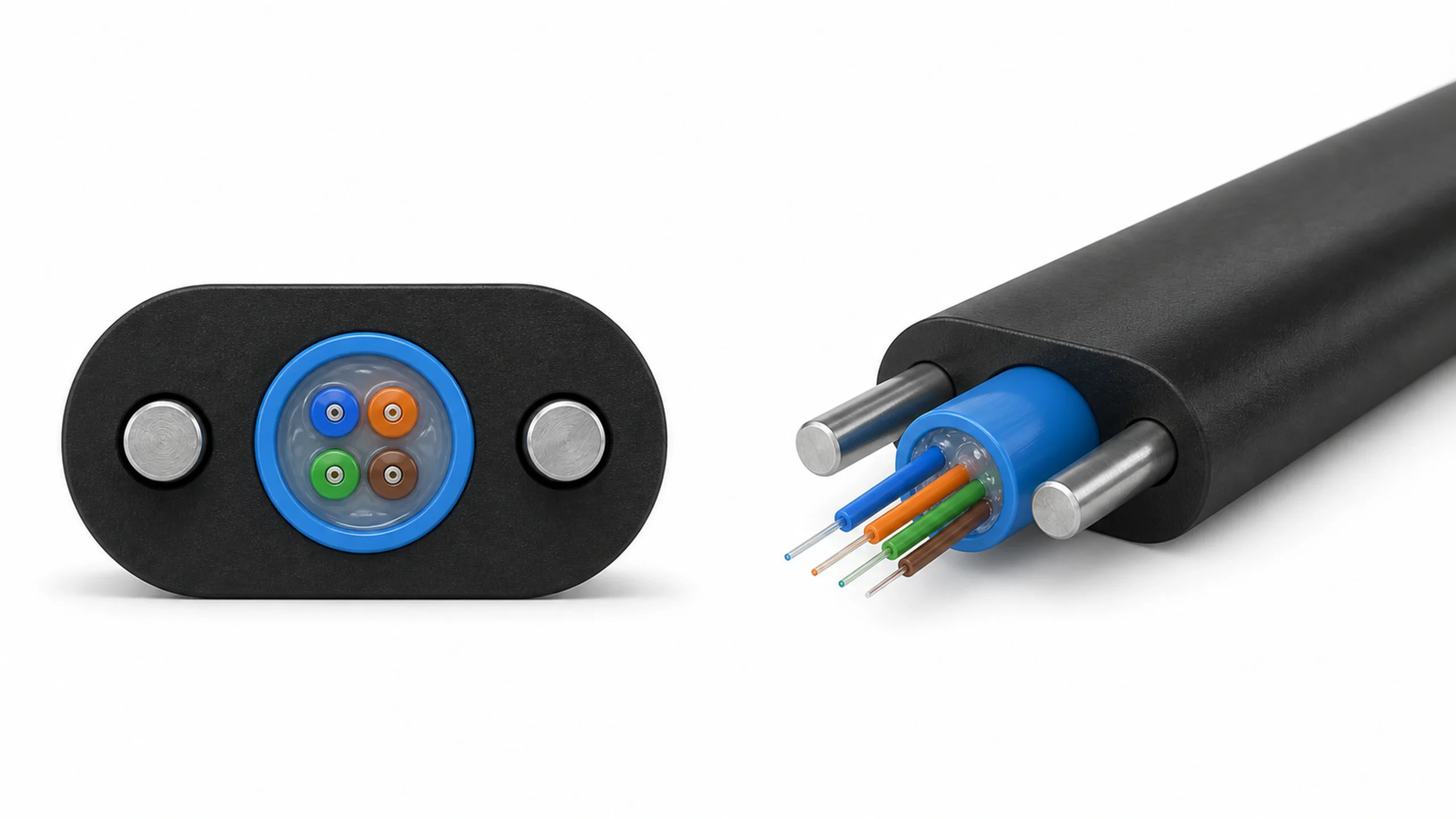
Reference test-equipment images from a HONGKAI optical-cable mechanical-performance equipment proposal. The final fixtures, ranges, methods and acceptance limits must be confirmed for the signed cable specification.
This guide explains how to convert fiber testing standards into a laboratory scope, equipment requirement and FAT evidence package. It does not publish universal loads, wavelengths, cycle counts or pass limits because those values depend on the product specification, cable construction, customer contract and current edition of the selected method.
Primeiro identifique o que está sendo aceito
The phrase “fiber test” is incomplete until the buyer identifies the object under acceptance. Bare optical fiber, finished cable, a connectorized assembly, an installed link and a testing machine require different standards and different evidence.
A cable factory normally receives qualified optical fiber and other materials, transforms them through coloring, buffering, stranding and sheathing, and releases a finished cable on a reel. A vertically integrated project may cover more stages, but the acceptance boundary must still be explicit.
| Acceptance object | Decisão do comprador | Evidência que pertence a este limite | Evidência que não a substitui |
|---|---|---|---|
| Fibra óptica de entrada ou outro material | A documentação do fornecedor é suficiente ou é necessária verificação na recepção? | Identidade do material, rastreabilidade do lote, certificado do fornecedor e inspeções de entrada acordadas | Um relatório de tração ou esmagamento de cabo acabado |
| Cabo óptico acabado | Quais requisitos de construção, aplicação e produto se aplicam? | Dimensões, registros ópticos e as evidências mecânicas, ambientais ou de fogo especificadas | An ISO 9001 certificate by itself |
| Conjunto de cabo com conectores | Quais testes de interface do conector, polaridade e montagem final se aplicam? | Registros de teste óptico, geometria da face final, polaridade/canal e demais registros exigidos | Apenas um registro de atenuação do cabo base |
| Sistema de cabeamento instalado | Qual desempenho de enlace ou canal deve ser comprovado após a instalação? | Registros de teste do sistema instalado feitos com o método de referência especificado | Apenas testes de tipo de cabo de fábrica |
| Máquina de teste ou laboratório | O equipamento pode reproduzir o método exigido e reter dados auditáveis? | Fixação, faixa, controle, status de calibração, registro de software e execução de amostra testemunha | Um folheto de máquina que apenas menciona uma família padrão |
Essa separação evita um erro comum de compra: solicitar que um único OTDR, um único medidor de tração ou um “laboratório IEC geral” comprove todas as etapas. O HONGKAI visão geral da linha de produção de cabos de fibra óptica mostra por que as etapas do processo e as evidências do cabo final devem ser planejadas em conjunto, mas aceitas separadamente.
Decision criterion: Write a one-line acceptance statement before selecting equipment: “This test releases [named object] against [named requirement] using [method and edition], with [pass/fail source] recorded in [required report].” Any blank field is a procurement question, not a detail to resolve after installation.
Monte a Pilha de Especificações Antes de Escolher o Equipamento
A test method explains how to perform a test; it does not automatically define which cable must be tested or what value constitutes a pass. The buyer needs a complete specification stack from the approved cable application down to the final record.
The generic IEC 60794-1-1 document establishes broad requirements for optical fibre cables and cable elements.1 IEC 60794-1-2 provides general requirements, methodology guidance and an overview of the test methods in the IEC 60794-1 series.2 Nenhum dos documentos deve ser copiado em uma cotação como um certificado universal de aprovação sem os requisitos aplicáveis do produto e os limites contratuais.
| Specification layer | O que decide | O que o RFQ ou plano de teste deve registrar |
|---|---|---|
| Requisito do cliente e da aplicação | Onde o cabo será utilizado e quais riscos são relevantes | Modelo do cabo, construção, ambiente de instalação, condições de serviço e especificação do cliente |
| Product requirement | Quais propriedades e testes de qualificação se aplicam a essa família de cabos | Referência completa do documento, edição, cláusulas, emendas e quaisquer desvios do cliente |
| Método de teste | Como o corpo de prova é preparado, carregado, condicionado e medido | Referência do método atual, comprimento do corpo de prova, fixações, sequência, regras de monitoramento e relatórios |
| Limite de aceitação do contrato | O que é aprovado, o que é reprovado e quem aprova um desvio | Fonte do valor, contagem de amostras, regra de arredondamento, regra de repetição de teste e autoridade de disposição |
| Evidence package | Como o resultado permanece rastreável até o produto liberado | ID do carretel/lote, ID da amostra, ID do equipamento, status de calibração, dados brutos, fotos e assinaturas |
The IEC mechanical-test collection is also changing from one broad document toward individual method publications. The official IEC page for IEC 60794-1-21 states that it has been partially replaced by newer method-specific documents.3 A 2015 method number copied from an old machine proposal may therefore be an unsafe contract reference in a new project.
Note: Freeze the edition and amendment status at the quotation or contract stage. Writing only “latest IEC standard” creates a moving target for equipment design, FAT preparation and dispute resolution.
O que IEC, TIA e ISO/IEC realmente controlam?
IEC, TIA and ISO/IEC documents overlap around optical communications, but their scopes are not identical. The correct family depends on whether the buyer is qualifying cable, testing a component, designing premises cabling, measuring an installed system or auditing a management system.
| Standards family | Objeto principal nesta decisão de compra | Useful role | O que não prova por si só |
|---|---|---|---|
| IEC 60794-1-1 and the IEC 60794 cable series | Cabo de fibra óptica e elementos do cabo | Requisitos genéricos, requisitos da família de produtos e estrutura de testes de cabos | Que qualquer máquina ou cabo passe por todos os tipos de cabos IEC |
| IEC 60794-1-2 and current IEC 60794-1 test-method documents | Metodologia de teste de cabo óptico | Orientação do método e o procedimento mecânico, ambiental, de elemento de cabo ou elétrico aplicável | Um limite universal de carga de aceitação, duração ou atenuação para cada cabo |
| TIA-455 series | Fibras ópticas, cabos, transdutores e outros componentes de fibra óptica | Procedimentos Padrão de Teste de Fibra Óptica quando selecionados pelo contrato | Desempenho do sistema instalado ou certificação abrangente do produto |
| ANSI/TIA-568.3-E | Componentes de cabeamento de fibra óptica para instalações e arranjos relacionados | Requisitos de componentes e cabeamento predial para projetos aplicáveis | Toda exigência de cabo externo, aéreo, submarino ou de utilidade |
| TIA-526 series | Sistemas de fibra óptica instalados ou redes de cabos | Medição óptica a nível de sistema em que o projeto seleciona o método relevante | Qualificação mecânica do cabo de fábrica ou teste de aceitação de carretel (FAT) |
| ISO/IEC 11801 series | Cabeamento genérico para instalações do cliente | Requisitos do sistema de cabeamento predial multi-fabricante | Um plano completo de ensaio de tipo de fábrica para todos os produtos de cabo óptico |
| ISO/IEC 14763-3 | Cabeamento de fibra óptica instalado | Inspeção e testes após a instalação | Qualificação de fábrica da construção do cabo |
| ISO 9001 | O sistema de gestão da qualidade de uma organização | Controle de processo, informação documentada, avaliação e melhoria | Aprovação do produto, um resultado de aprovação do cabo ou comprovação de que um teste específico foi realizado |
TIA identifies the TIA-455 series as standards for Fiber Optic Test Procedures.4 TIA’s own release for TIA-455-C states that the procedures apply to fibres, cables, transducers, sensors, connecting and terminating devices and other components, while system or subsystem testing belongs to the TIA-526 series.5 TIA also describes ANSI/TIA-568.3-E as its Optical Fiber Cabling Component Standard for premises cabling.6
ISO/IEC 11801-1 defines general requirements for generic customer-premises cabling and has a published 2025 amendment.7 ISO/IEC 14763-3 covers inspection and testing of installed optical-fibre cabling, reinforcing the boundary between factory cable evidence and site-link evidence.8 ISO 9001, by contrast, specifies quality-management-system requirements that can apply to organizations in many sectors.9 A factory may use ISO 9001 controls to manage calibration, traceability and nonconforming output, but the certificate does not replace a cable product requirement or test report. ISO itself does not perform certification or issue certificates; any management-system certificate must be attributed to the issuing certification body and its stated scope.10
Red flags: A supplier writes “IEC/TIA/ISO compliant” without naming the document, edition, acceptance object, test clause and pass/fail source. That phrase is not specific enough to select laboratory equipment or release finished cable.
Mapear Riscos de Cabos para Testes, Equipamentos e Registros
The laboratory scope should follow the risks created by the cable construction and its application. Online measurements control the manufacturing process; routine reel tests release production; qualification tests challenge representative samples; project-specific tests address requirements that do not apply to every cable.
| Risco ou característica | Função de teste típica | Equipamento ou interface a definir | Evidência mínima para solicitar |
|---|---|---|---|
| Diâmetro, espessura da parede, concentricidade, marcação e comprimento | Verificação dimensional e de processo | Medidor de diâmetro online, ferramentas dimensionais offline, marcação/registro de comprimento e plano de amostragem | ID do produto/lote, ponto de ajuste, valor medido, fonte da tolerância e disposição |
| Continuidade óptica e atenuação | Liberação óptica da fibra ou carretel acabado | Arranjo aprovado de fonte/medidor de potência ou OTDR, configuração de lançamento/recebimento e plano de comprimento de onda | Traço bruto ou leituras, ID do carretel/fibra, método, ID do equipamento e limite de aceitação |
| Tensile loading | Resposta do cabo durante uma condição de puxamento especificada | Quadro de carga, trajeto do cabo, garras, comprimento da amostra e interface de monitoramento óptico | Histórico de carga/tempo, registro de deformação da fibra ou atenuação, quando exigido, e inspeção pós-teste |
| Esmagamento ou impacto | Resistência a um evento compressivo ou de impacto especificado | Placas corretas, superfície de impacto, massa/carga, energia ou sequência de controle para o método selecionado | Configurar identidade, condição aplicada, monitoramento óptico e registro de danos visíveis |
| Dobramento, dobramento repetido, flexão ou torção | Resposta ao movimento de roteamento, manuseio ou serviço | Mandris, polias, pesos, braçadeiras, ângulos e controle de ciclo específicos para cabos | Dimensões do dispositivo, sequência, contagem, dados ópticos e inspeção antes/durante/após |
| Penetração longitudinal de água | Desempenho de bloqueio de água da estrutura do cabo aplicável | Interface selada do espécime, arranjo de coluna d'água ou pressão e observação cronometrada | Preparação da amostra, condição de água, duração, resultado da migração e fotos |
| Exposição à temperatura ou umidade | Resposta ambiental do cabo e dos materiais | Faixa de câmara, roteamento de amostras, passagem e disposição de monitoramento óptico | Perfil do programa, ID da câmara/equipamento, registro real e resultados antes/durante/após |
| Desempenho em chama ou fogo | Fire behaviour required by a specific product or installation rule | Aparelho de teste, montagem do corpo de prova, queimador e sistema de ventilação compatíveis com o método especificado | Método exato de ensaio ao fogo, condicionamento, corpo de prova, resultado observado e relatório autorizado |
An archived HONGKAI full-factory configuration contains equipment categories for tensile, crush/impact, repeated bending, torsion, flexing, water penetration and environmental conditioning, while another confirmed full-line project scope includes OTDR and a broader test-device package. Those records support a real integration boundary: HONGKAI can review production-line and specialist laboratory equipment together for a project. They do not establish one universal fixture, range or test limit for every optical cable.
The standards structure also prevents one fixed “indoor and outdoor” machine list. ITU-T L.103:2024 makes indoor-cable test selection and frequency dependent on the application and agreement, rather than requiring every listed test for every cable.11 IEC 60794-3:2022 covers outdoor uses as different as ducts, direct burial, aerial routes, water crossings, sewers and utility pipes, with additional requirements possible for some applications.12
HONGKAI insight: HONGKAI treats laboratory investment as a conditional project scope, not a universal machine list. A buyer planning both indoor and outdoor cable families may evaluate a broader in-house equipment package when the approved product scope and budget support it. With a limited budget, the first phase should cover the tests required to release the launch products and satisfy the signed customer specification; lower-frequency, specialist or currently non-applicable tests can be deferred or assigned to an external laboratory. “Lower priority” means outside the present launch and contract scope, not technically unimportant.
| Rota de investimento em laboratório | Best fit | O que proteger primeiro | Limite a manter explícito |
|---|---|---|---|
| Pacote interno mais abrangente | Um portfólio definido para ambientes internos e externos, demanda recorrente por testes, pessoal treinado e orçamento suficiente | Cada estação que mapeia para as famílias de produtos aprovadas, métodos e registros retidos | Um pacote completo não é permissão para aplicar todos os testes a todos os cabos |
| Pacote interno implementado por fases | Um portfólio de lançamento limitado ou um orçamento restrito para a primeira fase | Verificações rotineiras de liberação e evidências de qualificação exigidas por contrato para os cabos de lançamento | Adicionar estações quando um novo produto ou requisito do cliente criar uma necessidade documentada |
| Laboratório interno mais laboratório externo | Trabalho infrequente, de longa duração, destrutivo, especializado ou testemunhado independentemente | Preparação de amostra, rastreabilidade, método externo acordado e aceitação do relatório | Evidências externas não eliminam os controles rotineiros de processo da fábrica e os controles de liberação do carretel |
When external evidence is required, verify that the laboratory’s competence or accreditation scope includes the exact selected method. ISO/IEC 17025:2017 addresses laboratory competence, impartiality and consistent operation, but its name alone does not show that every optical-cable test is inside one laboratory’s approved scope.13
A atual HONGKAI guia da linha de produção de tubo solto applies the same principle at process level: the cable construction, material system, packages and acceptance evidence must be defined before a machine configuration becomes auditable.
Note: Fire testing is not a default requirement for every optical cable, and a generic vertical burner image is not proof of compliance. IEC 60332-1-2:2025 covers a single vertical cable and explicitly separates that result from grouped-cable fire propagation, while IEC 60332-3-24:2018 addresses a defined bunched-cable Category C type-approval test.1415 O RFQ deve, portanto, mencionar o documento aplicável sobre incêndio, o aparelho, a disposição dos corpos de prova e os requisitos de relatório antes que aquela estação seja incluída.
Transformar normas em um plano de testes laboratoriais
A useful laboratory plan is executable by an operator and auditable by a buyer. It must define the sample, method, setup, equipment status, acceptance source and record before the first test begins.
Para cada teste, utilize a seguinte sequência.
- Identifique a amostra. Registre o modelo do cabo, a construção, o rolo ou lote, a quantidade de fibras, os materiais relevantes e a localização da amostra.
- Congele o requisito. Registre a especificação do cliente, requisito do produto, método de ensaio, edição, emenda e desvio contratual, se houver.
- Define conditioning and setup. State sample length, preconditioning, fixtures, cable routing, environmental condition, monitoring points and test sequence.
- Confirm measurement capability. Match force, displacement, temperature, optical wavelength, resolution, data acquisition and software output to the selected method without assuming that a larger machine is automatically suitable.
- Defina a regra de aceitação. Identifique a origem de cada limite, a regra de amostragem, o arredondamento, a condição de repetição do ensaio e a autoridade para a decisão.
- Build the record before the run. Prepare campos para operador, testemunha, data/hora, IDs de amostra e equipamento, status de calibração, dados brutos, fotos, resultado e assinaturas.
This plan should also state who owns specialist items such as optical instruments, reference cords, fixtures, calibration services, chamber feed-throughs, test software and computer interfaces. A complete machine price without these interfaces can still leave the factory unable to execute the signed method.
Evidence to request: Ask for a method-to-equipment matrix before purchase. Each row should name the cable scope, method/edition, required fixture and range, monitoring instruments, report output, calibration responsibility, FAT sample and items excluded from the supplier’s scope.
O Que o FAT de Fábrica Pode Comprovar?
Factory acceptance testing can prove that the contracted equipment functions with the agreed sample and produces the specified records. It does not automatically replace cable qualification, long-duration environmental testing, an accredited third-party report or installed-system acceptance.
| Evidence gate | Primary question | Representative proof | Limite ao estado |
|---|---|---|---|
| Teste de equipamento FAT | Does the contracted station execute the agreed function safely and repeatably? | Controles, dispositivos, sensores, alarmes, captura de dados, status de calibração e execução de amostra testemunhada | O FAT está limitado à estação assinada, amostra e protocolo |
| FAT da linha de produção | A linha consegue produzir o cabo representativo acordado nas condições assinadas? | Stable operation, dimensions, online records, alarms, sample cable and agreed test data | Uma amostra FAT não constitui aprovação para todas as futuras construções de cabos |
| Liberação rotineira do cabo | Does the identified reel or lot meet its release checks? | Traceable optical, dimensional, visual and other routine records | Ensaios de rotina não substituem ensaios de tipo ou de qualificação |
| Ensaio de qualificação ou de tipo | Um projeto representativo sobrevive ao desafio especificado? | Complete method, sample, conditioning, raw data, result and authorised report | Applicability to design changes must be defined |
| Evidência de terceiros ou do esquema | É necessária evidência de conformidade independente pelo cliente ou mercado? | Relatório ou certificado do órgão competente exigido e escopo | Supplier self-test records cannot be relabelled as third-party certification |
| Site acceptance | O equipamento entregue opera corretamente após a instalação e integração? | Utilidades, segurança, funcionamento, teste de amostra, treinamento e encerramento de itens pendentes | O SAT não comprova um enlace de telecomunicações instalado, a menos que esse escopo esteja contratado. |
O HONGKAI installation and commissioning guide separates equipment readiness, product evidence, training and unresolved alarms for the same reason. Test records are meaningful only when the acceptance gate and responsibility owner are clear.
The laboratory plan must also include calibration and maintenance status. Test equipment can produce a plausible number while a sensor, reference cord, fixture or software configuration is outside its valid control. The HONGKAI guia de manutenção e peças sobressalentes explica como a identificação e os registros específicos da configuração devem apoiar as decisões de manutenção, em vez de depender de uma lista genérica de peças sobressalentes.
Escreva o RFQ como um Pacote de Evidências
A strong fiber optic cable laboratory RFQ asks the supplier to prove a complete test-and-record chain, not merely to quote a list of machines. The final scope should be specific enough that the buyer, supplier and future laboratory operator would execute the same test plan.
Antes de enviar a RFQ, confirme:
- ☐ Cada família de cabos e objeto de aceitação é nomeado.
- ☐ Cada requisito do produto, método de ensaio, edição e emenda é registrado.
- ☐ Os desvios do cliente e os limites de aprovação/reprovação têm uma fonte identificada.
- ☐ Sample preparation, conditioning, fixture and monitoring rules are defined.
- ☐ Equipment ranges and interfaces are matched to the selected methods.
- ☐ Os instrumentos ópticos, os itens de lançamento/recepção e os acessórios de referência estão atribuídos.
- ☐ As responsabilidades de calibração, software, exportação de dados brutos e retenção de registros são atribuídas.
- ☐ As amostras FAT, testemunhas, sequência de ensaio e evidências de aceitação são acordadas.
- ☐ Long-duration, destructive or third-party tests are separated from normal FAT.
- ☐ Training covers setup, alarm recovery, method selection, record creation and escalation.
The resulting laboratory may be a phased first-stage package, a broader indoor-and-outdoor facility or an in-house system supported by external specialist testing. The correct scope is not the longest equipment list. It is the route that releases the approved cable under the signed requirement, while giving the buyer a documented trigger for adding the next station.
-
IEC 60794-1-1:2023, Cabos de fibra óptica – Especificação genérica – Geral, IEC.↩
-
IEC 60794-1-2:2021, Basic optical cable test procedures – General guidance, IEC.↩
-
IEC 60794-1-21:2015+A1:2020, Métodos de ensaios mecânicos, IEC; a página oficial do ciclo de vida lista substituições parciais por publicações mais recentes específicas do método.↩
-
Reafirmações da TIA para a série de Procedimentos de Teste de Fibra Óptica TIA-455, Telecommunications Industry Association.↩
-
TIA-455-C general requirements announcement, Telecommunications Industry Association.↩
-
ANSI/TIA-568.3-E Optical Fiber Cabling Component Standard announcement, Telecommunications Industry Association.↩
-
ISO/IEC 11801-1:2017, Cabeamento genérico para instalações do cliente – Requisitos gerais, incluindo o histórico de emendas indicado pela ISO.↩
-
ISO/IEC 14763-3:2024, Teste de cabeamento de fibra óptica, ISO. ↩
-
ISO 9001:2015, Quality management systems – Requirements, ISO. ↩
-
Explicação da ISO sobre certificação e avaliação da conformidade, ISO. ↩
-
ITU-T L.103 (08/2024), Cabos de fibra óptica para aplicações internas, União Internacional de Telecomunicações.↩
-
IEC 60794-3:2022, Cabos para exterior – Especificação seccional, IEC.↩
-
ISO/IEC 17025:2017, General requirements for the competence of testing and calibration laboratories, ISO. ↩
-
IEC 60332-1-2:2025, Vertical flame propagation for a single insulated wire or cable, IEC.↩
-
IEC 60332-3-24:2018, Propagação vertical de chama em fios ou cabos agrupados – Categoria C, IEC.↩

 English
  हिन्दी
  فارسی
فارسی