


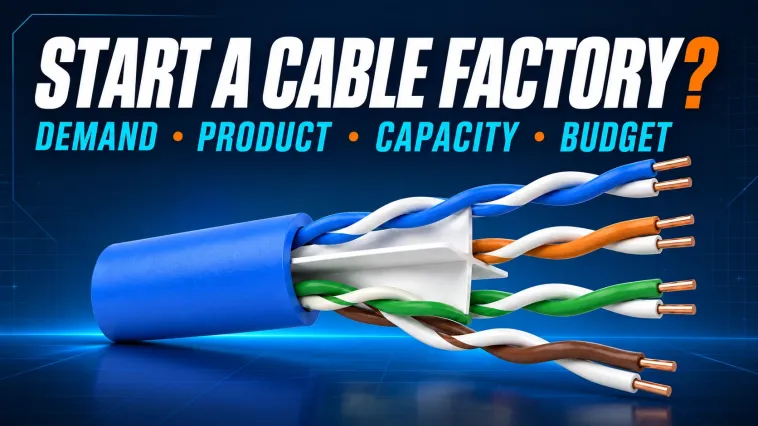
If you are planning your first network cable factory, the first question is not which machines to buy. It is who will buy the cable, what they will accept and how much you can reasonably expect to supply.
Start with real orders. If you do not have orders yet, check the target market before choosing a cable category. Then connect the first product, required output and available budget to a production plan.
You can still ask about investment before every detail is settled. The important distinction is between a rough budget for exploring an idea and a detailed proposal for a defined factory. This guide explains how to move from one to the other.
Bắt đầu với Đơn hàng, hay Thử thị trường trước tiên

Minh họa lập kế hoạch: tách nhu cầu đã được xác nhận khỏi các điều kiện và giả định trước khi chọn cáp đầu tiên.
An actual order gives you a starting point: the buyer, cable specification, quantity and delivery requirement. Ask whether the order depends on sample approval, testing or another condition. A pending trial order should not be counted as confirmed repeat demand.
Record the product and the evidence behind each sales opportunity. Separate firm orders from forecasts and general expressions of interest. Otherwise, the same possible sale may appear in several estimates and make the planned factory look busier than it is.
If you have no orders, begin with the people you expect to sell to: distributors, cable brands, installers or project buyers. Find out which products they actually purchase, their packaging requirements, expected volumes, acceptance requirements and reasons for changing suppliers. A popular cable name on a marketplace does not establish demand for a new factory’s output.
Market research should test demand, competing offers and achievable customer access. The U.S. Small Business Administration recommends examining demand, location, competing options and pricing, using existing information and direct customer research.1 Áp dụng cách tiếp cận nghiên cứu đó vào thị trường của bạn; điều này không phải là bằng chứng cho thấy một quốc gia cụ thể sẽ mua một loại cáp cụ thể nào.
You do not need to claim a precise market share at this stage. You need enough evidence to distinguish a product customers are asking for from a product you simply hope to manufacture.
Chọn sản phẩm đầu tiên mà khách hàng của bạn sẽ mua
Cat5 or Cat6 may be a suitable starting point where customers genuinely buy those products. Cat6A is also an option, but the production plan must address its higher precision and process-control demands. The category should follow the market, not a universal rule for new factories.
Cat5 và Cat5e là các loại khác nhau; hãy chỉ rõ loại chính xác mà người mua yêu cầu.
In HONGKAI’s early project discussions, the starting category is considered alongside orders, market requirements, budget and expected output. This is a project-screening approach, not a guarantee that one category is the cheapest or most profitable in every market.

Existing HONGKAI 3D cable reference. The drawing illustrates one four-pair U/UTP construction; it does not prove a performance category or prescribe a separator for every cable.
Write down the first saleable product rather than requesting a machine that makes “all network cables.” Is it bulk cable in boxes or reels, or a finished connectorized patch cord? Specify the conductor, insulation, screening where required, jacket, package length and acceptance requirements. A category label alone does not complete that definition.
A higher-performance cable is not just a different jacket marking. Review the required control of conductor and insulation geometry, pair lay, tension and any screening against the proposed construction. Then agree how the resulting cable will be tested. The Tham chiếu tuyến sản xuất cáp LAN giải thích cách những yêu cầu đó làm thay đổi cấu hình thiết bị.
Cat6A should therefore be treated as a defined product-development and manufacturing requirement, not an automatic later setting on an unspecified Cat6 machine. Equally, do not rule it out solely because the factory is new if the buyer demand, engineering support, equipment scope and budget can support it.
Các hướng dẫn kiểm tra cáp tại nhà máy helps distinguish product and production-lot evidence from an installed-link test. Set the acceptance requirement before choosing equipment; a machine list does not replace a saleable-cable specification.
Chuyển Nhu cầu thành Yêu cầu Sản xuất Hàng tháng
Một mục tiêu năng lực cần có sản phẩm, đơn vị và khoảng thời gian. “Một nhà máy lớn” hoặc “sản xuất tốc độ cao” là chưa đủ để xác định số lượng máy móc cần thiết.
For cable sold in boxes, start with the number of accepted boxes you need to ship and the length in each box. Keep different cable constructions on separate lines in the plan. If you sell finished patch cords, use the assembly quantities and lengths as well; the bulk-cable calculation is not the complete finished-cord capacity plan.
Mối quan hệ lập kế hoạch cơ bản là:
Chiều dài cáp có thể bán được yêu cầu mỗi tháng = số gói được chấp nhận theo kế hoạch mỗi tháng × chiều dài cáp mỗi gói.
For a mixed product plan, calculate each product separately and add the lengths only for a total demand summary. Do not assume different constructions use the same production speed or the same equipment time.
Sử dụng bảng tính nhu cầu trên năng lực này trước khi yêu cầu số lượng máy:
| Planning input | Cần ghi lại những gì | Tại sao điều này làm thay đổi kế hoạch nhà máy |
|---|---|---|
| Demand basis | Đơn hàng chắc chắn, đơn hàng có điều kiện hoặc dự báo thị trường, kèm theo nguồn gốc và thời điểm của chúng | Tách biệt công việc đã cam kết khỏi một giả định |
| Product mix | Bản vẽ cáp hoặc đặc tả cho từng sản phẩm dự kiến | Các sản phẩm khác nhau có thể yêu cầu các thiết lập, tuyến đường và quá trình chuyển đổi khác nhau |
| Shipping unit | Hộp, cuộn dây hoặc dây hoàn chỉnh, với chiều dài và số lượng được xác định | Chuyển đổi số lượng thương mại thành yêu cầu sản xuất có thể sử dụng được |
| Working calendar | Ngày làm việc, ca làm có nhân viên và số giờ mỗi ca | Đặt thời gian sẵn có trước khi dừng máy và chuyển đổi |
| Tốc độ sản xuất đã được chứng minh | Đầu ra được chấp nhận cho sản phẩm và quy trình đã chỉ định | Ngăn tốc độ tối đa trong brochure trở thành tốc độ lập kế hoạch |
| Tổn thất và thời gian ngừng hoạt động | Giả định về vật liệu khởi động, phế phẩm, sản phẩm làm lại, chuyển đổi và bảo trì | Cho thấy sự khác biệt giữa sản lượng gộp và sản lượng được chấp nhận |
| Expansion scenario | Nhu cầu bổ sung nào sẽ biện minh cho việc thêm một ca làm việc hoặc máy móc khác | Tách biệt tăng trưởng trong tương lai khỏi công suất cam kết ban đầu |

Existing HONGKAI equipment reference for discussing pair-twisting capacity. The image does not establish a production rate, required machine quantity or complete factory configuration.
Now check each production stage on a consistent basis. Insulation, pair twisting, cabling, sheathing, testing and packing do not all process the same intermediate product. Convert their outputs to the finished-cable requirement, using the approved construction and appropriate allowances. The slowest adequately supplied stage can limit the factory’s output.
Avoid counting a loss twice. For example, if a measured production figure already reports accepted output over a full shift, do not automatically deduct the same downtime and rejection allowance again. State what each figure includes before using it in a calculation.
For a project that is still exploratory, prepare a lower-demand and a higher-demand scenario with explicit assumptions. These are planning cases, not predictions or a promised return. Machine quantities remain to be confirmed per project.
Quyết định xem nên mua dây đồng đã được kéo sợi hay tự kéo sợi trong nhà máy.
Monthly copper demand also helps define where production should start. Compare buying copper wire already prepared to the required diameter and condition for insulation with adding an in-house drawing process. Do not include drawing equipment simply because the project is described as a complete cable factory.
Là tài liệu tham khảo lập kế hoạch dự án HONGKAI, nhu cầu đồng khoảng 4 metric tonnes per month or more is a point at which adding drawing equipment is worth evaluating. This is an experience-based starting point for a comparison, not an industry rule or a proven break-even threshold. Use the ongoing copper requirement, not finished-cable weight or a one-off stock purchase.
The comparison should examine possible savings in transport, time spent waiting for purchased wire and the cost of buying different wire diameters. Set those potential savings against the equipment investment and actual costs of operating the drawing process. A lower or uncertain volume does not automatically rule out drawing, but it is a reason to examine the purchased-wire option before committing to another process. Confirm the material and process scope before comparing quotations.
Ngân sách cho Nhà máy, Không Chỉ cho Máy móc
Minh họa phạm vi ngân sách. Các nhóm này không phải là các khoản tiền hoặc tỷ lệ được báo giá; hãy xác nhận các chi phí áp dụng cho dự án.
Báo giá thiết bị là một phần trong ngân sách khởi động. Tự thân nó không cho chủ sở hữu mới biết cần bao nhiêu tiền để đạt được sản xuất ổn định và cung cấp các đơn hàng đầu tiên.
Tách biệt chi phí thiết lập ban đầu khỏi các khoản chi phí phát sinh liên tục trong quá trình vận hành. Đây cũng là sự phân biệt được sử dụng trong hướng dẫn lập kế hoạch chi phí khởi nghiệp của SBA.1 Sử dụng phương pháp này để lập ngân sách, không dùng làm nguồn tham khảo cho giá địa phương, cách xử lý thuế hoặc điều kiện đủ để được tài trợ.
Đối với một dự án cáp mạng, hãy giữ các nhóm ngân sách này ở chế độ hiển thị:
| Budget group | Phạm vi cần xác nhận trước khi sử dụng tổng số |
|---|---|
| Production equipment | Dây mua sẵn sàng để cách điện so với quy trình kéo sợi kèm theo; các quy trình khác, số lượng máy, dụng cụ, điều khiển và phạm vi đóng gói |
| Factory readiness | Cơ sở phù hợp, bố trí mặt bằng, nguồn điện và các tiện ích cần thiết cho các quy trình đã chọn |
| Chuẩn bị về chất lượng và kỹ thuật | Thiết bị thử nghiệm, đồ gá, phương pháp, đào tạo vận hành viên và mọi đánh giá bên ngoài cần thiết |
| Delivery and startup | Cước vận chuyển, các chi phí nhập khẩu áp dụng, trách nhiệm lắp đặt, chạy thử và vật liệu thử nghiệm |
| Initial operations | Chi phí vật liệu, bao bì, nhân sự và vận hành trong khi sản xuất và thanh toán từ khách hàng đang được triển khai |
Get current local and supplier inputs for the groups that apply. Mark exclusions instead of treating them as zero. A lower equipment price may simply leave more work, utilities, testing or startup support outside the quotation.
If the intended product needs UL Listing, include that preparation and the relevant external evaluation in the project scope. The network cable UL readiness guide giải thích lý do vì sao việc nghiệm thu máy móc và chứng nhận là những trách nhiệm riêng biệt. Không thêm gói chứng nhận chung vào mọi thị trường hoặc sản phẩm.
When the budget does not cover the proposed scope, revisit the product range, starting material, output target or timing. Do not keep the original promise while silently removing the controls or tests needed to make the agreed cable.
Yêu cầu Đề xuất Phù hợp với Mức Độ Sẵn Sàng của Bạn
Hướng dẫn thảo luận: một ngân sách sơ bộ và một đề xuất chi tiết từ nhà máy trả lời những câu hỏi khác nhau.
You do not need a final factory configuration to ask an initial investment question. But the answer should state what is known, what is assumed and what must be confirmed before equipment is ordered.
Có hai cách hữu ích để tiếp cận cuộc thảo luận đó:
- Budget enquiry: name the target market, likely first products, available budget and any demand estimate. Ask for an indicative scope with its assumptions and exclusions. The purpose is to understand the scale of the project, not to approve a final machine quantity.
- Đề xuất chi tiết từ nhà máy: provide the product specifications, order or demand basis, monthly output by product, operating calendar, site conditions and budget boundary. Ask the supplier to connect each process to the production target and explain the capacity calculation.
Turn the discussion into a short project brief. For each unresolved input, write who will confirm it and how the answer changes the plan. A distributor can help verify customer requirements; the factory owner sets the investment boundary; technical personnel and the equipment supplier develop and check the production route. Those roles need actual people before startup, not just an assumption that the machines will resolve every gap.
The next step is not necessarily buying equipment. If demand is unclear, test the market. If the product is unclear, obtain the buyer’s specification. If the output is unclear, calculate it. Once those inputs are connected to a workable budget, the equipment discussion can become a factory plan with a clear purpose.
-
U.S. Small Business Administration — Plan your business, specifically “Market research and competitive analysis” and “Calculate your startup costs.” Used only for general market-research and one-time-versus-recurring cost-planning principles, not for cable demand, machine prices, local compliance, tax advice or investment returns. ↩ ↩
