


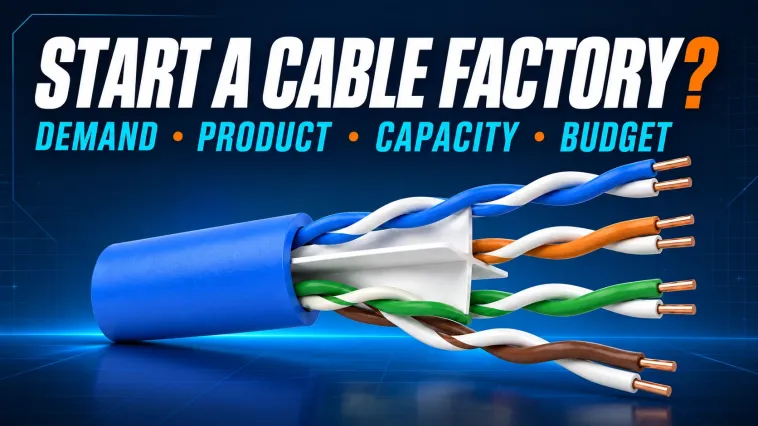
If you are planning your first network cable factory, the first question is not which machines to buy. It is who will buy the cable, what they will accept and how much you can reasonably expect to supply.
Start with real orders. If you do not have orders yet, check the target market before choosing a cable category. Then connect the first product, required output and available budget to a production plan.
You can still ask about investment before every detail is settled. The important distinction is between a rough budget for exploring an idea and a detailed proposal for a defined factory. This guide explains how to move from one to the other.
Начните с заказов или сначала протестируйте рынок

Иллюстрация планирования: отделите подтвержденный спрос от условий и предположений до выбора первого кабеля.
An actual order gives you a starting point: the buyer, cable specification, quantity and delivery requirement. Ask whether the order depends on sample approval, testing or another condition. A pending trial order should not be counted as confirmed repeat demand.
Record the product and the evidence behind each sales opportunity. Separate firm orders from forecasts and general expressions of interest. Otherwise, the same possible sale may appear in several estimates and make the planned factory look busier than it is.
If you have no orders, begin with the people you expect to sell to: distributors, cable brands, installers or project buyers. Find out which products they actually purchase, their packaging requirements, expected volumes, acceptance requirements and reasons for changing suppliers. A popular cable name on a marketplace does not establish demand for a new factory’s output.
Market research should test demand, competing offers and achievable customer access. The U.S. Small Business Administration recommends examining demand, location, competing options and pricing, using existing information and direct customer research.1 Примените этот исследовательский подход к своему собственному рынку; это не является доказательством того, что конкретная страна купит определённый кабель.
You do not need to claim a precise market share at this stage. You need enough evidence to distinguish a product customers are asking for from a product you simply hope to manufacture.
Выберите первый продукт, который купят ваши покупатели
Cat5 or Cat6 may be a suitable starting point where customers genuinely buy those products. Cat6A is also an option, but the production plan must address its higher precision and process-control demands. The category should follow the market, not a universal rule for new factories.
Cat5 и Cat5e — это разные категории; уточните точную категорию, необходимую покупателю.
In HONGKAI’s early project discussions, the starting category is considered alongside orders, market requirements, budget and expected output. This is a project-screening approach, not a guarantee that one category is the cheapest or most profitable in every market.

Existing HONGKAI 3D cable reference. The drawing illustrates one four-pair U/UTP construction; it does not prove a performance category or prescribe a separator for every cable.
Write down the first saleable product rather than requesting a machine that makes “all network cables.” Is it bulk cable in boxes or reels, or a finished connectorized patch cord? Specify the conductor, insulation, screening where required, jacket, package length and acceptance requirements. A category label alone does not complete that definition.
A higher-performance cable is not just a different jacket marking. Review the required control of conductor and insulation geometry, pair lay, tension and any screening against the proposed construction. Then agree how the resulting cable will be tested. The LAN cable production-route reference объясняет, как эти требования изменяют конфигурацию оборудования.
Cat6A should therefore be treated as a defined product-development and manufacturing requirement, not an automatic later setting on an unspecified Cat6 machine. Equally, do not rule it out solely because the factory is new if the buyer demand, engineering support, equipment scope and budget can support it.
The руководство по испытанию кабелей на заводе helps distinguish product and production-lot evidence from an installed-link test. Set the acceptance requirement before choosing equipment; a machine list does not replace a saleable-cable specification.
Превратите спрос в месячный производственный план
A capacity target needs a product, a unit and a time period. “A large factory” or “high-speed production” is not enough to work out how many machines are required.
For cable sold in boxes, start with the number of accepted boxes you need to ship and the length in each box. Keep different cable constructions on separate lines in the plan. If you sell finished patch cords, use the assembly quantities and lengths as well; the bulk-cable calculation is not the complete finished-cord capacity plan.
The basic planning relationship is:
Required saleable cable length per month = planned accepted packages per month × cable length per package.
For a mixed product plan, calculate each product separately and add the lengths only for a total demand summary. Do not assume different constructions use the same production speed or the same equipment time.
Use this demand-to-capacity worksheet before asking for a machine quantity:
| Planning input | What to record | Why it changes the factory plan |
|---|---|---|
| Demand basis | Firm order, conditional order or market forecast, with its source and timing | Separates committed work from an assumption |
| Product mix | Cable drawing or specification for each intended product | Different products may require different settings, routes and changeovers |
| Shipping unit | Boxes, reels or finished cords, with the length and quantity defined | Converts commercial quantities into a usable production requirement |
| Working calendar | Working days, staffed shifts and hours per shift | Sets the time available before stoppages and changeovers |
| Proven production rate | Accepted output for the specified product and process | Prevents brochure maximum speed from becoming the planning rate |
| Losses and downtime | Предположения относительно стартового материала, брака, переделок, переналадок и технического обслуживания | Shows how gross production differs from accepted output |
| Expansion scenario | Какой дополнительный спрос оправдает введение еще одной смены или установку еще одного станка | Отделяет будущий рост от первоначальной заявленной мощности |

Existing HONGKAI equipment reference for discussing pair-twisting capacity. The image does not establish a production rate, required machine quantity or complete factory configuration.
Now check each production stage on a consistent basis. Insulation, pair twisting, cabling, sheathing, testing and packing do not all process the same intermediate product. Convert their outputs to the finished-cable requirement, using the approved construction and appropriate allowances. The slowest adequately supplied stage can limit the factory’s output.
Avoid counting a loss twice. For example, if a measured production figure already reports accepted output over a full shift, do not automatically deduct the same downtime and rejection allowance again. State what each figure includes before using it in a calculation.
For a project that is still exploratory, prepare a lower-demand and a higher-demand scenario with explicit assumptions. These are planning cases, not predictions or a promised return. Machine quantities remain to be confirmed per project.
Решите, покупать ли медную проволоку заданного размера или производить волочение на собственном производстве.
Monthly copper demand also helps define where production should start. Compare buying copper wire already prepared to the required diameter and condition for insulation with adding an in-house drawing process. Do not include drawing equipment simply because the project is described as a complete cable factory.
В качестве справочного материала по планированию проектов HONGKAI, потребность в меди составляет около 4 metric tonnes per month or more is a point at which adding drawing equipment is worth evaluating. This is an experience-based starting point for a comparison, not an industry rule or a proven break-even threshold. Use the ongoing copper requirement, not finished-cable weight or a one-off stock purchase.
The comparison should examine possible savings in transport, time spent waiting for purchased wire and the cost of buying different wire diameters. Set those potential savings against the equipment investment and actual costs of operating the drawing process. A lower or uncertain volume does not automatically rule out drawing, but it is a reason to examine the purchased-wire option before committing to another process. Confirm the material and process scope before comparing quotations.
Бюджет на завод, а не только на оборудование
Иллюстрация в рамках бюджета. Эти группы не являются указанием сумм или пропорций; уточните применимые расходы по проекту.
Коммерческое предложение на оборудование составляет одну часть стартового бюджета. Само по себе оно не показывает новому владельцу, сколько денег потребуется для выхода на стабильное производство и выполнения первых заказов.
Отделите первоначальные затраты на настройку от расходов, которые продолжаются во время эксплуатации. Это также соответствует разграничению, используемому в рекомендациях SBA по планированию стартовых затрат.1 Используйте его как метод бюджетирования, а не как источник местных цен, налогового режима или условий получения финансирования.
Для проекта сетевого кабеля оставьте следующие бюджетные группы видимыми:
| Budget group | Область подтверждения перед использованием итоговой суммы |
|---|---|
| Production equipment | Покупная проволока, готовая к изоляции, в сравнении с включенным процессом волочения; другие процессы, количество машин, оснастка, системы управления и объем упаковки |
| Factory readiness | Подходящие помещения, планировка, электроснабжение и коммунальные услуги, требуемые выбранными процессами |
| Качество и техническая подготовка | Испытательное оборудование, оснастка, методы, обучение операторов и любая необходимая внешняя оценка |
| Поставка и запуск | Фрахт, применимые импортные расходы, обязанности по установке, пусконаладочные работы и материалы для испытаний |
| Initial operations | Материалы, упаковка, персонал и операционные расходы в период наращивания производства и поступления платежей от клиентов |
Get current local and supplier inputs for the groups that apply. Mark exclusions instead of treating them as zero. A lower equipment price may simply leave more work, utilities, testing or startup support outside the quotation.
Если предполагаемый продукт должен иметь сертификацию UL, включите подготовку и соответствующую внешнюю оценку в объем проекта. The руководство по готовности сетевого кабеля к сертификации UL объясняет, почему приемка оборудования и сертификация являются отдельными обязанностями. Не добавляйте универсальный пакет сертификации для каждого рынка или продукта.
When the budget does not cover the proposed scope, revisit the product range, starting material, output target or timing. Do not keep the original promise while silently removing the controls or tests needed to make the agreed cable.
Запросите предложение, соответствующее вашей готовности
Руководство для обсуждения: ориентировочный бюджет и подробное предложение завода отвечают на разные вопросы.
You do not need a final factory configuration to ask an initial investment question. But the answer should state what is known, what is assumed and what must be confirmed before equipment is ordered.
Существует два полезных способа подойти к этому обсуждению:
- Budget enquiry: name the target market, likely first products, available budget and any demand estimate. Ask for an indicative scope with its assumptions and exclusions. The purpose is to understand the scale of the project, not to approve a final machine quantity.
- Подробное предложение завода: provide the product specifications, order or demand basis, monthly output by product, operating calendar, site conditions and budget boundary. Ask the supplier to connect each process to the production target and explain the capacity calculation.
Turn the discussion into a short project brief. For each unresolved input, write who will confirm it and how the answer changes the plan. A distributor can help verify customer requirements; the factory owner sets the investment boundary; technical personnel and the equipment supplier develop and check the production route. Those roles need actual people before startup, not just an assumption that the machines will resolve every gap.
The next step is not necessarily buying equipment. If demand is unclear, test the market. If the product is unclear, obtain the buyer’s specification. If the output is unclear, calculate it. Once those inputs are connected to a workable budget, the equipment discussion can become a factory plan with a clear purpose.
-
U.S. Small Business Administration — Plan your business, specifically “Market research and competitive analysis” and “Calculate your startup costs.” Used only for general market-research and one-time-versus-recurring cost-planning principles, not for cable demand, machine prices, local compliance, tax advice or investment returns. ↩ ↩
