












If you are planning your first network cable factory, the first question is not which machines to buy. It is who will buy the cable, what they will accept and how much you can reasonably expect to supply.
Start with real orders. If you do not have orders yet, check the target market before choosing a cable category. Then connect the first product, required output and available budget to a production plan.
You can still ask about investment before every detail is settled. The important distinction is between a rough budget for exploring an idea and a detailed proposal for a defined factory. This guide explains how to move from one to the other.
Mulai dengan Pesanan, atau Uji Pasar Terlebih Dahulu
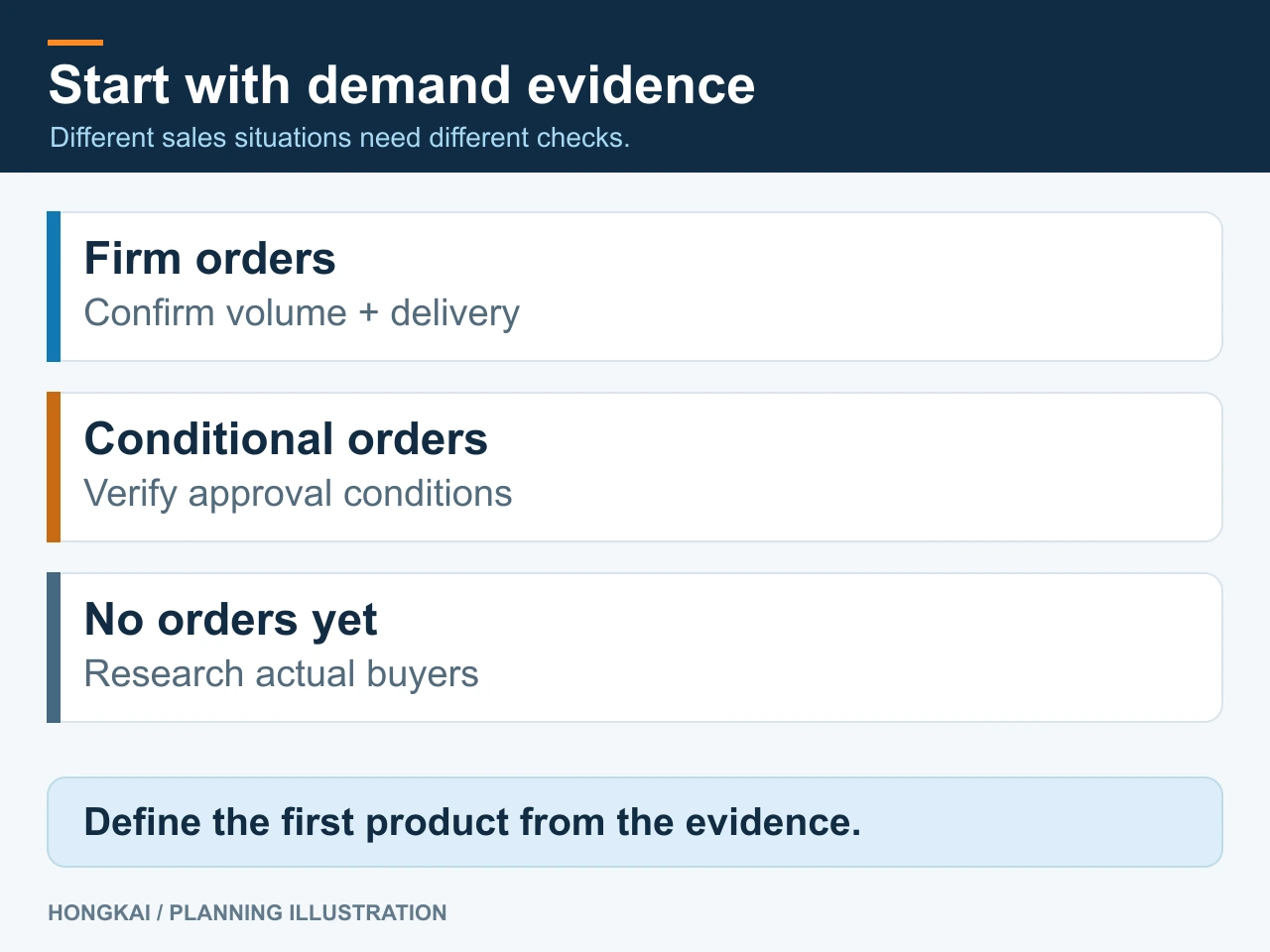
Ilustrasi perencanaan: pisahkan permintaan yang telah dikonfirmasi dari kondisi dan asumsi sebelum memilih kabel pertama.
An actual order gives you a starting point: the buyer, cable specification, quantity and delivery requirement. Ask whether the order depends on sample approval, testing or another condition. A pending trial order should not be counted as confirmed repeat demand.
Record the product and the evidence behind each sales opportunity. Separate firm orders from forecasts and general expressions of interest. Otherwise, the same possible sale may appear in several estimates and make the planned factory look busier than it is.
If you have no orders, begin with the people you expect to sell to: distributors, cable brands, installers or project buyers. Find out which products they actually purchase, their packaging requirements, expected volumes, acceptance requirements and reasons for changing suppliers. A popular cable name on a marketplace does not establish demand for a new factory’s output.
Market research should test demand, competing offers and achievable customer access. The U.S. Small Business Administration recommends examining demand, location, competing options and pricing, using existing information and direct customer research.1 Terapkan pendekatan penelitian tersebut ke pasar Anda sendiri; ini bukan bukti bahwa suatu negara tertentu akan membeli kabel tertentu.
You do not need to claim a precise market share at this stage. You need enough evidence to distinguish a product customers are asking for from a product you simply hope to manufacture.
Pilih Produk Pertama yang Akan Dibeli Pembeli Anda
Cat5 or Cat6 may be a suitable starting point where customers genuinely buy those products. Cat6A is also an option, but the production plan must address its higher precision and process-control demands. The category should follow the market, not a universal rule for new factories.
Cat5 dan Cat5e adalah kategori yang berbeda; tentukan kategori tepat yang dibutuhkan pembeli.
In HONGKAI’s early project discussions, the starting category is considered alongside orders, market requirements, budget and expected output. This is a project-screening approach, not a guarantee that one category is the cheapest or most profitable in every market.

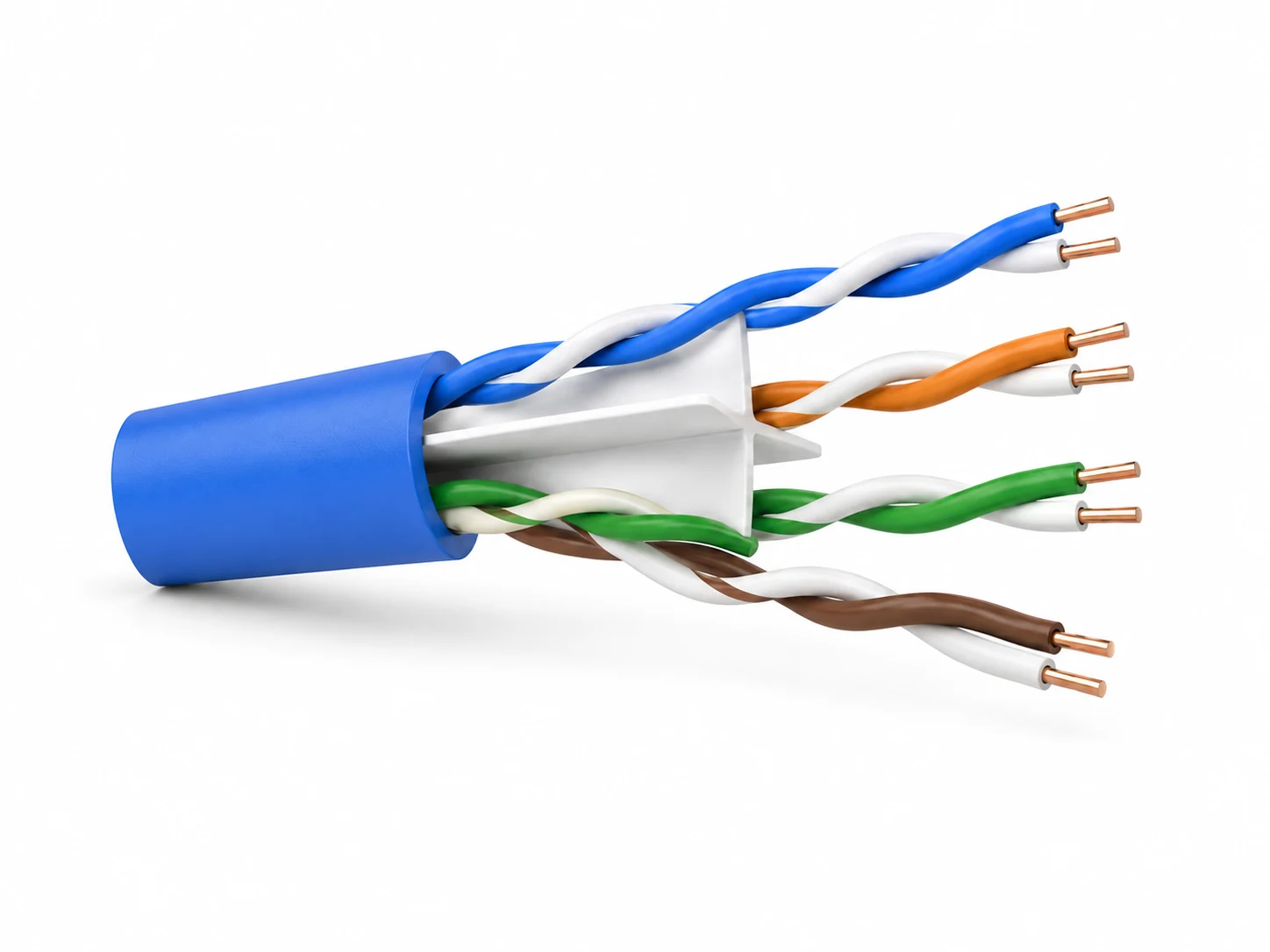
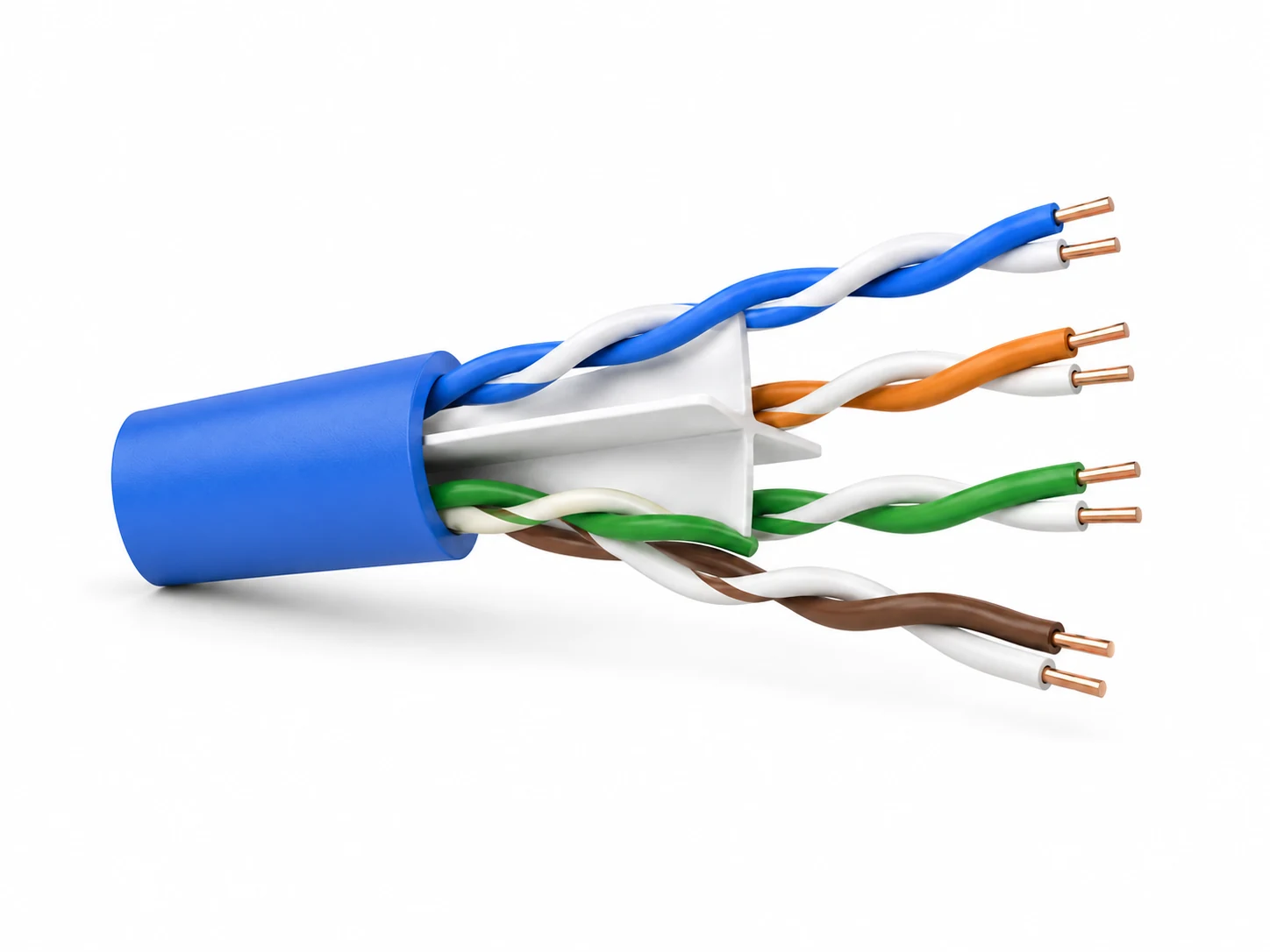
Existing HONGKAI 3D cable reference. The drawing illustrates one four-pair U/UTP construction; it does not prove a performance category or prescribe a separator for every cable.
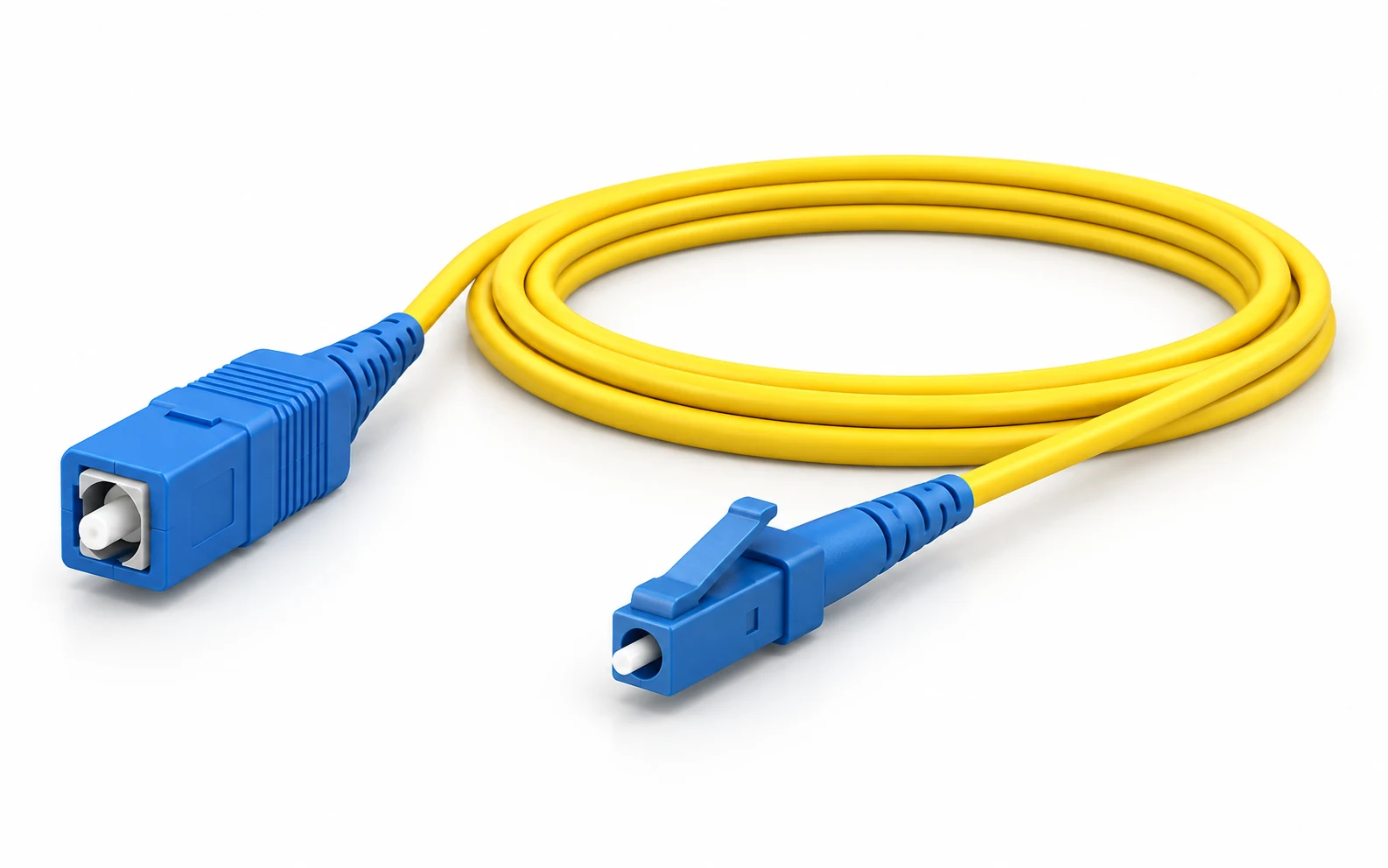
Write down the first saleable product rather than requesting a machine that makes “all network cables.” Is it bulk cable in boxes or reels, or a finished connectorized patch cord? Specify the conductor, insulation, screening where required, jacket, package length and acceptance requirements. A category label alone does not complete that definition.
A higher-performance cable is not just a different jacket marking. Review the required control of conductor and insulation geometry, pair lay, tension and any screening against the proposed construction. Then agree how the resulting cable will be tested. The Referensi rute produksi kabel LAN menjelaskan bagaimana persyaratan tersebut mengubah konfigurasi peralatan.
Cat6A should therefore be treated as a defined product-development and manufacturing requirement, not an automatic later setting on an unspecified Cat6 machine. Equally, do not rule it out solely because the factory is new if the buyer demand, engineering support, equipment scope and budget can support it.
Itu panduan pengujian kabel pabrik helps distinguish product and production-lot evidence from an installed-link test. Set the acceptance requirement before choosing equipment; a machine list does not replace a saleable-cable specification.
Ubah Permintaan menjadi Kebutuhan Produksi Bulanan
Target kapasitas memerlukan produk, unit, dan periode waktu. “Pabrik besar” atau “produksi berkecepatan tinggi” tidak cukup untuk menentukan berapa banyak mesin yang diperlukan.
For cable sold in boxes, start with the number of accepted boxes you need to ship and the length in each box. Keep different cable constructions on separate lines in the plan. If you sell finished patch cords, use the assembly quantities and lengths as well; the bulk-cable calculation is not the complete finished-cord capacity plan.
Hubungan perencanaan dasar adalah:
Panjang kabel layak jual yang dibutuhkan per bulan = paket yang direncanakan diterima per bulan × panjang kabel per paket.
For a mixed product plan, calculate each product separately and add the lengths only for a total demand summary. Do not assume different constructions use the same production speed or the same equipment time.
Gunakan lembar kerja permintaan-terhadap-kapasitas ini sebelum meminta jumlah mesin:
| Planning input | Apa yang harus dicatat | Mengapa hal ini mengubah rencana pabrik |
|---|---|---|
| Demand basis | Pesanan tetap, pesanan bersyarat, atau prakiraan pasar, dengan sumber dan waktunya | Memisahkan pekerjaan yang telah dikomitmeni dari asumsi |
| Product mix | Gambar atau spesifikasi kabel untuk setiap produk yang dimaksudkan | Produk yang berbeda mungkin memerlukan pengaturan, rute, dan pergantian yang berbeda |
| Shipping unit | Kotak, gulungan, atau kabel jadi, dengan panjang dan jumlah yang telah ditentukan | Mengonversi jumlah komersial menjadi kebutuhan produksi yang dapat digunakan |
| Working calendar | Hari kerja, shift yang diisi staf, dan jam per shift | Mengatur waktu yang tersedia sebelum berhenti dan pergantian |
| Tingkat produksi yang terbukti | Output yang diterima untuk produk dan proses yang ditentukan | Mencegah kecepatan maksimum brosur menjadi laju perencanaan |
| Kerugian dan waktu henti | Asumsi material awal, barang cacat, pengerjaan ulang, pergantian produk, dan perawatan | Shows how gross production differs from accepted output |
| Expansion scenario | Permintaan tambahan apa yang dapat membenarkan penambahan shift atau mesin lain | Memisahkan pertumbuhan di masa depan dari kapasitas awal yang telah dikomitmenkan |
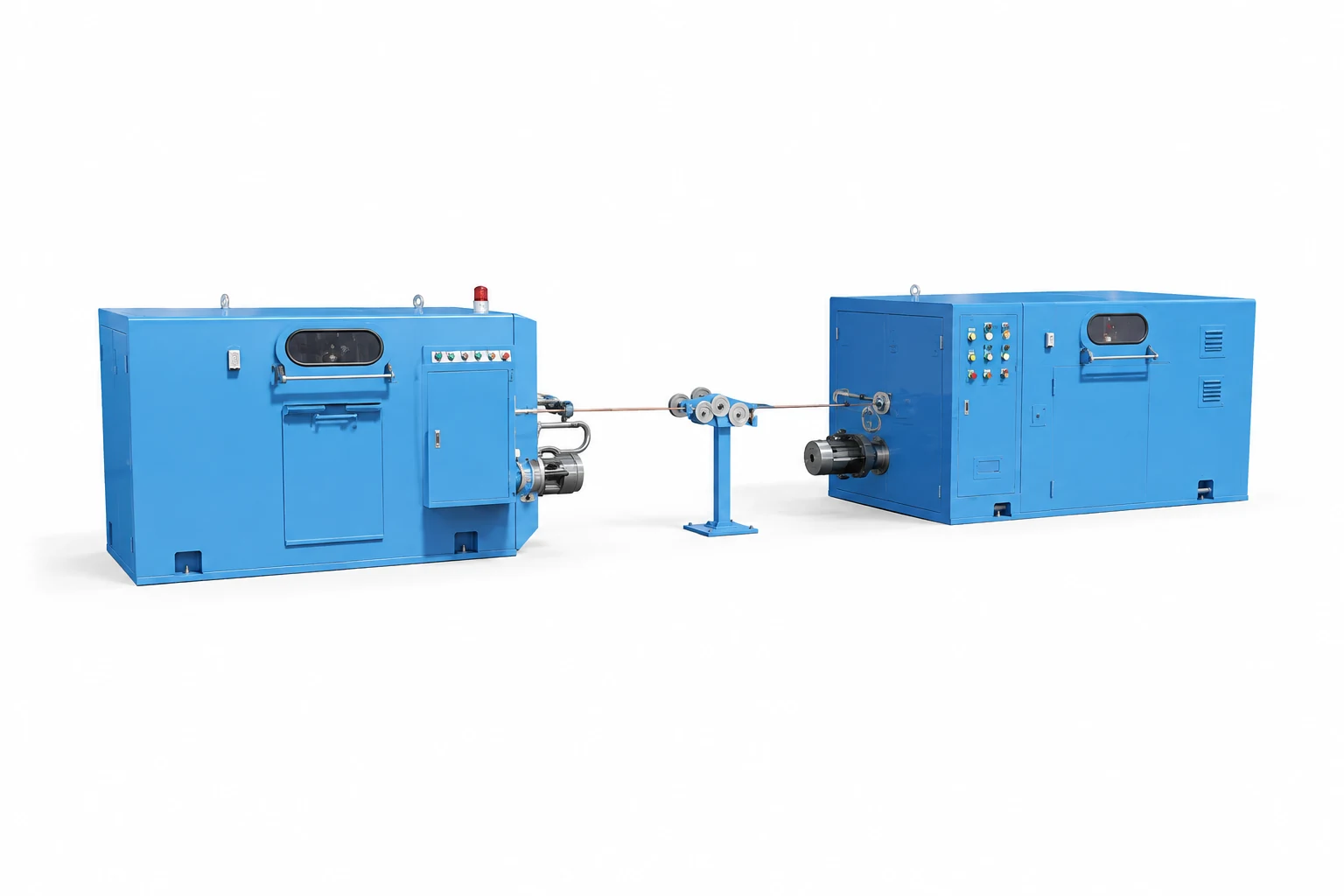
Existing HONGKAI equipment reference for discussing pair-twisting capacity. The image does not establish a production rate, required machine quantity or complete factory configuration.
Now check each production stage on a consistent basis. Insulation, pair twisting, cabling, sheathing, testing and packing do not all process the same intermediate product. Convert their outputs to the finished-cable requirement, using the approved construction and appropriate allowances. The slowest adequately supplied stage can limit the factory’s output.
Avoid counting a loss twice. For example, if a measured production figure already reports accepted output over a full shift, do not automatically deduct the same downtime and rejection allowance again. State what each figure includes before using it in a calculation.
For a project that is still exploratory, prepare a lower-demand and a higher-demand scenario with explicit assumptions. These are planning cases, not predictions or a promised return. Machine quantities remain to be confirmed per project.
Tentukan apakah akan membeli kawat tembaga berukuran atau menariknya sendiri di dalam pabrik.
Monthly copper demand also helps define where production should start. Compare buying copper wire already prepared to the required diameter and condition for insulation with adding an in-house drawing process. Do not include drawing equipment simply because the project is described as a complete cable factory.
Sebagai referensi perencanaan proyek HONGKAI, permintaan tembaga sekitar 4 metric tonnes per month or more is a point at which adding drawing equipment is worth evaluating. This is an experience-based starting point for a comparison, not an industry rule or a proven break-even threshold. Use the ongoing copper requirement, not finished-cable weight or a one-off stock purchase.
The comparison should examine possible savings in transport, time spent waiting for purchased wire and the cost of buying different wire diameters. Set those potential savings against the equipment investment and actual costs of operating the drawing process. A lower or uncertain volume does not automatically rule out drawing, but it is a reason to examine the purchased-wire option before committing to another process. Confirm the material and process scope before comparing quotations.
Anggaran untuk Pabrik, Bukan Hanya Mesinnya
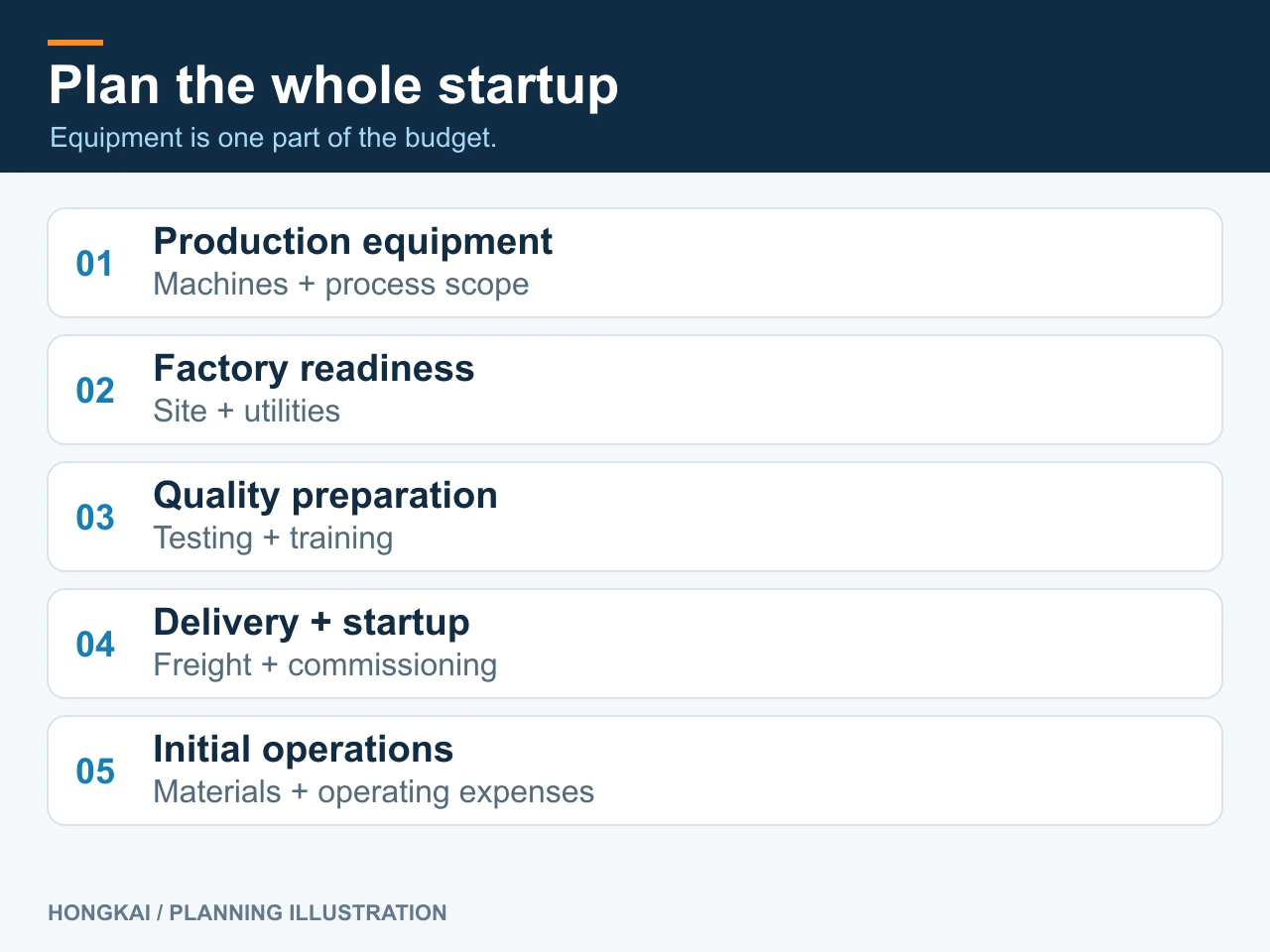
Ilustrasi cakupan anggaran. Kelompok-kelompok ini bukan merupakan jumlah atau proporsi yang dikutip; konfirmasikan biaya yang berlaku untuk proyek tersebut.
Kutipan peralatan adalah salah satu bagian dari anggaran startup. Kutipan tersebut, dengan sendirinya, tidak memberi tahu pemilik baru berapa banyak uang yang dibutuhkan untuk mencapai produksi stabil dan memenuhi pesanan pertama.
Pisahkan pengeluaran awal untuk penyiapan dari biaya-biaya yang terus berlangsung selama operasi. Ini juga merupakan perbedaan yang digunakan dalam panduan perencanaan biaya awal usaha oleh SBA.1 Gunakan sebagai metode penganggaran, bukan sebagai sumber harga lokal, perlakuan pajak, atau kelayakan pendanaan.
Untuk proyek kabel jaringan, tetap tampilkan grup anggaran berikut:
| Budget group | Ruang lingkup yang harus dikonfirmasi sebelum menggunakan total |
|---|---|
| Production equipment | Kawat yang dibeli siap untuk diisolasi dibandingkan dengan proses drawing yang disertakan; proses lainnya, jumlah mesin, peralatan, kontrol, dan lingkup pengemasan |
| Factory readiness | Tempat yang sesuai, tata letak, pasokan listrik, dan utilitas yang dibutuhkan oleh proses yang dipilih |
| Kualitas dan persiapan teknis | Peralatan uji, perlengkapan, metode, pelatihan operator, dan evaluasi eksternal yang diperlukan |
| Delivery and startup | Biaya pengiriman, biaya impor yang berlaku, tanggung jawab instalasi, komisioning, dan material uji coba |
| Initial operations | Bahan baku, kemasan, tenaga kerja, dan biaya operasional selama produksi dan pembayaran pelanggan berkembang |
Get current local and supplier inputs for the groups that apply. Mark exclusions instead of treating them as zero. A lower equipment price may simply leave more work, utilities, testing or startup support outside the quotation.
If the intended product needs UL Listing, include that preparation and the relevant external evaluation in the project scope. The panduan kesiapan kabel jaringan UL menjelaskan mengapa penerimaan mesin dan sertifikasi merupakan tanggung jawab yang terpisah. Jangan menambahkan paket sertifikasi universal ke setiap pasar atau produk.
When the budget does not cover the proposed scope, revisit the product range, starting material, output target or timing. Do not keep the original promise while silently removing the controls or tests needed to make the agreed cable.
Minta Proposal yang Sesuai dengan Kesiapan Anda
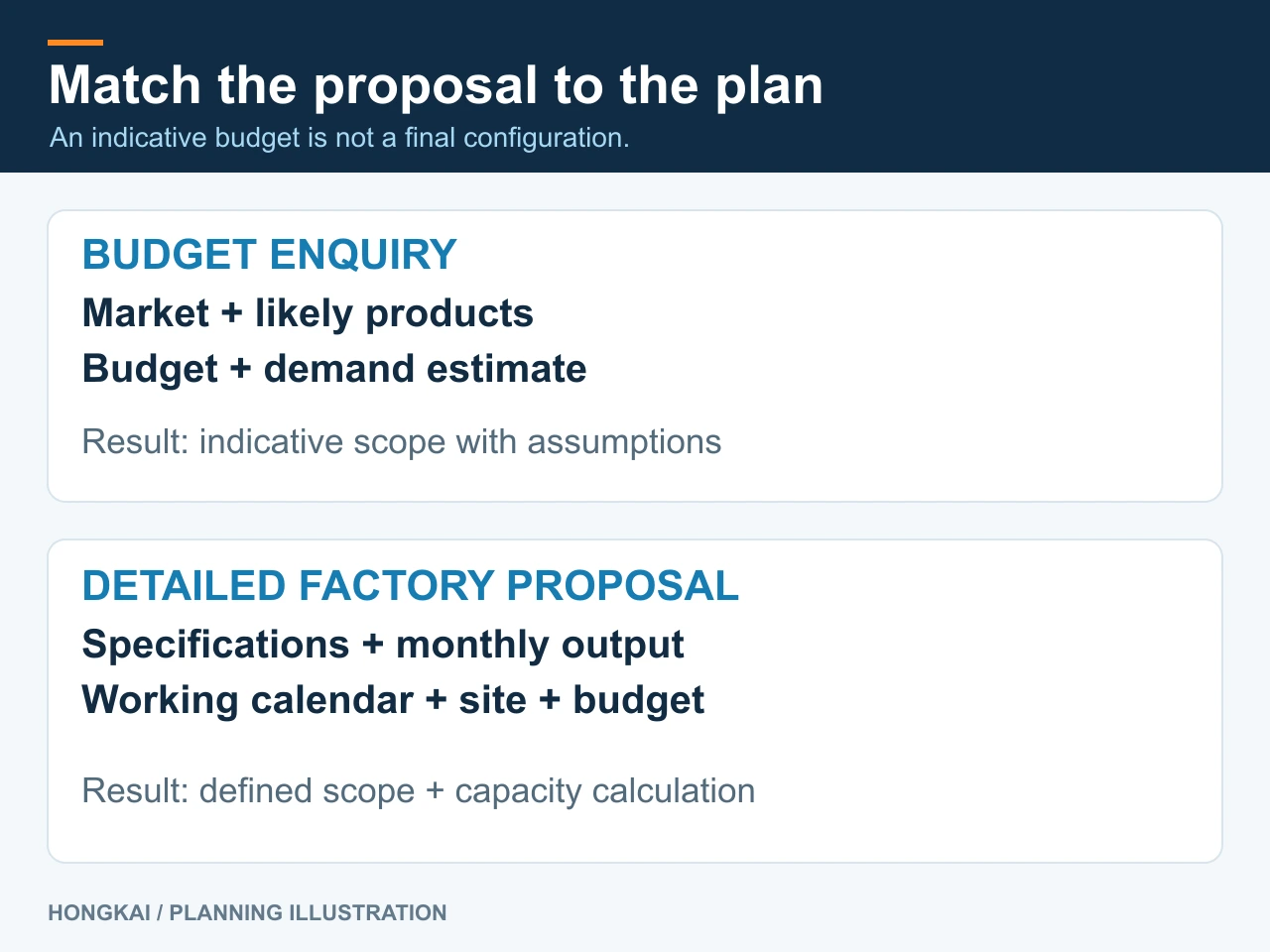
Discussion guide: an indicative budget and a detailed factory proposal answer different questions.
You do not need a final factory configuration to ask an initial investment question. But the answer should state what is known, what is assumed and what must be confirmed before equipment is ordered.
Ada dua cara berguna untuk menghadapi diskusi tersebut:
- Budget enquiry: name the target market, likely first products, available budget and any demand estimate. Ask for an indicative scope with its assumptions and exclusions. The purpose is to understand the scale of the project, not to approve a final machine quantity.
- Proposal pabrik terperinci: provide the product specifications, order or demand basis, monthly output by product, operating calendar, site conditions and budget boundary. Ask the supplier to connect each process to the production target and explain the capacity calculation.
Turn the discussion into a short project brief. For each unresolved input, write who will confirm it and how the answer changes the plan. A distributor can help verify customer requirements; the factory owner sets the investment boundary; technical personnel and the equipment supplier develop and check the production route. Those roles need actual people before startup, not just an assumption that the machines will resolve every gap.
The next step is not necessarily buying equipment. If demand is unclear, test the market. If the product is unclear, obtain the buyer’s specification. If the output is unclear, calculate it. Once those inputs are connected to a workable budget, the equipment discussion can become a factory plan with a clear purpose.
-
U.S. Small Business Administration — Plan your business, specifically “Market research and competitive analysis” and “Calculate your startup costs.” Used only for general market-research and one-time-versus-recurring cost-planning principles, not for cable demand, machine prices, local compliance, tax advice or investment returns. ↩ ↩