



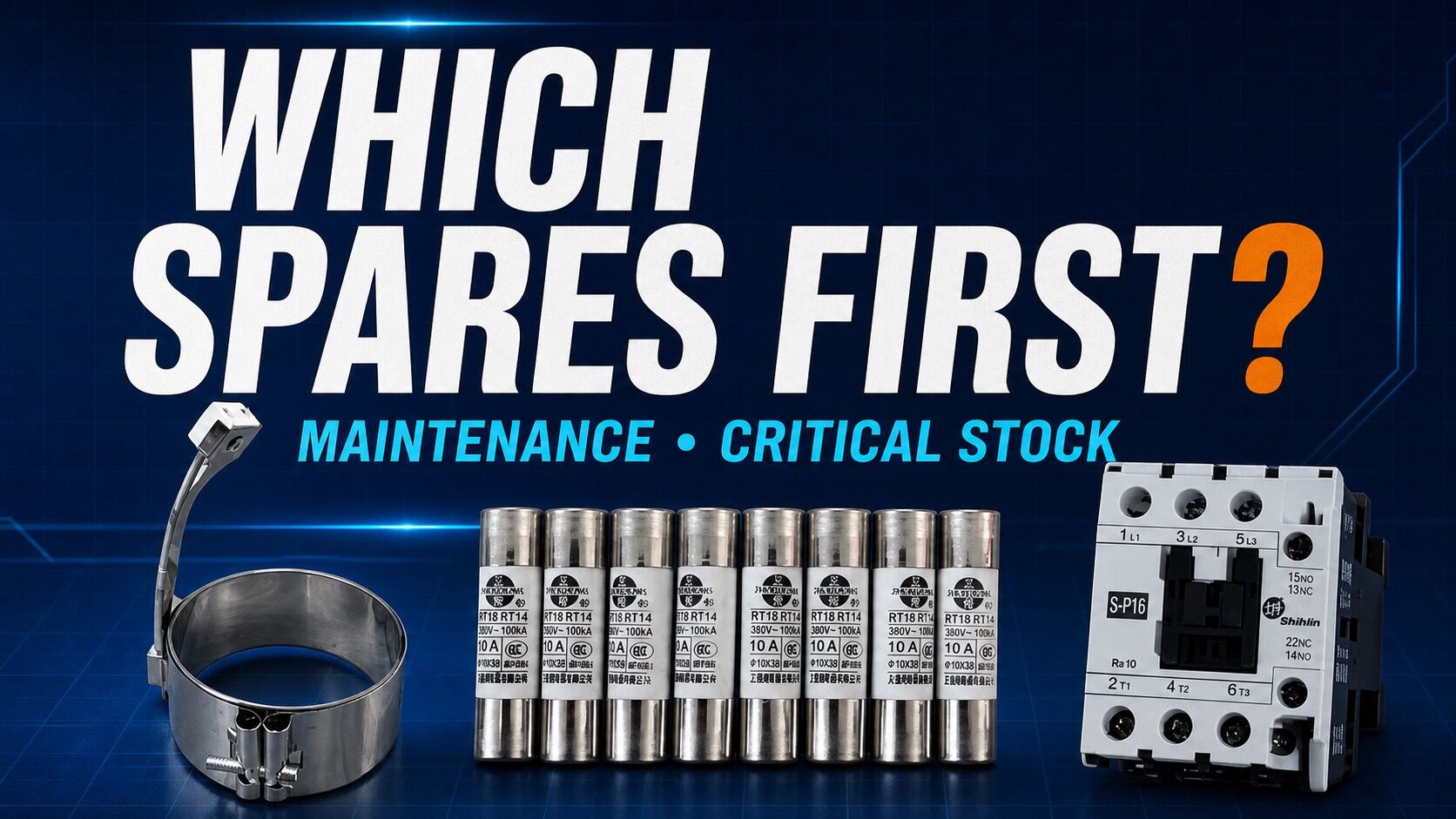
A cable factory should not build its maintenance system from a generic spare-parts catalog. The production manager first needs to know which assets stop saleable production, which conditions can be inspected, which work requires controlled isolation, and which replacement details must be frozen before a failure occurs.
A cable production line maintenance plan should connect each machine position to a safe task, inspection evidence, action limit, responsible person and exact spare-part identity. Critical stock is not simply the most expensive stock or the longest list; it is the smallest justified set of parts whose failure, sourcing difficulty and process consequence the factory cannot accept. Wear parts, repairable assemblies, control components and vendor-specific items should be reviewed separately. HONGKAI can help match parts to the confirmed machine and configuration, but the factory must set its final maintenance and inventory policy from real operating conditions and local safety requirements.

HONGKAI technical reference illustration of mechanical cable-machine parts. The image is a category guide, not a universal spare-parts kit for every production line.
This guide is for factory owners, production managers, maintenance teams and technical buyers who need a usable system before commissioning a new line or taking over an existing one. The decision is not whether to “buy more spares.” The decision is how to prevent an avoidable failure from becoming an uncontrolled repair, an untraceable quality change or an extended wait for an unidentified component.
Apa yang Harus Ditentukan Pabrik Sebelum Menyetujui Rencana Pemeliharaan Lini Produksi Kabel?
A factory should approve eight connected decisions: the asset register, safe-work boundary, process criticality, condition evidence, task ownership, spare-part identity, stock policy and supplier handover. These decisions turn a machine list into a controlled cable production line maintenance system. The same framework can cover extrusion, drawing, bunching, stranding, fiber processing, testing and handling while keeping every task configuration-specific. A proposed interval, action limit or stock quantity should remain project-specific until the machine documents and factory operating history support it.
1. Daftar Aset: Dapatkah setiap item yang dipelihara diidentifikasi pada posisi mesinnya yang tepat?
Why it matters: A maintenance request such as “replace the sensor” is not actionable when one production line contains multiple sensors, controllers, drives and tension zones. The asset register must connect the complete line, each machine unit, the installed assembly and the replacement component. Without that hierarchy, technicians can fit a visually similar part with a different range, signal, mounting, material or control behavior.
What to ask: Record the line name, machine model, serial or project identifier, unit position, equipment drawing reference, electrical designation, component manufacturer, complete part number, revision, quantity installed and photo. For tooling or mechanical parts, add the approved drawing, dimensions, material, surface treatment and mating component. For a HONGKAI replacement review, also provide the apparent cause of damage and clear photographs that show both the installed position and measured detail when the number or drawing does not identify the item completely. For software-controlled equipment, record the PLC, HMI and drive versions plus the controlled backup location without storing passwords in the maintenance register.
How to verify: Walk the physical cable production line with the signed equipment list, electrical drawings, manuals and packing list. Photograph nameplates and installed positions, then test whether a person who did not build the register can locate the correct item and its document. HONGKAI’s cable machine spare-parts hub organizes replacement enquiries by production process, part name, photos and machine identity; the factory register should retain all four paths.
Red flags: The register contains only generic names, photos omit the installed position, drawings have no revision, two different parts share one store label, or a supplier code cannot be traced to the original component specification.
2. Pekerjaan Aman: Apakah setiap tugas pemeliharaan terkait dengan metode pengendalian energi yang disetujui?
Why it matters: Cleaning, lubrication, adjustment and replacement can expose personnel to electrical, pneumatic, hydraulic, thermal, rotating, gravitational or stored-tension hazards. Pressing an HMI stop or emergency stop does not by itself prove that every hazardous energy source is isolated. The maintenance plan must be subordinate to the factory’s risk assessment, local law and machine-specific safe-work procedure.
What to ask: Define who may authorize, isolate, verify, test and return each machine to service. Identify main and secondary energy sources, stored-energy locations, isolation devices, discharge or restraint steps, test points, required tools and communication between operations and maintenance. State when guards may be removed and how a controlled test or positioning step is performed before isolation is reapplied.
How to verify: Conduct a documented field trial of each energy-control procedure with qualified personnel. IEC 60204-1:2016 with Amendment 1:2021 covers electrical equipment of machines from the supply connection and is a useful technical reference, while the applicable law and project risk assessment remain controlling.1 For factories subject to United States rules, OSHA 29 CFR 1910.147 requires an energy-control program, documented procedures in covered cases, training and verification before servicing.2
Red flags: The procedure says only “switch off power,” stored pneumatic or mechanical energy is not addressed, outside technicians follow a different isolation method without coordination, or production can restart the line while maintenance personnel remain exposed.
3. Tingkat Kritis: Kegagalan mana yang menciptakan konsekuensi produksi, keselamatan, atau kualitas yang tidak dapat diterima?
Why it matters: Not every installed component deserves the same stock or monitoring policy. A common fastener, a process-contact tool, a matched mechanical assembly and a discontinued controller create different consequences. Criticality should reflect what happens to people, product, traceability and the production route when the function is lost—not the visual size or purchase price of the component.
What to ask: For each asset or component, record the failure effect, whether the line can run safely, whether product made before detection must be contained, whether an approved temporary method exists, how the fault is diagnosed, whether repair is possible and what sourcing information is already available. Distinguish a line stop from a hidden quality drift. Name any single point whose loss blocks several downstream stages or makes retained product evidence unreliable. As a starting screen in HONGKAI spare-parts reviews, core electronic components and frequently used wear parts receive early attention; that is not a universal stock list, so the factory must still confirm process stoppage, interchangeability and whether a verified replacement can arrive inside its acceptable interruption window.
How to verify: Run a cross-functional review with production, quality, maintenance, safety and purchasing. Trace a failure from the machine position to cable dimensions, tension, temperature, surface, electrical result, marking, package or other controlled characteristic only when that relationship applies to the approved process. Require one written reason for every “critical” rating and one defined response for every detected condition.
Red flags: Every part is labelled critical, no quality consequence is considered, a bypass is accepted without technical approval, or the rating is copied from another factory whose line, materials and support network differ.
4. Bukti Kondisi: Pengamatan apa yang memberi tahu pabrik untuk memeriksa, menyesuaikan, atau mengganti?
Why it matters: Calendar-only maintenance can create unnecessary intervention while still missing deterioration between intervals. Condition monitoring is useful only when the factory defines the parameter, measurement method, baseline, trend, action boundary and response. Vibration, temperature, current, pressure, tension, wear, leakage, surface condition and product measurements are different evidence streams and should not be mixed without a stated relationship.
What to ask: For every monitored item, name the failure mode, observable condition, instrument or inspection method, measurement position, operating condition, unit, baseline source, review owner and action rule. Link process measurements to the cable specification where a component can cause gradual quality change. Mark conditions that require an immediate safe stop separately from those that trigger planned inspection.
How to verify: Repeat the measurement under comparable machine and production conditions, retain the raw result and confirm that different qualified people can apply the method consistently. Treat a production alarm that continues to recur as a trigger for controlled diagnosis rather than repeated reset. For an extrusion line, a heating zone that cannot reach its setpoint, unstable material output or a new noise traceable to the equipment interior justifies investigation, but none of those observations alone identifies the failed part or authorizes continued production. ISO 17359:2018 gives general procedures for establishing a machine condition-monitoring program and remains current after ISO’s 2023 review.3 The standard supplies a framework, not universal alarm values for a cable production line.
Tanda merah: Rencana menyatakan “periksa secara teratur” tanpa metode, pembacaan portabel tidak memiliki posisi pengukuran, ambang batas berasal dari mesin yang tidak terkait, atau cacat produk dianggap sebagai peringatan pertama yang dapat diterima terhadap penurunan peralatan.
5. Rencana Tugas: Apakah tugas pemeliharaan, bukti, dan kepemilikan dapat digunakan di lantai pabrik?
Mengapa penting: Jadwal pemeliharaan gagal ketika hanya mencantumkan aktivitas tanpa kondisi aman, bukti penerimaan, atau tanggung jawab. “Lumasi bantalan” tidak lengkap jika pelumas, titik, keadaan mesin, jumlah, kontrol kontaminasi, dan catatan tidak diketahui. “Periksa keselarasan” tidak lengkap jika referensi, metode, dan batas tindakan tidak tersedia.
What to ask: Write each task with its asset, purpose, trigger or approved interval, prerequisites, isolation state, tools and materials, procedure reference, expected condition, action if outside the limit, record and responsible role. Separate operator care, planned maintenance, condition-based inspection, calibration, safety-device verification, controlled cleaning and corrective repair. For a HONGKAI cable extrusion line, the initial review covers the extrusion section, traction equipment, guide wheels, gearbox, screw and cooling trough; repeated-motion components need inspection and upkeep, while the screw, trough and other material-contact areas also need controlled cleaning. Use the installed extruder, processed material, manufacturer instruction and approved factory method to set the exact task, interval and acceptance condition rather than applying one schedule to every line.
Cara memverifikasi: Amati orang yang ditugaskan melakukan tugas menggunakan instruksi terkontrol. Konfirmasi bahwa catatan mengidentifikasi aset, kondisi yang ditemukan, pekerjaan yang selesai, suku cadang yang digunakan, hasil pengukuran, masalah yang belum terselesaikan, dan persetujuan kembali ke layanan. Tinjau apakah tugas itu sendiri mengubah perkakas, keselarasan, resep, posisi sensor, atau kondisi lain yang memerlukan pemeriksaan produk atau proses setelahnya.
Tanda merah: Tugas tidak memiliki revisi dokumen, operator menandatangani pekerjaan yang tidak dapat mereka lakukan, kelengkapan dicatat tanpa kondisi yang ditemukan, atau lini yang diperbaiki kembali ke produksi tanpa memeriksa karakteristik kabel yang terpengaruh.
6. Identitas Suku Cadang: Dapatkah pembelian mendapatkan pengganti yang fungsional benar sebelum terjadi kegagalan?
Mengapa penting: Suku cadang berguna hanya ketika identitas dan kompatibilitasnya dikonfirmasi. Bentuk yang tampak sama dapat menyembunyikan perbedaan tegangan, arus, suhu, sinyal, akurasi, rentang, bahan, kekerasan, geometri, arah, konektor, firmware, atau detail pemasangan. Pembelian darurat menciptakan risiko tertinggi ketika suku cadang yang gagal harus terlebih dahulu direkayasa ulang di bawah tekanan waktu.
Apa yang harus ditanyakan: Bekukan pabrikan asli dan nomor suku cadang yang sesuai, plus fungsi, spesifikasi teknis, gambar, foto, pelat nama, rencana konektor atau terminal, dimensi pemasangan, suku cadang pasangan, dan aturan pengganti yang disetujui. Untuk perkakas aus, simpan referensi suku cadang baru dan produk kabel atau sistem bahan yang geometrinya disetujui. Untuk item mekanis khusus, identifikasi apakah HONGKAI memerlukan sampel, gambar, dimensi terukur, atau ketiganya.
How to verify: Compare the proposed spare with the installed item and project documents before ordering. After receipt, inspect identity and critical dimensions, then store the evidence with the stock record. The HONGKAI spare-parts process accepts machine brand and model, part description, key dimensions, photos or drawings because no single identifier is reliable for every legacy or custom component. The request should also distinguish handling damage, misuse, normal wear and a suspected quality issue so the review can determine whether replacement alone is reasonable or whether the installation, operating condition or mating assembly needs examination. A photograph without the machine position and measured detail is not sufficient for many custom or legacy parts.
Tanda merah: Pengganti dipilih hanya dari foto online, gambar asli tidak tersedia, inspeksi masuk hanya memeriksa kuantitas, atau suku cadang khusus pertama kali dipasang selama henti tak terjadwal.
7. Kebijakan Stok: Suku cadang mana yang harus disimpan, dipantau, diperbaiki, atau dipasok sesuai permintaan?
Mengapa penting: Tingkat kritisitas saja tidak menentukan persediaan. Pabrik juga harus mempertimbangkan detektabilitas kegagalan, jumlah yang terpasang, interkatabilitas, persyaratan pelestarian, opsi perbaikan, status pemasok, kendala transportasi dan bea cukai, pengganti yang disetujui, dan buffer produksi yang tersedia untuk rute yang terpengaruh. Gudang besar tetap bisa gagal jika barang yang dibutuhkan tidak teridentifikasi, rusak, atau dipesan untuk mesin lain.
Apa yang harus ditanyakan: Tetapkan setiap item yang ditinjau ke strategi yang jelas: konsumibel operasional, stok keausan terjadwal, suku cadang asuransi kritis, perakitan yang dapat diperbaiki, suku cadang interchangeable bersama, suku cadang yang dipegang pemasok atau dibuat sesuai pesanan, atau item non-stok dengan berkas sumber daya lengkap. Catat data tinjauan minimum tanpa memaksakan kuantitas universal. Sertakan kondisi simpan, perlindungan lingkungan, rotasi, inspeksi, kompatibilitas firmware atau perangkat lunak, dan tinjauan obsolesensi jika berlaku.
How to verify: Test the stock decision against realistic failure scenarios and the factory’s production plan. Treat the basic spare set supplied with a new HONGKAI machine as a starting package, then review the commonly worn parts on the exact supplied configuration and agree any additional initial stock before shipment. Current HONGKAI control projects commonly select Siemens PLC hardware, which may be available through local channels, but the exact model, program, revision and local availability still require confirmation; discuss a production-stopping or ageing part early enough to establish a compatible reserve or replacement path. Confirm that the physical shelf item matches the digital register and that reserved parts are not silently consumed by another line. Reassess the strategy when the cable mix, operating load, equipment revision, supplier status or acceptable production interruption changes.
Tanda merah: Jumlah stok disalin dari pemasok tanpa tinjauan konsekuensi, suku cadang elektronik disimpan tanpa catatan kompatibilitas, segel atau senyawa menua tanpa disadari, atau perakitan kritis satu-satunya sudah terpasang pada mesin lain.
8. Serah Terima: Apakah pemasok memberikan catatan yang diperlukan untuk memelihara dan memulihkan lini?
Mengapa ini penting: Sebuah pabrik tidak dapat mempertahankan lini produksi kabel hanya dari kutipan penjualan. Serah terima harus mencakup gambar, manual, identitas komponen yang terpasang, cadangan, daftar alat dan suku cadang, prosedur aman, bukti pemecahan masalah, dan isu-isu yang belum terselesaikan. Pelatihan yang hanya mencakup start-up normal membuat tim pemeliharaan bergantung pada insinyur yang berkunjung.
Apa yang harus ditanyakan: Mintalah gambar mekanis dan listrik terkini, manual operasi dan pemeliharaan, informasi pelumasan, panduan alarm dan pemecahan masalah, daftar komponen dan suku cadang, gambar perkakas, cadangan perangkat lunak dan resep, kontrol perubahan parameter, catatan pelatihan, rute kontak layanan, dan daftar item terbuka terakhir. Sebutkan pemilik file, revisi, dan lokasi penyimpanan. Pisahkan peralatan yang diproduksi oleh HONGKAI- dari peralatan spesialis terintegrasi agar tanggung jawab dan sumber suku cadang tetap terlihat.
How to verify: During FAT and site handover, select sample faults and parts from different line sections. Ask factory personnel to identify the machine position, find the correct drawing, isolate the equipment, locate the approved spare, explain the verification step and restore the documented configuration. A previous verified HONGKAI installation package included installation drawings, operating manuals, electrical diagrams and packing information; the final project list still needs to match the exact supplied line. Release a repaired machine only after the fault is cleared, operation is stable, no abnormal condition remains and the required process or finished-product checks for the affected function have passed. A machine that merely restarts while alarms, unstable output, abnormal noise or quality uncertainty remain is not ready for released production.
Tanda bahaya: Cadangan hanya tersimpan di laptop pemasok, daftar suku cadang tidak mencantumkan posisi terpasang, gambar tidak mencerminkan perubahan di lokasi, mesin terintegrasi tidak memiliki pemilik dukungan yang ditentukan, atau alarm yang belum terselesaikan menghilang dari catatan serah terima yang ditandatangani.
Catatan: Rencana pemeliharaan menjadi dapat diaudit ketika setiap tugas dan suku cadang dapat dilacak dari mesin fisik hingga bahaya, mode kegagalan, bukti, tindakan yang disetujui, dan catatan kembali ke layanan.
Kelompok Suku Cadang Apa yang Harus Ditinjau Pabrik Kabel Berdasarkan Proses Produksi?
Pabrik kabel harus meninjau suku cadang berdasarkan posisi proses dan fungsi kegagalan, bukan dengan satu kit universal. Ekstrusi, pemrosesan serat, pelintiran, penarikan, penanganan, dan sistem kontrol mengekspos bagian-bagian berbeda terhadap panas, gesekan, tegangan, kontak material, gerakan, dan beban listrik. Tabel di bawah ini adalah peta tinjauan, bukan rekomendasi stok. HONGKAI harus mengonfirmasi suku cadang akhir, jumlah, dan kompatibilitasnya terhadap konfigurasi peralatan yang disetujui dan daftar pengemasan.
| Area proses | Kelompok suku cadang yang perlu ditinjau | Bukti pembeli yang diperlukan sebelum stok | Mengapa keputusan akhir tetap spesifik proyek |
|---|---|---|---|
| Ekstrusi dan pelapisan | Sekrup dan barrel; crosshead dan mati; pemanas pita atau pelat; termokopel; item yang terkait dengan leburan atau tekanan jika dipasang; sabuk haul-off | Model ekstruder dan crosshead, sistem polimer, gambar perkakas, peringkat pemanas, jenis sensor, posisi terpasang, dan dimensi pasangan | Kontak material, pola keausan, konstruksi pemanas, dan geometri perkakas berubah sesuai dengan ekstruder dan desain kabel |
| Pewarnaan serat dan tabung longgar | Mati pewarna; panduan serat; PBT atau perkakas tabung longgar; bagian kontrol tegangan; sensor dan pemanas yang disetujui jika dipasang | Jalur serat, gambar mati atau perkakas, konstruksi tabung yang disetujui, dimensi panduan, fungsi tegangan, dan identitas perangkat yang tepat | Perbedaan kecil pada geometri atau permukaan dapat memengaruhi proses serat atau tabung yang sensitif |
| SZ pelintiran dan pemintalan | Roda pandu; pandu keramik; penegang; rem magnetik atau kopling; pengikat; bobin dan antarmuka gulungan | Posisi pelepasan dan pelintiran, profil pandu, peringkat rem atau kopling, gambar gulungan, arah dan antarmuka kontrol | Nama bagian yang sama dapat melayani zona ketegangan, paket, dan struktur kabel yang berbeda |
| Pembuatan dan anil kawat | Cetakan pembuat; cincin pandu atau capstan; roda anil; segel dan suku cadang terkait pelumasan yang ditentukan oleh mesin | Bahan dan jangkauan kawat, jadwal cetakan, pembuatan roda atau cincin, spesifikasi pendinginan dan pelumasan, identitas mesin yang terpasang | Keausan, permukaan, dan kontak listrik bergantung pada sistem pembuatan dan anil yang sebenarnya |
| Listrik dan kontrol | Fus; kontaktor; relai; tombol; encoder; sensor; pengontrol suhu; modul VFD, PLC, atau HMI bila disetujui | Nomor bagian lengkap, peringkat listrik, jenis I/O atau sinyal, rencana terminal, cadangan program atau parameter, revisi, dan pengganti yang disetujui | Housing yang serupa tidak membuktikan kompatibilitas fungsional atau perangkat lunak |
| Pneumatik, pendingin, dan utilitas | Pipa, fitting, katup, filter, pompa, segel, dan suku cadang antarmuka utilitas yang termasuk dalam proyek | Medium, tekanan atau suhu dasar, bahan, ukuran port dan pipa, arah aliran, kompatibilitas segel, dan posisi mesin | Desain dan bahan utilitas bervariasi menurut jalur, lokasi, dan konfigurasi yang disetujui |
| Peralatan, fastener, dan alat pemeliharaan | Cetakan khusus produk; alat standar dan khusus; sekrup dan suku cadang pengencang yang disetujui | Daftar alat, torsi atau instruksi penggunaan bila diperlukan, revisi gambar, spesifikasi kabel, dan kontrol penyimpanan | Sebuah alat atau cetakan mungkin khusus produk meskipun tampak secara mekanis sederhana |
Verified HONGKAI project documents show why a generic list is unsafe. One PY-70+35 cable-extrusion project included a machine-neck heating film, eye-mould heating ring, K-type thermocouples, fuses, potentiometers, buttons and a heating contactor in its supplied spare set. A separate verified indoor fiber-cable configuration described standard tools, selected tubing and fasteners, product-specific moulds, crosshead heating items, source-specified thermocouples, selected electrical spares and document packages. These are configuration examples, not a promise that the same kit, quantities or component identities suit another cable production line.
The buyer should also separate stocking from identification. A custom extrusion die may be planned as a controlled wear item; a large mechanical assembly may be documented for repair or made-to-order supply; a common electrical device may be stocked only after its rating, program and substitute rule are confirmed. The correct policy follows the failure consequence and recovery path, not the category name.
Note: The most useful spare-parts list does not begin with quantity—it begins with the installed position, exact function, compatibility evidence and recovery strategy.
Apa Bukti Pemeliharaan dan Suku Cadang yang Harus Dimasukkan ke dalam RFQ, FAT, dan Serah Terima?
A buyer should require maintenance and spare-parts evidence before the cable production line leaves the supplier, then verify the same evidence during FAT and site handover. The RFQ should define document scope, identification rules, training, initial spare review and responsibility for integrated equipment. FAT should prove that records match the supplied configuration, while handover should prove that factory personnel can use them. The list below is a procurement control, not a substitute for the factory’s safe-work system or project-specific maintenance instructions.
- ☐ Complete production-line and machine-unit asset hierarchy
- ☐ Signed equipment list with manufacturer, model and source attribution
- ☐ Current mechanical, electrical, pneumatic and utility drawings
- ☐ Installed-component list with part numbers, ratings and machine positions
- ☐ Product-specific tooling list and controlled drawings
- ☐ Instruksi operasi, pembersihan, pelumasan, dan pemeliharaan
- ☐ Informasi isolasi energi spesifik mesin dan pemilik prosedur lokasi
- ☐ Referensi alarm, kesalahan, dan pemecahan masalah dengan jalur escalasi
- ☐ PLC, HMI, cadangan drive, resep, dan parameter di bawah kendali revisi
- ☐ Titik pemantauan kondisi, metode, dan aturan tindakan yang disetujui proyek
- ☐ Tanggung jawab kalibrasi dan verifikasi fungsi keselamatan
- ☐ Usulan suku cadang awal dengan alasan tertulis untuk setiap item kritis
- ☐ Klasifikasi suku cadang: aus, diperbaiki, dapat ditukar, dibuat sesuai pesanan, dan tidak tersedia di stok
- ☐ Metode inspeksi masuk untuk suku cadang khusus dan sensitif terhadap kompatibilitas
- ☐ Persyaratan penyimpanan, pelestarian, rotasi, dan tinjauan usang
- ☐ Tanggung jawab pemasok dan pabrik untuk peralatan spesialis terintegrasi
- ☐ Catatan pelatihan operator dan pemeliharaan menggunakan jalur yang benar-benar disuplai
- ☐ FAT penyimpangan, alarm yang belum terselesaikan, dan item terbuka yang terkait dengan pemilik yang bertanggung jawab
Di FAT, pilih sampel dari beberapa area proses alih-alih hanya meninjau karton suku cadang. Cocokkan satu item perkakas dengan gambar dan kabel yang disetujui, satu item listrik dengan penunjukan dan peringkatnya, satu item mekanis dengan posisi pemasangannya, dan satu cadangan dengan revisi pengontrol yang sebenarnya. Konfirmasi bahwa kuantitas dan identitas sesuai dengan daftar pengepakan terakhir, tetapi jangan menganggap kesesuaian daftar pengepakan sebagai bukti kompatibilitas fungsional.
Pada serah terima lokasi, hubungkan dokumen dengan pekerjaan. Seorang teknisi yang berkualifikasi harus mampu menemukan catatan kesalahan, menemukan posisi mesin, menerapkan prosedur aman yang disetujui, mengidentifikasi suku cadang pengganti, mencatat pekerjaan, dan menjelaskan bukti proses atau produk apa yang diperlukan sebelum produksi dilanjutkan. Manajer produksi juga harus mengetahui item mana yang merupakan stok pabrik, sumber pemasok, dapat diperbaiki, atau dalam proses, serta jalur atau produk mana yang akan terdampak oleh kehilangannya.
Untuk jalur yang sudah ada, kirim foto yang jelas, nama piring, gambar, dimensi, dan lokasi pemasangan melalui halaman permintaan HONGKAI project enquiry page sebelum mengasumsikan kompatibilitas. Untuk jalur baru, lampirkan daftar periksa ini ke RFQ dan wajibkan pemasok untuk mengembalikan matriks suku cadang dan dokumentasi khusus proyek. Kuantitas tepat, interval penggantian, waktu tunggu, dan tingkat stok masih perlu dikonfirmasi per proyek.
Catatan: Kesiapan pemeliharaan terbukti ketika pabrik dapat mengidentifikasi, mengisolasi, mendiagnosis, mengganti, memverifikasi, dan mendokumentasikan komponen tanpa kehilangan kendali atas keselamatan atau bukti produk.
-
IEC 60204-1:2016, Keselamatan mesin — Peralatan listrik mesin — Bagian 1, dengan Amandemen 1:2021 available from the same official IEC publication record. The standard covers electrical, electronic and programmable electronic equipment of machines from the supply connection. ↩
-
OSHA 29 CFR 1910.147, The control of hazardous energy. This United States rule applies to covered servicing and maintenance; factories elsewhere must follow their applicable law and approved risk controls. ↩
-
ISO 17359:2018, Condition monitoring and diagnostics of machines — General guidelines. ISO states that the third edition was confirmed in 2023 and remains current. ↩
