


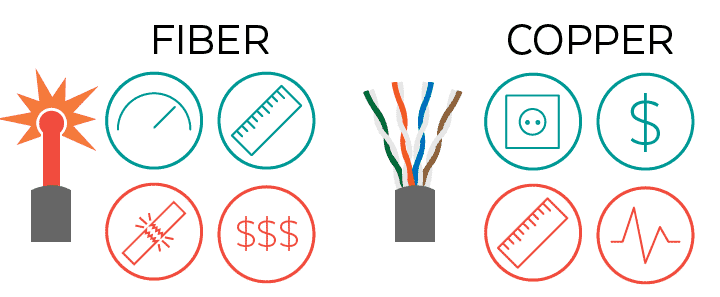
Is copper wire more expensive than fiber optic cable? There is no single answer without specifying the cable and the job it must do. A useful comparison separates cable purchase price from the cost of the complete installed system.
For communications, compare copper and fiber links against the same requirements for reach, capacity and installation conditions. For electrical power delivery, optical fiber is not a direct substitute for a copper conductor. Specify the application before comparing quotations.
As seções abaixo explicam os principais fatores de custo, distinguem as aplicações comuns e mostram quais detalhes incluir em uma cotação de cabo equivalente.

Preços de cabos de fibra óptica:
Como um exemplo histórico, Atlantech’s July 2022 installation-cost guide cited cable material costs of $1 per foot for 24 fibers and $6 per foot for 288 fibers. These are source-specific historical figures, not a current HONGKAI quotation or a universal market price. Compare current quotations using the same cable specification and length unit. A complete building installation has additional costs that depend on the following factors:
Área/Tamanho do edifício:
Especifique a contagem de fibras com base no layout da rede, nas conexões e na capacidade de reserva planejada. O tamanho do edifício por si só não determina quantas fibras são necessárias; o orientação de projeto de rede FOA começa com os requisitos reais de comunicação e rota.
Obstáculos físicos:
Levante a rota antes de estimar o custo de instalação. Escavação, travessias aquáticas, restrições de acesso e licenças podem acrescentar trabalho que é separado da compra do próprio cabo.
Distância da fibra iluminada mais próxima:
For a service connection, ask the network provider whether a nearby fiber route is available for your premises and obtain a site-specific connection quotation. Proximity alone is not a sufficient basis for a cost estimate. For a private network, price the planned route and equipment instead.
Cenários para uso de fibra óptica:
Fibras ópticas servem comunicações e outras aplicações, including sensing and light delivery. These uses require different components and system designs. A specialized medical or sensing application does not establish the suitability of an ordinary telecommunications cable for the same task.
Área Médica:
Guias de luz especializados em fibra óptica fornecem iluminação, e conjuntos de guias de imagem podem transmitir imagens em endoscópios. Visão geral de endoscopia da SCHOTT distingue esses componentes. Eles são ópticas médicas projetadas especificamente, não intercambiáveis com cabos de rede comuns.
Transmissão de dados:
Communications fiber carries optical signals between transmitters and receivers. Link reach depends on the fiber, operating wavelength, transceivers and total optical loss; it is not a fixed property of every cable sold as fiber optic cable.

Uso industrial:
Sistemas de sensoriamento por fibra óptica podem medir temperatura, deformação ou vibração. À medida que o Introdução da FOA aos sensores ópticos explica que a fibra pode atuar como o elemento sensor ou conduzir luz até um sensor separado. Um sistema completo de medição exige mais do que um comprimento de cabo.
Defesa:
Specialized fiber-optic acoustic sensors can be used in underwater sensing arrays. This is a particular sensor-system application, not a capability of every communications cable. Cable selection alone does not define the sensing function or its performance.
Especificações da fibra óptica:
Fiber optic links transmit information using light. Glass and plastic describe fiber materials; singlemode and multimode describe how light propagates. These classifications should not be treated as interchangeable performance ratings.
Tipos de fibra óptica:
A comparação de materiais abaixo abrange dois grupos:
· Fibras ópticas plásticas
· Fibras ópticas de vidro
O Guia de fibra óptica FOA explica as classificações e aplicações das fibras. O seu guia do data-link explains why transmission rate depends on the complete link, not the material name alone.
| Comparison point | Glass optical fiber | Plastic optical fiber (POF) |
|---|---|---|
| Material | Glass core; check the specified core and cladding design | Polymer fiber; check the specific POF grade |
| Fiber design | Singlemode and multimode options | Different index profiles exist; identify the actual type |
| Application examples | Telecom and premises-network links, depending on fiber type | Conventional POF is used in short links, including consumer audio |
| Data-rate selection | Match fiber bandwidth, link loss, distance and transceivers | Match the POF grade, link loss, distance and transceivers |
For either material, request the finished cable’s bend-radius, pulling-tension and temperature limits. Do not assume that all glass cables are fragile or that plastic cables are bend-proof. Compare the complete installed system when evaluating cost, rather than assigning a universal cheaper or more expensive label.
Preço do fio de cobre:
There is no single per-meter price for copper cable. Request a dated quotation for the exact construction, length and order quantity, and check whether connectors, freight and taxes are included. Compare cable material prices separately from the cost of an installed, tested link. The three cable types below require different quotation details:
Cabo de par trançado:
For twisted-pair cable, specify the application and cable category where applicable, conductor material and size, pair count, shielding and jacket requirements. Ask whether the quotation is for bulk cable or a terminated assembly, and confirm the supplied length and minimum order quantity before comparing unit prices.
Cabo plano multicondutor:
For multi-conductor flat cable, state the conductor count, conductor size, pitch, insulation and required connector compatibility. Confirm whether the supplier is pricing a reel of cable, a cut length or a finished assembly. Compare quotations only after those details and the order quantity are aligned.
Cabo coaxial:
For coaxial cable, identify the impedance, operating frequency, acceptable attenuation, conductor and shield construction, jacket and required length. Specify any connectors and their termination requirements separately. A quotation for a different cable construction or assembly length is not a like-for-like cost comparison.
Cenários para uso de fios de cobre:
Copper’s electrical conductivity makes it useful for power conductors, winding wire and communications cables. The Copper Information Center’s properties and applications guide describes these uses. The required conductor size, insulation and construction still depend on the application.
Eletroímãs:
A current flowing through a wire coil creates a magnetic field. Copper winding wire is used in electromagnets, including electromagnetic locks and lifting magnets. The complete device design determines its force and operating limits.
Motores:
Copper winding wire is widely used in electric motors for applications such as pumps, household appliances and fans. A motor winding is a different product from an insulated building wire or a communications cable, so their prices should not be treated as interchangeable.
Transformadores:
Transformers can use copper or aluminum windings. For example, Schneider Electric’s winding-material guidance identifica a construção de modelos específicos de transformadores. Verifique o material do enrolamento especificado em vez de assumir que todos os transformadores são fabricados com cabo de cobre.
Telecomunicação:
Copper communications cables carry electrical signals. Twisted-pair and coaxial cables are common examples, but the supported service and distance depend on the cable specification and connected equipment. A generic multi-conductor flat cable is not automatically suitable for a telecommunications link.

Especificações do fio de cobre:
A seguir estão três construções de cabos de cobre, não uma classificação por capacidade de dados. Suas aplicações e limites dependem do cabo específico e dos equipamentos conectados:
· Cabo de par trançado · Cabo plano multicondutor · Cabo coaxial
Use the comparison below as a specification checklist. The manufacturer examples linked after the table illustrate particular products; they are not ratings for every cable in that group.
| Comparison point | Cabo de par trançado | Cabo plano multicondutor | Cabo coaxial |
|---|---|---|---|
| Construção | Condutores isolados dispostos em pares torcidos | Parallel conductors joined by insulation; ribbon designs are one example | Condutor central, isolamento dielétrico e uma blindagem condutiva externa |
| Application example | Cabeamento Ethernet com uma categoria especificada e aplicação suportada | Wire-to-board connections using compatible connectors | Conexões RF entre equipamentos e antenas |
| Performance checks | Categoria do cabo, aplicação Ethernet suportada e comprimento de canal permitido | Conductor size, pitch, connector compatibility and circuit requirements | Impedância, atenuação na frequência de operação e comprimento do cabo |
| Handling checks | Siga o raio de curvatura e os limites de tração do cabo durante a instalação | Check the product’s flexibility and suitability for repeated movement | Siga o raio de curvatura especificado; o cabo coaxial não é universalmente rígido |
Manufacturer examples: Belden 2142A Category 6A cable lista as aplicações Ethernet suportadas; 3M 3365 flat cable descreve uma construção flexível em fita para conexões fio-placa; Belden 8259 coaxial cable especifica aplicações de RF, atenuação e um raio mínimo de curvatura para instalação.
For a cost comparison, request dated quotations for the required conductor size, shielding, jacket, length and quantity. These three construction names alone do not establish which cable is cheaper.
Comparação de cabo de fibra óptica e fio de cobre:
Both copper and fiber links have signal loss. For fiber, the loss budget includes the fiber length, splices and connectors; it must fit within the selected equipment’s optical power budget.
Compare supported data rate and reach for the complete link, not the cable material alone. A fiber link’s usable performance depends on compatible fiber, transceivers, bandwidth and loss, as described in the data-link guide above.
O Guia de projeto de rede FOA starts media selection with the communication system, required speed and distance. Fiber, copper and wireless can coexist in one network; there is no universal winner for every application.
Perguntas relacionadas:
Quais são as desvantagens do cabo de fibra óptica?
Fiber installation requires suitable tools, trained personnel and testing. Poor handling or termination can increase loss or damage the cable, but normal routing does not mean the cable will break: follow the manufacturer’s bend-radius and pulling limits. Include termination, splicing where needed and acceptance testing in the project budget. The Guia de instalação FOA explains preparation, handling and installer training.
Como funcionam os cabos de fibra óptica?
Conventional glass telecommunications fiber guides light in a core surrounded by cladding with a lower refractive index. The FOA optical-fiber explanation describes this using total internal reflection. In a communications link, a transmitter encodes information onto an optical signal and a receiver detects it.
Observações finais:
Neither copper nor fiber is always the cheaper choice. First define the required application, data rate, distance, environment and equipment interfaces. Then compare dated quotations for systems that meet those requirements, including cable, connectors or splices, network equipment, installation and testing. A cable-only price does not determine the total project cost, and a forecast that fiber will replace every copper application is not a sound purchasing basis.
