


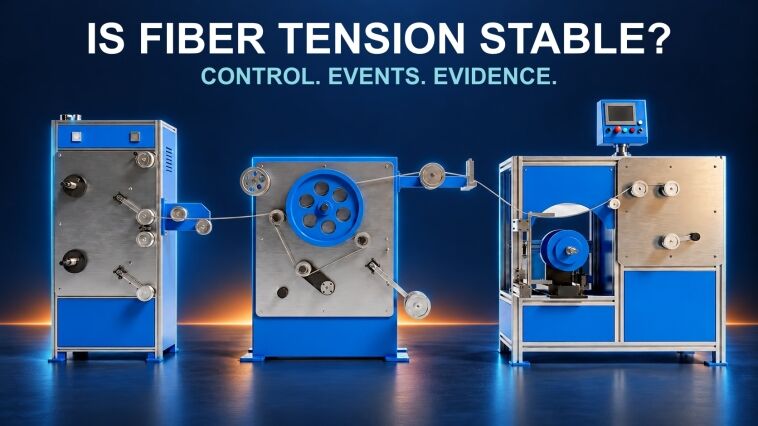
A production manager investigating repeated fiber breaks needs more than a lower tension setting. A technical buyer comparing pay-off systems needs more than a promise of constant tension. Both need to identify what material is being handled, where tension is assessed and which running condition produces the problem.
Specify fiber tension control as a process requirement: identify the fiber, reel, handling section, measurement point, operating cycle and evidence needed to judge the result. A setting on one screen is not proof that every part of the fiber path behaves correctly.
This discussion concerns handling supplied, coated optical fiber during cable production or respooling. It is not a guide to drawing glass fiber from a preform, and it does not provide a universal tension value. Changes to a running machine, protection logic or control parameters require the machine supplier’s instructions and the factory’s authorized engineering procedures.
Identify the Material and the Tension Section
Start by naming the material at the point being discussed. Individual coated fiber leaving a pay-off is different from an extruded loose tube, a buffered fiber or an assembled cable core. A tension value qualified for one of those materials should not be copied to another merely because both travel through the same factory. For a loose-tube production review, connect each incoming fiber position to the tube construction and downstream package.
For an initial HONGKAI pay-off review, reel dimensions and the intended production speed are the first selection inputs. Send the actual reel drawing or dimensions rather than a photograph alone, and identify the speed required for the intended product. These inputs allow the supplier to begin matching the arrangement; they do not establish every material-handling or acceptance limit.
Then record the incoming fiber identification and supplier’s handling requirements, coating construction, winding condition and proposed process. Include the events that the offered equipment must accommodate. Values remain project-specific until the material supplier and machinery supplier have agreed on the relevant limits.
Draw the fiber path from its incoming reel to the next process boundary. Mark the driven or braked reel, guide points, control element and downstream feed. Where several fibers enter a process together, identify the individual pay-off positions rather than assigning one unexplained value to the whole group.
The useful question is not simply whether a production line has tension control. HONGKAI identifies the fiber pay-off as an important section to review when unstable tension affects production. Ask which section the control covers and which material it acts on. A finished-cable take-up requirement does not, by itself, define the requirement for individual incoming fibers.
| Item to identify | What the buyer should put in the review record | What an incomplete answer hides |
|---|---|---|
| Material at the measurement point | Supplied coated fiber, buffered fiber, tube or cable core | Whether the stated limit belongs to the actual material |
| Reel and package | Reel drawing, usable package condition and identification | Whether the trial uses the intended input |
| Handling section | Start and end of the controlled path | Which guides or downstream pulls remain outside the explanation |
| Position or channel | Individual pay-off identifier, where applicable | Which fiber produced the event in a multi-fiber process |
| Operating condition | Product, recipe, speed state and reel stage | Whether a stable display describes the condition that caused the fault |

Editorial selection diagram based on confirmed HONGKAI inputs. It is not a machine layout or an acceptance record.
Keep this map with the quotation or fault report. A clear photograph can help identify components, but only a confirmed path and control description establish their roles.
Find Out What the Display Actually Represents
Ask whether the displayed number is a setpoint, a measured force, a calculated tension value or another control signal. Require the supplier to identify the measuring point and explain how the displayed value relates to the fiber in that section.
A proposal may refer to a brake, driven pay-off, dancer, sensor or controller. These names describe possible parts of a system, not equivalent acceptance evidence. Ask the supplier to explain the offered arrangement rather than choosing a controller from its name or appearance.
In HONGKAI’s described selection approach, applications with demanding optical-fiber tension requirements use active pay-off with a motor and servo control. Magnetic-powder or passive arrangements may be considered where the tension requirement is less demanding. This is a configuration-selection boundary, not a claim that every optical-fiber process must use the same drive or that every lower-cost arrangement is suitable.
| Offered route | Condition in HONGKAI’s selection approach | What the buyer still needs to establish |
|---|---|---|
| Active motor and servo-controlled pay-off | Demanding optical-fiber tension requirement | Actual feedback arrangement and performance with the agreed reel and speed |
| Magnetic-powder arrangement | A less-demanding tension application, subject to matching | Whether the arrangement maintains the agreed requirement through the operating cycle |
| Passive pay-off | A less-demanding tension application, subject to matching | Suitability for the actual package, process and running conditions |

Conceptual selection boundary, not three equivalent machine specifications. Each offered configuration still needs its own trial evidence.
For a sensor-based arrangement, request the sensor identification, working range, calibration or verification method, measuring location and display units. For a dancer-based arrangement, ask how dancer position is used, what establishes the operating condition and which limits are monitored. If a value is calculated from another signal, have that relationship explained before treating the value as a measurement.
Separate three functions in the technical schedule: establishing the commanded condition, observing the response and recording an event. A machine can display a setpoint without retaining a trace. A position indicator can support control without being a direct tension measurement. Ask which functions are actually included and what record the buyer can obtain.
Also identify the controlled actuator. If the system adjusts a pay-off drive, the explanation should say what signal it uses and which downstream condition it follows. If the system uses a brake, the supplier should explain how the agreed operating condition is maintained as the package changes. Do not infer the control behavior from a photograph of a cabinet.
Evidence to request: A marked control-path drawing connecting material, measurement or feedback, controller, actuator and the operator display. Add an example record from the offered configuration, with units and channel names explained. It must be a real example or an explicitly blank record template, not a fabricated test trace.
This makes quotations comparable without requiring the buyer to design the control system. An unexplained claim of constant tension remains an open technical item.
Compare Running States, Not Just a Stable Display
Review the operating cycle the factory actually uses. Starting, acceleration, steady running, deceleration and stopping are different observation points. A brief steady-speed demonstration should not be presented as evidence for an unobserved transition or package condition.
Before the trial, agree which events will be demonstrated, how they will be identified and what the equipment can record. The cable production line FAT and SAT checklist explains how to retain the actual sample, configuration and test coverage with each result. Do not prescribe one logging interval for every process. The interval and instrument response must be suitable for the event being investigated, and their limitations should be stated.
Use a run-state record instead of an isolated screenshot:
| Observation point | Conditions to identify | Evidence that allows comparison |
|---|---|---|
| Start and acceleration | Fiber and reel, starting package condition, agreed speed change | Time-linked feedback or tension record, machine state and any alarm |
| Steady operation | Actual speed, product and identified channel | Recorded behavior over the agreed observation period |
| Deceleration and stop | Agreed stop sequence and package condition | Response record and the material condition after the event |
| Different reel stages | How much of the approved package has been used | Comparable records under the agreed product and running conditions |
| Product or reel change | What changed, and which setup revision was used | New setup identification and any required repeat trial |
This is an editorial trial-record framework, not an existing HONGKAI FAT result. The actual cases and pass limits must be agreed for the offered machinery.
Where recording is unavailable, state that limitation. A video may show sequence and visible movement, but it should not be described as a calibrated tension trace. Likewise, a trace from one channel should not be used to approve every position in a multi-fiber system without an agreed sampling basis.
Keep Control, Alarm and Optical Evidence Separate
For the HONGKAI trial discussed here, the supplier should provide tension records, fiber-break alarm evidence and OTDR checks as agreed deliverables. Tie them to the same identified trial and samples. Do not assume that an OTDR is built into the pay-off or that every offered machine includes data export; specify how each record will be obtained and delivered.
| Evidence to request from the supplier | What it helps the buyer review | What it does not establish alone |
|---|---|---|
| Tension record with units, channel and operating state | Observed control behavior at the identified point | The optical condition of every produced sample |
| Fiber-break alarm record or safely demonstrated alarm evidence | The identified event and the offered alarm function | Absence of all damage, or the cause of a break |
| OTDR result tied to an identified sample and test setup | Optical characteristics and events under the recorded test conditions | Running tension, PID suitability or all mechanical handling conditions |
OTDR testing characterizes optical behavior using returned light and can help locate events along a fiber.1 It is separate from recording the operating tension. The test method, sample conditions and pass limits must be agreed for the product; no universal tension or optical pass value follows from the equipment name.

Evidence relationship diagram. No plotted trace, alarm event, optical result or pass mark represents an actual test.
Acceptance should connect the observed behavior to the agreed material-handling and product requirements. A maximum machine speed is not a substitute for this record.
Review Drive Settings and the Fiber Path Together
A broken fiber identifies a failure, not its cause. Preserve the product, reel and channel identification, the location of the break, the running state and any available event record. Compare cases under the same approved conditions before drawing a conclusion from one incident.
HONGKAI’s practical checks include the installed drive or inverter settings, whether the PID adjustment is appropriate for the actual arrangement, and the equipment’s weight-adjustment mechanism where fitted. A setting that is too high or too low may require review, but these answers do not prescribe a tuning value or prove that PID is the cause of a particular fault.
Have the supplier or authorized control engineer identify where the loop is implemented before changing parameters. Preserve the approved configuration and compare the installed settings with it. The exact role of the weight-adjustment mechanism must be confirmed from the machine documentation; it should not be assumed to be a particular dancer, sensor or counterweight design.

Investigation sequence, not a wiring diagram or a PID-tuning instruction. Review only the functions actually fitted to the machine.
Corning’s handling guidance distinguishes tensile-stress effects from damage caused by pinching, abrasion and particles. It also calls for suitable contact surfaces and process cleanliness.2 Those mechanisms are reasons to inspect the handling path; they do not prove the cause of a particular factory fault.
Have authorized personnel review the path under the supplier’s safe inspection procedure. The record should distinguish a visible material or contact problem from a control response that still needs measurement. Simply reducing the commanded tension is not proof that a configuration mismatch or contact problem has been resolved. Do not bypass a protection function, reach into a moving line or deliberately damage fiber to obtain an alarm demonstration.
| Observed evidence | Investigation question | Useful record to preserve |
|---|---|---|
| Break repeatedly associated with one position | Is the incoming package, guide path or position-specific control different? | Reel and channel identity, safe path photographs and event state |
| Problem appears during a speed transition | What did the observed control signal do during that transition? | Time-linked machine state, available signal record and alarm |
| Visible coating or contact-surface damage | Where could contact have occurred, and was it present before processing? | Incoming-material record, identified location and safe inspection evidence |
| Fault follows a replacement controller or setup change | Does the installed model and configuration match the approved interface? | Model, signal and configuration revision, not just a similar front panel |
| Optical result changes after processing | What agreed optical test and sample comparison establishes the change? | Separately measured result, sample identity and process history |
These are investigation prompts, not a diagnosis table assigning a single cause to each symptom. Material condition, handling surfaces and control behavior can require separate review.
Compare optical performance by the test method agreed for the product. A tension record does not measure optical attenuation, and a passed optical measurement does not explain every mechanical handling event. Keep the two kinds of evidence connected by sample identity rather than treating one as a substitute for the other.
Establish the Existing Interface Before an Upgrade
For a new machine, use the review to decide whether the offered arrangement covers the actual material, reel and operating cycle. For an existing line, decide what evidence supports a repair, a revised setup or an additional measurement function. Replacing a controller before identifying its interface and the observed fault risks leaving the original problem unexplained.
HONGKAI first asks for the existing control method and connection arrangement to assess a reasonable upgrade route. Provide the present system description and the relevant connection drawings or safely obtained photographs. Model identification and documented signal information can help explain those connections; do not guess a signal type from the cabinet’s appearance.
Keep the current arrangement, reported problem and proposed change in separate parts of the review. A similar-looking controller is not a confirmed replacement, and the initial review is not a promise that a stand-alone retrofit can be supplied. The compatible upgrade method and scope follow the interface assessment.

Conceptual upgrade-review worksheet, not an approved retrofit design. Connection and compatibility details must come from the actual machine.
HONGKAI’s previously confirmed optical fiber respooling application handles natural, uncolored coated optical fiber and includes tension recording and break detection in its defined scope. Optical attenuation testing is separate. This application is a bounded reference, not evidence that every HONGKAI coloring, loose-tube, buffering or take-up configuration provides the same controls or records.
Ask for the offered machine’s own schedule: input package, controlled section, sensing or feedback arrangement, actuator, display, recording, alarm response and trial evidence. Where a function is optional or supplied by the buyer, identify its owner and interface before comparing prices.
How to verify: Match each claimed function to a drawing, configuration item or observed trial record for the agreed material. Keep any unobserved product or operating condition explicitly outside the acceptance result.
The useful handover is a reproducible operating record with its limits stated. It identifies the approved material and setup, the monitored section, the events actually reviewed, the product evidence and any unresolved issue. That record is more useful than a universal tension recommendation or an unexplained controller specification.
-
Fluke Networks, OTDR — Optical Time Domain Reflectometer, sections “What Is an OTDR?” and “OTDR Test Parameters,” checked 10 October 2026. Used only to explain optical characterization and the need for a stated test setup; not as a cable-manufacturing acceptance standard or a source of tension limits. ↩
-
Corning, Suggested Guidelines for the Handling of Optical Fiber, updated September 2015, pages 2–4. Used only for handling-damage mechanisms and the need to inspect contact surfaces and cleanliness. This article does not adopt the paper’s numerical stress or bend limits as universal machine settings. ↩
