











UAV fiber-component product managers, process engineers and equipment buyers often begin with the same request: transfer a long length of natural, uncolored coated optical fiber onto a small spool that fits inside a customer-designed payout canister. The risk is treating the spool, the canister and the rewinding machine as one product even though each has a separate design boundary. A sound UAV fiber respooler selection therefore starts with the input fiber and both spool interfaces, not a machine catalogue.
A UAV optical fiber respooling machine transfers natural, uncolored coated optical fiber from a donor spool onto a small removable payout spool. The machine controls the winding process; the finished small spool is installed later inside a separate customer canister. Buyers must therefore specify both spool drawings, winding pitch, length acceptance, tension recording and break detection before comparing equipment. The HONGKAI machine does not manufacture or assemble the complete UAV payout canister.

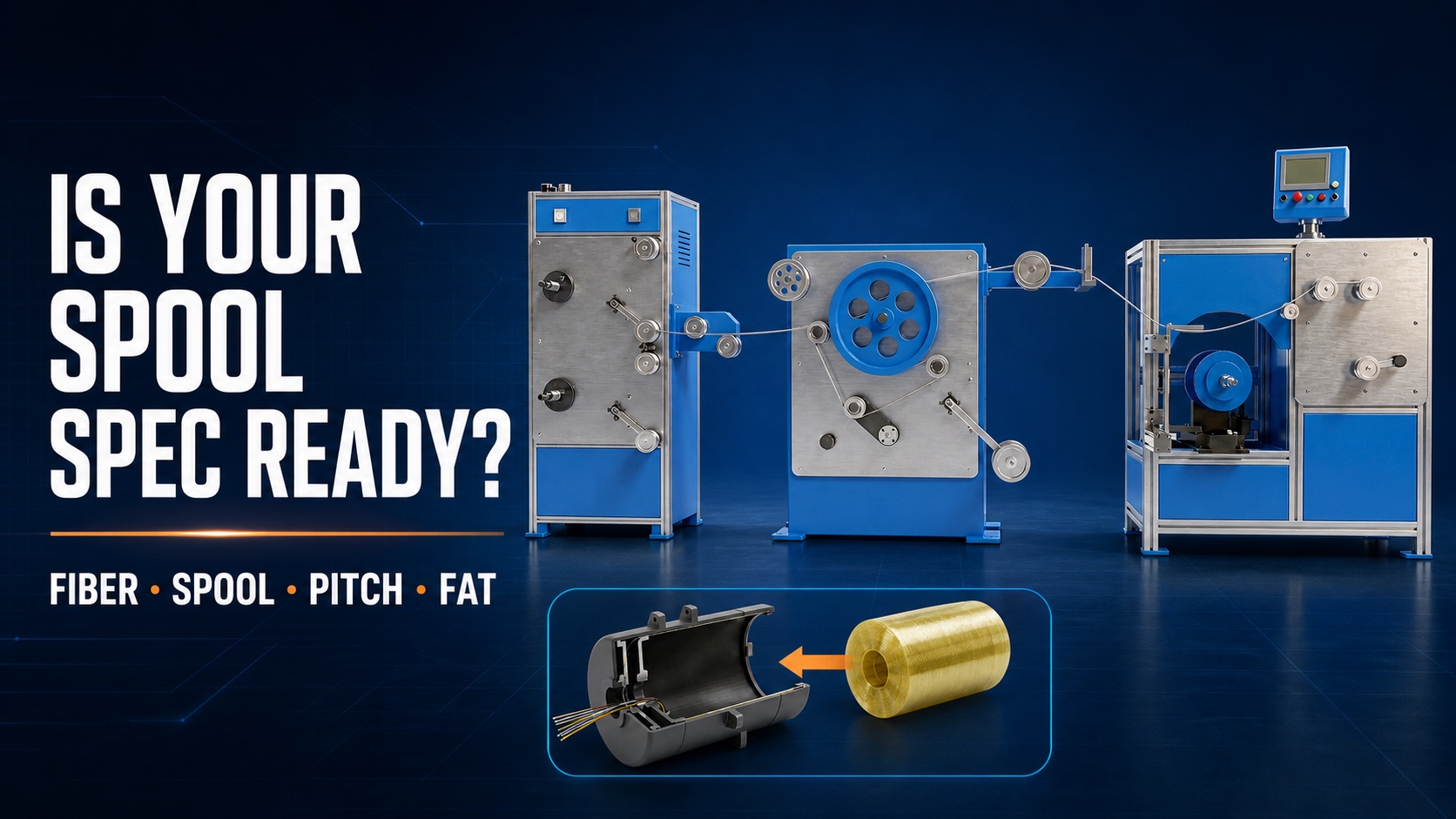
Real HONGKAI optical fiber respooling equipment. The final tooling and winding program are configured from the approved donor-spool and small take-up-spool specifications.
HONGKAI manufactures this equipment under a descriptive product name because a fixed model number has not yet been assigned. The machine handles natural, uncolored coated optical fiber rather than tight-buffered fiber or finished micro-cable. Its published maximum line speed is up to 500 m/min, while the approved production condition must still be confirmed with the actual fiber and small spool.1
The distinction between a small wound spool and a complete canister is central to the buying decision. Public dispensing references show the high-level relationship between a wound fiber pack, its spool or bobbin, a protective housing and a dispensing opening.2 The precise mounting, outlet and customer interface remain project-specific and outside the standard HONGKAI respooling-machine scope.
What Does a UAV Optical Fiber Respooling Machine Actually Produce?
The HONGKAI UAV optical fiber respooling machine produces a small spool carrying a controlled package of natural, uncolored coated optical fiber. It receives fiber from an approved donor spool, controls the fiber path and tension, counts length, detects a break and coordinates traverse with spool rotation. The completed small spool is a component for later canister assembly, not a finished UAV fiber payout canister. No coloring, tight buffering, cable extrusion or complete canister assembly occurs on this machine.
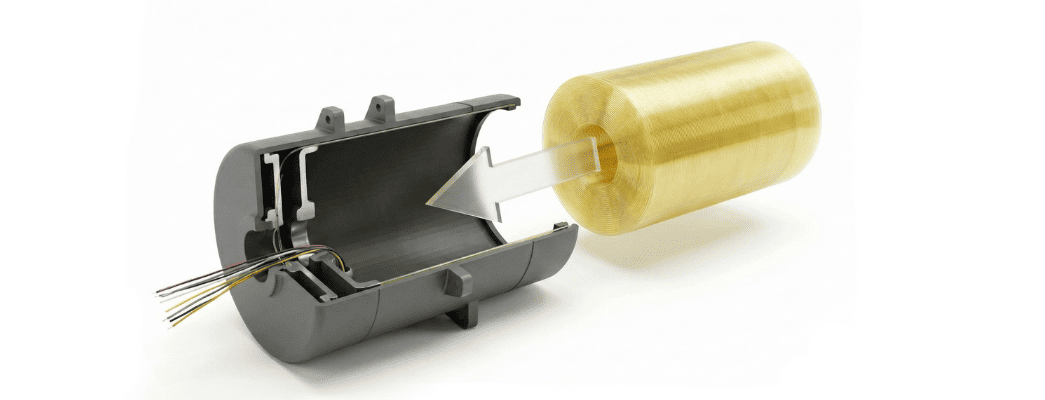
Real HONGKAI product reference: the respooling machine prepares the small wound spool; the customer installs that spool into a separate housing during downstream assembly.
| Process boundary | Included in the HONGKAI respooling stage? | Buyer evidence required |
|---|---|---|
| Donor-spool pay-off | हाँ | Approved donor-spool size and usable fiber data |
| Tension control and recording | हाँ | Agreed recording and acceptance method |
| Length counting | हाँ | Target length and permitted error |
| Fiber-break detection | हाँ | Detection demonstration during FAT |
| Automatic traverse and winding-pitch control | हाँ | Small-spool drawing and approved winding appearance |
| Small target-spool tooling | Yes, configured per project | Physical sample or controlled drawing |
| Optical attenuation measurement | नहीं | Separate OTDR test method when required |
| Complete payout-canister assembly | नहीं | Managed as a downstream customer process |
IEC optical-fiber test methods treat axial tension, bending and macrobending loss as measurable mechanical or optical concerns.34 These concerns explain why the fiber path, guide surfaces, agreed operating profile and approved spool geometry matter more than the machine’s headline speed alone.
Decision criterion: Draw a boundary around the small wound spool. Every operation before that boundary belongs in the respooling-machine specification; every housing, support, outlet or interface installed afterward belongs in the canister-assembly specification.
Note: A quotation for a “complete fiber canister machine” is not comparable with a quotation for a natural-color coated-fiber respooler unless both suppliers define the same finished deliverable.
How Is the HONGKAI UAV Fiber Respooler Different from an HK-235 Coloring and Rewinding Machine?
The HONGKAI UAV fiber respooler and the HK-235 coloring and rewinding machine have different process purposes. The UAV fiber respooler transfers natural coated fiber to a small removable spool and controls length, tension data, break detection and winding pitch. The HK-235 route adds fiber coloring and UV curing for later optical-cable production.5 A buyer should not use the HK-235 model name for the UAV respooler unless HONGKAI assigns that designation in a future approved specification.
| Comparison | HONGKAI UAV optical fiber respooler | HK-235 कलरिंग और रिवाइंडिंग मशीन |
|---|---|---|
| Confirmed input for this article | Natural, uncolored coated optical fiber | Optical fiber requiring identification by coloring or ordinary rewinding |
| Main output | Small wound spool for later customer canister assembly | Colored or rewound process spool for cable production |
| Coloring system | Not part of the confirmed scope | Included |
| UV curing | Not part of the confirmed scope | Included |
| Small-spool tooling and pitch program | Configured from the approved small-spool requirement | Not the defining purpose of the standard HK-235 route |
| Product model | Descriptive name; fixed model not assigned | HK-235 |
This separation prevents three common quotation errors. First, a UV coloring oven does not add value when the approved input must remain natural fiber. Second, a standard process spool does not prove compatibility with the small removable spool that later fits the customer housing. Third, a general rewinding speed does not prove an acceptable winding package at the agreed pitch, length and tension condition.
How to verify: Ask the supplier to mark the pay-off, guides, length counter, break detector, tension-recording point, traverse, small-spool fixture and take-up drive on one process drawing. If the drawing contains a coloring die or UV oven, confirm whether the proposal has confused the dedicated respooler with an HK-235 line.
Note: Similar words in two machine names do not make the machines interchangeable; the required fiber treatment and final spool decide the correct configuration.
What Must Buyers Confirm Before Selecting a UAV Fiber Respooler?
A buyer must define the incoming natural fiber, donor spool, small target spool, winding pattern, length requirement and acceptance evidence as one system. Changing one of these inputs may change tooling, guides, control settings or the qualified operating condition. HONGKAI can configure automatic traversing, length counting, break detection, tension recording and pitch control only after these inputs are fixed. The maximum machine speed of up to 500 m/min should therefore be treated as a machine capability, not a universal qualified production speed.
1. Fiber Input: Is the incoming fiber fully identified?
Why it matters: The confirmed HONGKAI scope in this article is natural, uncolored coated optical fiber. The fiber supplier’s packaging, coating condition and handling limits affect the guides, tension setting and trial plan.
What to ask: Provide the fiber datasheet, donor-spool identification, available length and any supplier handling requirements. State whether the fiber has already passed the incoming optical inspection required by the buyer.
How to verify: Check the actual fiber and donor spool during the sample trial. Record the same material reference in the quotation and FAT document.
Red flags: A proposal that silently expands the machine to tight-buffered fiber, micro-cable or another diameter without a trial is not based on the confirmed product scope.
2. Spool Geometry: Does the small spool match the customer canister?
Why it matters: The machine produces the wound small spool, while the customer’s downstream process installs that spool inside a separate housing. Flange, core, mounting and usable winding dimensions determine the fixture and traverse limits.
What to ask: Send a controlled small-spool drawing and, where possible, a physical sample. Also identify the approved donor spool; the currently confirmed reference includes φ236 and φ265 donor-spool formats, while final compatibility follows the project drawing.1
How to verify: Mount the real small spool on the proposed fixture and confirm access, alignment, winding width and safe removal after the trial.
Red flags: A catalogue photo or only the canister’s outside dimensions does not define the removable spool that the respooler must hold.
3. Tension Control: What evidence must the recorded tension provide?
Why it matters: IEC 60793-1-33 evaluates optical-fibre stress-corrosion behaviour through defined axial-tension and bending test methods.3 During respooling, a single tension set value still does not show how the process behaves during starting, acceleration, steady running and stopping.
What to ask: Define the required tension record, sampling or logging interval, alarm treatment and acceptance method per project. Do not copy an unverified tension range from a different fiber-processing line.
How to verify: Review the recorded trend through a complete agreed winding cycle and link the record to the sample-spool identification.
Red flags: “Stable tension” without a trace, acceptance limit or actual fiber trial is not measurable FAT evidence.
4. Traverse & Pitch: What winding appearance must the machine reproduce?
Why it matters: Automatic traversing coordinates lateral guide movement with spool rotation. The approved pitch and traverse limits influence how the fiber is arranged on the small spool and whether the finished package matches the customer’s drawing.
What to ask: Supply the target winding width, pitch requirement, edge limits and a reference photograph or accepted sample. Treat every additional pattern as a separate engineering requirement.
How to verify: Compare the completed sample against the agreed drawing and appearance standard. Record the program or setting reference used for FAT.
Red flags: Terms such as “perfect winding” or “universal program” hide the measurable pitch and edge conditions that the buyer actually needs.
5. Length Control: What length error is acceptable for each small spool?
Why it matters: The machine includes length counting, but the acceptable error has to come from the product requirement. A target length without a tolerance cannot produce a pass-or-fail FAT result.
What to ask: Define nominal length, permitted error, counter reset rule, treatment of a detected break and the record required for each completed spool.
How to verify: Compare the displayed and recorded result with the agreed reference method during the sample run. Keep the result with the spool traceability record.
Red flags: A supplier that quotes “accurate metering” without an agreed tolerance has not defined the acceptance boundary.
6. Break Detection: What must happen when a fiber break is detected?
Why it matters: HONGKAI confirms fiber-break detection as part of the machine function. Detection alone does not define the alarm, operator response, spool disposition or restart rule.
What to ask: State the required indication, data record and operator action after a detected break. Automatic stopping should be specified only if it appears in the approved project configuration.
How to verify: Demonstrate the agreed detection and recording response during FAT without claiming a function that is outside the ordered scope.
Red flags: A break indication alone is not sufficient evidence if the event cannot be associated with the affected spool and production record.
7. FAT Evidence: Which results determine whether the machine is accepted?
Why it matters: HONGKAI’s confirmed machine checks cover length error, tension record, break detection and winding pitch or appearance. Optical attenuation is a separate test and is not measured by the respooling machine.
What to ask: Agree the sample fiber, donor spool, target spool, operating condition, number of trials, recorded values and acceptance limits before the order.
How to verify: Use an independent OTDR and an agreed method if the buyer requires a before-and-after optical comparison. IEC 60793-1-40 identifies attenuation measurement methods, including backscattering approaches, but the exact test plan must match the purchased fiber and buyer requirement.6
Red flags: A machine-screen photograph cannot replace the small wound spool, process record and any separately agreed optical test report.
Note: The seven decisions convert a general equipment enquiry into a testable specification; none can be replaced by a maximum-speed number.
How Should a Buyer Run a Sample-Winding Trial and Factory Acceptance Test?
A sample-winding trial should use the buyer’s approved natural fiber, donor spool and small target spool whenever practical. The trial should prove the complete handling cycle, not only a brief run at maximum speed. FAT records should identify the sample, record length and tension, demonstrate break detection, and compare winding pitch and appearance with the agreed reference. Any optical attenuation comparison must be performed separately with an OTDR because the respooling machine does not measure attenuation.
Real HONGKAI working demonstration: natural coated optical fiber passes through the guide path and is rewound onto a small removable spool. The silent video documents the respooling stage only; it does not show complete payout-canister manufacture, UAV assembly or final FAT acceptance values.
:::flow
01 · Freeze inputs | Use one controlled material set
Record the fiber, donor spool, target spool, tooling and program revision before the run.
02 · Run full cycle | Include every operating phase
Observe start, acceleration, agreed running condition, deceleration and completion rather than a short display-speed test.
03 · Inspect spool | Compare measurable output
Check recorded length, tension trace, break status, pitch and winding appearance against the approved acceptance sheet.
04 · Separate optics | Use the agreed OTDR method
When optical comparison is required, test outside the machine and link both results to the same fiber and sample spool.
:::
Evidence to request: Ask for the FAT input sheet, completed sample-spool record, machine alarm or event record, tension log, length result, winding photographs and signed acceptance result. If an OTDR test is part of the commercial scope, name the test owner, instrument, wavelength, launch arrangement and comparison criterion in the agreed method rather than assuming the machine supplies them.
The maximum speed of up to 500 m/min may be demonstrated as a machine capability only when the agreed trial conditions allow it. The qualified production setting is the condition that produces an acceptable small spool with the specified fiber, tooling, pitch and records. This difference protects both buyer and supplier from treating an unloaded or short demonstration as production proof.
Note: FAT is complete when a traceable small wound spool and its measurable process evidence agree—not when the machine merely reaches a headline speed.
What Information Should Be Sent Before Requesting a UAV Fiber Respooler Quotation?
A useful RFQ starts with the material and both spool interfaces. The buyer should also define the required winding package, process records and FAT boundary. HONGKAI can then map each requirement to pay-off, guiding, counting, tension recording, break detection, traverse, tooling and take-up functions. Missing spool geometry or acceptance limits should be marked “to be confirmed per project,” not replaced with a generic promise.
Checklist: Send the following information with the enquiry:
- ☐ Natural, uncolored coated optical-fiber datasheet and available sample
- ☐ Donor-spool drawing, size, fiber length and a clear photograph
- ☐ Small removable target-spool drawing and physical sample when available
- ☐ Customer canister interface dimensions relevant to the small-spool fit
- ☐ एनओमीइनियलअल लेन्ग्थईनगथह पेरईर स्मालमअललल स्पूलपोलओओल औरपेरमीटेडएड पेरईरमीटरइटटईड लेन्ग्थईनगथह एररोरआरआरओआर
- ☐ आरईक्यूयूआईआरईडी टीआरएवीईआरएसई डब्ल्यूआईडीटीएच, डब्ल्यूआईएनडीआईएनजी पीआईटीसीएच, ईडीजीई एलआईएमआईटीएस एएनडी आरईएफईआरईएनसीई एपीपीईआरएआरएनसीई
- ☐ आवश्यक तनाव रिकॉर्ड और स्वीकृति विधि
- ☐ फाइबर-ब्रेक संकेत, रिकॉर्ड और ऑपरेटर-प्रतिक्रिया आवश्यकता
- ☐ आवश्यक उत्पादन स्थिति और क्या 500 m/min तक होना चाहिए, का मूल्यांकन किया जाना चाहिए
- ☐ FAT सामग्री, परीक्षण अवधि, नमूनों की संख्या और पास/फेल मानदंड
- ☐ अलग OTDR आवश्यकता, परीक्षण स्वामी और सहमत ऑप्टिकल तुलना विधि
- ☐ कारखाने की बिजली, भाषा, सुरक्षा और लेआउट आवश्यकताएँ
Decision criterion: Ask every supplier to return a scope matrix. Each item should be marked included, optional, customer-supplied or excluded, especially the small-spool fixture, sample material, OTDR testing and downstream canister assembly.
The HONGKAI पेआउट बिन के लिए ऑप्टिकल फाइबर रिसपूलर product page shows the current equipment and confirmed reference spool formats. The article’s RFQ checklist should take priority whenever the buyer’s natural fiber, small spool or acceptance method differs from that reference configuration.
नोट: एक पूर्ण RFQ मशीन से निकलने वाले छोटे स्पूल का वर्णन करता है; बाद के कैनिस्टर की बाहरी उपस्थिति पुनः स्पूलिंग प्रक्रिया को कॉन्फ़िगर करने के लिए पर्याप्त नहीं है।.
कब एक मानक UAV फाइबर रीस्पूलर कॉन्फ़िगरेशन पर्याप्त नहीं होता?
A standard HONGKAI configuration is not enough when the input is no longer natural coated fiber, when the small spool does not match the confirmed fixture range, or when the buyer requires a winding function that has not been included. A different payout arrangement, special handling environment or unsupported inspection requirement may also require engineering review. These cases should be identified before a production promise is made. The correct response is a sample and drawing review, not an assumption that one respooler handles every fiber package.
| पुष्टि किए गए लेख के दायरे से बाहर की आवश्यकता | आवश्यक अगला कार्य |
|---|---|
| रंगीन फाइबर, टाइट-बफर्ड फाइबर या तैयार माइक्रो-केबल | एक नए अनुप्रयोग के रूप में सामग्री की रचना, व्यास, गाइड और तनाव प्रणाली की समीक्षा करें |
| अलग दाता या छोटे स्पूल की ज्यामिति | फिक्सचर, शाफ्ट, वाइंडिंग चौड़ाई, ट्रैवर्स सीमाएँ और सुरक्षित निकासी की समीक्षा करें |
| पूर्ण कैनिस्टर निर्माण या असेंबली | एक अलग डाउनस्ट्रीम उपकरण और जिम्मेदारी क्षेत्र परिभाषित करें |
| चिपकने वाला पदार्थ, मरोड़ नियंत्रण या कोई अन्य अपुष्ट वाइंडिंग फ़ंक्शन | शामिल करने से पहले एक इंजीनियरिंग समीक्षा और नमूना परीक्षण करें |
| स्वचालित स्टॉप, रेसिपी स्टोरेज या डेटा इंटरफ़ेस अनुमोदित कॉन्फ़िगरेशन में सूचीबद्ध नहीं है | परियोजना विशिष्टता में एक मापने योग्य नियंत्रण आवश्यकता जोड़ें |
| स्वच्छता, पर्यावरणीय या नियंत्रित उत्पाद आवश्यकताएँ | उद्धरण से पहले लागू मानक और कारखाना सीमा को परिभाषित करें |
| मशीन पर ऑप्टिकल क्षीणन माप | अलग प्रमाणित ऑप्टिकल परीक्षण उपकरण का उपयोग करें; इसे अंतर्निहित रीवाइंडिंग फ़ंक्शन के रूप में प्रस्तुत न करें |
Common mistakes: Do not infer a complete internal canister design from a product photograph. Public dispensing references show the general relationship between a wound fiber pack, bobbin, housing and exit opening, but the customer’s mounting, guide and interface details remain project-specific.2
How to verify: Conduct a technical review using the actual fiber datasheet, donor spool, small target spool and downstream interface. If any item differs from the confirmed HONGKAI boundary, record it as a new engineering input and repeat the relevant sample-winding and acceptance review.
नोट: अनुकूलन वहां से शुरू होता है जहां सत्यापित सामग्री, स्पूल या स्वीकृति सीमा बदलती है—न कि वहां जहां कोई विक्रेता केवल मशीन का नाम बदल देता है।.
-
पेआउट बिन के लिए ऑप्टिकल फाइबर रिसपूलर, HONGKAI। वर्तमान प्रकाशित अधिकतम गति और संदर्भ स्पूल प्रारूपों के लिए उपयोग किया जाता है; अंतिम टूलिंग और योग्य उत्पादन परिस्थितियाँ परियोजना-विशिष्ट बनी रहती हैं।↩ ↩
-
US5179612A—अपघटनीय लेप वाला प्रकाशिक तंतु कैनिस्टर, यूनाइटेड स्टेट्स पेटेंट एंड ट्रेडमार्क ऑफिस का रिकॉर्ड, Google Patents के माध्यम से। केवल हाई-लेवल बॉबिन, फाइबर-पैक, हाउसिंग और डिस्पेंसिंग-ओपनिंग संबंध के लिए उपयोग किया गया।↩ ↩
-
IEC 60793-1-33:2017—तनाव संक्षारण संवेदनशीलता, अंतर्राष्ट्रीय विद्युततकनीकी आयोग। यह मानक सिलिका-आधारित प्रकाशिक तंतुओं के लिए अक्षीय तनन और झुकाव का उपयोग करके यांत्रिक परीक्षण विधियों को शामिल करता है। ↩ ↩
-
IEC 60793-1-47:2017—मैक्रोबेंडिंग हानि, अंतर्राष्ट्रीय विद्युत तकनीकी आयोग। यह मानक निर्दिष्ट प्रकाशिक-तंतु श्रेणियों में मैक्रोबेंडिंग हानि को मापने की विधियाँ स्थापित करता है।↩
-
मशीनों द्वारा ADSS केबल का उत्पादन कैसे करें, HONGKAI। HK-235 खंड रंगाई डाइ, UV लैंप और क्योरिंग ओवन की पहचान करता है जो रंगाई प्रक्रिया को समर्पित UAV रीस्पूलिंग क्षेत्र से अलग करते हैं।↩
-
IEC 60793-1-40:2024—Attenuation measurement methods, अंतर्राष्ट्रीय विद्युत तकनीकी आयोग।↩

 English
  हिन्दी
  فارسی
فارسی