











A fiber optic cable factory owner should not treat installation as finished when every machine is on the floor and can be switched on. The real decision is whether the complete line is safe, correctly connected, able to reproduce the agreed cable and supported by records that the buyer can use after the supplier leaves.
A fiber optic cable production line installation should close five evidence gaps: site readiness, machine condition, electrical and mechanical safety, controlled line functions, and product acceptance. The buyer should approve a written sequence from receipt inspection through dry running, material trials, site acceptance testing and handover. Each result must be linked to the contract configuration, cable drawing, approved materials and named measuring method. A signed open-item list is more useful than a verbal promise that commissioning is complete.
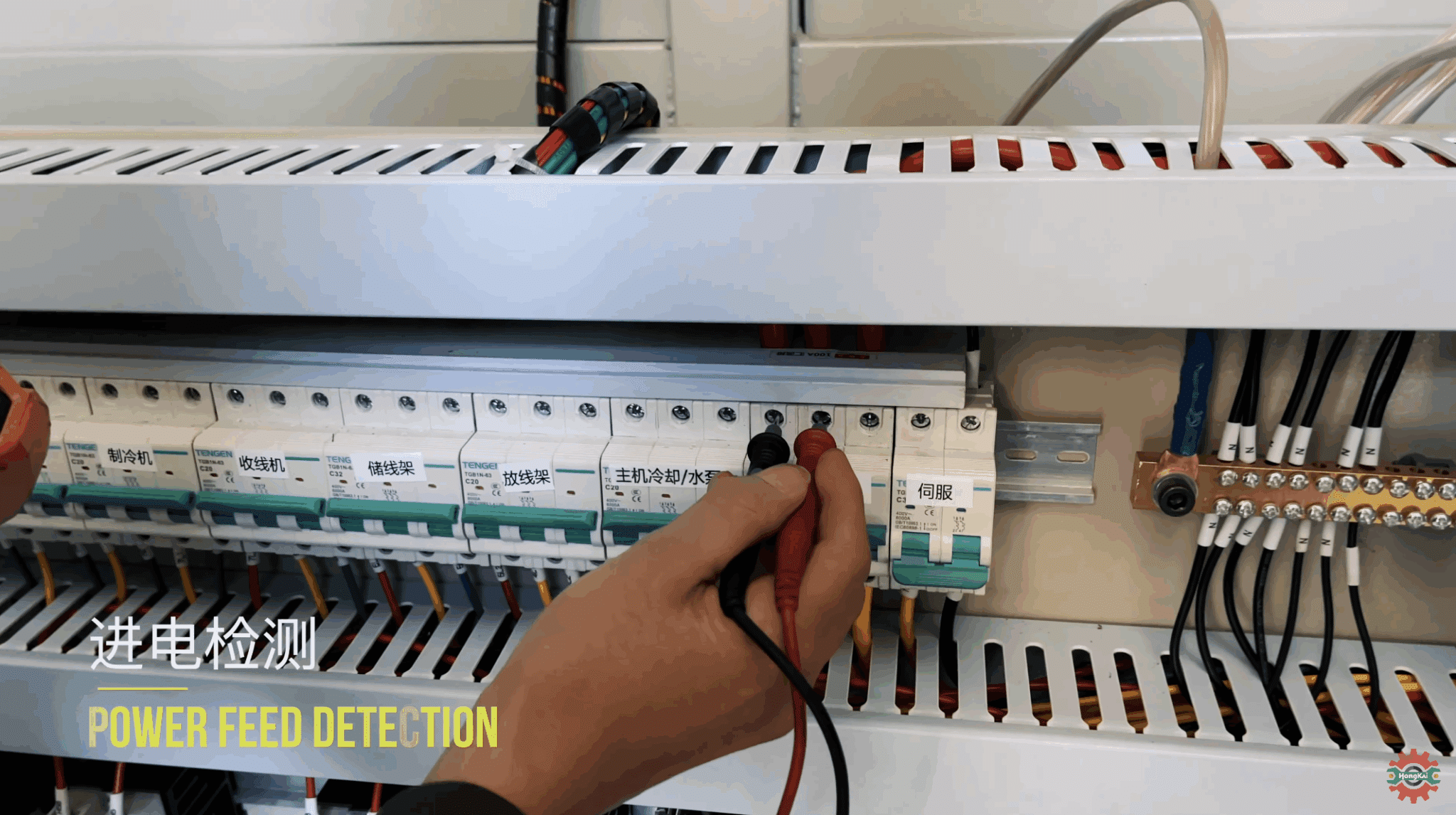
Real HONGKAI workshop photo: electrical power-feed inspection is completed before equipment delivery. The customer site must repeat the checks required by the project documents and local rules.
Installation, commissioning and acceptance are related but different. Installation places and connects the equipment. Commissioning proves the machine functions, interlocks and linked control. A site acceptance test, or SAT, then checks the agreed output and documents at the buyer’s plant. Controlled production should begin only after the remaining risks and responsibilities are visible.
The eight decisions below turn those stages into an auditable project plan. They apply whether the factory is adding one loose-tube line or coordinating coloring, secondary coating, SZ stranding and sheathing as a complete route.
What Should a Buyer Complete Before Accepting a Fiber Optic Cable Line?
A buyer should complete eight connected acceptance decisions: document control, site readiness, receipt inspection, physical installation, electrical and safety verification, dry commissioning, product trials, and training with final handover. Every decision needs an owner, input, pass criterion and retained record. HONGKAI machine drawings and control documents can define the supplied equipment, but the buyer must also connect them to local utilities, local safety obligations and the approved cable specification. Acceptance should move from low-risk checks to energized functions and then to material production.
1. Project Baseline: Which documents control the installation and acceptance?
Why it matters: A commissioning team cannot resolve a disagreement if the contract, machine configuration, layout, cable drawing and test method describe different scopes. The document baseline decides what was supplied, what the buyer must prepare and what result closes the project. HONGKAI reference configurations for HK-235 coloring, HK-50 loose-tube, HK-800/12 SZ stranding and HK-90 sheathing include installation drawings, operating instructions and electrical diagrams, but each project must confirm the final revision set.
What to ask: Create one controlled register for the signed technical configuration, equipment list, layout, foundation and installation drawings, electrical diagrams, utility schedule, software or recipe backup, cable and tube drawings, approved raw materials, factory acceptance records, SAT matrix, manuals, spare parts and open items. Name the current revision and approver for every document. Record any agreed difference between the factory acceptance test and the site acceptance test.
How to verify: Hold a document review before unloading or energizing the fiber optic cable production line. Trace every delivered unit, option, sensor, tool and interface to the signed scope. Mark missing or revised items in a dated action list instead of accepting an informal explanation. The HONGKAI sales-contract reference also makes the technical configuration an attachment and assigns trial-material responsibility to the buyer, so the final contract must state material quantity, specification, delivery point and unused-material disposition.
Red flags: Drawings arrive after machine placement, the SAT uses a different cable from the purchase specification, software and recipes have no backup, or the team cannot identify which document revision is controlling.
2. Site Readiness: Are space, foundations and utilities ready before unloading?
Why it matters: A line can be mechanically complete and still fail at the customer site because the floor, access route, electrical supply, cooling water, compressed air, ventilation or material path was not prepared for the exact configuration. Utility requirements are not interchangeable across coloring, loose-tube, stranding and sheathing equipment. A buyer should freeze the site interface before shipment rather than improvise connections during commissioning.
What to ask: Confirm the unloading route, lifting points, floor loading, machine centerline, foundation or anchor details, operator aisles, maintenance clearance, reel handling, raw-material storage, waste segregation and laboratory sample path. Build a utility matrix that names the required power, protective earthing, compressed air, process water, chilled water, drainage, extraction, nitrogen or other media only where the signed configuration requires them. HONGKAI installation reviews specifically check compressed air, water supply, drainage and a clear lifting and access route before unloading; these four checks are a project-readiness screen, not a substitute for the complete signed utility and layout requirements. Include connection location, quality, pressure or capacity, responsible party and readiness date without copying values from another line.
How to verify: Compare the actual site with the approved layout before the equipment is moved into final position. Inspect connection points and record measured utility conditions against the project requirements. HONGKAI’s current loose-tube reference includes hot and chilled water, compressed air and a coordinated electrical supply, while the coloring reference may also require a nitrogen interface for the agreed UV-curing process. The project configuration, not a generic factory checklist, controls the final list.
Red flags: The installer discovers an incompatible voltage after placement, hoses or cables cross access aisles, water supply and return are confused, reel handling blocks emergency access, or the line is energized before protective bonding and supply checks are complete.
3. Receipt Condition: Did every delivered unit arrive complete and undamaged?
Why it matters: Shipping damage, missing loose parts and mismatched labels are easier to resolve before assembly. Once packaging is discarded and units are connected, responsibility becomes harder to establish. The buyer should separate transport condition from machine performance and record both.
What to ask: Obtain the packing list, equipment list, serial or identification records, accessory and tooling list, spare-parts list, container loading plan and preservation instructions. Define who opens each package, who photographs the condition and how damage or shortage is reported. Keep moisture protection and temporary supports in place until the manufacturer instructions allow removal.
How to verify: Photograph packaging before opening and each machine unit after opening. Match nameplates, cabinets, pay-offs, take-ups, sensors, tooling, cables, manuals, spares and supplied tools against the signed list. Rotate or move only the parts that the manual permits during the receipt check. Record damage, corrosion, loose connections, contaminated surfaces and missing items with a location and corrective owner.
Red flags: Crates are discarded before reconciliation, the team signs a complete-delivery record from a packing count alone, tooling is not tied to the target product, or shipping locks remain installed during a powered test.
4. Physical Installation: Are alignment, guarding and interfaces correct before power-on?
Why it matters: Cable machinery is a linked system. A misplaced guide, uneven machine centerline, unstable foundation, wrong rotation path or restricted dancer can create tension and quality problems that look like control faults. Installation therefore has to verify both individual units and the continuous product path.
What to ask: Require a unit-by-unit placement and assembly checklist covering center height, centerline, leveling, anchoring, fasteners, guards, access panels, reel orientation, guide and capstan alignment, water and air connections, drain routing, lubrication, shipping-lock removal and cleanliness. Define the accepted method and tolerance in the project documents where the value matters; do not invent a universal alignment tolerance.
How to verify: Walk the complete material path from pay-off to take-up using the approved drawing. For a HONGKAI installation, the normal project sequence is to unpack the equipment, position each unit in the approved order and location, connect the units to the main control cabinet according to the electrical drawings, connect the incoming supply to the main cabinet and complete the specified water connections. Test individual units before linked operation, inspect the complete product path and horizontal centerline, make the final alignment adjustments and only then install the expansion anchors. Confirm that guides, dies, capstans, dancers, sensors and take-up traverse can move through their intended range without interference. Inspect guards and access points before trial material is loaded. Product trials and parameter fine-tuning follow mechanical fixation; exact electrical and utility checks remain project-specific. For a full outdoor route, repeat the check separately for coloring, loose-tube production, SZ stranding and sheathing because each process has different reels, tension zones and auxiliary systems.

Real HONGKAI installation and trial environment for fiber optic cable production equipment. Final placement follows the approved project layout.
Red flags: Operators must bypass a guard to thread the product, the product path rubs a frame, drain lines can flood an electrical area, reel lifting conflicts with an adjacent unit, or alignment is accepted by visual judgment without the project method.
5. Electrical Safety: Which checks must pass before the production line is energized?
Why it matters: Power-on is a controlled safety gate, not the first troubleshooting step. Supply compatibility, protective bonding, overcurrent protection, control circuits, emergency stops and documentation must be evaluated for the installed machine group. Local legal requirements and the contracted standards remain controlling.
What to ask: Define the competent person, lockout procedure, supply data, short-circuit and protection information, protective-bonding checks, insulation or other required measurements, cabinet inspection, phase and rotation checks, emergency-stop zones, reset behavior, control-voltage checks and test instruments. Require calibration or status evidence for the instruments used. Identify any site modifications and update the drawings before acceptance.
How to verify: Record the installed electrical checks before enabling powered movement, then challenge emergency stops, guards, limit switches and fault responses by the approved test method. IEC 60204-1:2016 with its 2021 amendment covers electrical equipment of machines from the supply connection and includes protective bonding, control-circuit protection, emergency-stop-related requirements and technical documentation.1 The standard reference does not replace local regulation or a project-specific risk assessment.
Red flags: Cabinet doors remain open during uncontrolled start-up, a safety device is bridged to save time, a site wiring change is not added to the diagram, or the SAT record says only “power OK” without the measured checks and responsible person.
6. Dry Commissioning: Do individual units, interlocks and linked controls behave correctly?
Why it matters: Dry commissioning isolates machine and control behavior before expensive fiber, polymer, gel, yarn or cable core is introduced. It should prove direction, manual movement, speed references, dancers, alarms, limits, heating and cooling functions, counters, recipes and coordinated stop behavior. A successful empty run does not prove product quality, but it removes avoidable faults from the material trial.
What to ask: Build a functional test list for every motor, drive, heater, pump, fan, valve, sensor, gauge, dancer, capstan, pay-off, take-up, traverse, alarm and human-machine-interface screen included in the project. Define normal response, fault response, reset condition and retained evidence. Include loss of signal, material absence or line-stop simulations only where the approved method permits them safely.
How to verify: Test units first in permitted manual or inching modes, then test linked operation at controlled conditions. Confirm direction and feedback before increasing speed. Review current and historical alarms, production trends, recipe storage, length counting and coordinated acceleration, deceleration and stop. HONGKAI’s HK-800/12 and HK-90 reference controls include linked PLC operation, alarm history, trend display and recipe functions; the final SAT should test only the functions actually supplied.
Red flags: The team jumps directly to a high-speed empty run, alarm history is cleared before review, one operator verbally confirms every interlock, or the supplier treats a spinning motor as proof that the linked production line is commissioned.
7. Product Trial: Can the line reproduce the agreed cable with traceable evidence?
Why it matters: Product commissioning connects machine functions to saleable cable requirements. The accepted trial must use named materials, tooling, settings, sampling positions and measurement methods. A short display of headline speed cannot replace stable production evidence for the agreed construction.
What to ask: Approve the product drawing, bill of materials, material grades and lots, fiber and reel packages, tooling, process recipe, target operating condition, stabilization rule, sample plan, measuring equipment, cable tests, run length or time when contractually required, and pass or fail criteria. Separate commissioning material from material intended for sale. State who owns the disposition of trial output and nonconforming material.
How to verify: Link every sample to the machine, recipe, time, reel and measured result. For a HONGKAI SAT, the core evidence set is stable line operation, finished-product dimensions, the agreed product-test data and no unresolved alarms. The contract and approved product specification must define every measurement method and pass limit because no universal value applies to every cable construction. Compare online gauges and counters with the agreed offline method. Review start-up, stable-run and end-of-run evidence instead of retaining only the best sample. IEC 60794-1-1:2023 establishes generic optical-cable requirements across geometry, transmission, materials, mechanical and environmental properties, while the buyer’s product specification and applicable test methods decide the actual SAT limits.2
Red flags: Trial material differs from the approved grade, samples have no time or reel traceability, speed is accepted without cable results, or pass criteria are written after the trial.
8. Handover: Are operators, maintenance staff and records ready for controlled production?
Why it matters: A line is not ready if only the visiting engineer knows how to start it, recover from a fault or change a product. Handover must transfer operating knowledge, maintenance responsibilities, backups, spares and unresolved actions to named factory personnel. Training attendance alone does not prove competence.
What to ask: Define separate training for operators, process engineers, maintenance staff and quality personnel. Cover safe start and stop, threading, recipe control, changeover, alarm response, cleaning, lubrication, inspection, sample traceability, backup and restoration, spare-parts identification and escalation. Require final manuals, drawings, software and recipe backups, training records, accepted SAT report, open-item list and responsibility matrix.
How to verify: Have factory personnel operate the fiber optic cable production line under observation, respond to selected safe fault scenarios, perform a defined changeover and retrieve the required records. Do not limit handover to normal start-up: verify product-specification changeover, alarm recovery, routine responses to operating errors, normal maintenance tasks, and the evidence needed when requesting online after-sales support. Reconcile all physical spares and tools. Close the SAT with three categories: accepted items, dated corrective actions and items that block production. The fiber optic cable production line is ready for controlled production only when the trial product meets the agreed test standard and the customer’s operator can run the process normally, handle basic problems and recognize when escalation is required. Do not hide a blocking issue inside a general “commissioning completed” signature.
Red flags: Training covers only normal running, backups remain on the supplier’s laptop, spare parts are unlabelled, drawings do not reflect site changes, or the acceptance signature has no attached open-item list.
Note: A defensible site acceptance test moves from documents and utilities to safety, functions, product evidence and human handover—so production starts from a controlled baseline rather than from memory.
How Does HONGKAI Structure a Project-Specific Commissioning Handover?
HONGKAI começa com a configuração da máquina assinada, o cabo-alvo, as interfaces do local e a matriz de aceitação acordada. Uma rota completa de cabo de fibra óptica ao ar livre pode incluir etapas separadas de coloração HK-235, tubo solto HK-50, torção HK-800/12 SZ- e revestimento HK-90, mas cada etapa é instalada e validada em relação às suas próprias funções fornecidas. Os documentos de referência HONGKAI incluem desenhos de instalação, instruções de operação e diagramas elétricos, enquanto o contrato final define os serviços no local, materiais de teste, presença e responsabilidades de aceitação. A velocidade de produção, a duração do teste e os limites do cabo permanecem específicos ao produto acordado e às condições SAT.
O HONGKAI guia de planejamento de equipamentos para cabo de fibra óptica mostra por que a rota deve começar a partir do cabo acabado e não a partir de uma lista universal de equipamentos. Uma fábrica que adicione apenas revestimento secundário deve usar o guia de especificação da linha de produção de tubo solto para bloquear o manuseio da fibra, polímero, enchimento, refrigeração, comprimento excessivo da fibra e evidência do carretel antes da comissionagem. Um projeto multietapa também deve usar o HONGKAI’s método de planejamento da capacidade de produção de fibra óptica para que as saídas aceitas e as interfaces dos carretéis não criem um novo gargalo.
Para a entrega, o comprador deve solicitar um único dossiê do projeto, e não pastas separadas que não possam ser reconciliadas. O dossiê deve conectar os seguintes itens:
- ☐ Configuração técnica assinada e registro de alterações
- ☐ Layout final, desenhos de instalação e diagramas elétricos
- ☐ Registros de utilidades e aterramento de proteção no local
- ☐ Registros de recebimento e inspeção de instalação
- ☐ Resultados dos testes funcionais, de alarme e de segurança
- ☐ Materiais, ferramentas, receitas e amostras de teste aprovados
- ☐ Medidas do produto vinculadas ao tempo e ao carretel
- ☐ Registros de treinamento, backup, peças de reposição e manutenção
- ☐ Relatório SAT assinado com itens abertos bloqueados e não bloqueados
As referências atuais de máquinas do HONGKAI suportam esta cadeia de evidências. A linha de coloração identifica documentos de instalação e circuito; as linhas de tubo solto e revestimento combinam extrusão, refrigeração, tensão e controles interligados; a linha SZ adiciona múltiplas alimentações, torção, vinculação e interfaces de recolhimento. Estes são fatos de configuração, não prova de que todos os projetos dos clientes utilizem as mesmas utilidades, controles ou testes de aceitação.
Um comprador também deve manter a verificação do produto separada da segurança da máquina. ISO 12100:2010 provides risk-assessment and risk-reduction principles across the machinery life cycle and remained current after its 2022 confirmation, although ISO shows a replacement draft in development.3 The contracted edition, local law and a competent site assessment must be checked when the project is executed.
Note: HONGKAI can supply machine-specific installation and control evidence, but the project closes only when the buyer can operate, measure, maintain and audit the agreed fiber optic cable line without relying on undocumented knowledge.
-
IEC 60204-1:2016, Safety of machinery — Electrical equipment of machines — Part 1. The IEC product page identifies the consolidated version with Amendment 1:2021; confirm the contract edition and local requirements. ↩
-
IEC 60794-1-1:2023, Optical fibre cables — Generic specification — General. Product-specific standards, customer specifications and agreed methods remain necessary for final acceptance. ↩
-
ISO 12100:2010, Safety of machinery — General principles for design — Risk assessment and risk reduction. ISO reports that the edition was confirmed in 2022 and is under revision; verify status when contracting. ↩