


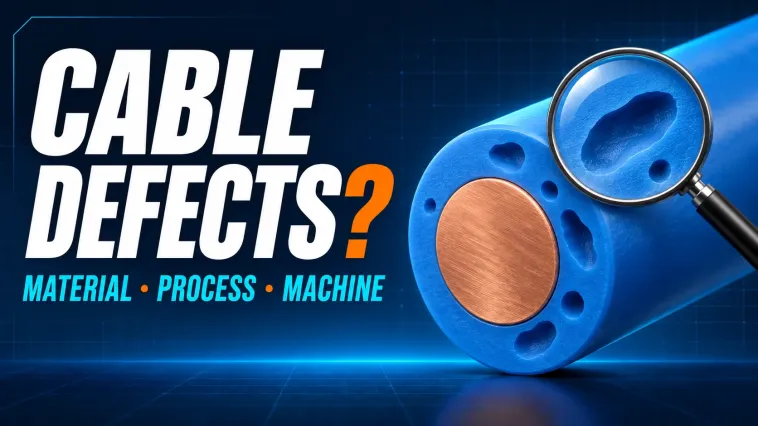
When bubbles, a rough surface or uneven dimensions appear during cable extrusion, the production team needs to know what to check first. Changing several settings at once can make the cause harder to find.
Start by checking the cable compound, its preparation and the stability of the extrusion process. If the cause remains unclear, retain material and cable samples with the operating records so the material supplier and equipment supplier can investigate the same problem.
This guide is for factories making solid insulation or solid cable jackets. Use the approved cable drawing to define the defect; a deliberately foamed insulation construction needs a different assessment.
재료 및 건조 기록부터 시작하세요
Before adjusting the extruder, identify exactly what went into the hopper. Record the compound supplier, grade and batch, and confirm whether the material is virgin, recycled or a declared blend. “PVC,” “PE” or “cable material” alone does not identify a production batch.
Check the purchase specification against the bag label and supplier documents. Confirm that the grade is intended for the cable layer being made. An unfamiliar or untraceable batch deserves investigation even when the machine settings have not changed.
This material-first check reflects HONGKAI’s practical troubleshooting approach: examine material quality and preparation together with the consistency of the extruded output before deciding that equipment needs repair. It is a starting point for diagnosis, not a guarantee that good-looking material will produce compliant cable.
경과 시간뿐만 아니라 건조 조건도 확인하세요.
Where the material supplier requires drying, compare the actual preparation with the instructions for that exact grade. Record the drying equipment, conditions, duration and handling between drying and feeding. If a moisture result is needed, agree on the measurement method with the material supplier.
“It was dried for a long time” is not the same as a verified material condition. Do not invent one drying temperature or time for every cable compound, and do not keep extending the cycle without checking the supplier’s instructions.
벌집 모양의 시료를 단서로 삼으세요.
Peter’s experience highlights a useful warning sign: a material may still produce a porous, honeycomb-like result after a drying attempt. At that point, retain the sample and investigate the compound rather than assuming that more drying will solve the problem.
The appearance alone does not prove that the material is recycled or identify the root cause. HMEL’s wire-and-cable extrusion guide lists both moisture and excessive temperature among possible causes of holes and bubbles.1 이것이 조사에 가시적 결함뿐만 아니라 재료 이력 및 가공 기록이 필요한 이유이다.

AI-generated illustration, not a photograph or test result. Left: uniform solid appearance. Right: illustrative voids in the insulation. The shapes are not to scale and do not identify a material grade, recycled content or the cause of a defect.
Ask the material supplier to confirm the grade, declared composition and suitability for the application. Whether recycled content is allowed is a question for the cable specification and material approval, not something a photograph can settle.
재료 문제를 공정 불안정성과 분리하기
Suitable material and steady extrusion are useful starting conditions. They do not, by themselves, prove that every cable requirement has been met. Compare what happened before and after the defect appeared.
Did the problem start with a new material batch? After a restart? After a tooling or recipe change? Or does the symptom appear and disappear while the recorded settings remain unchanged? These observations help decide which evidence to collect next.
조사 내용을 정리하려면 표를 사용하십시오. 점검 항목은 확정된 진단이나 설정을 변경하라는 지시가 아닙니다.
| Observation | 비교할 첫 번째 증거 | 관찰을 통해 입증되지 않는 것 |
|---|---|---|
| 솔리드로 지정된 층 내의 기포 또는 벌집 구조 | 영향을 받은 재료 배치, 건조 기록, 가공 온도 및 대응하는 케이블 샘플 | 재료가 재활용되어야 하거나, 건조가 불충분한 것이 유일한 원인이라는 것 |
| 완성 외경은 증가하고 감소한다 | 사용 가능한 경우, 스크류, 헐오프 및 와인더 속도 기록에 대한 직경 측정값 | 어느 기계 부품이 고장났습니까? |
| 외경은 적합하지만, 절연층이 한쪽 면에서 더 얇음 | 단면 측정치 및 적합한 벽 두께 또는 편심도 기록 | 허용 가능한 직경이란 도체가 중심에 위치해 있음을 의미한다. |
| 배치 또는 설정 변경 후 거칠어짐 또는 눈에 보이는 입자가 나타남 | 변화 전후의 샘플, 재료 식별 및 변화 순서 | 검사 없이 재료 또는 장비가 책임을 지는지 여부 |
HMEL also identifies unstable screw or line speed as possible contributors to uneven diameter.1 해당 관계를 사용하여 기록된 동작을 비교하되, 모터, 드라이브 또는 스크루의 교체가 필요하다고 가정하지 마십시오.
Keep diameter and eccentricity separate. Eccentricity means the conductor or core is off-center within the applied layer. SIKORA explains that comparing laser diameter measurements before and after extrusion can estimate wall thickness, but does not measure eccentricity.2 Use a measurement method suited to the characteristic being investigated.
AI-generated illustration, not measured samples. The outer diameter is the same in both examples, but the off-center conductor on the right leaves an uneven insulation wall. No dimensions or acceptance tolerances are implied.
For a comparison trial, agree on an appropriate reference material and an approved process with the responsible engineers. Record each planned change and retain the resulting sample. If a different grade needs a different recipe, record both changes; that trial is not a clean comparison of material alone.
A better result with the reference material directs attention toward the suspect material or its processing requirements. It does not automatically certify the machine as fault-free. A defect that remains with the reference material still needs a review of preparation, operating conditions and equipment behavior.
Do not confuse cable coating with making the compound itself. The comparison of cable extrusion and compound-production routes explains why those are separate manufacturing tasks.
Note: Keep checks within the machine’s operating and safety instructions. Intrusive inspection, cleaning or repair requires qualified personnel and the approved isolation procedure; a troubleshooting article is not permission to open running or pressurized equipment.
공급업체가 비교할 수 있는 샘플을 보내주세요
A useful support request connects the problem material, the defective cable and the conditions that produced it. Photos help explain the symptom; identified samples allow a more detailed examination.
Peter recommends supplying samples so the material characteristics and the equipment’s processing behavior can be considered together. Ask the receiving supplier what sample quantity, packaging and preparation are needed before dispatch. A sample can support diagnosis, but it cannot establish every aspect of machine condition without operating evidence or further tests.
다음 사항을 사용 가능한 경우 준비하십시오:
- 결함 발생 시 사용된 재료의 등급 및 배치 정보와 함께 별도로 식별된 샘플.
- 문제를 명확히 보여주는 불량 케이블 구간으로, 생산 기록과 일치하도록 라벨이 부착되어 있음.
- An acceptable comparison cable sample and, if available, the corresponding material batch details.
- The cable drawing or target dimensions, drying record, recipe and actual readings recorded when the defect appeared.
- 각 시도에서 무엇이 변경되었는지, 이미 시도한 내용은 무엇인지, 그리고 각 시도 후 결과가 어떻게 달라졌는지에 대한 간략한 설명.
AI-generated evidence-matching illustration. The matching markers represent one linked material, cable and production record; they are not actual batch labels. The blank document is illustrative, not a test result.
Keep samples from different batches or trials separate. Use clear photographs of the cable surface and cross-section, and identify which image belongs to which sample. Do not mark a sample as “after repair” without recording what was repaired or changed.
For equipment review, add the line or machine identification, the relevant tooling details and any alarms. A short operating video can help show when the defect occurs, but a video should not replace the material and sample information.
This gives both suppliers a common starting point. The compound supplier can review the material and its processing requirements. The equipment supplier can compare the approved setup with the line’s observed behavior and decide what inspection or controlled trial is justified.
더 많은 케이블을 풀기 전에 결과를 확인하세요.
An improved surface is useful evidence, but it is not the whole acceptance decision. Check the characteristics affected by the defect against the approved cable specification and test plan.
If the concern was uneven insulation, retain the relevant wall-thickness or eccentricity results. If it was diameter variation, review the diameter record for the agreed trial. Complete any other product checks required for that cable rather than assuming that the disappearance of one visible symptom proves compliance.
Record the material batch, preparation, approved settings, actual readings, sample identity and test results from the improved run. Keep affected production identifiable until the quality team decides its disposition. No universal test duration or sampling quantity is prescribed here; use the applicable factory and product requirements.
AI-generated verification illustration, not an actual drawing or inspection record. Compare the trial cable with the approved specification and retain the matching records and samples. The illustration does not show a passed test or authorize product release.
기계 문제를 가리키는 증거가 있다면, 부품을 주문하기 전에 점검된 상태를 문서화하십시오. 해당 케이블 라인 유지보수 및 예비 부품 안내서 설치된 구성 요소에 결함을 연결하는 방법, 해당 구성 요소의 식별 정보, 수리 후 필요한 점검 사항을 설명합니다.
The investigation is complete when the factory can explain what changed, show the resulting cable evidence and repeat the accepted process. That is a stronger outcome than changing settings until one short sample looks better.
-
HMEL, 와이어 및 케이블 압출 공정과 폴리슈어 제품에 관한 기술 가이드, Table 4, printed page 11, February 2022. Used for examples of possible bubble and diameter-variation causes, not universal settings for all cable compounds. ↩ ↩
-
SIKORA, Thickness measurement, especially the laser-measurement section. Supports the distinction between diameter-derived thickness and eccentricity measurement; no particular instrument is prescribed for every cable line. ↩
