


If you import Cat6 cable, sell it under your own brand or buy it for projects, a low price and a sample marked “PASS” are only a starting point. You need to know whether the factory can keep making the cable you approved, at the quality and delivery rate your order needs.
Start with the exact Cat6 model, whether you need bulk cable or finished patch cords, and the tests the product must pass. Then compare supplier identity, sample records, certificate scope, production control and capacity at a proven quality level. Put the same product and test requirements into the first order.
यह गाइड आपको उम्मीदवारों को खोजने, उनके प्रमाणों की जांच करने और एक नियंत्रित प्रथम ऑर्डर को मंजूरी देने में सहायता करती है। यह नामित कारखानों को रैंक नहीं करती है या आपूर्तिकर्ता को समर्थन नहीं देती है।.
एक Cat6 विशिष्टता के आसपास एक संक्षिप्त सूची बनाएं
Collect candidate names first, but compare them only after you have defined the same product and test requirements. A factory website, directory entry or introduction is a lead, not proof of reliability.
Use online searches, maps, factory websites, supplier directories, trade shows, social media and industry introductions to build an initial list. Record the company, claimed production site, offered cable model and contact. A map listing, exhibition presence or factory video is a lead; it does not establish who owns or operates the production equipment.
Send the same short enquiry to each candidate: exact Cat6 model, bulk cable in boxes or reels versus finished patch cords, construction, market requirements, order quantity, packaging, required tests and delivery target. Request a quotation, matching sample specification and relevant test records. Shortlist the candidates that can connect those items; use the six checks below before committing to an order.
फैक्टरी की कीमत या आकार पर चर्चा करने से पहले मॉडल, बिक्री फॉर्म और आवश्यक परीक्षण की पुष्टि करें। इससे प्रत्येक उम्मीदवार को उत्तर देने के लिए समान खरीद आवश्यकता प्राप्त होती है।.

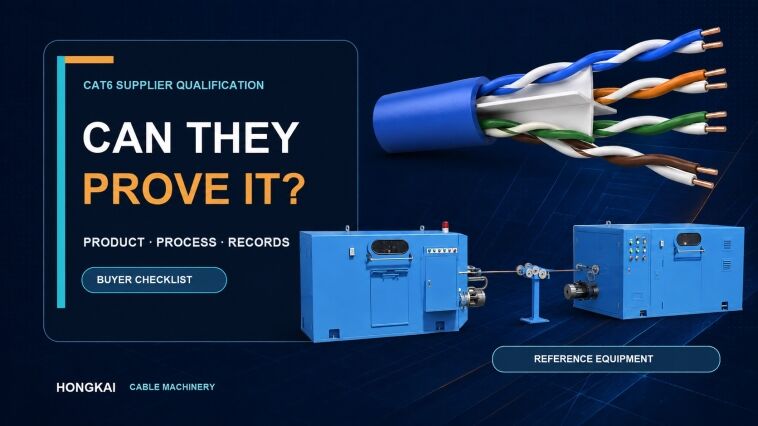
Existing HONGKAI 3D reference: four unscreened pairs with a cross separator. This is one illustrative construction, not a universal Cat6 design, a dimensional drawing or proof of compliance. Compare each supplier against the same approved cable specification.
| आप जो खरीद रहे हैं | उद्धरणों की तुलना करने से पहले सहमत हों | मिलान साक्ष्य के लिए पूछें |
|---|---|---|
| बॉक्स या रील में थोक क्षैतिज केबल | चालक सामग्री और निर्माण, इन्सुलेशन, जोड़ी डिज़ाइन, आवश्यकता होने पर स्क्रीन, जैकेट और पैकेज की लंबाई | केबल ड्रॉइंग, सामग्री की बिल (BOM), पहचाना गया नमूना, केबल परीक्षण विधि और लॉट रिकॉर्ड |
| तैयार पैच कॉर्ड | बेस केबल, कनेक्टर, बूट, पूर्ण लंबाई, वायरिंग और असेंबली आवश्यकताएं | घटक पहचान, असेंबली विशिष्टता और तैयार-कॉर्ड परीक्षण रिपोर्ट |
| स्थापित स्थायी लिंक या चैनल | केबल और कनेक्टिंग हार्डवेयर, कनेक्शन लेआउट, लंबाई और स्थापना क्षेत्र | वास्तविक स्थापित लिंक या चैनल के लिए फ़ील्ड-टेस्ट फ़ाइलें, कारखाने के केबल रिकॉर्ड का प्रतिस्थापन नहीं |
Screening and certification are additional specification choices, not separate proof that the product is suitable. Define the screen construction and any required safety listing or performance-verification program for the product you are buying.
TIA published ANSI/TIA-568.2-E for balanced twisted-pair cabling and components in November 2024.1 IEC 61156-5:2020 मुख्य रूप से क्षैतिज फर्श वायरिंग के लिए उपयोग किए जाने वाले सममित युग्म या चतुष्क केबलों को शामिल करता है।.2 पूछताछ में शासी दस्तावेज़ और संस्करण का नाम बताएं; “Cat6,” “TIA” और “IEC” एक-दूसरे के स्थान पर प्रयोग किए जा सकने वाले अनुमोदन लेबल नहीं हैं।.
Do not assume box cable and patch cords can be compared by length or a PASS label alone. Fluke’s guidance explains that patch-cord adapters assess the plug connections differently from channel testing.3 नमूने, तैयारी, एडाप्टर और चयनित सीमाओं को सहमत परीक्षण से मिलाएं। उस विवरण के बिना कोई उपयोगी सामान्य “आसान” या “कठिन” रैंकिंग नहीं है।.
Decision criterion: Compare prices only for the same product, packaging and test scope. If one quotation costs less, ask what changed before assuming the factory is more efficient or the sample represents the cheaper offer.
एक Cat6 निर्माता को योग्यता प्रदान करने के लिए छह साक्ष्य गेट्स का उपयोग करें
सत्यापित तथ्यों को बिक्री दावों से अलग करने के लिए छह जाँचों का उपयोग करें। एक लापता रिकॉर्ड ठीक किया जा सकता है, लेकिन ऑर्डर को मंजूरी देने से पहले इस खाई के लिए एक ज़िम्मेदार व्यक्ति और समय सीमा निर्धारित करें।.
1. कानूनी पहचान: क्या उद्धृत कंपनी वह फैक्ट्री है जिससे आप खरीदारी करेंगे?
इसका महत्व क्यों है: कंपनी जो उद्धरण दे रही है, केबल बना रही है, भुगतान प्राप्त कर रही है और प्रमाण पत्र रखती है, वह एक ही नहीं हो सकती। आपको प्रत्येक पक्ष की भूमिका का स्पष्ट रिकॉर्ड चाहिए।.
What to ask: Request the legal company name in Chinese and English, registered and production addresses, payment recipient and exporter if different. Ask which production, testing or packing steps are subcontracted.
How to verify: Compare names and addresses across the registration documents, quotation, payment instructions, certificate record and product label. Ask for documents explaining any difference; “same group” alone does not establish who is responsible.
Then check the claimed factory in practice. Ask which equipment is owned, leased or used through a production partner, where it operates, and who controls the work. Connect the actual site and machine identities to production and quality records for the offered cable. If needed, arrange a live walkthrough or an independent site visit; do not rely only on selected photos and edited videos.
2. Product Scope: Does the sample match the product you will order?
इसका महत्व क्यों है: नमूना और उद्धरण एक ही केबल का वर्णन करने चाहिए। इसे सीधे जांचें, बजाय इस धारणा के कि अच्छा नमूना फैक्ट्री द्वारा बेचे जाने वाले प्रत्येक उत्पाद की पुष्टि करता है।.
Evidence to request: Keep the drawing, BOM and sample under one agreed revision. Include material identities, conductor construction, dimensions and tolerances, pair lay lengths, any separator or screen, jacket marking and package length. Link the sample ID to its production lot and test file.
If the price, product form or testing scope changes between the sample and the bulk order, ask for an updated specification. Confirm whether the original sample still represents the revised offer before approving it.
Red flags: The sample has no traceable ID; the quotation says only “Cat6 UTP 23 AWG”; the factory will decide the compound later; or the sales sample cannot be connected to a production batch, drawing and test record.

Explanatory illustration, not a certificate or a real test result. Keep design approval, lot release, independent product verification and installed-link reports separate when checking a supplier’s claims.
3. Third-Party Claims: Are certificates current and product-specific?
Decision criterion: Check each claimed approval against its issuer’s records. Match the holder, site where specified, product or construction, scope, current status and permitted mark. A supplier’s PDF is a starting point for verification.
इन तीन प्रकार के साक्ष्यों को अलग रखें।.
- A Fluke test report records a test. Fluke states that it does not certify or endorse another manufacturer’s cabling components. Ask for the original result file and check the tested object, selected limits and instrument details; a cropped PASS screenshot is not enough.4
- एक UL दावे के लिए संबंधित उत्पाद रिकॉर्ड और अंकन क्षेत्र की आवश्यकता होती है। प्रोडक्ट iQ फ़ाइल, श्रेणी नियंत्रण और निर्माण संख्या जैसे पहचानकर्ताओं द्वारा खोज का समर्थन करता है।.5 UL की तार और केबल गाइड कॉइल, रील, फ्लैंज या बॉक्स पर पहचान चिह्न को केबल सतह पर संपूरक मुद्रण से अलग करती है।.6
- ISO 9001 concerns a quality-management system, not approval of the ordered Cat6 cable’s transmission performance. Check the certified company, site and scope as well as the issuing body and current status.
IAF CertSearch प्रबंधन प्रणाली प्रमाणपत्र जाँचों के लिए कंपनी, मानक, स्थिति, कार्यक्षेत्र और जारीकर्ता/मान्यता प्रदान करने वाली संस्था का विवरण प्रदान करता है।.7 If a record is missing or unclear, seek confirmation from the issuer rather than drawing a conclusion from the search alone. Which product approvals you need depends on the target market and order; these three items are not one universal certification package.
सत्यापित करने का तरीका: आपूर्तिकर्ता फ़ाइल के साथ दिनांकित सत्यापन रिकॉर्ड सहेजें। पहली शिपमेंट से पहले और होल्डर, स्थल, निर्माण या मार्किंग में परिवर्तन के बाद पुनः जाँच करें।.
4. Process Control: Can the factory trace a result back through production?
Why it matters: Final testing finds a problem; it does not fix the process that caused it. Ask whether each finished box or reel can be traced to its materials, production settings and test records.
The HONGKAI LAN केबल उत्पादन मार्ग चालक तैयारी, कोर-वायर इन्सुलेशन, जोड़ी मरोड़ना, केबलिंग, वैकल्पिक शील्डिंग, शीथिंग, विद्युत परीक्षण और पैकिंग को एक जुड़े हुए प्रक्रिया के रूप में मैप करता है। यह Cat6 फैक्टरी अनुपालन गाइड स्पष्ट करता है कि केबल डिज़ाइन, उत्पादन-बैच रिलीज़, स्वतंत्र उत्पाद सत्यापन और स्थापित लिंक प्रमाण को अलग-अलग क्यों रखा जाना चाहिए।.
Evidence to request: Choose one recent lot of the offered cable. Trace the conductor and compound batches through insulation, pair twisting, cabling, any screening, sheathing and final tests. Match the package label to that record, including failed tests and any rework. Use the approved product’s control limits, not generic numbers.
Machine condition is part of this review. Older or simplified equipment is a reason to examine maintenance, tension and speed control, repeatability and production records more closely. Age alone does not prove poor quality, and a new machine alone does not prove stable production. Ask to see the actual setup making a comparable cable.
Existing HONGKAI 3D cabling-equipment reference. During a supplier review, inspect the actual line’s condition and production records; this reference is not evidence of that supplier’s factory or output.
Also ask how the factory invests in product development and process improvement. A claimed research budget is only one indicator, not a Cat6 pass criterion. To check the capability behind it, request relevant engineering roles, development projects, trial and test records, and examples of documented improvements that the supplier can share. Use these as supporting evidence, without imposing an invented spending threshold.
Red flags: The only test evidence is a cropped PASS screenshot; material lots are not recorded; failed first tests disappear after retesting; production settings are handwritten without product revision; or the sample room cannot identify which line and lot made the displayed cable.
5. Capacity Evidence: Can the factory meet this order with the approved construction?
Decision criterion: Use the stable production speed at which the specified cable passes its agreed tests. Do not use the machine’s brochure maximum or the tester’s measurement speed as the production rate.
Ask what speed the line was running when it produced cable that passed the specified test. Connect the product revision, run date and line speed to the lot’s quality records. A short demonstration is useful, but it does not by itself establish sustained output.
How to verify: Build the delivery calculation from that supported rate, available shifts, stoppages, changeovers, usable yield and the slowest stage. Include testing and packing, and check what capacity is already booked. For a new construction, make pilot-run evidence a condition before accepting a volume promise.
Common mistakes: Multiplying brochure maximum speed by operating hours; counting every machine as available for the order; ignoring setup, material change, test, packing and rework time; or accepting a monthly total that mixes different cable types and package units.
6. Change Control: Will the approved cable remain the delivered cable?
What to ask: Define which changes require written buyer approval or renewed evidence. Typical decision fields include conductor source or construction, insulation and jacket compounds, foaming route, pair lay plan, separator or screen materials, manufacturing site, process route, test method, marking and packaging.
Evidence to request: Attach the approved drawing, BOM revision, sample ID, test plan and accepted deviations to the order. Agree how changes will be approved, how failed results and retests will be recorded, and who can stop shipment when the delivered product or evidence does not match.
Red flags: The contract permits “equivalent material” without a review path; the golden sample has no sealed or photographed identity; the sales team can change construction verbally; or the pre-shipment inspector receives only a visual checklist with no product-specific data.
एक साक्ष्य मैट्रिक्स में शॉर्टलिस्ट किए गए आपूर्तिकर्ताओं की तुलना करें
Do not total vague scores before resolving hard gates. Record a finding as verified, conditional or not demonstrated, and keep the evidence link or document reference in the same row.
Explanatory illustration, not supplier performance data. If suppliers quote a pass rate, compare the same test configuration and agreed unit; passed units divided by tested units gives the rate. Record first tests and retests separately. No minimum acceptance percentage is implied.
| Evidence gate | Verified | Conditional | समाधान होने तक रोकें या अस्वीकार करें |
|---|---|---|---|
| कंपनी और साइट पहचान | अनुबंध, भुगतान संस्था, उत्पादन स्थल और दावा किए गए अनुमोदन समन्वित हैं | एक संबंधित इकाई या उपठेकेदार दस्तावेज़ों और ज़िम्मेदारी के साथ प्रकट किया गया है | भुगतान, विनिर्माण या प्रमाणपत्र पहचान का मिलान नहीं किया जा सकता |
| Product definition | Quotation, drawing, BOM, sample and label share one revision | छोटे खुले क्षेत्रों के नामित मालिक और उत्पादन से पहले समय सीमा होती है | “Cat6” एकमात्र स्थिर विशिष्टता है |
| तृतीय-पक्ष दावा | वर्तमान जारीकर्ता रिकॉर्ड धारक, स्थल, उत्पाद और अंकन क्षेत्र से मेल खाता है | सार्वजनिक रिकॉर्ड अपूर्ण है और लेखित जारीकर्ता पुष्टि लंबित है | कवरेज के रूप में लोगो, स्क्रीनशॉट या अप्रासंगिक प्रमाण पत्र प्रस्तुत किया जाता है |
| Production traceability | एक लॉट को सामग्री से लेकर प्रक्रियाओं, परीक्षणों और पैकेज तक ट्रेस किया जा सकता है। | एक गैप के लिए सुधारात्मक कार्रवाई होती है और ऑर्डर जारी करने से पहले इसे बंद करना चाहिए। | डिस्प्ले नमूना या PASS परिणाम में कोई लॉट और प्रक्रिया पहचान नहीं है |
| क्षमता और डिलीवरी | गणना की पुष्टि समान उत्पादन और बॉटलनेक रिकॉर्ड्स द्वारा की जाती है। | आयतन अनुमोदन से पहले पायलट या प्रथम-रन प्रमाण आवश्यक है | ब्रोशर की गति, कारखाने का क्षेत्रफल या बिक्री की गारंटी ही एकमात्र प्रमाण है |
| Order controls | उत्पाद, परीक्षण योजना, परिवर्तन अनुमोदन और शिपमेंट रिलीज़ लिखित रूप में सहमत हैं | आदेश या उत्पादन की मंजूरी से पहले लापता दस्तावेज़ संलग्न किए जाने चाहिए | प्रतिस्थापन और स्वीकृति अपरिभाषित बनी हुई हैं |
How to verify: Ask a colleague or third-party auditor to pick one finished package at random and reconstruct its evidence chain. A presentation assembled only from the supplier’s best sample is not the same as a traceable production record.
शॉर्टलिस्ट को एक नियंत्रित प्रथम ऑर्डर में परिवर्तित करें
Before the first order, write down what will be tested, at what length, by which method and against which pass criteria. “Must pass Fluke” does not contain enough information to settle an acceptance disagreement.
Complete this test-agreement worksheet before production, alongside the approved product specification. Fill the fields from the buyer’s requirement and applicable method; no single test length or instrument suits every Cat6 order.
Explanatory comparison, not a wiring instruction. The pictured reel and channel lengths describe different example configurations, not a default factory test length. Agree the test object, method, adapters and limits for the order; a patch-cord test is not the same as a channel test.3
| Acceptance field | खरीदार और आपूर्तिकर्ता को क्या लिखना चाहिए |
|---|---|
| Product form | सटीक मॉडल और संशोधन; थोक बॉक्स/रील केबल या तैयार पैच कॉर्ड; पैकेजिंग और आदेशित मात्रा |
| नमूना और परीक्षण वस्तु | लॉट और नमूना आईडी; केबल नमूना, स्टैंडअलोन पैच कॉर्ड, स्थायी लिंक या चैनल; नमूना चयन और तैयारी |
| Test length | मीटर में सहमत लंबाई, इसे कैसे मापा जाता है, और क्या पूरा पैकेज या एक तैयार नमूना परीक्षण किया जा रहा है |
| उपकरण और कनेक्शन | फ्ल्यूक या अन्य सहमत प्रणाली, मॉडल, कैलिब्रेशन स्थिति, सॉफ़्टवेयर, फिक्सचर/एडाप्टर और विधि के लिए उपयुक्त कनेक्शन व्यवस्था |
| मानक और पास मानदंड | शासी दस्तावेज़ और संस्करण, चयनित परीक्षण/सीमा सेट, आवश्यक पैरामीटर और ग्राहक-विशिष्ट आवश्यकताएँ |
| परिणाम और जारी करना | Original result files, plots where required, date and operator, lot reference, failure/retest history and who approves shipment |
Keep package length and test length as separate fields. Testing a prepared sample from a box does not mean the whole packaged length was tested in that configuration. Likewise, an installed-channel result should not be relabelled as a standalone patch-cord result.
Before shipment, compare the production lot with the approved specification and sample. Check labels, quantity, the agreed inspection results and any failed tests or rework. Record deviations and resolve them through the agreed release process. Keep the first accepted lot’s record pack as the comparison point for repeat orders.
Pitfalls: A buyer approves a polished sample but not its BOM; pays an exporter without reconciling the manufacturer; asks for “full Cat6 test” without naming the test object; or allows shipment because the cable appearance matches while the traceability and raw results remain missing.
जहाँ HONGKAI उपकरण साक्ष्य फिट बैठता है
HONGKAI can help review whether a proposed cable construction matches the equipment and production route. That is different from certifying a finished-cable manufacturer or independently approving its product.
The HONGKAI Cat6 उत्पादन-लाइन संदर्भ provides a starting point for equipment questions. Match the actual drawing, materials, process controls and production target to the proposed configuration. A machine picture or equipment list does not prove a cable supplier’s ownership, available capacity or certification.
Existing HONGKAI 3D equipment reference, not a factory-audit photo. Use it to frame questions about the actual pairing setup, tension control and process records. The pictured equipment does not establish any supplier’s ownership, available output or cable approval.
For a machinery project, agree the supplied equipment, any integration, factory acceptance test (FAT), training and exclusions in the project scope. Product certification, independent factory audits and shipment acceptance need their own named responsible parties; they are not implied services.
Choose the supplier that can connect your exact cable to a matching sample, relevant tests, controlled production and a credible delivery plan. Keep those same requirements in the first order and every repeat order.
-
TIA announcement for ANSI/TIA-568.2-E, dated November 5, 2024; identifies the cabling and components standard, not a factory certificate. ↩
-
IEC 61156-5:2020 RLV publication page, केवल मानक के सार्वजनिक दायरे के लिए उपयोग किया जाता है; RLV में मानक और इसका रेडलाइन संस्करण शामिल है, नि:शुल्क पूर्ण परीक्षण प्रक्रिया नहीं। ↩
-
फ्ल्यूक नेटवर्क्स: चैनल, स्थायी लिंक और पैच कॉर्ड परीक्षण, परीक्षण किए गए कनेक्शन प्रकारों और पैच-कॉर्ड एडाप्टरों के बीच अंतर करने के लिए उपयोग किया जाता है; सार्वभौमिक बल्क-केबल परीक्षण लंबाई या किसी वर्तमान मानक संस्करण के लिए नहीं।↩ ↩
-
फ्लूक नेटवर्क्स: तृतीय-पक्ष नेटवर्क केबल प्रमाणन, टेस्टर रिपोर्ट और स्वतंत्र उत्पाद प्रमाणन के बीच अंतर करने के लिए, तथा मूल परिणामों और उनकी स्थापना का निरीक्षण करने की आवश्यकता के लिए प्रयुक्त।↩
-
UL Solutions Product iQ overview, used for the certification-record search fields and verification purpose. ↩
-
UL समाधान तार और केबल अनुप्रयोग मार्गदर्शिका, , जिसका उपयोग पैकेज या रील पहचान और अतिरिक्त केबल-सतह मुद्रण के बीच अंतर करने के लिए किया जाता है। ↩
-
IAF CertSearch certificate-verification guidance, प्रबंधन प्रणाली प्रमाणपत्र की पहचान, स्थिति, क्षेत्र और जारीकर्ता निकाय की जांच के लिए उपयोग किया जाता है।↩
