















A customer sends a cable drawing and asks for a “fiber coating line.” Before pricing an extruder, circle the part your factory is expected to supply. Is it a tube that carries coated fibers, or is it a single coated fiber with a snug outer layer of its own?
If the drawing shows fibers sharing a tube filled with fiber filling gel, specify a loose-tube line with a gel-filling stage. If it calls for a close-fitting buffer around each individual coated fiber, specify a tight-buffer line. If you already buy that component on a reel, start the equipment discussion at the next operation.
The distinction is easiest to see before the outer cable jacket goes on. Look at the cut end of the component, then follow that same part to the reel leaving the machine.
Read the cut end: a shared bore or a layer on one fiber?
In a loose tube, the polymer forms a wall around a common interior space called the bore. The colored fibers lie inside it; the wall does not wrap each fiber separately. In the example shown, fiber filling gel fills the space between the coated fibers and the tube wall. The gel helps block water along the tube; it is not a tight buffer extruded onto each fiber. A design that specifies dry water blocking needs a different filling arrangement. In a tight-buffered fiber, an extra polymer layer fits closely over one fiber's existing protective coating. It is not applied to uncoated glass.1
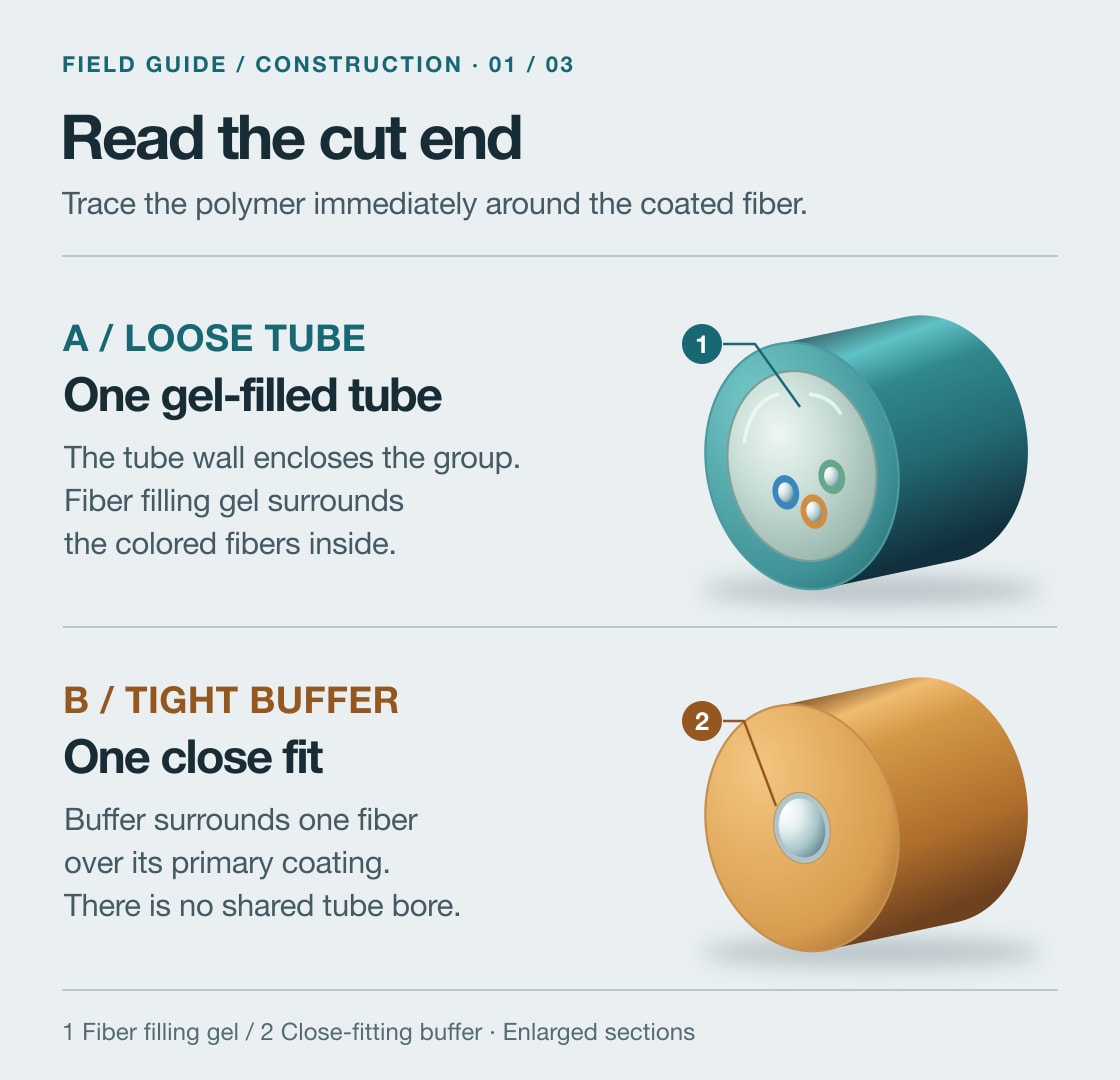
Enlarged 3D sections, not to scale. The pale material inside the teal tube represents fiber filling gel around the colored fibers. The amber buffer in the lower diagram fits one coated fiber directly and has no gel-filled bore. Colors and fiber count are illustrative; outer cable layers are not shown.
| What to look for | Loose-tube example | Tight-buffer example |
|---|---|---|
| Trace the polymer boundary | One tube wall encloses the fibers together. | Each coated fiber has its own close-fitting buffer. |
| Identify the output on the reel | A tube containing the specified fibers and fiber filling gel. | An individually buffered fiber, not a jacketed cord. |
| If the cut end is hard to read | Ask for the tube inner diameter and the number of fibers inside it. | Ask for the incoming coated-fiber diameter and finished buffer diameter. |
Fiber count alone can mislead. A finished distribution cable may contain many fibers, each with its own tight buffer, under a common jacket. That jacket is not a loose tube. Likewise, a single fiber inside a tube does not become tight-buffered just because it has no neighbors. Trace the layer immediately around the coated fiber. “Single-mode” and “multimode” identify the optical fiber, not that layer.1
Two familiar drawings illustrate the difference. On an outside-plant cable drawing, you may see several fiber-filled tubes laid around a central strength member. Circle one tube, not the whole cable. On a simplex patch-cord cable drawing, look underneath the outer jacket and aramid yarn: the single buffered fiber is the part the tight-buffer line makes.1
Match the reel to the production line
On a loose-tube line the extruder forms a tube. On a tight-buffer line it applies a layer to a fiber. Both routes can have an extruder, cooling, a diameter gauge and a take-up. A photograph of those shared stations, or the screw size alone, will not tell a buyer which product the line can make.
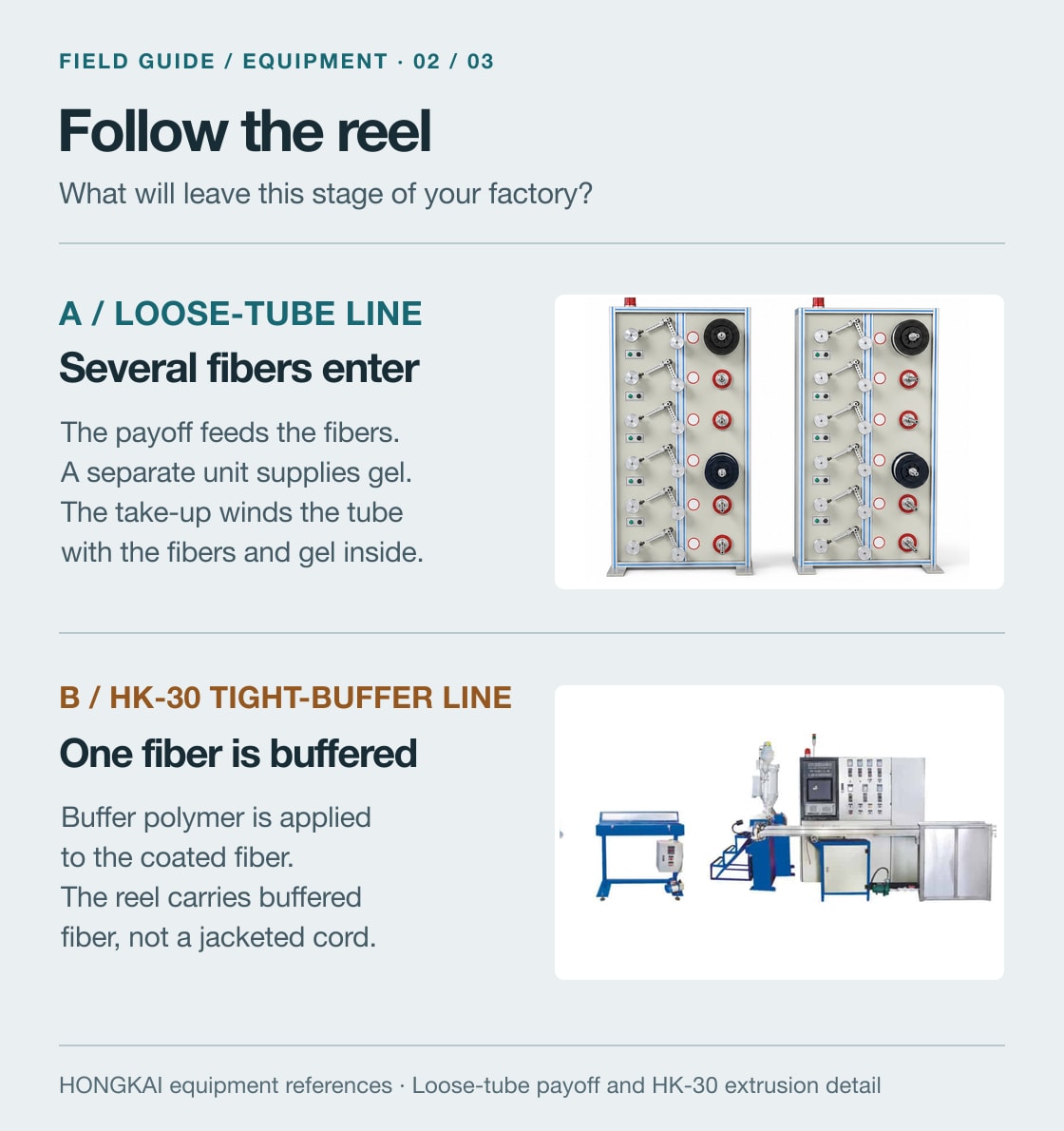
Top: the fiber payoff for a HONGKAI loose-tube route. Bottom: the extrusion end of the HK-30 catalog line. These are two separate equipment references, not one factory layout or a fixed equipment list.
For a 느슨한 튜브, start with the fibers that must feed one tube. For the gel-filled design shown, match the payoff positions to the fiber count and include the gel supply and filling unit in the quote. Then follow tube extrusion, cooling, measurement and take-up. The HONGKAI loose-tube production line shows these stations and the available reel-handling configurations. Ask how the supplier will check the length of fiber laid into a known length of tube. That length relationship matters in a loose-tube design; it cannot be read from the radial gap in a cross-section.2
For tight-buffered fiber, follow one incoming coated fiber through the line. The HONGKAI HK-30 tight-buffered fiber line shows controlled payoff, preheating, buffer extrusion, cooling, diameter monitoring, traction and take-up. The reel leaving this route holds buffered fiber. If your order is for a jacketed simplex cord, adding reinforcement and a jacket is a later operation; fitting and testing connectors is another. The patch-cord manufacturing route shows those handoffs separately.
For an existing factory, ask what already comes through the door on a reel. A shop buying finished loose tubes for stranding does not need to specify a new tube extruder for that order. A shop buying tight-buffered fiber to make cord cable can begin at reinforcement and jacketing. If the factory wants to make both components in-house, request a configuration and a sample trial for each; do not count the second product as covered by the first quote.
Mark these dimensions before asking for a quote
Send two views if you have them: a finished-cable cross-section with the component circled, and an enlarged drawing of that component. Write the output on the reel at the top. This prevents one supplier from quoting a buffering stage while another quotes an entire cable line.

Drawing key, not a measurement report. The dimension arrows identify which surfaces to measure. Enter your own nominal dimensions, tolerances and units; do not scale the illustration.
For the loose-tube enquiry: Mark the number of fibers per tube, the coated-fiber size, tube inner diameter (ID) and outer diameter (OD), with tolerances. Identify the tube material and specify the fiber filling gel. If the customer instead supplies a dry-tube drawing, quote that construction separately. For a trial, name the sample length and the agreed method for checking tube dimensions and excess fiber length. A round tube at the right OD does not establish what is inside it.
For the tight-buffer enquiry: Mark the incoming diameter over the primary coating and the finished diameter over the new buffer, with its tolerance. Name the proposed buffer material and the input and output reels. If the next operator must strip the buffer for termination, specify what must be removed, what must remain, and how the customer will judge a sample. A diameter reading does not answer that handling question.
Here is a quick check before sending the drawing: could a supplier describe the correct reel without seeing the finished cable's trade name? “One tube with the specified fibers inside” and “one individually buffered fiber” are different deliverables. If the only answer is “indoor cable,” “outdoor cable” or “single-mode cable,” ask for the component detail before comparing machine prices.
-
The Fiber Optic Association, 광섬유 케이블, illustrates loose-tube, tight-buffered simplex and distribution constructions. The examples are cable designs, not dimensional specifications for a new order. ↩ ↩ ↩
-
K. Borzycki and P. Gajewski, Accurate Location of Fiber Cable Fault with OTDR, distinguish fiber length from tube length in equations (3) and (4). These describe the geometry, not a machine setting or an acceptance limit for your order. ↩

 English
 हिन्दी
 فارسی