






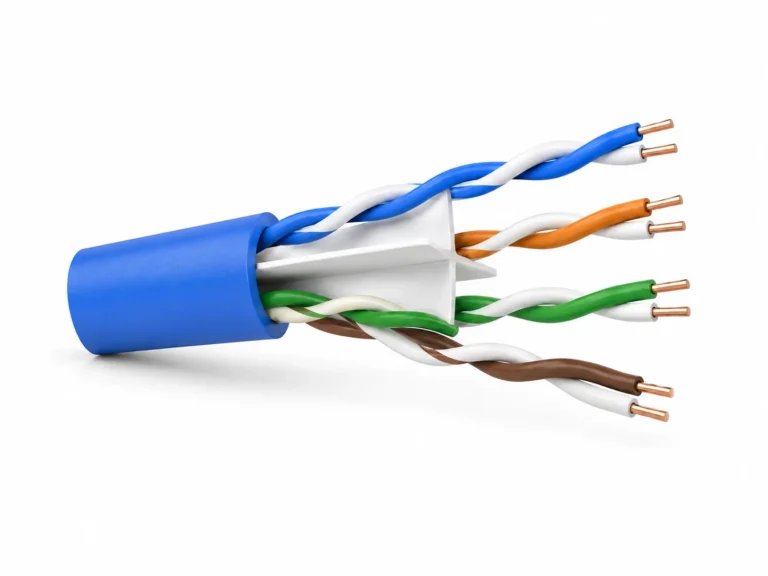

The lab calls: the orange–green pair combination on a Cat6 sample failed the near-end crosstalk (NEXT) test. The production manager has two orange pair reels on the shift sheet and one finished reel on hold. Which orange reel was actually in the sample?
Start with the two metre marks on the sample, not the setting on the twister. The test tells you which pair combination failed. The production records tell you which reels supplied it. Neither, on its own, tells you what to adjust.
Keep the marked sample, the original test file and the identified finished reel available before anyone cuts another piece, remakes an end or changes a machine setting. Here is how to use those records together.
What does “orange–green FAIL, end A” actually tell you?
In a pair-to-pair NEXT test, a signal is applied to one twisted pair and unwanted coupling is measured on another at the same end. Results vary with frequency and can differ when tested from the opposite end.1 “Near end” means the end sending the signal for that measurement. It does нет mean the fault is at the first metre of the reel, and it does not say that the orange pair, rather than the green, is defective.
Save the original traces for both test directions, including the selected limit, the worst margin and its frequency. Label both physical ends and record the jacket marks, specimen length, fixture and port-to-colour mapping. You want the next shift to be able to connect the same end and compare the same two pairs.
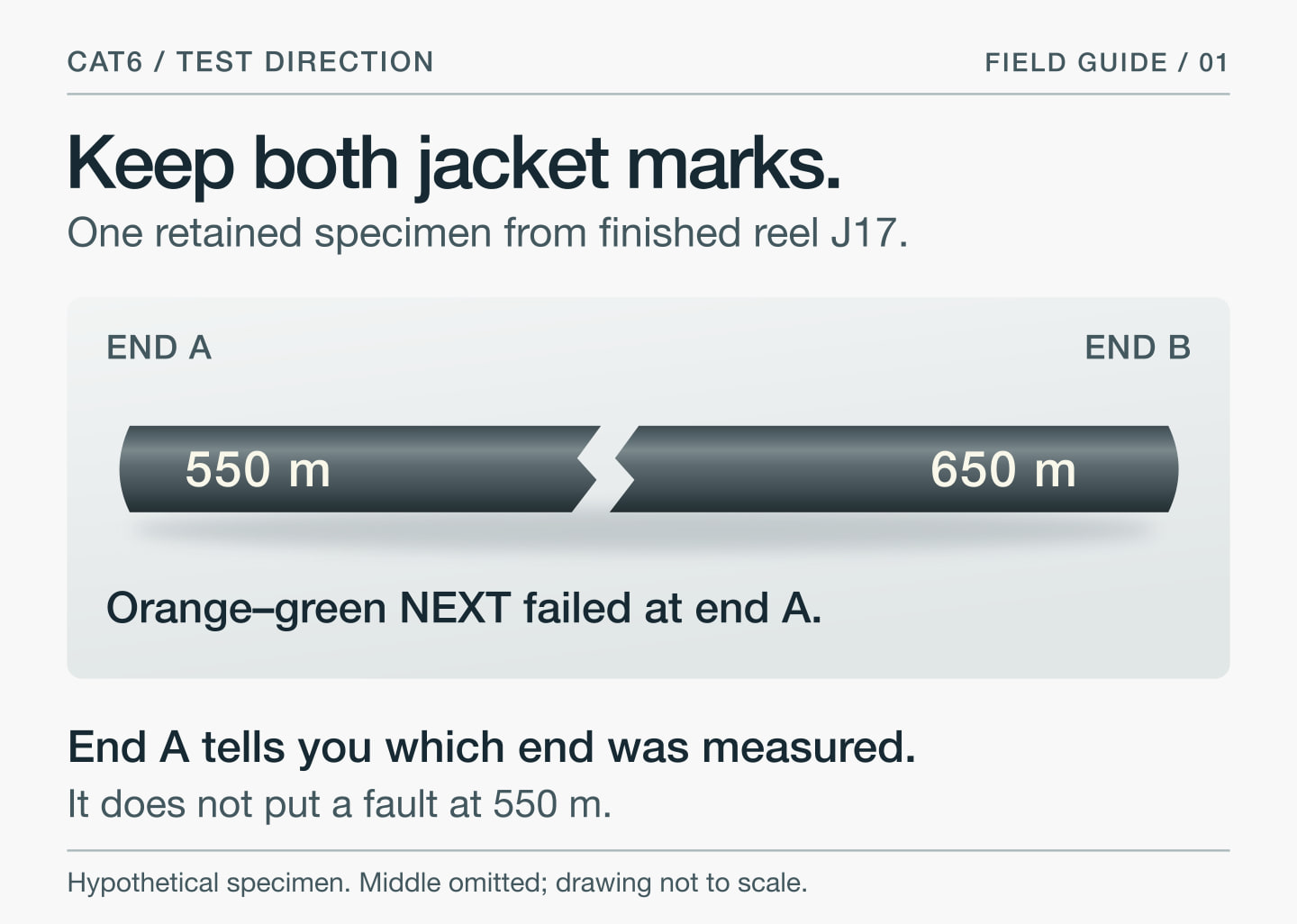
In this hypothetical example, mark both ends before reconnecting the specimen. End A is the direction of the failing measurement. It does not put a defect at 550 m.
An installed-channel result includes the connections. Treat it as grounds to investigate, not a factory verdict on the cable. IEC 61156-5, for example, covers cable intended primarily for horizontal floor wiring.2 Use the cable specification and specimen method agreed for the order; the factory and field testing guide explains why those results answer different questions.
Repeat the measurement on the retained specimen under that method. If you suspect an end preparation or fixture, document it before changing one item and repeating the test. If the result changes when only the end is remade, investigate the connection first. The second reading does not erase the first or release the whole reel.
Worked example: an orange pair reel changes at the 500 m mark
Hypothetical example, not a customer case. All reel IDs, marks and test outcomes below are invented to show the trace. The distances are printed jacket marks, not instrument fault distances or recommended test lengths.
The failed sample is from finished reel J17. End A is marked 550 m and end B 650 m. The jacket log identifies C08 as the cabled-core reel for that section. The cabling log shows orange reel O13 replaced by O14; the green pair came from G09 throughout. The blue and brown reels did not change in this example. Keep their IDs on the trace sheet too.
The crucial entry is the handover between the two logs. In this example, the team recorded the orange change position on C08, then matched that position to the 500 m print on J17 during jacketing. The transfer record confirms that O14 lies on the higher-numbered side after accounting for the direction the core was unwound and any cut-off length. Without that entry, the number on a pair or core counter is not a jacket metre mark.

Read the two sample marks against the change on J17. Only orange switches at 500 m. A cut across the boundary contains both orange reels and the same green reel.
| Jacket marks on J17 | Orange reel(s) | Green reel | What the records establish |
|---|---|---|---|
| 350–450 m: before the change | O13 | G09 | This is an O13/G09 interval to use for comparison. No test result is assumed. |
| 450–550 m: crosses 500 m | O13 and O14 | G09 | This piece contains both orange reels. One failing result for the whole piece would not distinguish them. |
| 550–650 m: failed sample | O14 | G09 | Both ends are above 500 m. Trace O14 and G09 first; O13 was not in this sample. |
Where do those IDs come from? HONGKAI’s UTP Cat6 production route separates pair twisting from cabling. Record the pair reel actually loaded at the cabling payoff; that is the entry that connects it to C08.
Now remove just one fact: the shift sheet says “orange changed at 10:20” but nobody recorded where the change reached J17. Even for the same 550–650 m sample, O13 and O14 both remain candidates, alongside the known green reel G09. Multiplying clock time by nominal line speed cannot reconstruct a missing transfer or rewind. Mark the orange source unresolved and keep both reel records.
Which comparison would justify checking a machine setting?
Use separately identified finished-cable specimens from either side of the known change, at the length and with the fixture required by the agreed method. Compare like with like: label the test direction on each specimen and use the same pair combination and frequency range. Check whether the green reel, cabling setup and jacket run also stayed the same. A loose orange pair on the bench cannot, by itself, reproduce a measurement between orange and green in the assembled cable.
If the result repeats only on the O14 side under comparable conditions, inspect O14 first. Measure its lay length (the distance along the pair for one complete twist) against the approved range for the orange pair. If it is within range, the reel number alone is no reason to tighten the twist.
If sections made with either orange reel fail with G09, look at what they share: the green pair, end preparation, and how the pairs were held together in cabling and jacketing. If the cabling setup changed at the same time as the orange reel, the before-and-after test cannot tell those two changes apart.
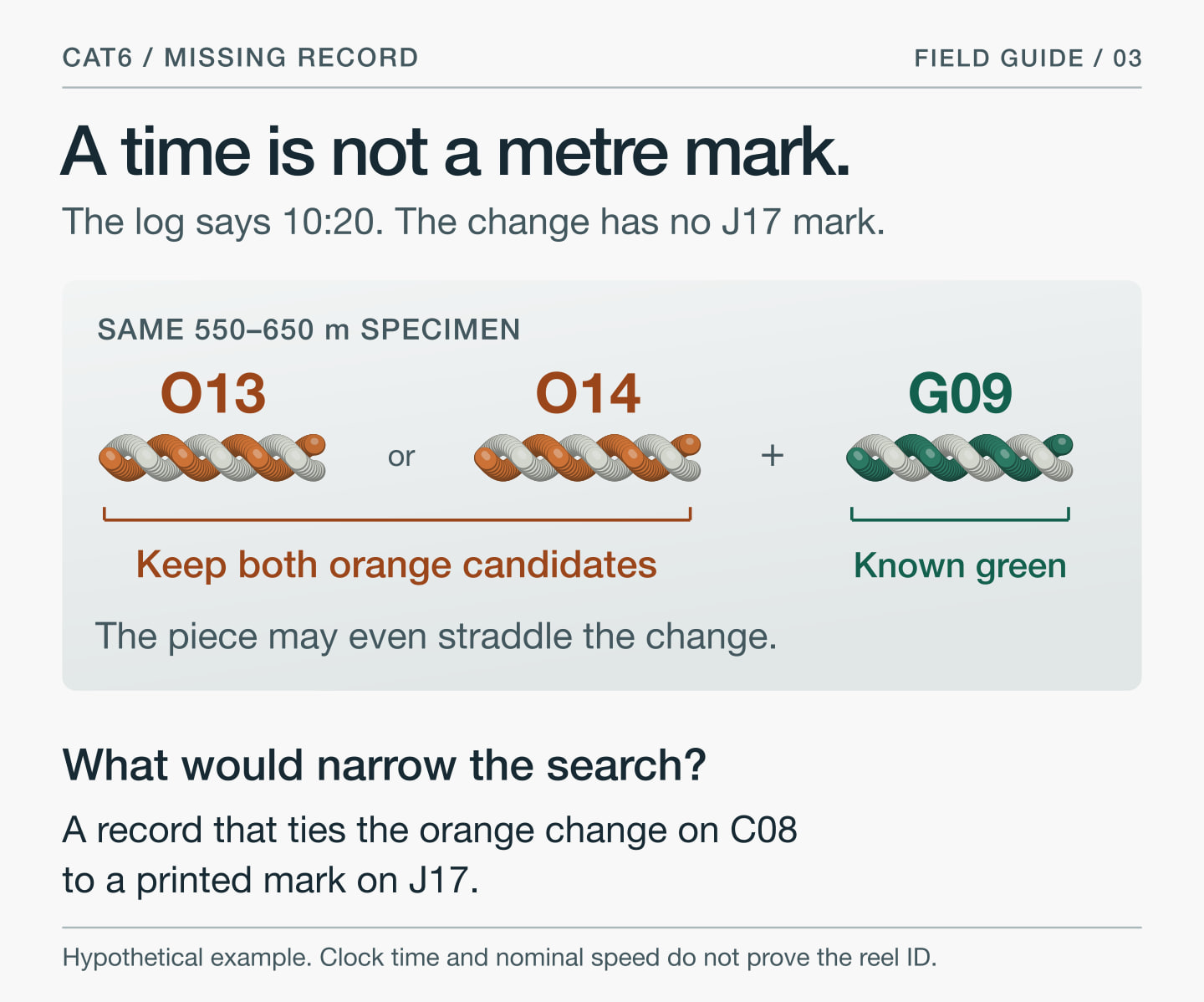
If 10:20 is the only change record, the same 550–650 m cut could be before, across or after it. Keep both orange reel records. A clock time is not evidence for changing the orange pair’s twist.
At shift handover, write down what is known: “J17, 550–650 m; orange–green NEXT failed at end A; O14 and G09 identified; cause not established.” If the 500 m link is missing, record “green G09; orange O13 or O14, unresolved” instead. Keep the affected material on hold under the factory’s quality plan. Only change a setting when evidence points to that stage; record what changed and retest identified finished material before deciding what can be released.
-
Fluke Networks, NEXT troubleshooting with the DSX CableAnalyzer. It explains frequency, test ends and termination effects for field links; it does not set this factory’s bulk-cable release method. ↩
-
IEC, IEC 61156-5:2020 — symmetrical pair/quad cables for horizontal floor wiring. The scope distinguishes the cable as a product; use the specification agreed for the actual order. ↩


 English
 Русский
 हिन्दी
 한국어
 বাংলা
 Bahasa Indonesia
 Tiếng Việt
 മലയാളം
 Português do Brasil
 العربية
 فارسی