














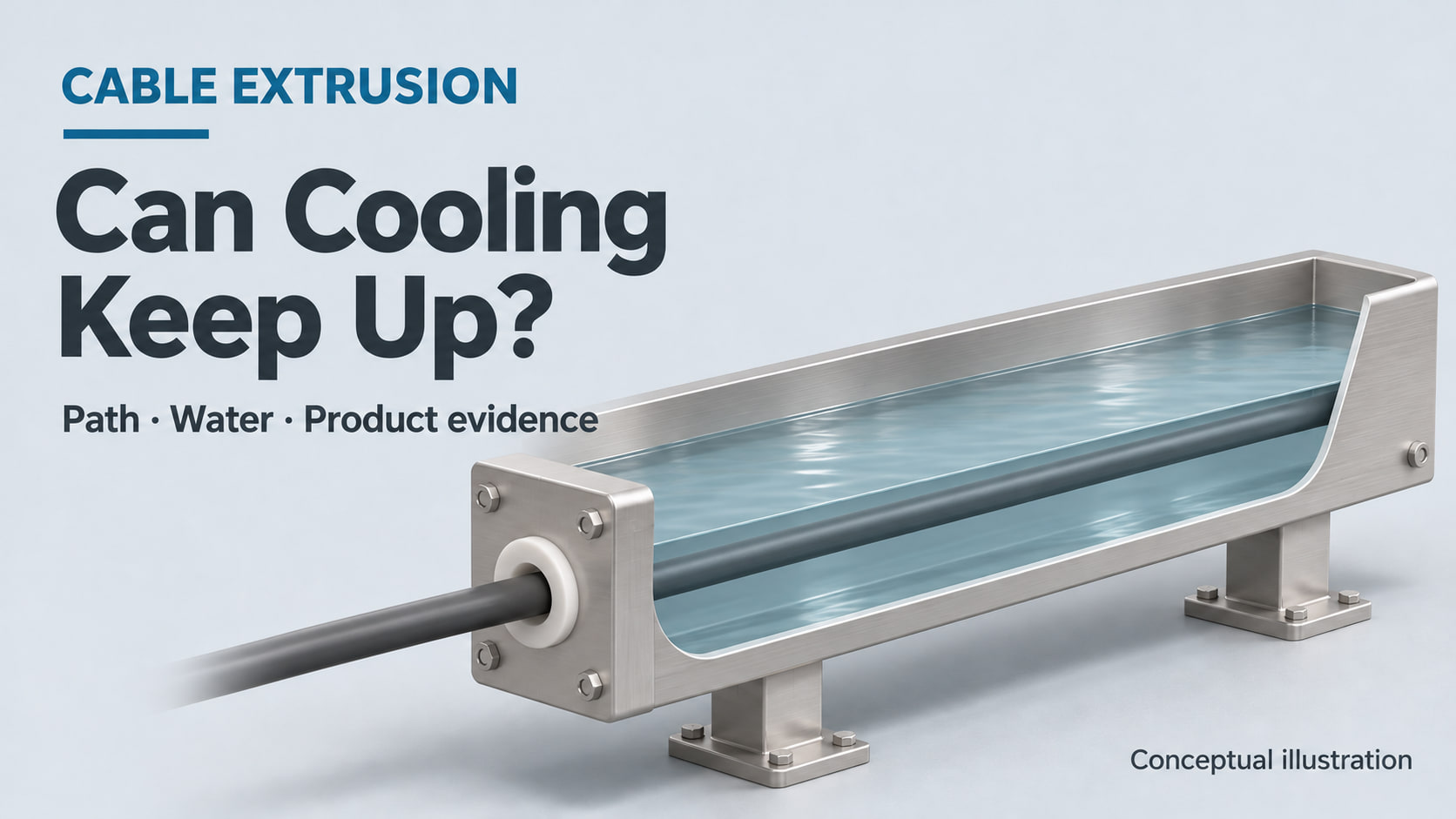
Production managers comparing a faster insulation or sheathing line need more than an extruder output figure: they need evidence that the identified cable meets its requirements after the proposed cooling route. Compare cable extrusion cooling through three connected records—the actual product path, the water conditions during the run, and measurements taken at named positions. This buyer’s guide uses water-cooled PVC/PE processes as starting examples; keep the separate cálculo de dimensionamento da saída do polímero e da linha completa ao lado dele, pois a capacidade suficiente em kg/h não resolve a questão do resfriamento.
Conte o Caminho do Produto, não a Pegada da Calha
At constant speed, transit time through a defined section is the cable’s actual path length divided by its speed. Measure the route the cable follows, not the trough’s outside length, and separate immersed, sprayed and dry sections.
Cooling equipment can include a movable entry, fixed sections, several water-temperature zones or a multipass route. Maillefer’s MCS200 describes these modular choices in relation to the process, cooling demand and floor space.1 As listas de referência multipasso da AW Machinery abrangem resfriamento por inundação/spray, arranjos de roldanas livres/motriz e polias multicanal.2 These are examples of different arrangements, not evidence that every cable can use every route.
Ask for a drawing that marks each pass, return and water zone. Keep supports and turning arrangements visible: a return outside the water contributes to cable travel, but not to the immersed path. Distinguishing footprint, total travel and water-exposed length prevents a compact multipass proposal from being compared with a straight tank by outside dimensions alone.
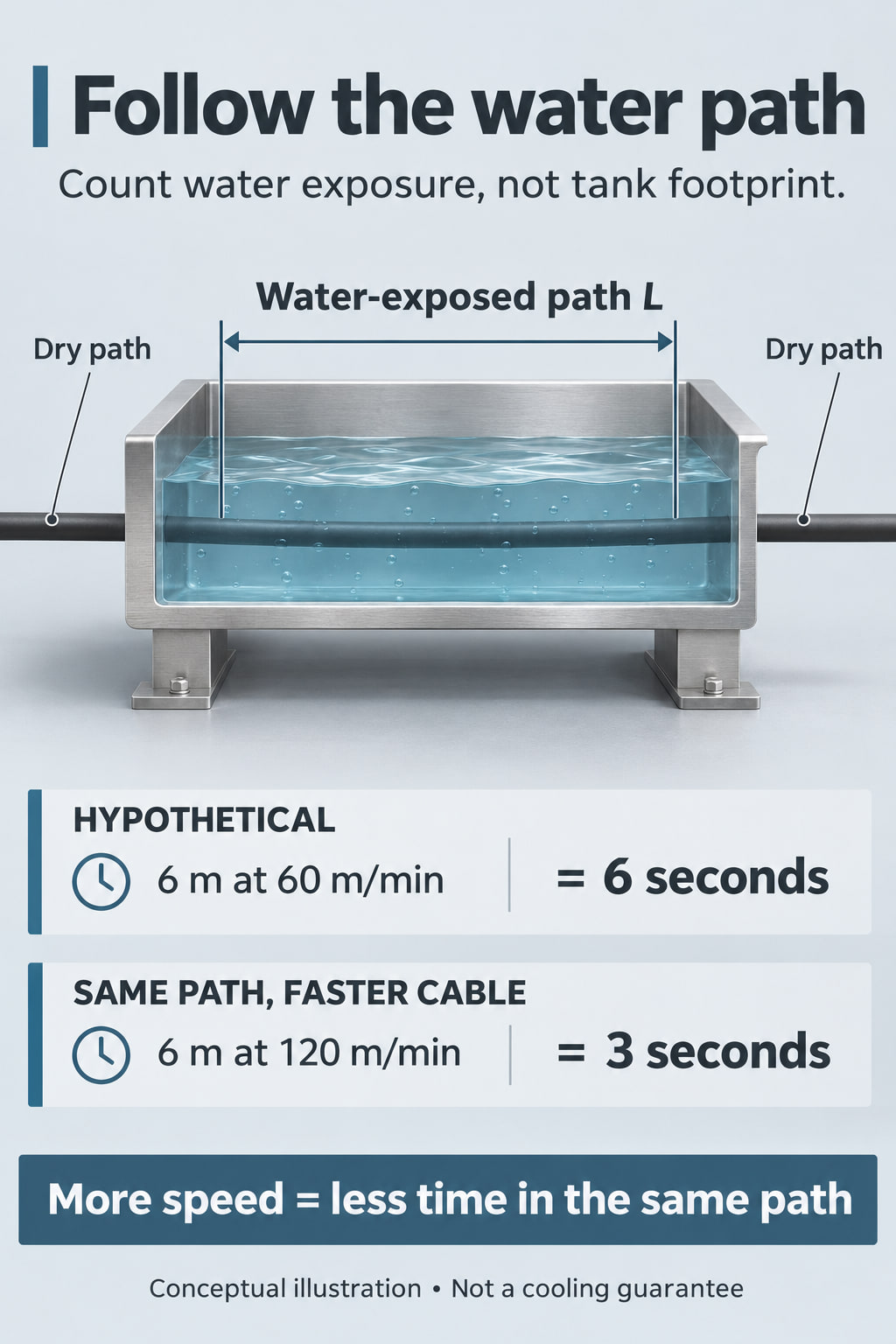
Conceptual 3D cutaway, not a machine drawing. The assumed 6 m water-exposed path takes 6 s at 60 m/min and 3 s at 120 m/min; these are transit-time examples, not accepted cooling conditions.
A Time Comparison, Not a Cooling Guarantee
Let L be the cable path in one defined water-cooling section, in metres, and você the constant cable speed, in metres per minute:
t = 60 × L / v, with t in seconds.
The factor 60 converts minutes to seconds. This calculates travel time, not heat transfer or the temperature inside the cable.
| Hypothetical arrangement | Assumed water-exposed path | Assumed cable speed | Calculated transit time |
|---|---|---|---|
| Reference route | 6 m | 60 m/min | 6 s |
| Same route, doubled speed | 6 m | 120 m/min | 3 s |
| Longer route at the higher speed | 12 m | 120 m/min | 6 s |
The inputs are hypothetical, not HONGKAI machine ratings or production results. Doubling speed halves the time in an unchanged path. Doubling the path restores the calculated time, but the product and water conditions still determine whether the resulting duty is suitable.
Calculate each water zone separately where conditions differ. For acceleration, stopping or restart, use the affected cable’s running history rather than applying the constant-speed calculation to the entire interval.
Note: Equal transit time does not mean equal product condition. The calculation does not select a water temperature, flow, trough length, bend radius or acceptable speed; those require a product-specific engineering or trial basis.
Put the Water Duty on the Same Sheet as the Cable
Put the incoming cable construction, compound supplier/grade, applied wall, dimensional tolerances and target speed on the cooling-duty sheet. Finished outside diameter alone does not identify the product being evaluated. Treat a different compound or layer arrangement as a separate case until its coverage has been reviewed.
On the same sheet, define the water circuits, zones and measurement points. The equipment and utility suppliers should specify the relevant supply/return temperatures, flow, pressure and heat-removal requirements, with units and methods. A cabinet setpoint alone is not a record of the water conditions maintained at the machine during the run.
| Review boundary | Put in the proposal or trial record | Decisão que apoia |
|---|---|---|
| Incoming product | Drawing revision, compound grade, applied layer and relevant upstream condition | Does the evidence belong to this cable? |
| Route and water zones | Entry/exit, exposed path, immersion/spray, supports and returns | Are the compared arrangements equivalent? |
| Water at the machine | Supply/return measuring points and running records; required utility conditions | Can the site maintain the stated duty? |
| Water-system supply scope | Included equipment, buyer services, interfaces and responsible party | Is the operating circuit covered, not just the trough? |
| Product leaving the section | Sample identity, position, handling condition and applicable limits | Does this operating point meet the agreed requirements? |
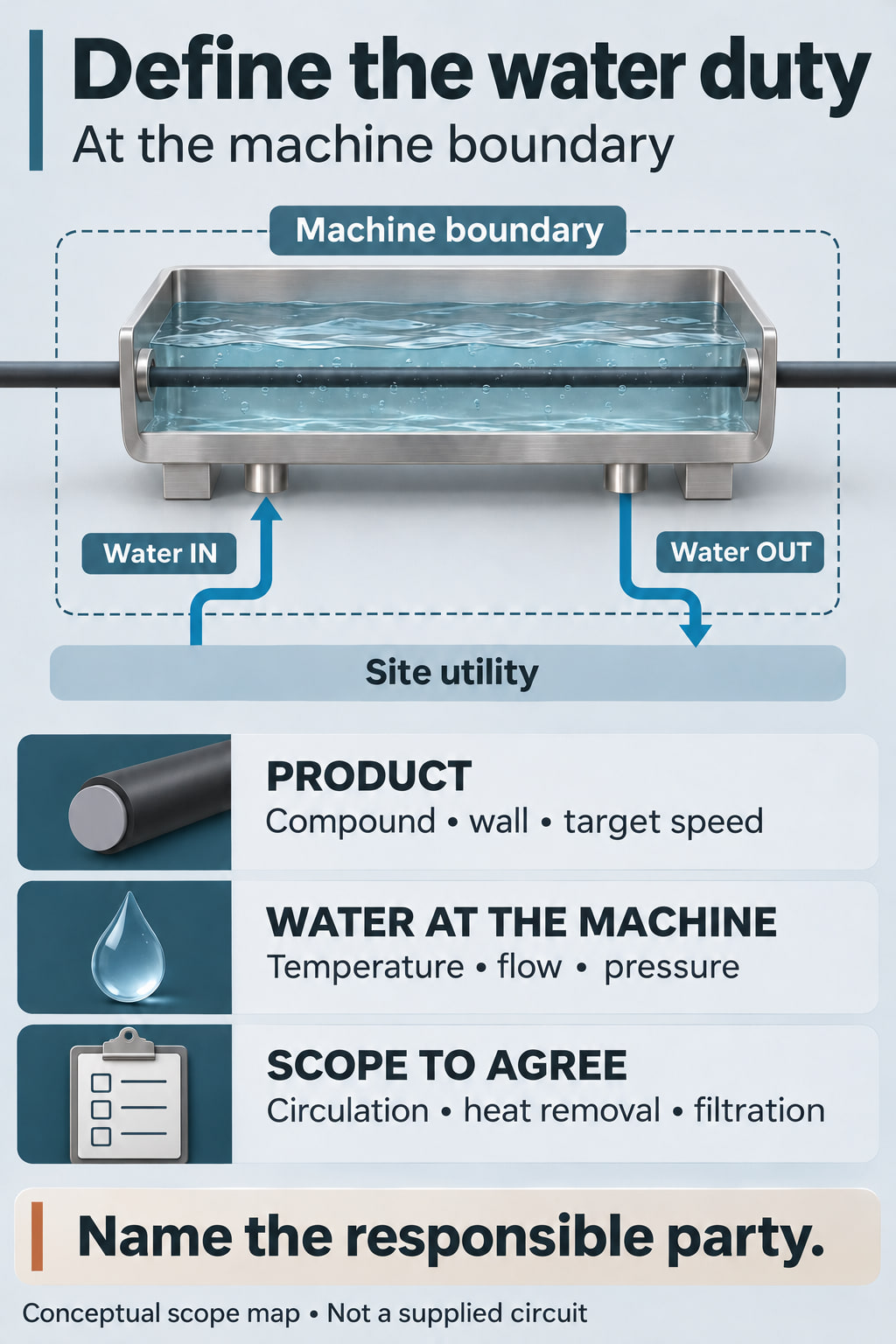
Conceptual scope map, not a supplied water circuit. Grey cores are generic product envelopes, not specified cable constructions; empty boxes identify items to agree, not completed checks.
Separate circulation from heat removal and supply responsibility. Maillefer lists closed water circulation as an option,1 but an option name does not establish that a complete site utility is included. Identify whether pumps, a reservoir, heat exchange or chilling, filtration, connections and controls are included, supplied by the buyer, or outside the offer. The list defines interfaces; it is not a requirement that every project use the same equipment.
Apply the same review to an existing water system. Obtain its documented conditions and the basis for reuse at the proposed product and speed; mark any unverified interface as open.
What to ask: Which water conditions must be maintained at the machine, where are they measured, and who supplies the equipment that maintains them?
Compare Product Readings at Named Positions
Name each measuring position on the route drawing and keep its location and method with the reading. An intermediate diameter, a downstream diameter and a collected-sample result may describe different product conditions. A report containing only a diameter and a pass mark leaves an important question unanswered: which cable length, at which position and against which requirement?
SIKORA gives a specific sheathing-line example: an X-ray unit between cooling troughs measures the outer jacket, while another diameter gauge near the line end works with Hot-Cold-Control to account for diameter shrinkage.3 This illustrates why position matters; it is not a mandatory layout or a declaration that HONGKAI supplies these instruments.
| Position to identify in the project | Keep with the observation | Do not conclude from it alone |
|---|---|---|
| Upstream or intermediate gauge | Location, method, cable identity, running condition and applicable limits | The later dimensional requirement has already been met |
| Agreed exit or downstream check | Route/water records, handling or wiping arrangement, reading and sample reference | A clean or dry surface proves the required internal condition |
| Collected cable after specified handling/conditioning | Reel/sample identity, test-method conditions and relevant product results | One accepted sample covers other materials, walls or speeds |
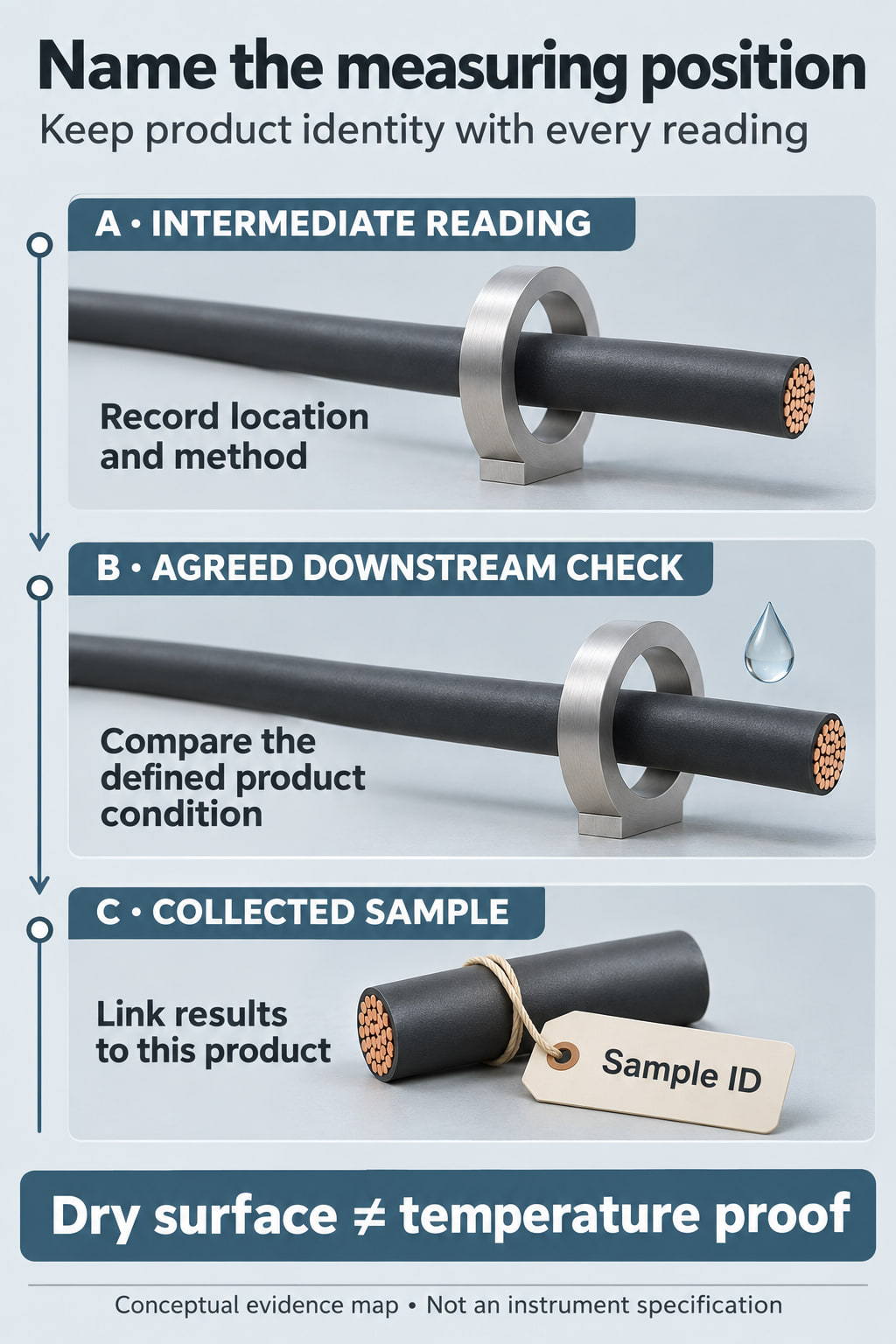
Conceptual evidence map, not a required instrument layout. The insulated conductor is a generic example, not a product specification. Keep position and method with the sample; a dry surface is not evidence of temperature through the cable.
Air wiping needs its own requirement. AW Machinery lists optional air wipers,2 but observing water removal does not measure temperature through the cable. Specify the wiping result separately from the dimensional and product checks assigned to the trial.
If a problem appears at higher speed, preserve the affected sample and corresponding speed, water, upstream and handling records before naming the cause. A mark first noticed at take-up does not establish that the trough is too short. Resolve missing sample identities or changed measuring conditions before judging a cooling modification.
Accept a Product–Speed–Cooling Combination
Use the route and water-duty sheet to define trial cases before accepting a higher speed or replacement trough. Separate the reference condition, a speed change, and a change of compound or geometry. An easy product’s result cannot be extended to the range without a documented basis.
| Proposed case—not a completed test | Question the case should answer | Evidence to agree before the run |
|---|---|---|
| Reference product at an agreed operating point | Is there a usable baseline? | Product revision, material lot, route, running records and applicable results |
| Same product at the proposed higher speed | Does this cable meet its requirements at the new point? | Speed history, water conditions, named measuring positions and traceable samples |
| Different compound, wall or construction | Is the baseline applicable? | Documented coverage basis, or a separate trial with its own required results |
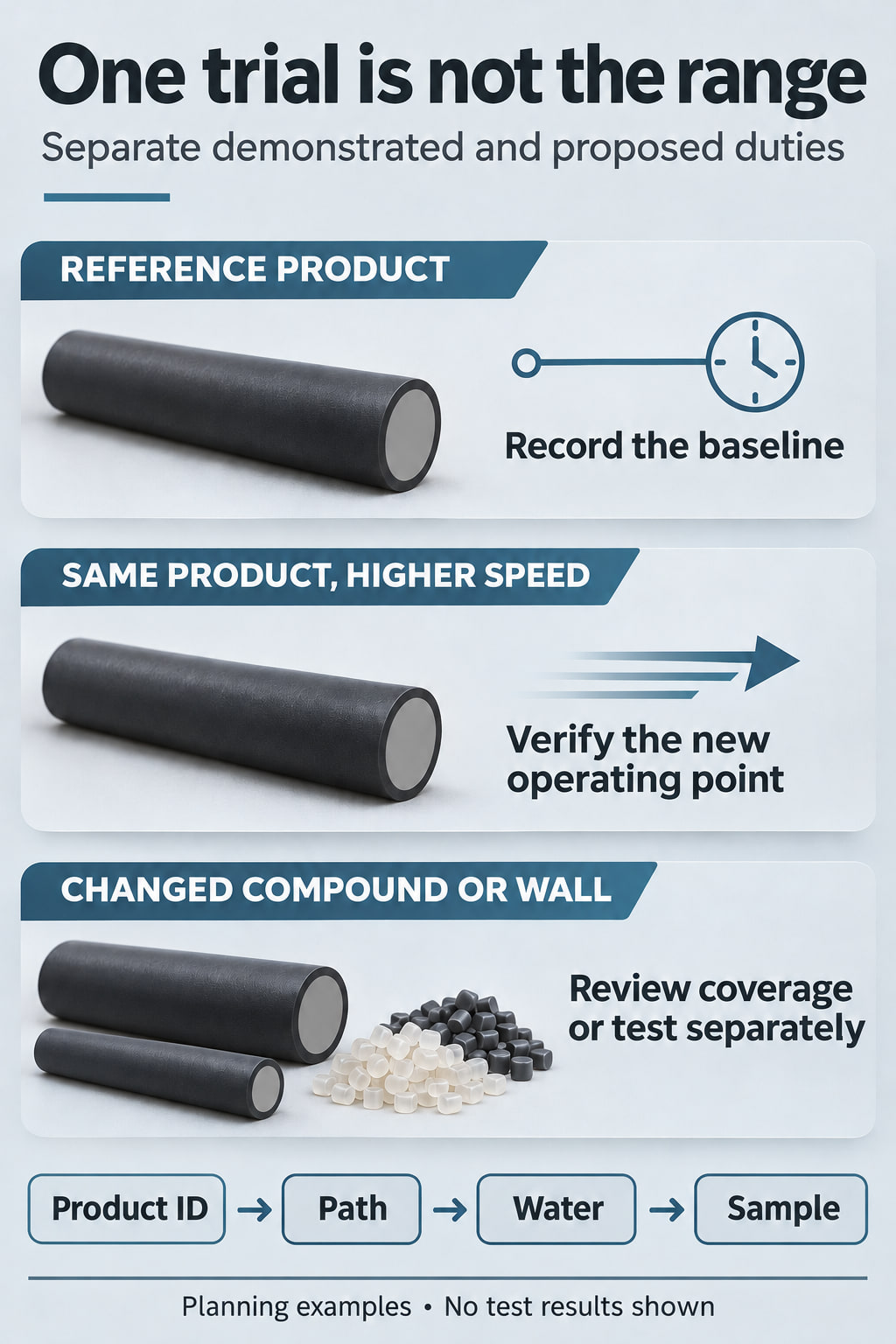
Conceptual planning examples, not test results. Grey cores are placeholders rather than specified conductor constructions. Each changed duty needs reviewed evidence or a documented coverage basis; no pass status is shown.
Agree sustained-running duration, sampling and acceptance criteria, plus the treatment of startup, interruptions and restart where relevant. A brief favorable interval does not demonstrate a different water supply or order mix. Identify who approves and operates the trial, interprets results and authorizes product release; unperformed tests remain open, not implied supplier responsibilities. Any adjustment belongs under equipment instructions, material guidance and authorized site procedures, not a generic cooling recipe.
For a HONGKAI sheathing enquiry, the cable outer-sheath extrusion reference places cooling alongside extrusion, haul-off and drum handling. Bring the incoming construction, jacket grade, wall, finished dimensions, working speed, cooling space and site utilities to that discussion. The page is an equipment-scope starting point, not evidence of a particular water system, instrument package or demonstrated cooling performance.
Finish with one marked route drawing linked to the utility boundary, measuring positions and product-specific trial records. The offer can then distinguish a demonstrated operating point from a proposed change still awaiting evaluation—and provide a concrete record to revisit when the order changes.
-
Maillefer, Cooling System MCS200, Description and Options: modular arrangements, water-temperature zones and optional closed water circulation. Manufacturer example only; no HONGKAI supply scope is inferred. ↩ ↩
-
AW Machinery, Multipass Cooling, Features: flood/spray, idler/driven arrangements, multigroove sheaves and optional air wipers. Manufacturer-specific features, not a HONGKAI configuration. ↩ ↩
-
SIKORA, Measuring and control technology for data cables, automotive cables and building wires, X-RAY 6000 PRO/X-RAY 6000 PURE section, PDF page 19: sheathing-line measuring positions and Hot-Cold-Control for diameter shrinkage. This is a specific equipment example, not a universal acceptance procedure. ↩

 English
 हिन्दी
 فارسی