



Many investors believe that producing LAN cables requires investing millions in complex physical foaming lines. This is not always true.
To set up a highly efficient, cost-effective production line for Cat5e and Cat6 (and entry-level Cat6A), you can utilize a Chemical Foaming Insulation line, High-Speed Triple (or Double) Twist Pairing machines, a Cantilever Cabling line, a Sheathing extruder, and an automatic Coiling machine. This configuration significantly reduces your initial capital investment while maintaining high production speeds.
I have worked with numerous clients in Southeast Asia and Africa who began with modest budgets. They did not have the budget for a Swiss-made physical foaming line. I told them, "You don’t need a Ferrari to deliver pizza." If your primary market is Cat5e and standard Cat6, a chemical foaming or solid insulation setup is an innovative and profitable choice. It is easier to operate, cheaper to maintain, and gets you into the market faster. In this guide, I will show you how to build this "Smart Economy" line.
Is raw material selection different for Chemical Foaming?
Since we are not injecting nitrogen gas, the chemistry happens inside the plastic pellet. You need to understand your materials differently.
For this production method, you need Oxygen-Free Copper (OFC) and a specific HDPE compound pre-mixed with a chemical blowing agent (masterbatch). Unlike physical foaming, which uses gas, chemical foaming relies on heat to activate the foaming agent, making the extruder temperature control your most critical variable.
When I visit factories using this method, the most common mistake is using the wrong "Masterbatch1." In physical foaming, you buy pure HDPE and inject gas. In chemical foaming, you buy HDPE that has a "baking powder" inside it. When it gets hot, it releases gas bubbles.
The Chemistry of Cost Reduction
Why is this method cheaper to start?
- No Gas System: You do not need high-pressure nitrogen generators or injection nozzles.
- Simpler Screw: The extruder screw is shorter and simpler (L/D ratio is different).
- Lower Maintenance: There are fewer seals and valves to break.
Material Checklist
- Copper: Still needs to be 99.99% OFC. You cannot compromise here.
- Solid HDPE: For Cat5e, we often use solid insulation. It is cheap and stable.
- Chemical Foam HDPE: For Cat6 and Cat6A, you need to lower the dielectric constant. You mix a foaming masterbatch (usually Azodicarbonamide-based) with the HDPE.
- Ratio: You typically mix 1% to 3% masterbatch depending on the expansion rate you need.
- Expansion: Chemical foaming usually achieves 15%-25% expansion. (Physical foaming can do 50%+). This means your cable will be slightly heavier, but it is electrically sufficient for Cat6.
Cost Analysis: Chemical vs. Physical Setup
| विशेषता | Chemical Foaming / Solid Line | Physical Foaming Line |
|---|---|---|
| Machine Cost | Low ($$) | High ($$$$) |
| Operation Difficulty | Easy (Plug and Play) | Hard (Requires Engineer) |
| Material Cost | Slightly Higher (Masterbatch is extra) | Lower (Gas is cheap) |
| Best Product | Cat5e, Cat6 | Cat6A, Cat7 |
| Startup Time | Fast (1 month) | Slow (3 months) |
I advise clients: If you are making 80% Cat5e and 20% Cat6, go with the Chemical/Solid line. The ROI (Return on Investment) is much faster.
How does the Chemical Foaming/Solid Insulation line work?
This is the workhorse of the factory. It is robust and reliable.
The insulation line melts the HDPE and activates the chemical foaming agent at a precisely controlled temperature. It extrudes this mixture over the copper wire, creating a cellular insulation structure that improves signal speed without the complexity of gas injection systems.**
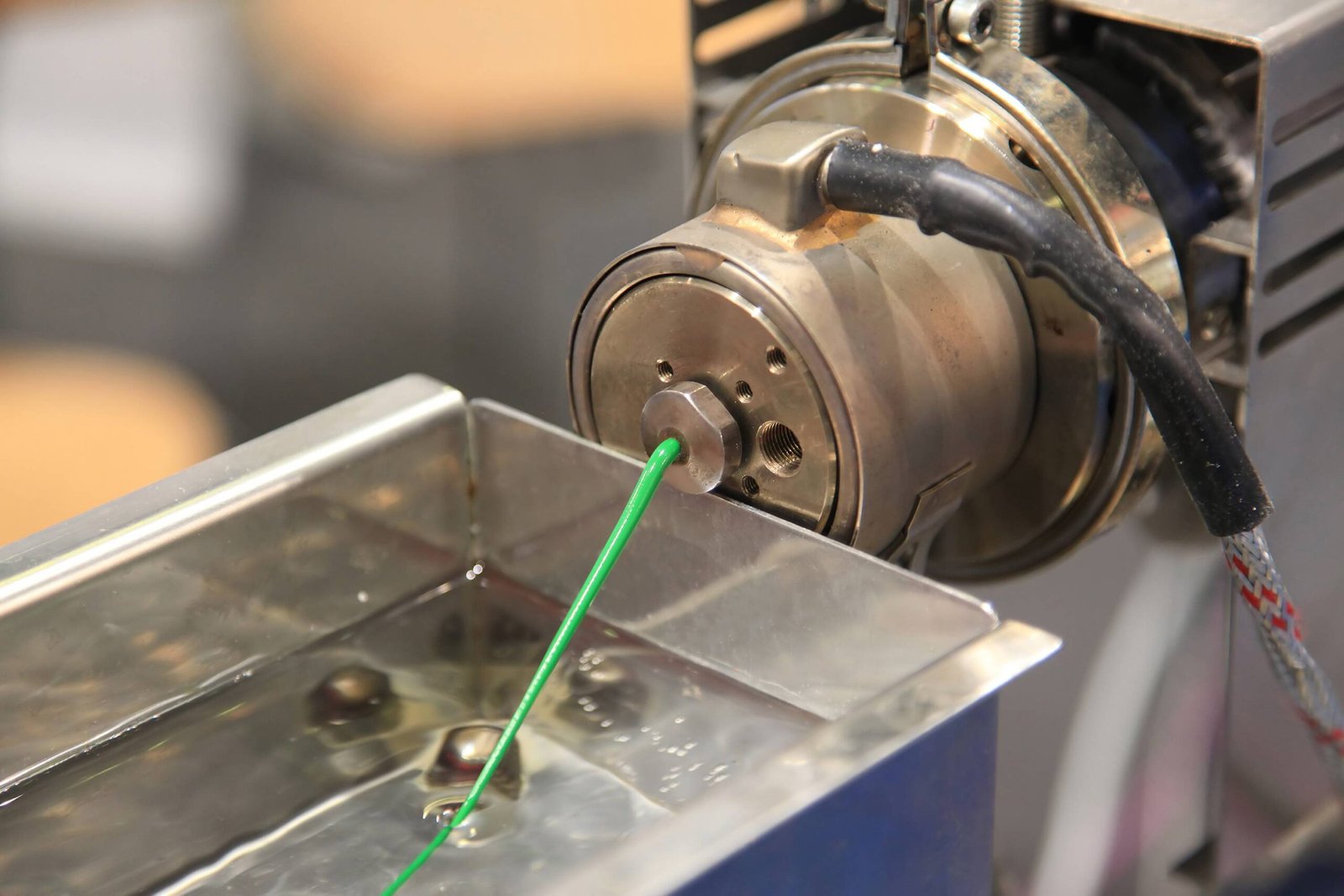
The secret here is "Temperature Profile."
If the extruder is too hot at the beginning, the gas releases too early, causing it to escape from the hopper.
If it is too hot at the end, the bubbles become too big and burst.
You need a "bell curve" temperature profile.
The Process Flow
- भुगतान करें: The bare copper wire enters the machine. It must be pre-heated to dry any moisture.
- एक्सट्रूडर: The screw melts the plastic.
- Zone 1-2: Melting.
- Zone 3-4: Decomposition (Foaming starts).
- Zone 5 (Head): Shaping.
- ठंडा करना: The wire enters a warm water trough. This is critical. If you hit the hot foam with cold water, it collapses. You need "Gradient Cooling2" (Warm -> Cool -> Cold).
- Capacitance Control3: Even in chemical foaming, we use a water-tube capacitance monitor. It instructs the extruder to speed up or slow down to maintain stable electrical properties.
Cat5e vs. Cat6A on this Machine
- Cat5e: You run Solid HDPE. No foaming. Very easy. Speed: 1000m/min.
- Cat6: You run Chemical Foam. Speed: 600-800m/min.
- Cat6A: This is the challenge. Cat6A requires very low capacitance. With chemical foaming, it is hard to get high expansion. You should make the insulation slightly thicker to compensate for this. This makes the final cable thicker. You must check if your RJ45 plugs4 can handle the larger diameter.
Why is the Triple Twist (or High-Speed) Pairing machine the efficiency booster?
Twisting is usually the bottleneck. To make money from cheap cable, you need to have a high volume of sales.
The Triple Twist (or high-speed double twist) machine is designed for maximum output. By optimizing the bow design and rotational speed, these machines can produce paired wire significantly faster than standard twisters, which is essential for high-volume Cat5e production.
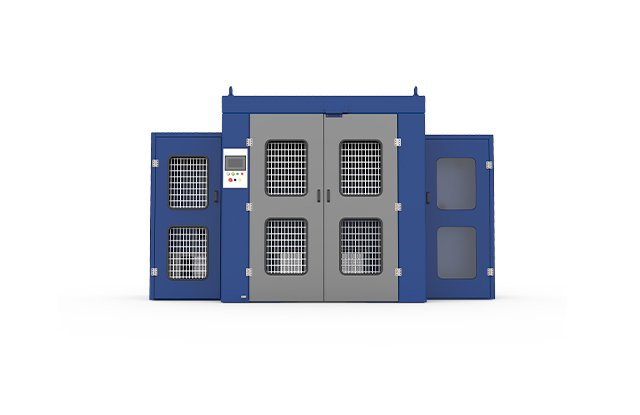
When we refer to "Triple Twist" in the industry, we typically mean high-efficiency machines that maximize twists per minute, specifically machines designed to handle the high throughput of commodity cables. For Cat5e, you sell by the meter, so speed is a profit.
How it Works
A standard double-twist machine produces two twists per revolution.
If the machine runs at 2000 RPM = it will produce 4000 twists/minute.
High-speed pairing machines (optimized for LAN) can run at higher RPMs or use lighter bows to achieve higher effectual output with less energy.
Pitch Control for Crosstalk
Even with high-speed machines, the physics is the same.
- Pair 1: Short pitch.
- Pair 2: Medium pitch.
- Pair 3: Long pitch.
- Pair 4: Very long pitch.
You need a machine with a digital lay length control. Old machines used gears. You had to stop the machine and change dirty gears with grease on your hands to change the pitch.
HONGKAI machines use Servo Motors5. You type "12mm" on the touch screen, and the machine adjusts instantly. This saves hours of setup time every week.
Back-Twist: Is it needed?
For this "Economy Line":
- Cat5e: No back-twist needed. Standard high-speed twisting is fine.
- Cat6: Standard twisting is usually fine if your insulation is good.
- Cat6A: Here, a back-twist payoff is helpful, but if you are on a budget, you can manage without it if you control your tension perfectly. However, passing the Fluke test6 will be harder.
How does the Cantilever Cabling machine simplify assembly?
You have four pairs. You need to make a cable. The Cantilever machine is the industry standard for a reason.
The Cantilever Cabling machine (Single Twist Cabler) is the most efficient solution for assembling U/UTP cables. It allows for high rotational speeds and easy integration of the cross-separator (spline) required for Cat6, making it the backbone of standard LAN cable production.

I love the Cantilever machine. It is simple. It is fast. It gets the job done. Unlike the complex "Planetary" machines used for shielded cables, the Cantilever is built for speed.
The Setup for Cat6
- 4 Payoffs: The four twisted pairs sit on bobbins behind the machine.
- Cross-Filler Payoff: For Cat6, a plastic cross (+) is fed from the top.
- Closing Die: The four pairs meet the cross. They fall into the slots.
- The Bow: The machine spins the whole bundle to create the final spiral.
- Taping (Optional): If you are making F/UTP (Shielded), you can add a taping head here to wrap the foil.
Why Cantilever?
- Speed: It can run at 800-1000 RPM. Since it is a single twist (usually), or a double twist depending on design, it produces cable very fast.
- तनाव: It handles the tension well.
- Cost: It is 50% cheaper than a planetary cable.
The "Cat6A" Challenge with Cantilever
If you are making Cat6A U/UTP (Unshielded), the Cantilever is fine.
When making Cat6A F/UTP (Shielded), you need to be careful. The Cantilever machine adds a twist to the cable. If you wrap foil around it, the twist might cause the foil to wrinkle.
- समाधान: Use a high-quality taping head with active tension control. This ensures the foil stays smooth even at high speeds.
What is the role of the Sheathing Line in this setup?
The sheathing line does not just add plastic; it controls the cost.
The sheathing extruder applies the final jacket (PVC or LSZH). In a cost-effective line, precise diameter control is crucial to minimize material waste, and the line must be versatile enough to handle various compounds without lengthy changeover times.
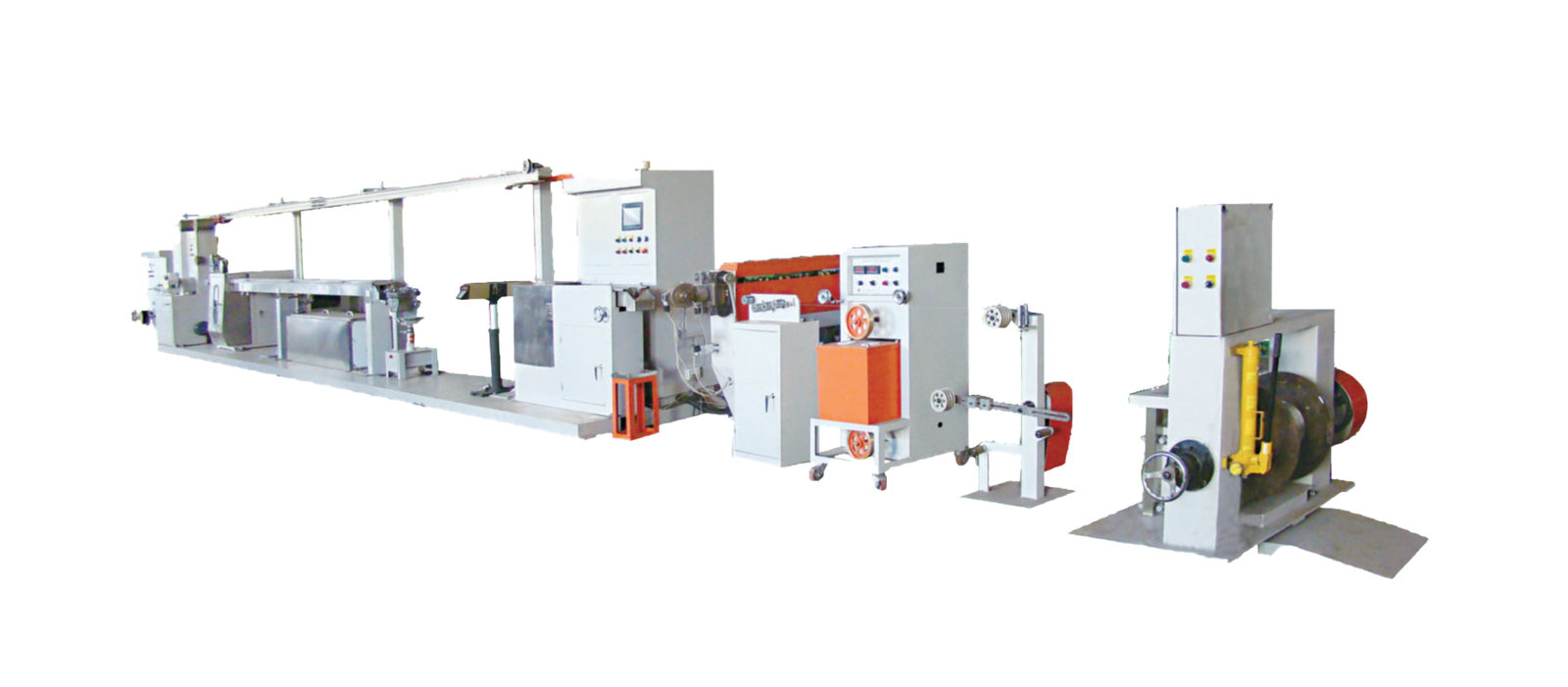
In the "Economy" setup, we focus on OEE (Overall Equipment Effectiveness). We don’t want the machine to stop.
Screw Design for Versatility
You might switch from PVC (cheap) to LSZH (fire-rated) on the same day.
We use a BM (Barrier Mixing) Screw. It is a general-purpose design that mixes well and melts efficiently. It allows you to run PVC, PE, and LSZH on the same machine (with proper purging).
The "Injecting" vs. "Tubing" Method
- Tubing (Loose): The plastic forms a tube around the cable. It is easy to strip. This is standard for LAN cables.
- Pressure (Tight): The plastic is pushed into the gaps. This is rare for LAN, but it is sometimes used for outdoor cables.
For this line, we use a Semi-Tubing setup. It gives a tight look but is easy to strip.
Branding
Use a high-speed Inkjet Printer. It is the cheapest way to brand. You can offer "OEM Services7" to other companies. You can change the brand name from "HONGKAI" to "Client X" in 10 seconds on the screen. This flexibility helps you get more orders.
How does the Automatic Coiling Machine turn cable into cash?
You cannot sell a 2km drum to a home installer. You need 305-meter boxes.
The Automatic Coiling and Boxing machine takes the finished cable, coils it into a precise 305m (1000ft) figure-8 bundle, and can even push it into the cardboard pull box. This automation reduces labor costs and creates the retail-ready product that the market demands.**
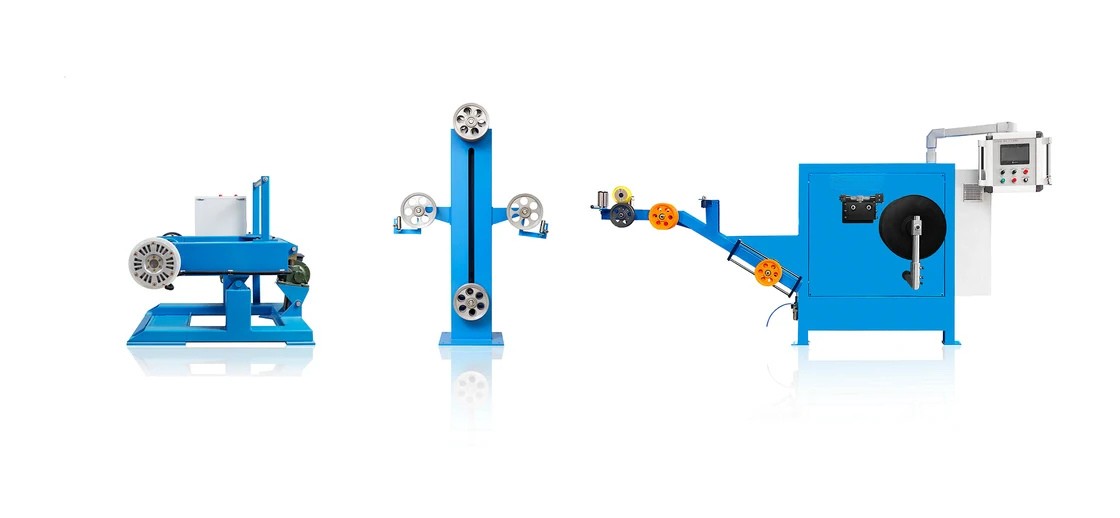
This is the machine that makes you look like a big brand.
In the past, people coiled by hand. It was slow and messy. The cable would tangle when pulled from the box.
The modern machine creates a "Reelex" style coil (or a figure-8 wind). This ensures that when the installer pulls the wire, it does not twist or knot.
The Workflow
- संचायक: The sheathing line runs continuously. The coiling machine stops to cut. You need a "Dancer/Accumulator" to store the wire while the coiler cuts the box.
- Coiling Head: It spins and moves in a pattern to create the figure-8.
- Cutting: It cuts exactly at 305m.
- Boxing: Some machines push the coil into the box automatically. Others require an operator to put the coil in the box.
- Economy Tip: Buy the semi-auto version. The machine coils, the operator boxes. It saves $50,000 on the machine cost.
Can this "Economy Line" really produce Cat6A?
I want to be honest with you.
While this setup is perfect for Cat5e and Cat6, producing Cat6A (500MHz) with chemical foaming is technically challenging. You will face limitations in transmission distance and attenuation, so it is best to position your Cat6A product for specific short-distance applications or patch cords.
The Physics Limitation
Chemical foaming creates a "closed cell" structure, but the bubbles are not as uniform as those made by physical foaming. The dielectric constant is higher.
- Result: The signal fades faster (Attenuation).
- The Fix: To pass the test, you must make the copper thicker (lower resistance) or the insulation thicker (lower capacitance).
- The Problem: If you make the insulation thicker, the cable might not fit in a standard RJ45 plug.
Market Strategy
If you use this line:
- Dominate Cat5e: You can make it cheaper than anyone else.
- Lead in Cat6: You can make excellent Cat6.
- Niche Cat6A: Produce Cat6A for "Patch Cords" (1m, 3m, 5m). For short lengths, the attenuation problem is not visible. You can sell millions of patch cords. Do not try to sell 90-meter permanent link Cat6A cables to data centers with this setup. It is too risky.
निष्कर्ष
You do not need to spend a fortune to start a cable factory. By using Chemical Foaming for insulation, High-Speed Pairing for efficiency, Cantilever Cabling for assembly, and Automatic Coiling for packaging, you can build a robust production line. This setup is the "Toyota" of cable factories—reliable, cost-effective, and perfect for the mass market of Cat5e and Cat6. At हांगकाई, we specialize in helping you optimize this exact configuration to maximize your profit margin.
-
Explore the role of masterbatch in achieving desired foaming properties in cables. ↩
-
Learn about the cooling techniques that ensure the quality of foamed cables. ↩
-
Learn about the techniques used to maintain stable electrical properties in cables. ↩
-
Explore the importance of RJ45 plugs in networking and their specifications. ↩
-
Discover the advantages of using Servo Motors in modern cable production machinery. ↩
-
Understand how Fluke testing ensures the reliability and performance of LAN cables. ↩
-
Understand how offering OEM services can expand your business opportunities. ↩