











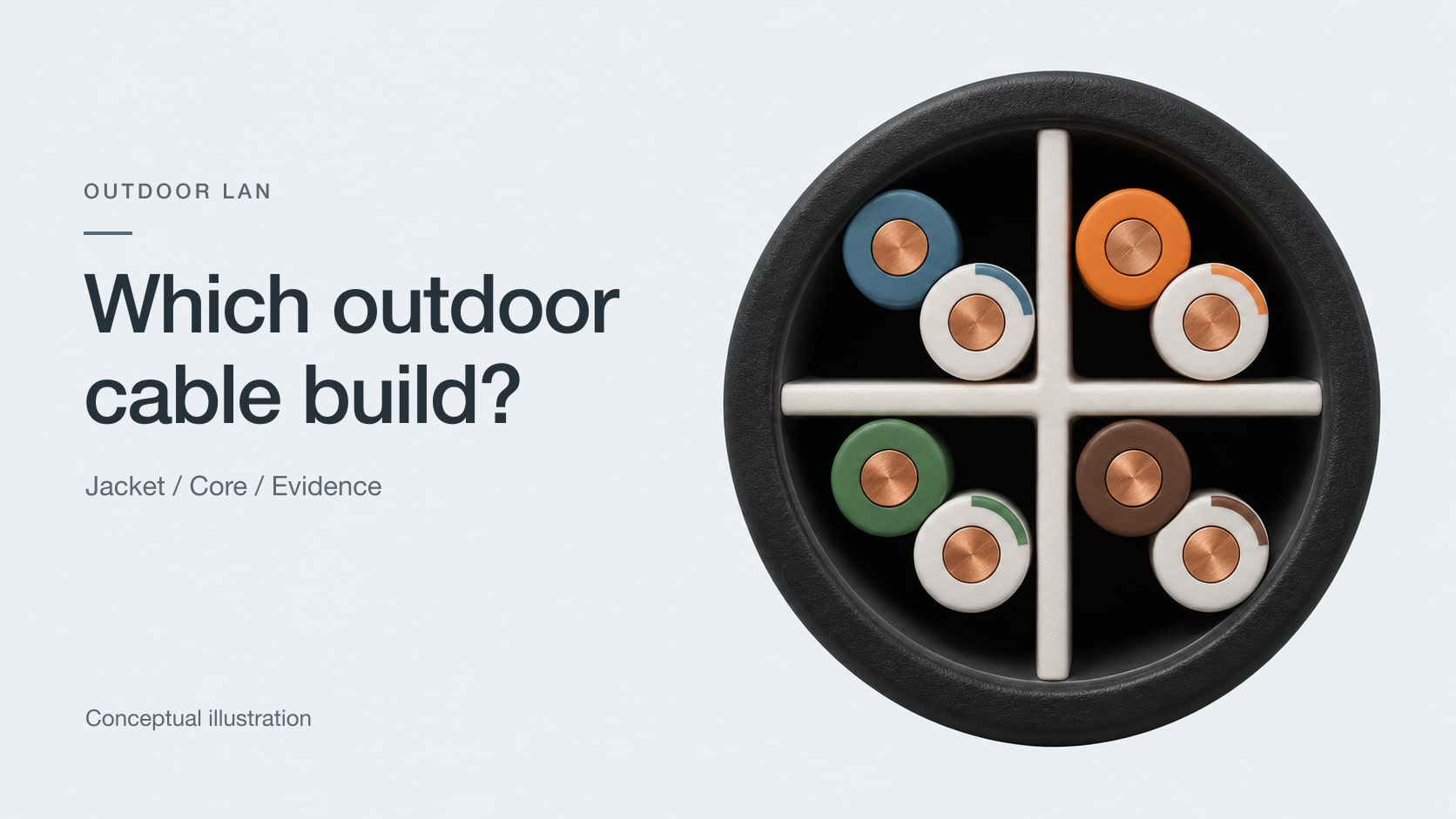
An indoor LAN-cable factory adding outdoor network cables is not making one simple jacket substitution. The buyer must identify the intended exposure, the approved cable construction and the evidence needed to support the finished product’s claims before deciding what the existing equipment can retain.
Treat weather exposure, water blocking, mechanical protection and electrical screening as separate requirements. Select an actual construction for the first outdoor product, then review its material feeds, jacket-stage limits and qualification duties against the factory’s existing route.
The subject is copper twisted-pair LAN cable, not optical-fiber loose-tube production. This is a buyer-selection and document-review guide, not an installation guide, a validated retrofit recipe or a declaration that a material, machine or demonstration sample carries an outdoor approval. Product-specific limits and required tests belong in the agreed specification.
Outdoor Claims Need Separate Product Evidence
Start an outdoor-cable enquiry with the environment the customer actually intends to serve. Exposed sunlight, a wet route, a mechanically protected route and direct contact with soil are not interchangeable descriptions. An indoor/outdoor requirement also needs its own product scope; do not infer it from the word outdoor on another cable’s data sheet.
The distinction is visible in an actual manufacturer example. Belden describes OSP6U as a gel-filled, polyethylene-jacketed Category 6 cable, but its product notes qualify direct-burial use with additional crush and impact protection. The same notes limit the sunlight-resistance statement to the black-jacket version.1 Those are conditions of that published product, not an instruction to copy its construction or an approval for another manufacturer’s cable.
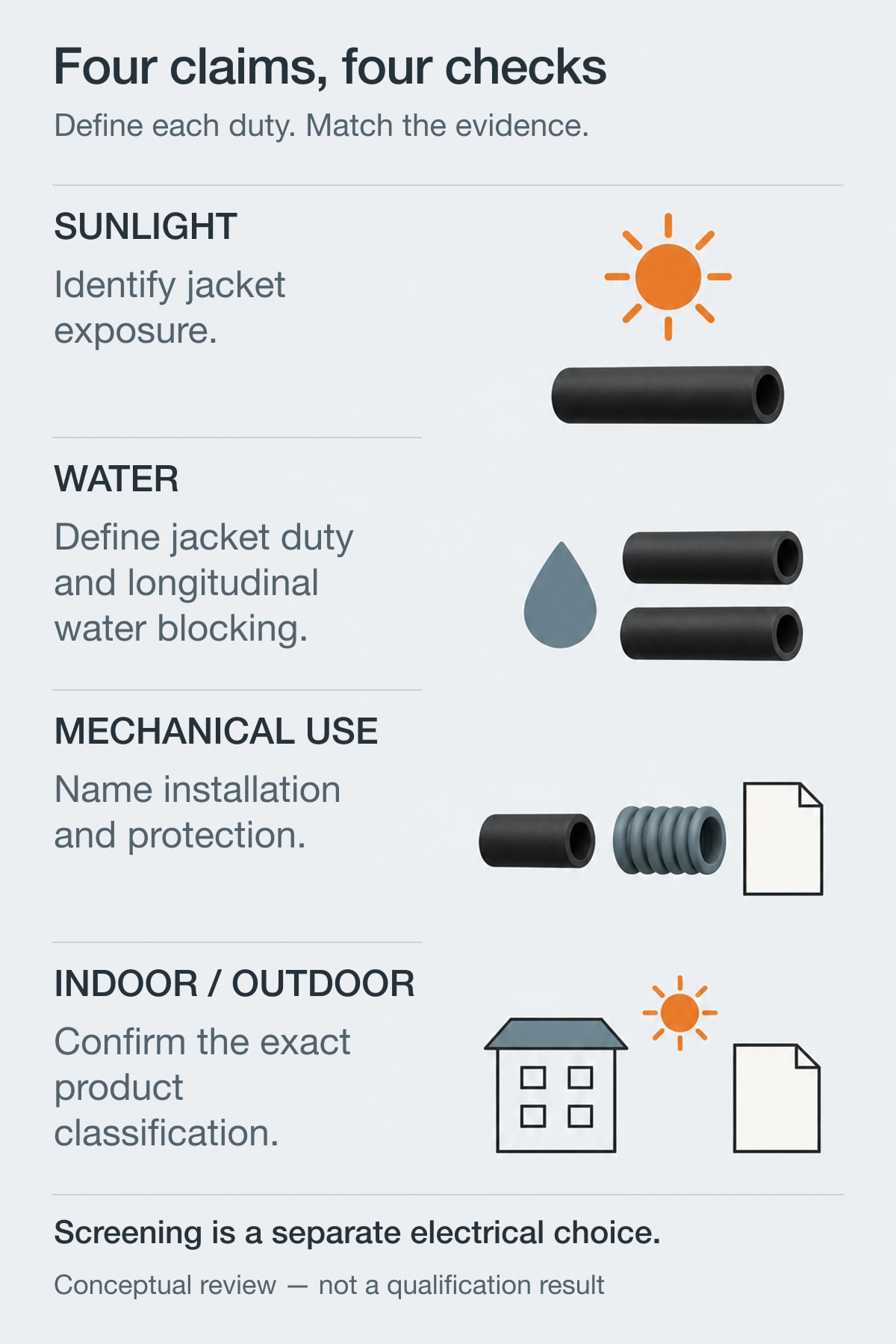
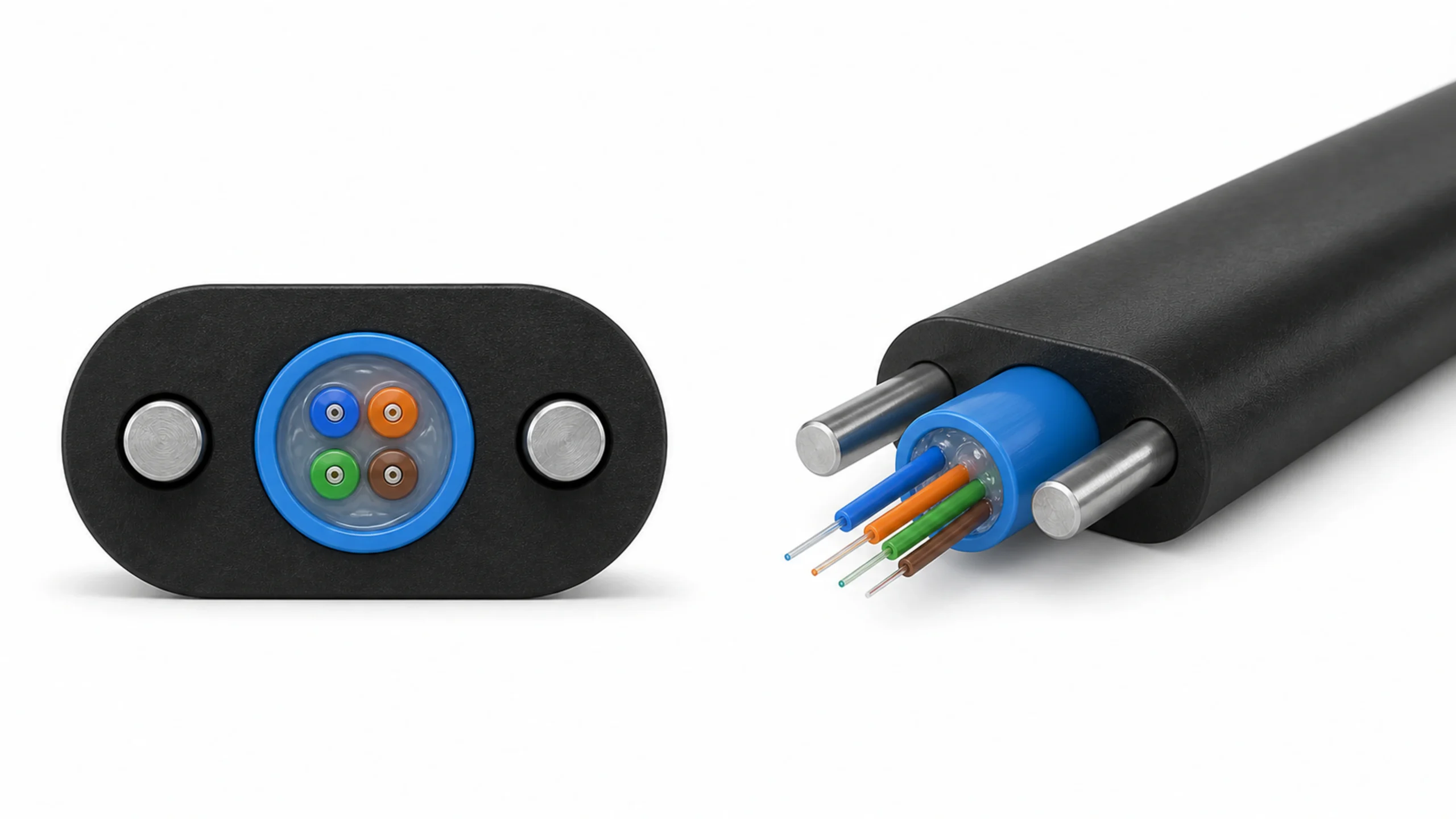
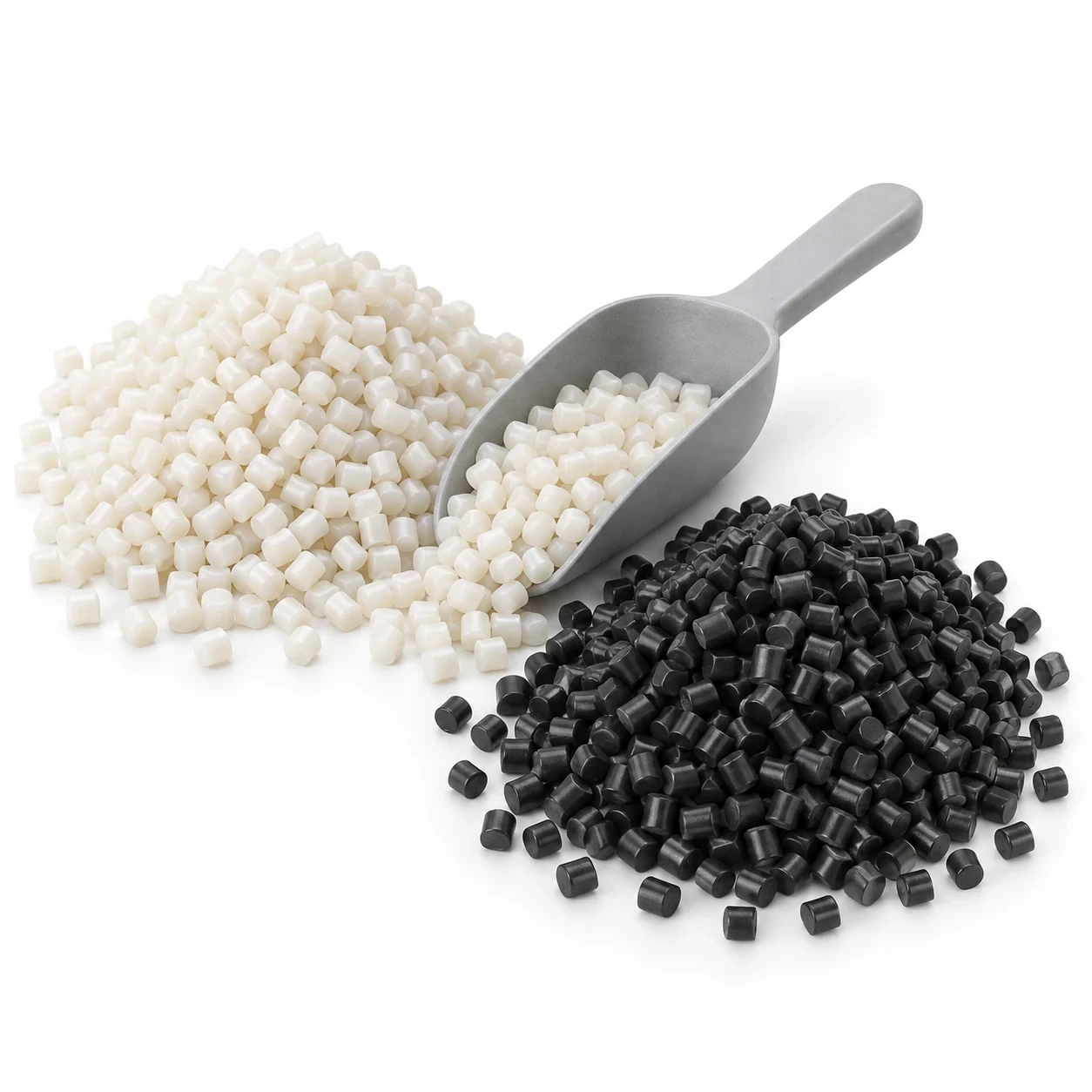
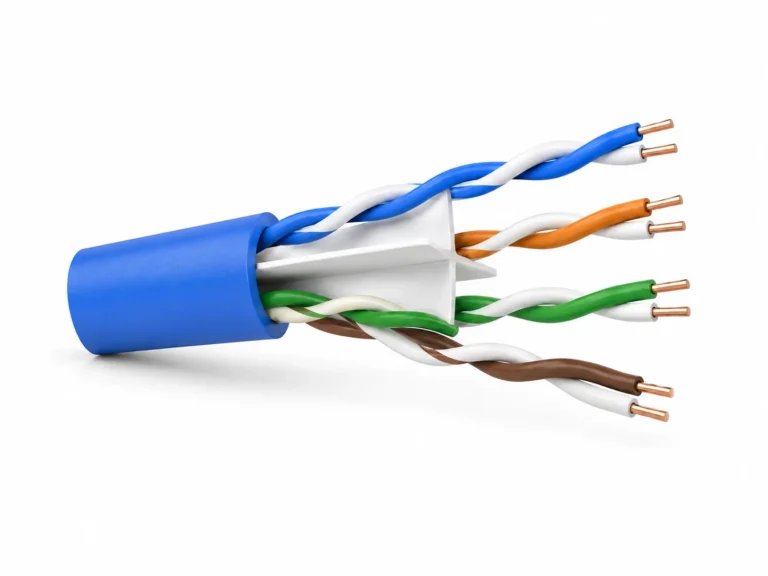
Conceptual claim-review illustration with 3D product samples and flat explanatory symbols, not photographs. Black cylinders represent outer-jacket surfaces only, not a finished cable construction. Conduit and building sketches are review symbols, not an approved installation or product rating. No test is shown passed; screening remains a separate electrical choice.
Use an exposure-and-evidence record before asking suppliers to change the production line:
| Intended product claim | Decision that must be written down | Evidence to identify separately |
|---|---|---|
| Exposure to sunlight | Exact finished jacket construction and material grade | The specified finished-product evidence supporting that exposure claim |
| Wet-location or water-blocking duty | Whether the requirement concerns the jacket, longitudinal water travel, or both | The agreed method, specimen construction and acceptance result for that duty |
| Direct-burial or other mechanical duty | Actual installation context and required protection in the product design | The applicable product examination and any restrictions on the claim |
| Indoor/outdoor use | Required product classification and marking for the intended market and use | Documentation tied to the exact offered construction, not a similar outdoor-only cable |
| Shielded outdoor LAN cable | Specified pair screens, overall screen and any drain-wire arrangement | Electrical and screening evidence in addition to the environmental evidence |
This is a specification-writing framework, not a test standard. Have the responsible cable designer and test provider identify the actual methods and limits. A blank entry remains an unresolved product requirement rather than becoming a machinery supplier’s assumed default.
Keep evidence for the cable separate from evidence for its ingredients. A compound supplier’s data sheet identifies a proposed material; it is not, by itself, a qualification record for the buyer’s completed cable. Similarly, a successful electrical test answers the parameters covered by that test. It does not document an unperformed exposure or water-blocking examination.
Common mistakes: Treating a black jacket as proof of every outdoor claim, using a shield as a substitute for a water-blocking definition, or describing an outdoor-only design as indoor/outdoor without matching product evidence.
Choose a Construction, Not a Generic Waterproof Recipe
The equipment discussion becomes useful when the buyer supplies a layer-by-layer construction. Identify the conductor and insulated pairs, the assembled core, each specified protective or screening element, and every jacket. Record dimensions and material identities at the stages where those layers enter the process.
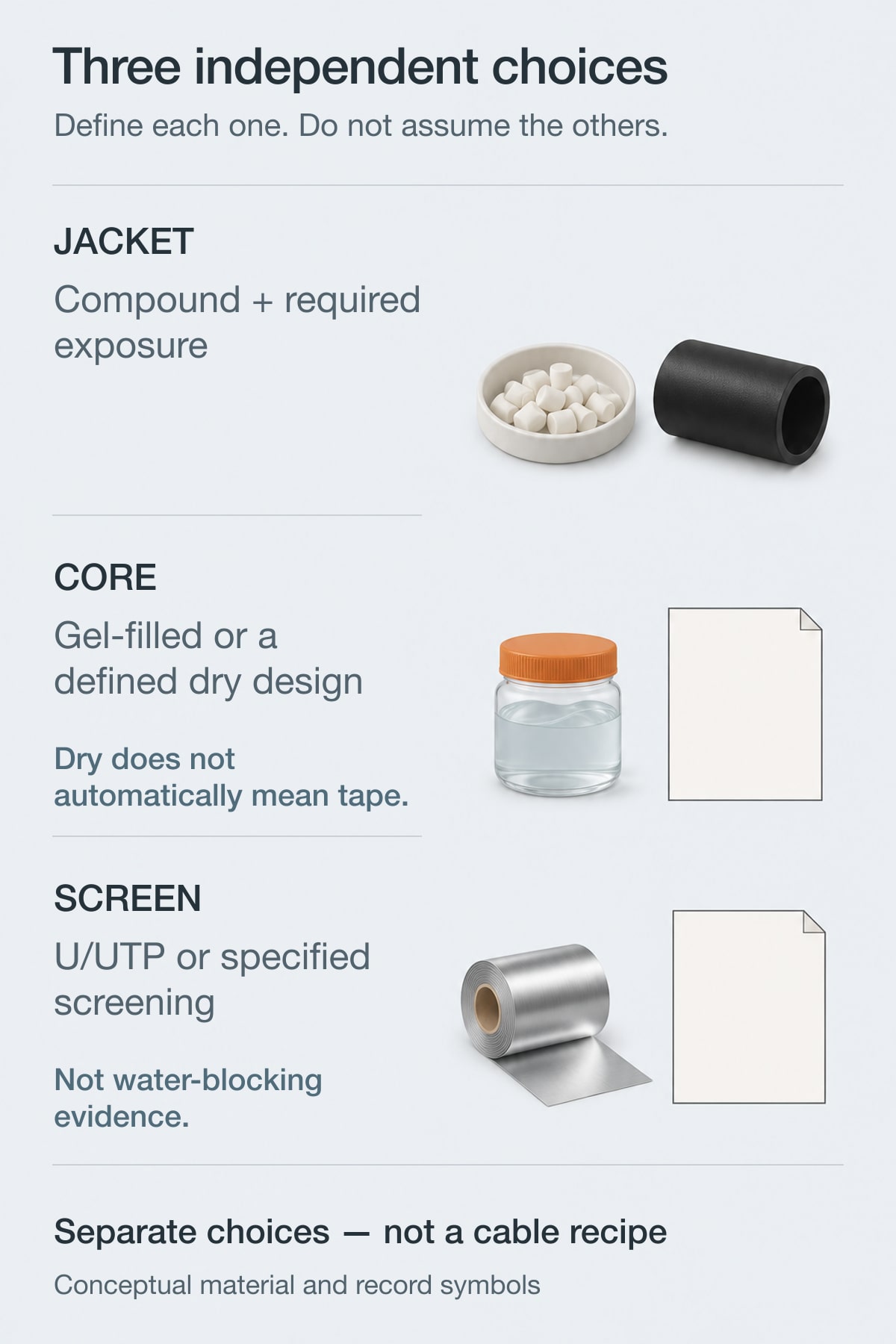
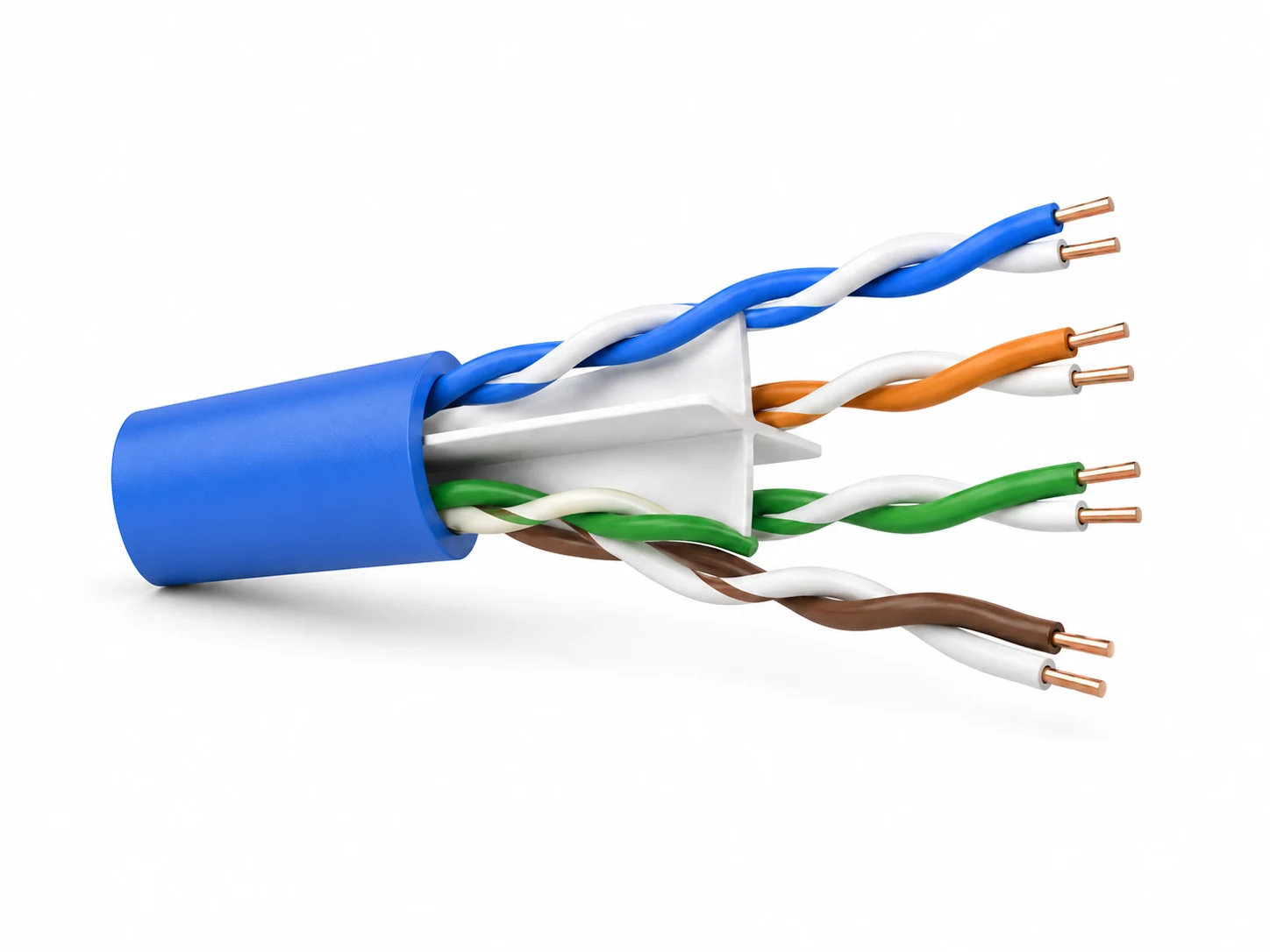
Conceptual material-and-record illustration with 3D material models and flat records, not photographs. The jacket sample, gel jar, dry-design record and isolated foil roll represent independent review choices, not a combined cable stack. Dry does not automatically mean adding tape; the drawing specifies no filling system, dry-core recipe, approved product or passed test.
Jacket material and water blocking are independent choices
A polyethylene jacket is not the only construction appearing in published outdoor LAN-cable ranges. Belden’s 2143A page describes an indoor/outdoor, gel-filled Category 6 cable with its named UV-resistant, flame-retardant LSZH jacket compound.2 Compare that with the OSP6U example as two identified product constructions. Neither example establishes that the compounds, tooling or process conditions are interchangeable on the buyer’s extruder.
Water blocking also needs a construction definition rather than a label. Belden’s Category 6 range lists both gel-filled and dry-core outside-plant options. Its dry-core description specifically distinguishes products without water-blocking gels, tapes or powders.3 Therefore, dry core must not automatically be translated into add a water-swellable tape unit. Ask how the chosen product design provides its stated function and which equipment duties that design actually requires.
For the copper cable examples here, gel-filled is a more useful procurement description than a vague request for an oil-filled cable. If the approved design uses a filling compound, identify the specified material and its intended location. Ask the supplier to describe the proposed application and control arrangement, material preparation, supply, containment, cleaning and changeover. These are review questions, not confirmation that a particular filling system belongs on every outdoor line. A generic oil name or an optical-fiber loose-tube diagram is not a copper-LAN filling specification.
For any specified dry water-blocking component, identify the exact component and its location before reviewing its feed or application equipment. If a proposed dry-core design does not use such a component, do not add an unrelated operation merely because another cable route uses it. Obtain evidence for that design’s claimed performance instead.
A second jacket is another distinct product decision. Where the drawing includes inner and outer coverings, give each layer its own material identity, incoming diameter, thickness requirement and finished diameter. Ask the supplier to show how those layers are produced, whether any intermediate handling is required, and which finished-cable trial supports the arrangement. No common number of extrusion passes is prescribed here.
Screening does not define outdoor suitability
Keep the screening code on a separate line of the construction record. An unshielded cable and a screened cable can have different electrical constructions while still requiring an independently specified outdoor jacket and environmental evidence. Foil, braid, drain wire and water-blocking elements should not be merged into a single generic protective layer.
The shielded and unshielded LAN production comparison helps separate the screening operations. Its purpose here is to identify the added electrical-screening duty, not to qualify the product for an outdoor environment.
For supplier comparison, the useful deliverable is a marked construction drawing accompanied by an operation list. Each listed operation should point to a specified layer or control duty. If the drawing is still unresolved, compare preliminary options rather than presenting one arrangement as an approved production recipe.
Audit the Existing Jacket Stage Against That Construction
The fact that an existing machine makes an acceptable indoor LAN jacket establishes its current duty, not the whole proposed outdoor range. Review the actual installed line and the proposed product together before deciding whether the result is reuse, a bounded modification or another equipment arrangement.
HONGKAI’s current LAN cable production route treats outer sheathing as a defined stage with a cabled or shielded core and a jacket compound as inputs. The published reference connects the extrusion stage with cooling, haul-off, take-up and project-specific inspection scope. This establishes a route for discussion, not an independently verified outdoor filling installation or approval to process every jacket compound on an existing machine.
An independent equipment example helps explain the review boundary. Maillefer’s published LAN Wire Sheathing configuration lists several jacket-material families and identifies the extruder, crosshead, cooling, haul-off, measuring and take-up functions as parts of a coordinated arrangement.4 That supports reviewing a complete configuration. It does not establish that any installed PVC screw, tooling or cooling setup can process every proposed PE or LSZH compound unchanged. The manufacturer’s published range belongs to that manufacturer’s configuration, not to an unreviewed customer machine.
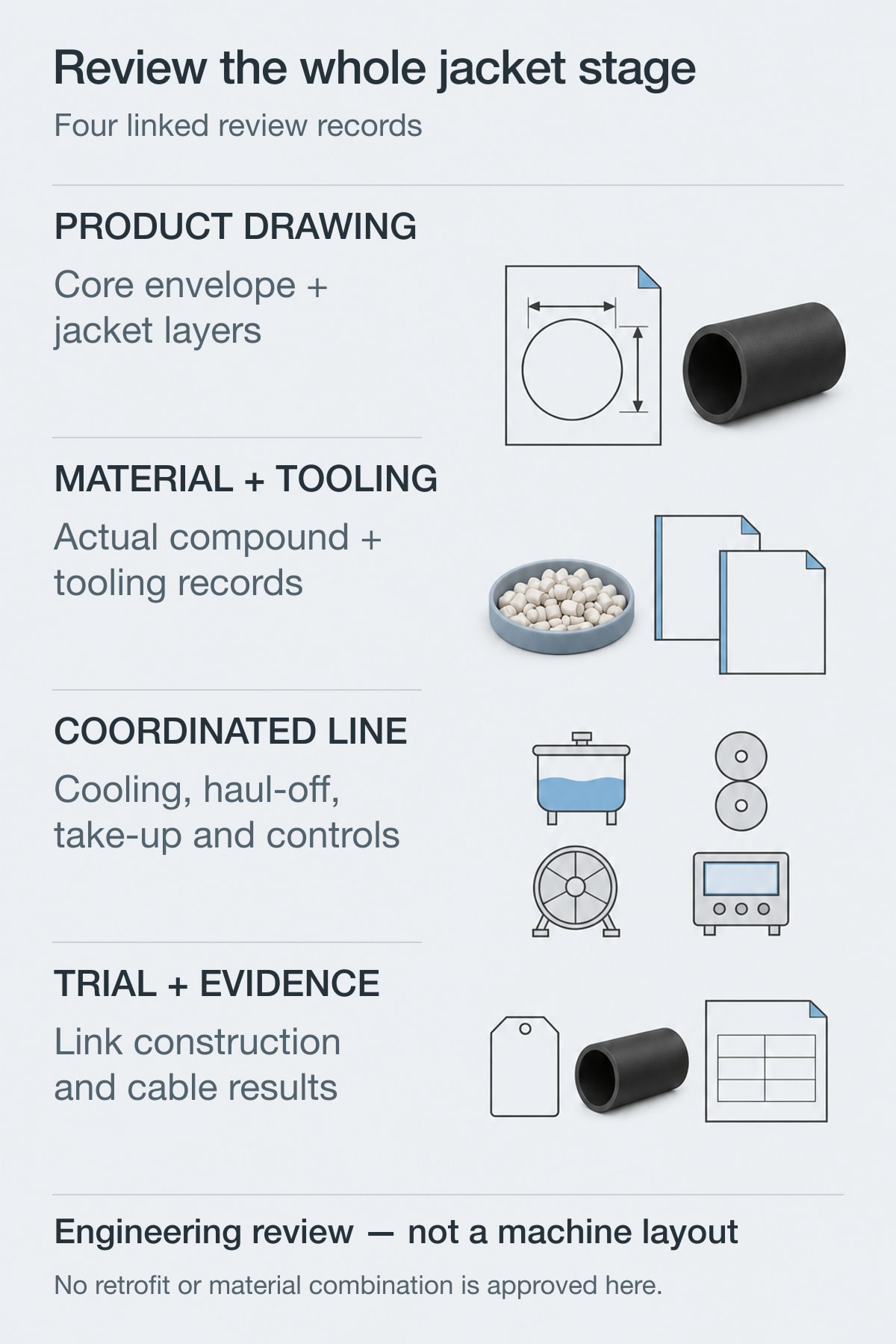
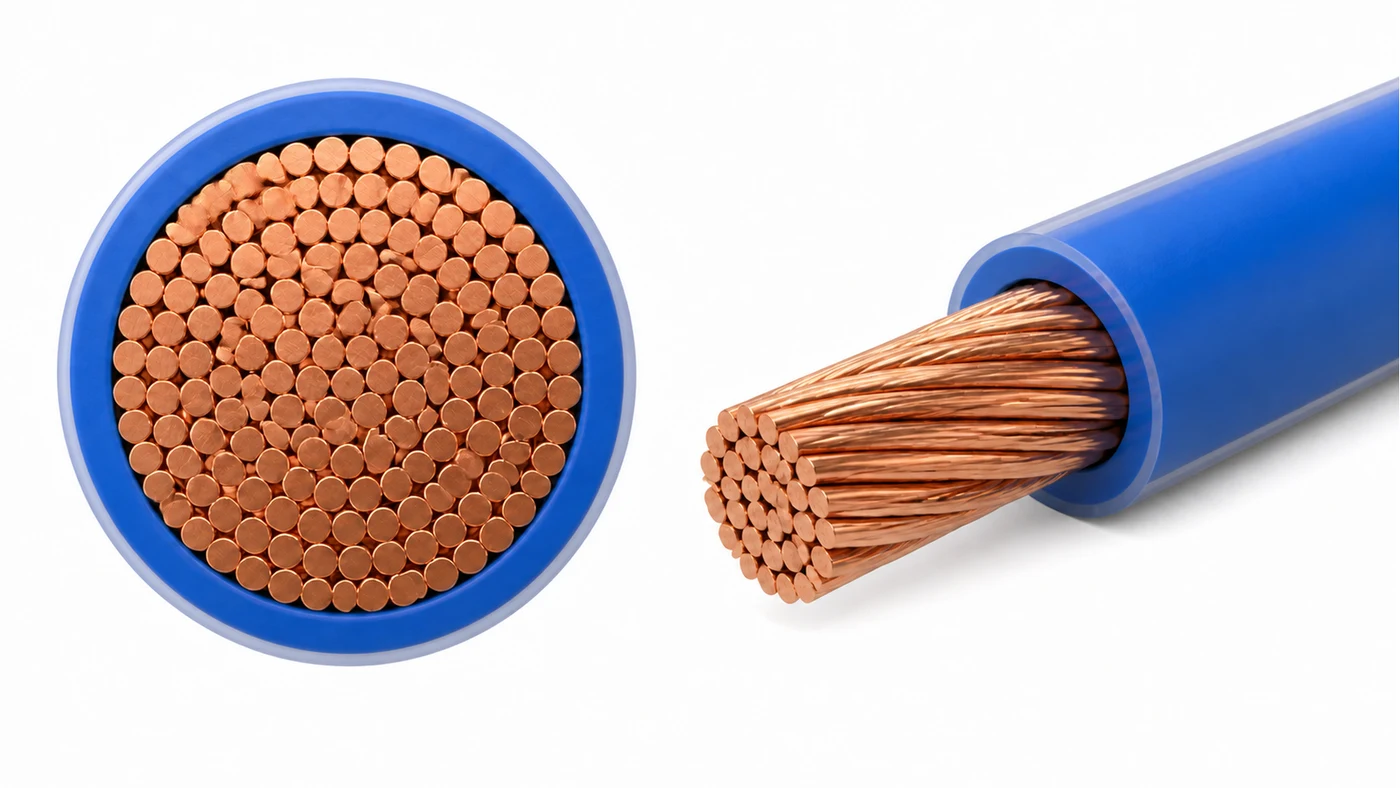
Conceptual engineering-review map with 3D samples and flat function and record symbols, not photographs. Jacket samples, record sheets and cooling, haul-off and take-up symbols identify functions to review, not machine anatomy or a spatial installation. The drawing is not a HONGKAI layout or retrofit approval; no filling or protective-layer equipment position is assigned.
The retrofit review should return a specific decision for each changed input:
| Existing-line record | Proposed outdoor-product input | Question the supplier should resolve |
|---|---|---|
| Installed extruder, screw, barrel and material-handling information | Exact jacket compound and supplier processing information | Is the existing material-processing arrangement suitable, and what evidence supports that decision? |
| Current crosshead, guides and tooling | Core envelope at jacket entry, including the specified additional layers | Which interfaces and tools remain usable for this construction? |
| Demonstrated jacket duty and finished dimensions | Required layer thickness, finished dimensions and agreed acceptable output | What must be demonstrated on the actual compound and cable rather than inferred from a machine size? |
| Cooling, haul-off, take-up and current controls | Required output package, handling conditions and connection information | Which parts of the coordinated line are retained, modified or separately supplied? |
| Existing preparation and changeover arrangements | Any new filling material, protective component or additional covering | Which supporting functions are included, and what must the factory provide? |
Do not reduce this review to a photograph of the extruder nameplate. Exchange the machine and component information needed for engineering review, the proposed product drawing, the actual material specification and the intended output package. Mark unsupported assumptions explicitly.
For a filling or additional protective-layer duty, ask the proposal to show its actual position relative to the relevant cabling and jacket operations. Do not prescribe a position from a generic diagram before the supplier has reviewed the specified construction. Check the material path, intermediate product dimensions and control handovers as one arrangement.
Check the application scope of a proposed equipment reference before using it to close that review. Maillefer identifies its GEL 300 as a system for continuous loose-tube production, with gel circulation under vacuum to remove air bubbles.5 That is not evidence that the same unit or process is suitable for a copper twisted-pair LAN core. It also shows why the presence of vacuum equipment cannot, on its own, identify a dry water-blocking process: the documented vacuum duty in this example belongs to a gel-filled operation.
Another Maillefer reference, TEL 60 Extend Telecom Cable Sheathing, presents a separate telecom sheathing configuration and lists its compound families.6 That published configuration does not establish compatibility with the buyer’s chosen LAN construction or existing equipment. These two references define the limits of the evidence; neither is being offered here as a HONGKAI configuration or an approved outdoor-LAN filling arrangement.
Convert the remaining filling question into an interface record that the responsible equipment supplier must complete:
| Required engineering artifact | Information tied to the selected copper-LAN product | What remains open without it |
|---|---|---|
| Marked product drawing and process sequence | The actual incoming pair/core arrangement, filling location and the adjacent forming or jacket operation | The application point and the product entering the filling duty |
| Compound-to-contact-material record | The named filling compound, the insulation/screen/jacket materials it contacts and the evidence proposed for that combination | Suitability cannot be inferred from a loose-tube filler or a generic material name |
| Application and control interface drawing | The proposed material path, application components, line-control handover and the supplier’s defined start/stop and changeover behavior | A unit photograph or output rating does not describe its integration into this route |
| Linked construction and electrical trial record | The same drawing revision, materials, offered arrangement and representative operating conditions, with the agreed filling and cable-test observations | A visually acceptable jacket does not verify the internal fill or the resulting LAN cable performance |
This is an engineering handoff record, not a prescribed machine sequence, test standard or assertion that a particular supplier has completed those checks. An unresolved row remains outside the accepted supply scope. Do not replace it with a machine model borrowed from a different cable family.
Filling changes must be reviewed with the electrical construction. In a historical Category 6 outside-plant example, US7750243B1 reports different propagation-delay outcomes for samples with different insulation and filling combinations.7 The document describes its own experimental designs; it is not a current cable standard, a material approval or a HONGKAI production record. The purchasing implication is to request electrical results for the exact proposed core-and-filler combination, rather than accepting a filler label or a water-blocking statement as proof of LAN transmission performance.
Trace the filling grade through contact materials and the trial
A material-family description is only the first filter. HEC-Holland explicitly lists copper-gel use in data and LAN cables separately from its optical-fiber gel applications.8 This is a relevant application lead, not a grade-specific compatibility statement for the buyer’s proposed insulation, separator, wrap, screen or jacket.
For the actual enquiry, request three linked records:
- Grade identity: exact proposed compound grade, the current technical and safety data sheets, and the supplier’s stated intended use.
- Contact map: the drawing revision and identities of every material that the filling compound actually contacts; identify who will supply the compatibility evidence for that combination.
- Trial link: the same material identities, offered application arrangement and operating conditions connected to the agreed construction, water-blocking and electrical observations.
These are proposed procurement records, not a test standard or a statement that the missing qualification work has been completed. Do not substitute a similar ingredient’s data sheet or a visually full core for those linked results.
How to verify: Agree a trial using the identified incoming core, actual proposed materials, offered configuration and required output package. Connect the resulting dimensional, construction and product-test evidence to that same trial. Record any condition that was not demonstrated instead of extending a successful indoor recipe to the whole outdoor range.
The comparison also needs an honest output basis. If two constructions require different preparation, additional layers or changeovers, a single advertised line speed does not settle their qualified production capacity. Ask for the accepted output and operating-time assumptions for each actual construction. No universal speed, scrap rate or machine replacement threshold is assigned here.
Build the First Outdoor Range Around the Unresolved Duty
An expansion can remain narrow while the evidence becomes complete. Compare candidate products by the duty that is still unresolved rather than ordering every possible accessory at once. A sunlight-exposure claim, a longitudinal water-blocking claim and an indoor/outdoor claim can require different evidence even where parts of the existing production route remain candidates for reuse.
For a proposed jacket-only change, establish first that the target product actually requires no new core construction or protective-layer operation. The supplier still needs to review material processing, geometry, the coordinated jacket line and the resulting product evidence. The absence of an added machine is not proof that the new product has been qualified.
For a proposed filled construction, add the unresolved filling duty to the comparison: material preparation, application, process interface, changeover and the required finished-cable examination. A good-looking jacket does not close those open items. Identify which machinery supplier, material supplier or test provider is responsible for each answer.
For a proposed additional jacket, specify the two covering duties and the intermediate product. Ask what equipment and handling arrangement supports them, which existing assets have actually been reviewed, and what must be tested on the completed cable. Do not treat the word double jacket as a confirmed line layout or a universal environmental rating.
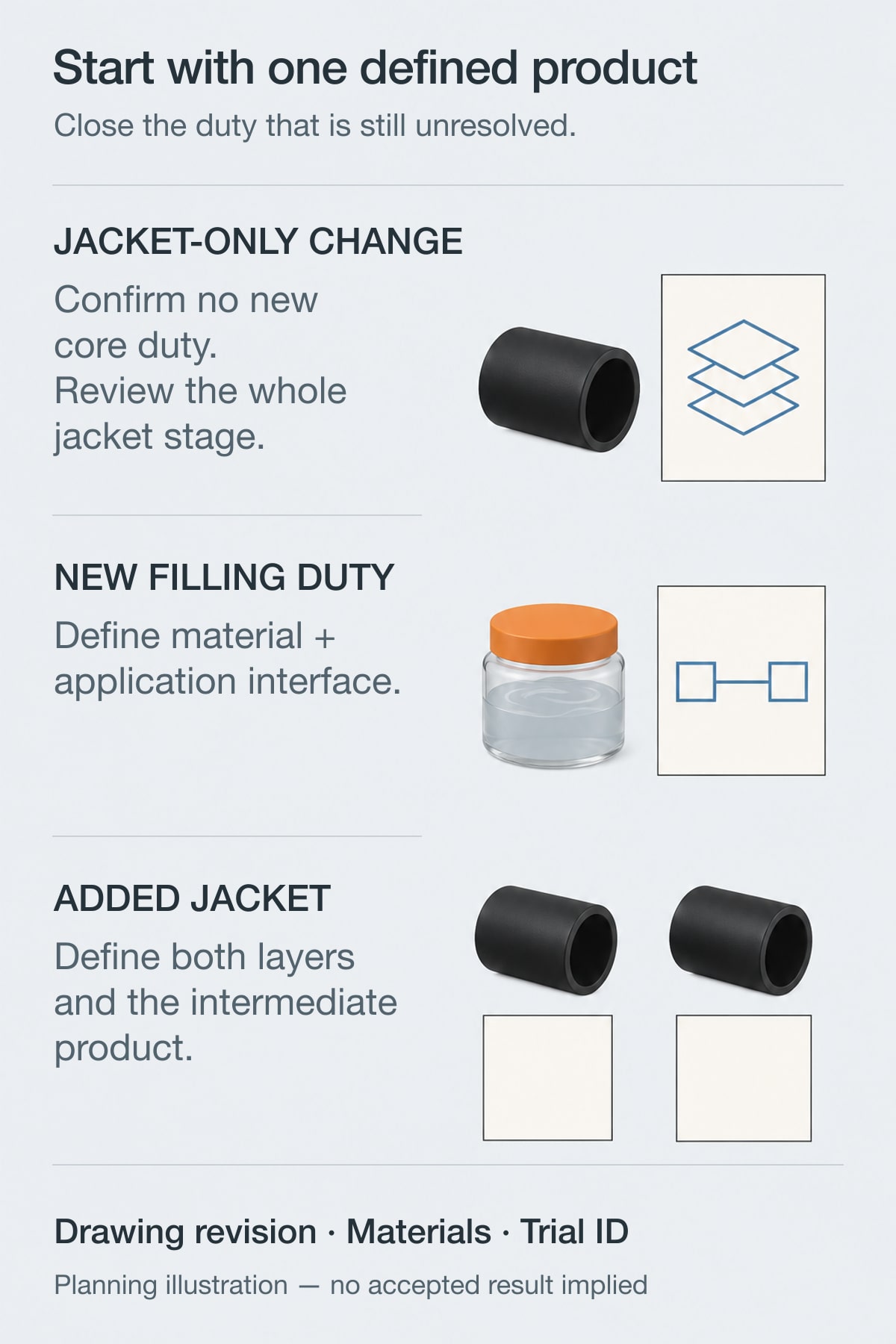
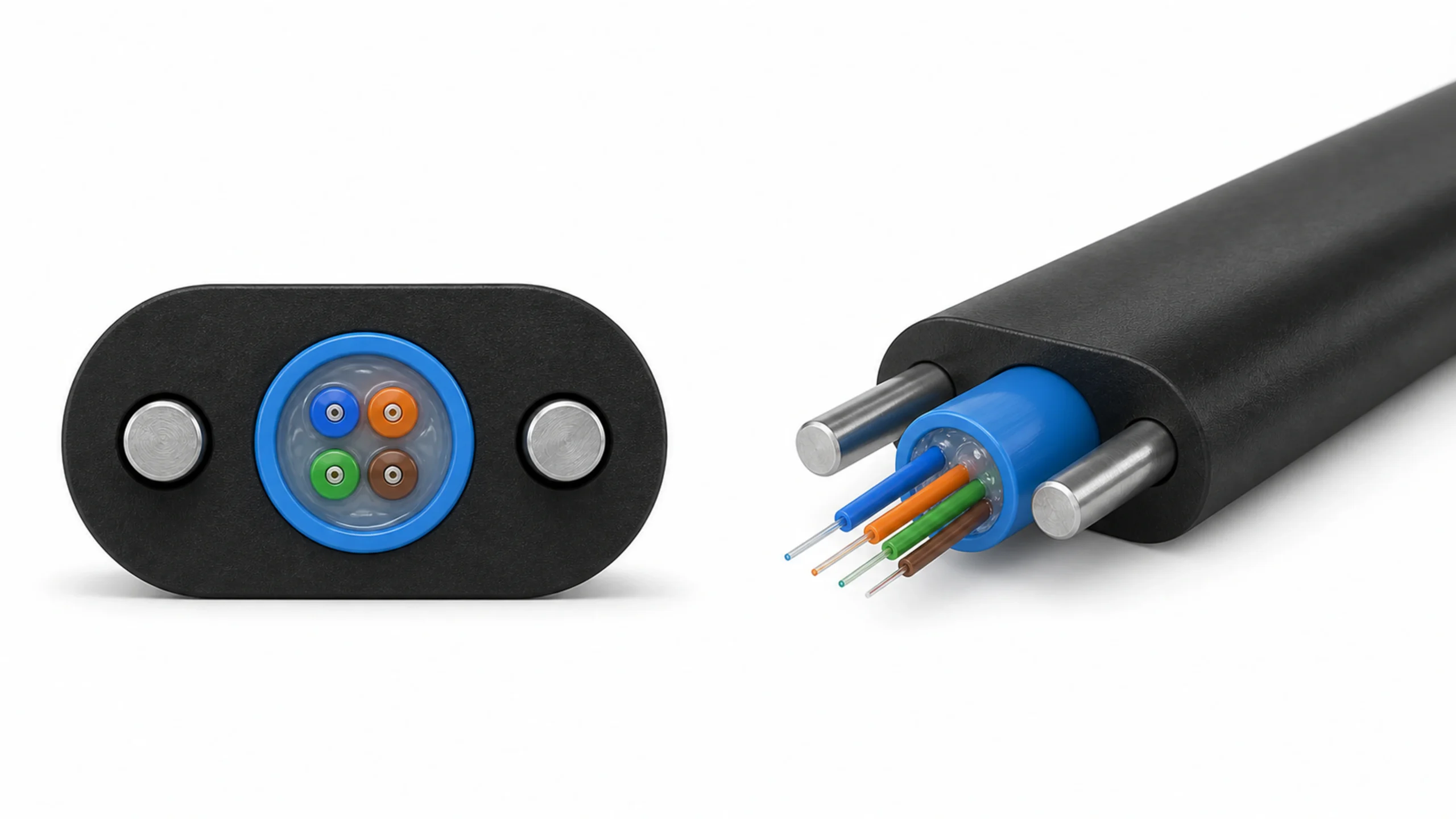
Conceptual scope-planning illustration with 3D samples and flat technical records, not photographs. The three panels are alternative unresolved duties, not consecutive production steps. The two covering samples are separate symbols, not an installed double-jacket design; no filling position, machine layout or accepted result is shown. Keep evidence tied to the actual drawing, material and trial identity.
Use the Cat6 factory compliance guide for the separate question of cable-test evidence and its relationship to production. Environmental and construction claims still need their own agreed evidence. For every candidate product, keep the drawing revision, material identities, trial identity and applicable results together; a passed result should not silently migrate to another jacket compound or layer arrangement.
The purchasing decision should end with a bounded first product, a list of retained and added duties, and an identified owner for every unclosed qualification item. That is a stronger basis for launching an outdoor LAN-cable range than a broad waterproof label attached to an unchanged indoor machine list.
-
Belden, OSP6U Category 6 OSP Cable, checked 16 November 2026. Product-specific evidence for the gel-filled PE construction, qualified direct-burial statement and black-jacket sunlight-resistance restriction; not a universal construction rule or installation instruction. ↩
-
Belden, 2143A Category 6 Indoor/Outdoor Cable, checked 16 November 2026. Identifies this product’s gel-filled construction and named LSZH jacket; not evidence that a HONGKAI or existing customer line processes that compound. ↩
-
Belden, Category 6 Cable range, checked 16 November 2026. Used only to distinguish its published gel-filled and dry-core outside-plant options and the stated dry-core material boundary; not a specification for another manufacturer’s cable. ↩
-
Maillefer, LAN Wire Sheathing, checked 16 November 2026. A manufacturer-specific example of declared material families and a coordinated LAN sheathing configuration; no speed, diameter or model capability is transferred to HONGKAI or a customer’s existing line. ↩
-
Maillefer, Gel Filling System GEL 300, checked 16 November 2026. Its stated application is continuous loose-tube production and its vacuum circulation removes air from gel. Used to bound that reference, not to select a copper-LAN filling system or qualify a dry cable. ↩
-
Maillefer, Telecom Cable Sheathing — TEL 60 Extend, checked 16 November 2026. Identifies a separate telecom sheathing configuration and its compound families, not the buyer’s LAN retrofit compatibility; no filling option, speed, size, capacity or HONGKAI supply claim is adopted. ↩
-
Jeffrey H. Mumm and Kristina Elyse Harrell Anderson, US7750243B1 — Water blocked communication cable comprising filling compound and method of fabrication, published 6 July 2010; description, comparative samples; checked 16 November 2026. Historical primary-source example only. Its recipes, numerical results, referenced standards and commercial-material statements are not adopted as current specifications or evidence of HONGKAI capability. ↩
-
HEC-Holland, Cable Filling Gels, application section checked 16 November 2026. The supplier distinguishes copper data/LAN applications from optical-fiber applications. This is application-family evidence only; no named grade, contact-material compatibility result, LAN category approval or HONGKAI machinery performance is inferred. ↩

 English
 हिन्दी
 فارسی