


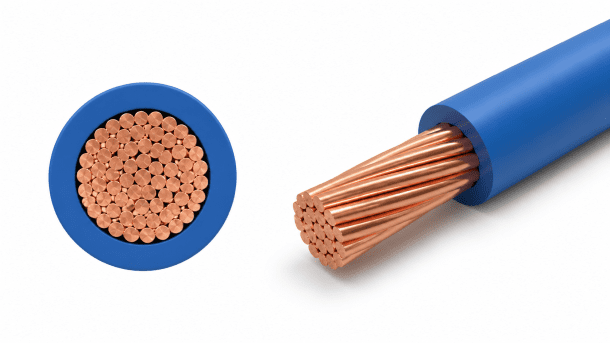
Cable structure preview Reference cable
01 Selected cable solution
Building Wire Production Line
What is a building wire production line? It turns prepared solid or stranded conductors into insulated building wire. Form strands first when needed, then extrude the insulation, cool and dry the wire, inspect it and wind or coil it to the agreed format.
- Cable designation
- BV / BVR / H07V
- Conductor material
- Copper reference · final material to confirm
- Conductor route
- Make strands first—or start with a prepared conductor
- Final configuration
- Confirmed against the approved cable design
02 Cable definition
Define the Building Wire Before Selecting Equipment
The image is a construction reference only. Equipment selection starts by confirming whether the conductor is solid or made from multiple wires, then defining its component-wire and finished-conductor dimensions.

Known inputs and open confirmations
- Cable family
- Building Wire
- Reference designations
- BV / BVR / H07V for project review; final designation and scope To be confirmed
- Conductor material
- Copper in this reference; an alternative conductor material requires separate review
- Conductor construction
- Solid, stranded or fine-stranded / flexible · To be confirmed
- Individual wire diameter
- To be confirmed for a multi-wire conductor
- Number of wires / strands
- To be confirmed for each conductor
- Finished bare-conductor diameter
- To be confirmed before insulation extrusion
- Nominal conductor cross-section
- To be confirmed
- Finished-product core count
- Single insulated core in this example. Strand count inside its conductor is a separate input.
- Primary insulation
- PVC single-layer example; final compound and grade to confirm
- Insulation thickness / finished diameter
- Target and tolerance To be confirmed
- Rated voltage / final designation
- To be confirmed
- Target output / capacity
- To be confirmed
- Acceptance basis
- To be confirmed
Strand count is not the number of insulated cable cores. Specify the conductor as n × d mm: n is the number of individual wires and d is each wire’s diameter. Also confirm the finished bare-conductor diameter and nominal cross-section. Form the strands before insulation, or start with an approved ready-stranded conductor.
03 Preliminary process route
Match the Route to the Conductor Construction
This route illustrates single-core, thermoplastic-insulated building wire. Start with the actual incoming conductor: individual wires need forming; prepared solid or ready-stranded conductors enter the insulation extrusion stage.
Prepare component wires as required → Bunch / strand → Insulate → Cool / dry → Inspect → Take up Coiling and packing follow the sales format. Drawing and annealing are not repeated if the supplied wire already meets the approved inputs.
Typical process / not a fixed layout Read the order, not a fixed machine spacing: conductor forming precedes insulation. Spark testing follows surface drying. A diameter gauge may be used before and/or after cooling; the capstan may sit within the cooling system. Marking, striping, preheating and accumulators are added where the cable and line design require them.

Stage 02 / Required when forming strands
Bunching / Stranding
Form the specified number of individual wires into one bare conductor using the approved bunching or stranding method. This is conductor forming, not the cabling of separately insulated cores. Skip this operation if a suitable ready-stranded conductor is purchased.
- Input
- Number of wires (n) × individual-wire diameter (d), material and incoming spools
- Output
- One bare stranded conductor on the agreed intermediate package
- Equipment source
- Specialist equipment, method and source defined in the proposal
- Confirm
- Strand count, wire diameter, lay length/direction, tension, finished bare-conductor diameter and conductor resistance
04 Equipment by required stage
Review the Equipment Categories for This Route
Review each machine’s actual function, then confirm its model and interfaces. These are 3D category references—not an automatic equipment configuration or a claim that one machine performs every downstream operation.
 3D equipment reference · final model and configuration to confirm
 01 / Upstream / as required
Drawing & Annealing
Reduce incoming copper rod or wire to the component-wire diameter. Include annealing where required to achieve the specified conductor condition; purchased wire may already meet these inputs.
Drawing and annealing are different functions. Confirm whether an annealer is integrated or separate; this reused image identifies only the drawing-equipment category.
07 Quality checkpoints
Check the Conductor, Insulation and Finished Wire
Agree the inspection plan before equipment selection. These 3D references explain the checks; they are not factory photographs, customer cases or evidence of passed tests.
Conductor acceptanceConductor acceptance
Check the Bare Conductor
Confirm wire count, individual-wire diameter, lay, finished bare-conductor diameter and the specified conductor resistance.
Wire count inside one conductor is not the number of insulated cores. The 3D cable is a structure illustration, not a test sample.
 Dimensional control
Dimensional control
Measure Diameter; Verify the Wall
Monitor outside diameter during production. Verify insulation thickness and eccentricity using the specified measurement method or cross-section samples.
A laser outside-diameter gauge alone cannot establish minimum wall thickness. The acceptance method and tolerances must be defined.
 In-line electrical check
In-line electrical check
Inspect the Dry Insulation
Dry the wire after cooling, apply the approved spark-test method and record or mark detected faults as specified.
Test type, voltage and response are product-specific. In-line spark testing is not a complete cable-certification test.
 Finished-product release
Finished-product release
Confirm the Sale-Ready Package
Check the agreed length, marking, winding and packing, plus the finished-wire electrical, dimensional and material tests required by the product specification.
The coiling-machine image illustrates handling only. Test records, product approval and FAT/SAT evidence require actual project data.
Keep illustration and evidence separate. Add actual trial records, sample measurements and project acceptance documents once available. No performance or certification is inferred from a render.
Project records required